Image Detection Sensor Market Size & Forecasts 2026-2035, By Segments (Application, Technology Type, End-User), Growth Opportunities, Innovation Landscape, Regulatory Shifts, Strategic Regional Insights (U.S., Japan, China, South Korea, UK, Germany, France), and Competitive Dynamics (Omron, Keyence, Sony, Panasonic, Hamamatsu)
Market Size and Growth Outlook
Image Detection Sensor Market size is likely to expand from USD 31.54 billion in 2025 to USD 74.67 billion by 2035, posting a CAGR above 9% across 2026-2035. The industry’s revenue potential for 2026 is USD 34.01 billion.
Get more details on this report
Request Free Sample ReportImage Detection Sensor Market Intelligence Snapshot
Regional Market Dynamics
Segment Momentum
Market Expansion Drivers
Leading Market Participants
Global Market Forecast Snapshot
Market Outlook
Regional and Segment Outlook
Market Growth Drivers and Industry Trends
Rising integration of vision systems in passenger vehicles and factories is a primary growth driver for the image detection sensor market. Automakers such as Toyota and Ford are publicly expanding ADAS and autonomous testing programs, while suppliers like Bosch report increased orders for camera modules; Siemens and ABB emphasize vision-led factory automation in press materials. These developments reflect shifting procurement and production priorities and create opportunities for incumbent sensor manufacturers to scale high-reliability products and for new entrants to win design‑ins with niche solutions and software stacks. Given ongoing OEM announcements and capital investment in smart factories, adoption momentum is set to continue through supply‑chain partnerships and sensor–software co‑development.
Advances in CMOS and Specialized Detection Technologies
Rapid technical progress in CMOS architectures and alternative detection approaches is reshaping the image detection sensor market. Sony’s IMX series and product releases from ON Semiconductor showcase backside‑illuminated and stacked CMOS improvements, while Prophesee and other startups demonstrate event‑based and neuromorphic prototypes; these firms regularly publish roadmaps and technical briefings. This trend enables incumbents to refresh portfolios with lower‑power, higher‑resolution devices and allows new entrants to commercialize differentiated sensors and accompanying algorithms. With continued supplier press releases and public R&D disclosures, technology‑led differentiation will increasingly determine competitive positioning.
Standardization and Regulatory Guidelines for Image Detection Systems
Evolving rules and standards are shaping procurement, testing, and liability frameworks across the image detection sensor market. UNECE WP.29 regulations, NHTSA guidance on vehicle automation, and ISO 26262 functional safety standards are cited in OEM and supplier compliance roadmaps, while IEC and IEEE workstreams address interoperability and cybersecurity. These requirements drive demand for certified hardware, validated toolchains, and independent testing—favoring established players with certification capabilities and creating niches for entrants offering specialized validation services or secure sensor modules. As regulators and standards bodies publish incremental updates and OEMs embed compliance into contracts, certified and interoperable solutions will gain commercial preference.
Industry Restraints:
Supply Chain and Manufacturing Capacity Constraints
Chronic shortages of advanced semiconductor capacity and specialized lithography tools materially limit image sensor availability and upgrade cycles. The Semiconductor Industry Association (SIA) and public statements from TSMC document prolonged fab lead times, while ASML has noted constraints on EUV tool availability; Sony Semiconductor Solutions has repeatedly announced capacity investments to address backlog, underscoring persistent supply-demand imbalances. For incumbents, constrained wafer capacity raises input costs and forces allocation choices between automotive, mobile, and industrial customers; for new entrants, long equipment lead times and dependence on third-party foundries create high barriers to timely scale-up. Expect continued rationing and premium pricing in the near to medium term, with capacity expansion programs and export-control interventions by the U.S. Department of Commerce shaping supplier strategies and regional supply footprints.
Regulatory and Privacy Restrictions on Imaging Applications
Tighter data-protection regimes and AI-specific rules are curbing deployment scenarios for image detection sensors. The European Union’s General Data Protection Regulation (GDPR), the China Personal Information Protection Law (PIPL), and the European Commission’s draft AI Act impose consent, transparency, and risk-assessment obligations; NIST research on face-recognition accuracy and bias has informed regulatory caution. Firms face compliance costs, slowed product rollouts, and limitations on surveillance and biometric use cases; established vendors with legal and compliance teams (e.g., major platform partners) can navigate these burdens more readily than early-stage providers. Over the near to medium term, regulatory scrutiny will channel R&D toward privacy-preserving architectures and certification processes, raising the cost of market entry while favoring players that invest in compliant, auditable solutions.
| Growth Driver | Impact on CAGR | Regulatory Influence | Geographic Relevance | Adoption Rate | Impact Timeline |
|---|---|---|---|---|---|
| Demand for image sensors in automotive and industrial applications | 3.00% | Short term (≤ 2 yrs) | North America, Europe | Medium | Fast |
| Advancements in CMOS and specialized detection technologies | 2.50% | Medium term (2–5 yrs) | Asia Pacific, Europe | Low | Moderate |
| Standardization and regulatory guidelines for image detection systems | 1.50% | Long term (5+ yrs) | North America, Europe | High | Slow |
Unlock insights tailored to your business with our bespoke market research solutions.
Click to get your customized report now.
Regional Demand Dynamics
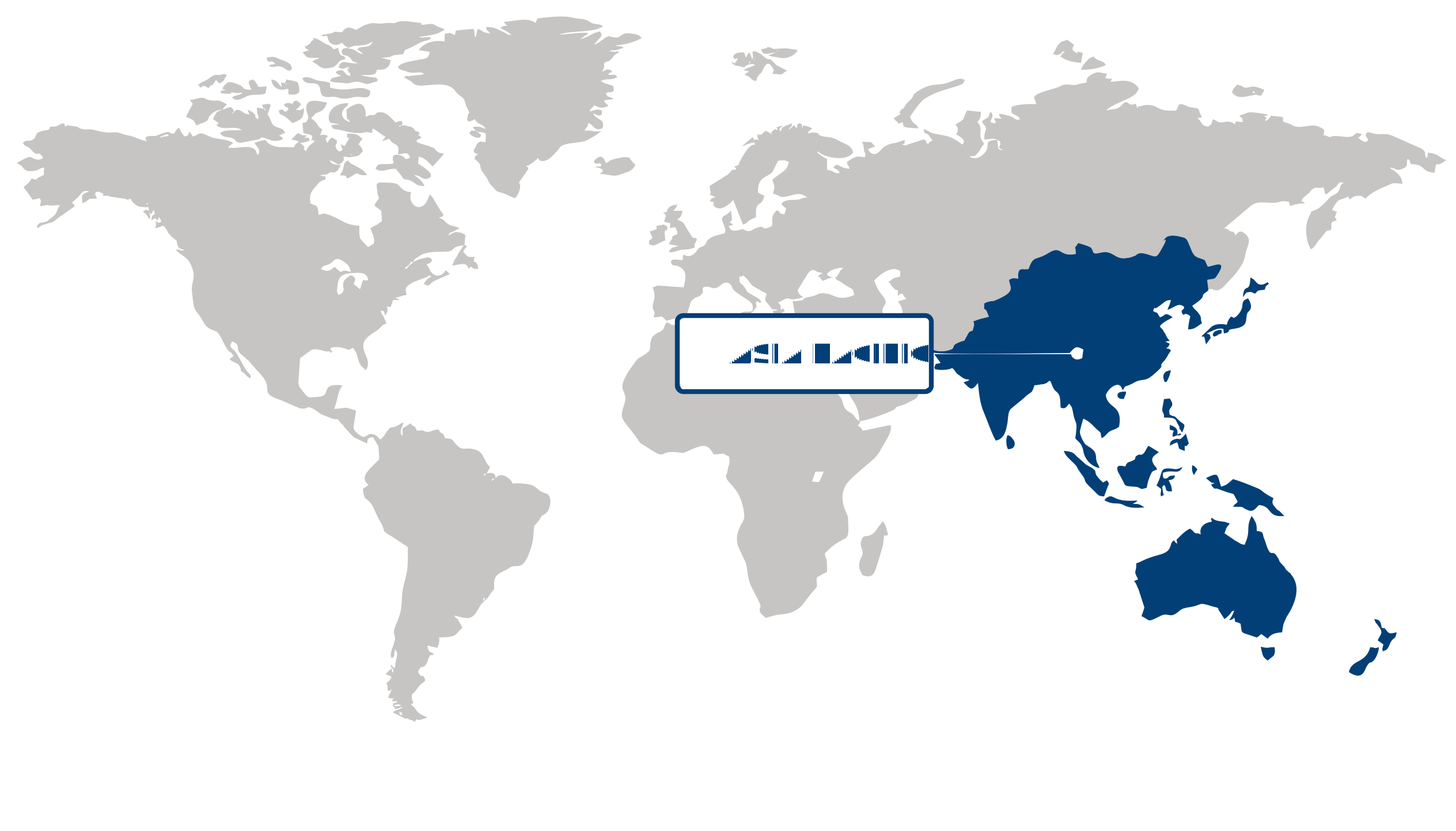
The image detection sensor market captured approximately 45.00% of global share in 2025, making Asia Pacific the largest regional market by share; this leadership is driven by the region’s concentration of semiconductor hubs and massive smartphone production volumes. Taiwan Semiconductor Manufacturing Company (TSMC) capacity expansions and Hon Hai Precision Industry Co., Ltd. (Foxconn) scale underpin component availability and manufacturing density, while Counterpoint Research and China’s Ministry of Industry and Information Technology (MIIT) document the region’s outsized smartphone output that fuels demand for advanced sensors. Policy support and incremental automation across fabs and assembly lines further lower unit costs and shorten time-to-market. These factors position Asia Pacific as a high-opportunity zone for investors seeking scale, tiered product segmentation, and close supplier collaboration.
The image detection sensor market in Japan is positioned as a pivotal hub in Asia Pacific due to its strengths in high-performance sensor IP and precision manufacturing. Sony Corporation’s sustained leadership in CMOS image sensors and collaboration with automotive OEMs, alongside Ministry of Economy, Trade and Industry (METI) programs encouraging sensor R&D, illustrate how premium, application-specific sensors are being scaled for robotics, automotive safety, and industrial inspection. Japan’s ecosystem favors high-margin, differentiated sensors, creating strategic partnerships and export opportunities that complement mass-production centers elsewhere in the region.
The image detection sensor market in China anchors Asia Pacific’s manufacturing scale and rapid commercialization of sensor-equipped devices. Counterpoint Research and MIIT data highlight China’s dominant smartphone assembly volumes, while Semiconductor Manufacturing International Corporation (SMIC) and large EMS providers like Hon Hai enable local sourcing and faster design-for-manufacturability cycles. Domestic OEMs and platforms accelerate integration of sensors into consumer and commercial devices, widening addressable markets and driving localized supply chains. China’s role in volume uptake and iterative product launches amplifies regional opportunities for tiered sensor suppliers and contract manufacturers.
North America Market Analysis:
North America emerged as the fastest-growing region in the image detection sensor market, registering a robust CAGR of 12.2% driven by the rapid integration of AI-powered image recognition in automotive and retail sectors. Rapid uptake of advanced driver-assistance systems (ADAS) and autonomous vehicle trials is pushing demand for higher-resolution, low-latency sensors and edge AI processing; companies such as NVIDIA and Intel’s Mobileye have publicly expanded automotive sensor and AI platforms to meet this need (NVIDIA press releases, Mobileye announcements). In retail, deployments of cashierless stores and real-time inventory systems by Amazon and Walmart are increasing demand for compact, high-accuracy vision modules (Amazon Go announcements, Walmart technology labs). Strong domestic semiconductor and software ecosystems, supportive U.S. testing initiatives from the U.S. Department of Transportation, and concentrated commercial pilot programs together create near-term commercial pathways and scale advantages for sensor makers across North America, offering sustained opportunities in adjacent industrial and smart-city applications.
The U.S. leads regional demand in the image detection sensor market as a primary adopter and innovation hub, where rapid integration of AI-powered image recognition in automotive and retail is most pronounced. Major automakers and mobility players—Tesla, Waymo, and Cruise—have intensified sensor and perception investments, while the National Highway Traffic Safety Administration (NHTSA) has issued guidance that shapes ADAS validation and deployment, accelerating procurement cycles (NHTSA guidance). In retail and logistics, Amazon’s cashierless store experiments and Walmart’s automated inventory pilots have driven early procurement of vision subsystems (Amazon Go announcements, Walmart technology labs). The concentration of compute providers (NVIDIA), vision specialists (Mobileye), and Tier‑1 suppliers in the U.S. shortens integration timelines and lowers go‑to‑market friction for new modules, making the country a strategic launchpad that reinforces North America’s overall leadership in the image detection sensor market.
Europe Market Trends:
Held a significant share, Europe’s image detection sensor market benefits from integrated industrial ecosystems, dense OEM partnerships and policy support that together sustain demand for advanced vision systems. The European Commission’s AI Act discussions and Horizon Europe funding have nudged buyers toward compliant, high-privacy solutions while the European Investment Bank and national industrial programs have underpinned capital for pilots; visible supplier strength is shown by Robert Bosch GmbH and Infineon Technologies AG product roadmaps and announcements. Logistics and supply-chain reshoring efforts, plus Fraunhofer Society research partnerships, reinforce resilience. These factors create a substantial runway for premium sensor applications across automotive, industrial automation and infrastructure monitoring.
Germany is a manufacturing and R&D anchor in the image detection sensor market, where scale production and automotive integration drive uptake. Strong domestic demand from vehicle OEMs and Tier‑1s, exemplified by collaborations involving Robert Bosch GmbH and Infineon Technologies AG, pairs with public support from the Federal Ministry for Economic Affairs and Climate Action and applied research from the Fraunhofer Society to accelerate sensor qualification and volume supply. Robust engineering talent and established supply chains reduce time-to-market for camera modules and CMOS solutions, making Germany a strategic hub for regional sensor sourcing and industrial piloting.
France is a hub for aerospace, defense and space-focused image detection sensor market applications, emphasizing high-reliability and mission-critical systems. Prime contractors such as Thales Group and Safran, together with Centre national d'études spatiales (CNES) programs and financing support from Bpifrance, drive procurement for specialty imaging sensors and secure-systems integration. Strong state-led procurement and cross-sector R&D foster specialized startups and component suppliers, creating exportable capabilities that complement broader European commercial opportunities and attract partnerships for turnkey sensing solutions.
| Parameter | North America | Asia Pacific | Europe | Latin America | MEA |
|---|---|---|---|---|---|
| Innovation Hub i Scale Nascent Developing Advanced | |||||
| Cost-Sensitive Region i Scale Low Medium High | |||||
| Regulatory Environment i Scale Restrictive Neutral Supportive | |||||
| Demand Drivers i Scale Weak Moderate Strong | |||||
| Development Stage i Scale Emerging Developing Developed | |||||
| Adoption Rate i Scale Low Medium High | |||||
| New Entrants / Startups i Scale Sparse Moderate Dense | |||||
| Macro Indicators i Scale Weak Stable Strong |
Segment Leadership and Growth Trends
Image Detection Sensor Market Share (%), by Application, 2026
Go beyond the chart, access full insights & data tables
Request Free Sample ReportImaging dominated the image detection sensor market as the largest segment in 2025, driven by widespread use in cameras, smartphones, and medical devices. Leadership stems from sustained demand for higher resolution and multispectral capability in consumer and clinical imaging, evidenced by Apple press releases on iPhone camera systems, Canon product announcements, and GE Healthcare imaging platforms cited by the U.S. Food and Drug Administration (FDA) approvals; this reflects shifting consumer preferences for superior imaging, rising telehealth adoption, and tighter regulatory scrutiny on diagnostic devices. The segment creates opportunities for optical component specialists and algorithmic imaging startups, and it will remain central as device makers and hospitals prioritize enhanced imaging and integration with AI-enabled workflows.
Analysis by Technology Type
CMOS represented largest share in the image detection sensor market in 2025 due to low power consumption and high integration in consumer devices. CMOS leadership is reinforced by vendor roadmaps from Sony Corporation, Samsung Electronics, and OmniVision emphasizing backside-illuminated and stacked CMOS designs that lower energy use and simplify integration with application processors. Supply-chain maturation, foundry partnerships, and demand for edge compute in smartphones and IoT drive adoption; ON Semiconductor and TSMC collaborations illustrate scalability. This favors established fabs and nimble design houses to deliver differentiated pixel architectures, and CMOS will stay dominant as energy-efficient, highly integrated sensors align with mobile, wearable, and embedded imaging trends.
Analysis by End-User
Consumer Electronics held largest share in the image detection sensor market in 2025 as expanding smartphone and wearable shipments drove demand for advanced imaging capabilities. Market leadership reflects OEM initiatives—Apple and Samsung Electronics product cycles and Qualcomm platform announcements—that push sensor performance, affecting supplier strategies and channel dynamics; GSMA and device vendor disclosures show persistent handset and wearable innovation cycles. Consumer priorities for photography, social media, and AR features, combined with supply-chain investments in camera modules, create openings for component suppliers and niche imaging startups. The segment should remain pivotal as continuous device refreshes, AR/VR integration, and on-device AI sustain demand for advanced image sensors.
| Segment | Sub-Segment | Largest Segment | Fastest Growing |
|---|---|---|---|
| Application | Imaging, Photography | ||
| Technology Type | CMOS, CCD, Thermal | ||
| End-User | Automotive, Health Care, Industrial, Consumer Electronics, Aerospace & Defense, Others |
Competitive Landscape and Market Positioning
The competitive environment is dynamic, with leading vendors expanding capabilities through external growth, selective third-party ties, and intensified internal engineering to shorten product cycles. Several names are moving beyond standalone sensors toward integrated optics, enhanced low-light stacks, and software-enabled image pipelines, while others emphasize ruggedized modules for factory and automotive contexts. Those moves shift bargaining power toward firms that can offer system-level value, accelerate adoption in target verticals, and defend margins by combining proprietary components with application know-how.
Strategic / Actionable Recommendations for Regional Players
North America: Deepen ties with Tier‑1 automotive and edge‑AI software providers, prioritize edge‑optimized sensor stacks, and aim for design wins in ADAS, robotics, and cloud‑native inspection platforms to convert semiconductor scale into systems advantage.
Asia Pacific: Leverage proximity to major device manufacturers and contract fabs to secure supply continuity, scale production of mobile and consumer sensors, and strengthen offerings for smart factory and logistics automation to capitalize on regional demand density.
Europe: Build on strengths in high‑reliability photonics and automotive-grade engineering by collaborating with specialist optics and medical imaging developers, pursuing premium industrial and safety segments where certification and component integration command value.
| Company | Market Share | Company Revenue | Revenue CAGR (%) | Product Portfolio | Geographic Presence | Innovation / R&D Focus | Strategic Developments |
|---|---|---|---|---|---|---|---|
| No companies available. | |||||||
Industry Development/News
| Company Name | Date | Key Development |
|---|
Customize Your Report
Explore examples of how this report can be tailored to different research needs, including custom segments, additional topics or chapters, and related reports. Click a section of the wheel or its numbered marker to explore the available options.
Image Detection Sensor Market — Custom Segments
| Segment | Sub-Segment |
|---|---|
| No segment data available. | |
Image Detection Sensor Market — Custom TOC
| Custom Chapter | Custom Details | ||
|---|---|---|---|
| No custom TOC data available. | |||
Need a different cut of the data?
Request Custom ResearchHow large is the image detection sensor market?
How will the image detection sensor industry grow in terms of size and CAGR by 2035?
What is the leading region in terms of image detection sensor market share?
What is the fastest growing region in the image detection sensor sector?
Why does imaging sub-segment dominate the application segment of image detection sensor sector?
How much is the CMOS segment expected to grow in the image detection sensor industry beyond 2025?
What factors give consumer electronics segment a competitive edge in the image detection sensor sector?
Who holds a significant market share in the image detection sensor landscape?
Our Clients
"Working with FBI has been a good experience. The market report provided a holistic view, covering everything from emerging trends to potential risks."
Semtech Corporation
"The experience was highly positive. The team showcased remarkable flexibility in adapting to our specific needs and delivered report that perfectly aligned with all our requirements."
TSMC
"What really stood out to me was how clearly and promptly the Fundamental Business Insights team communicated throughout. It made the collaboration feel effortless."
NXP Semiconductors
Our Research Team & Methodology
Every Fundamental Business Insights report is built by a dedicated vertical research team, validated through a structured primary-and-secondary methodology, and reviewed for accuracy before it reaches you.
Research Team Overview
Prepared by the Electronics & Semiconductors Research Team
Delivery
Published
Demand
Available
Support
Trust & Compliance
Research Domains
10 coverage areasResearch Intelligence
| Source | Reference |
|---|---|
| Semiconductor Industry Association (SIA) | www.semiconductors.org |
| SEMI | www.semi.org |
| JEDEC Solid State Technology Association | www.jedec.org |
| IEEE | www.ieee.org |
| IPC – Association Connecting Electronics Industries | www.ipc.org |
| International Electrotechnical Commission (IEC) | www.iec.ch |
| International Organization for Standardization (ISO) | www.iso.org |
| U.S. Bureau of Industry and Security (BIS) | www.bis.gov |
| U.S. Patent and Trademark Office (USPTO) | www.uspto.gov |
| European Patent Office (EPO) | www.epo.org |
| Taiwan Semiconductor Industry Association (TSIA) | www.tsia.org.tw |
| World Semiconductor Trade Statistics (WSTS) | www.wsts.org |
| International Energy Agency (IEA) | www.iea.org |
| GSMA | www.gsma.com |
| 3GPP | www.3gpp.org |
| ITU (International Telecommunication Union) | www.itu.int |
| Omdia (public insights) | omdia.tech.informa.com |
| Display Supply Chain Consultants (DSCC) | www.displaysupplychain.com |
| U.S. Department of Energy (DOE) | www.energy.gov |
| NIST (National Institute of Standards and Technology) | www.nist.gov |
Research Workflow & Quality Assurance
Data Collection
Verified information gathered through primary and secondary research.
Data Triangulation
Cross-validation using multiple independent data sources.
Forecast Modelling
Market estimates developed using historical trends and analytical models.
Analyst Validation
Findings reviewed by domain experts for accuracy and consistency.
Editorial & Quality Review
Final editorial, quality, and compliance checks before publication.
Final Publication
Released after successful completion of the internal review process.
Report Coverage
📊 Market Assessment
- Market Size & Forecast
- Market Segmentation
- Regional Analysis
- Growth Drivers & Challenges
- Market Dynamics
🏢 Competitive Intelligence
- Competitive Landscape
- Company Profiles
- Competitive Benchmarking
- Mergers & Acquisitions
- Market Share Analysis or Key Company Strategies
🔍 Strategic Analysis
- Value Chain Analysis
- Porter's Five Forces
- PESTLE Analysis
- Pricing Trends
- Supply-Demand Analysis
🚀 Future Outlook
- Technology Landscape
- Regulatory Landscape
- Investment & Funding Landscape
- Emerging Opportunities
- Future Market Outlook
Have a question about this report or need a custom scope?
Request Customization