Hydronic Heat Pump Compressors Market Size & Growth Forecast 2027–2036, By Segments (End Use, Technology, Speed, Refrigerant), Regional Demand Trends (North America, Asia Pacific, Europe), Key Country Insights (U.S., Japan, South Korea, Germany, France, Italy), and Competitive Landscape
Market Size and Growth Outlook
Hydronic Heat Pump Compressors Market size was valued at USD 12.75 Billion in 2026 and is anticipated to grow at 16.64% CAGR from 2027 to 2036, crossing USD 59.43 Billion by 2036. The industry revenue for 2027 is estimated at USD 14.59 Billion.
Get more details on this report
Request Free Sample ReportHydronic Heat Pump Compressors Market Intelligence Snapshot
Regional Market Dynamics
- Europe leads through strong heat pump adoption, energy-efficiency initiatives, building decarbonization efforts, and supportive policies promoting efficient heating systems.
- Asia Pacific is expanding through rapid urbanization, construction activity, infrastructure investment, environmental awareness, and improving HVAC manufacturing capabilities.
Segment Momentum
- Space heating held a 47.06% market share in 2026, supported by growing adoption of energy-efficient heating systems that provide reliable indoor temperature control while reducing operating costs and carbon emissions.
- Scroll compressors are the fastest-growing technology because they deliver higher energy efficiency, smoother compression, reliable operation under varying loads, and strong performance in advanced heat pump systems.
Market Expansion Drivers
- Low-carbon heating demand accelerating adoption in residential and commercial buildings
- Incentive-backed regulations driving rapid deployment of energy-efficient heat pump systems
- Electrification of heating systems replacing fossil fuel-based boiler infrastructure
Leading Market Participants
- Major companies in the hydronic heat pump compressors market include Daikin Industries Ltd. (Japan), Carrier Global Corporation (United States), Trane Technologies plc (Ireland), Johnson Controls International plc (Ireland), Mitsubishi Electric Corporation (Japan), LG Electronics Inc. (South Korea), Samsung Electronics Co., Ltd. (South Korea), Danfoss A/S (Denmark), Copeland LP (United States), Panasonic Corporation (Japan)
Global Market Forecast Snapshot
Market Outlook
- 2026 Market Size: USD 12.75 Billion
- 2027 Estimated Market Size: USD 14.59 Billion
- Projected Market Size: USD 59.43 Billion by 2036
- Growth Forecast: 16.64% CAGR (2027-2036)
Regional and Segment Outlook
- Leading Regional Market: Europe
- High-Growth Regional Hub: Asia Pacific
- Core Revenue Segment: Space Heating (End Use) | Rotary (Technology) | Single Speed (Speed) | R410A (Refrigerant)
- Emerging Opportunity Segment: Domestic Hot Water (End Use) | Scroll (Technology) | Variable Speed (Speed) | R290 (Refrigerant)
Market Growth Drivers and Industry Trends
Low-carbon heating demand accelerating adoption in residential and commercial buildings
The transition toward sustainable building technologies is increasing demand for heating systems that reduce carbon emissions while maintaining high energy performance. This shift will propel the hydronic heat pump compressors market growth as residential and commercial property owners increasingly adopt hydronic heat pump systems for efficient space heating and hot water applications. Advanced compressors play a critical role in maximizing system efficiency, ensuring reliable performance across varying operating conditions, and supporting long-term reductions in energy consumption compared with conventional heating technologies.
Incentive-backed regulations driving rapid deployment of energy-efficient heat pump systems
Policy measures promoting energy-efficient building technologies are encouraging property owners to replace conventional heating equipment with environmentally friendly alternatives. The hydronic heat pump compressors market is benefiting from incentive programs, building efficiency standards, and regulatory initiatives that lower the financial barriers to adopting advanced heat pump systems. These supportive frameworks stimulate demand for high-performance compressors that enable efficient heat transfer, improve seasonal operating efficiency, and help buildings comply with evolving energy performance requirements.
Electrification of heating systems replacing fossil fuel-based boiler infrastructure
The growing electrification of building heating is reshaping residential and commercial energy systems as consumers and facility operators transition away from fossil fuel-based boilers. This transformation will boost the hydronic heat pump compressors market demand because compressors are essential components that enable electrically powered heat pumps to deliver reliable and efficient heating. Replacement projects increasingly prioritize technologies capable of integrating with modern electrical infrastructure while supporting reduced emissions, improved operational efficiency, and enhanced compatibility with renewable electricity sources.
| Growth Driver | Impact on CAGR | Regulatory Influence | Geographic Relevance | Adoption Rate | Impact Timeline |
|---|---|---|---|---|---|
| Low-carbon heating demand accelerating adoption in residential and commercial buildings | 3.2% | Moderate | Europe, North America, Asia Pacific | High | Near Term |
| Incentive-backed regulations driving rapid deployment of energy-efficient heat pump systems | 3.8% | High | Europe, North America | High | Near Term |
| Electrification of heating systems replacing fossil fuel-based boiler infrastructure | 3.5% | Moderate | Europe, North America, Asia Pacific | High | Mid Term |
Unlock insights tailored to your business with our bespoke market research solutions.
Click to get your customized report now.
Regional Demand Dynamics
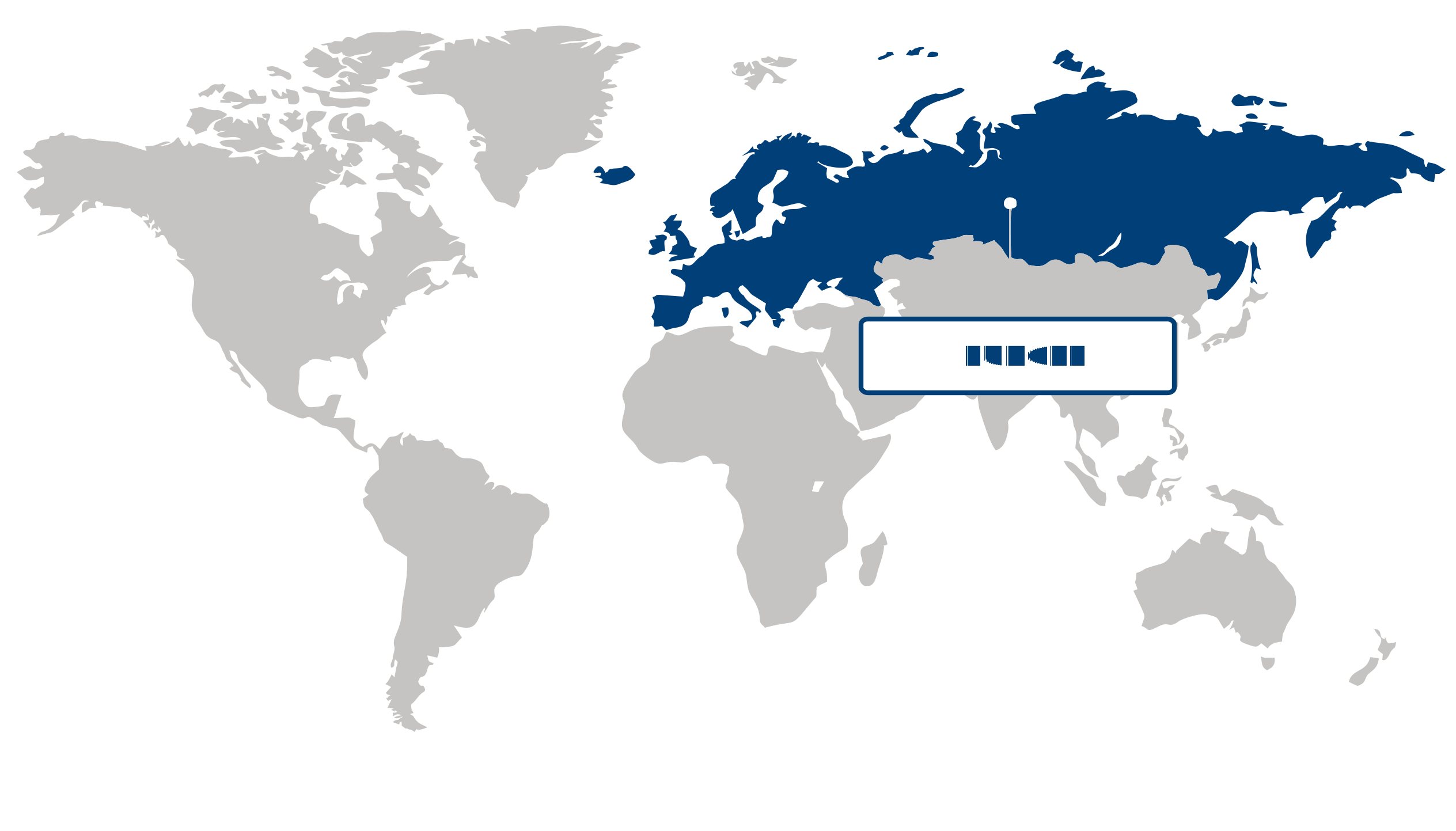
Europe (Largest Region)
Europe accounted for the largest share of the hydronic heat pump compressors market in 2026, driven by strong adoption of heat pump technologies, energy-efficiency initiatives, and efforts to reduce dependence on conventional heating systems. The region's focus on building decarbonization and efficient space heating is encouraging the replacement of traditional heating equipment with electrically driven heat pump systems. Growing demand for efficient residential and commercial heating solutions, together with supportive policy measures and infrastructure modernization, is creating sustained opportunities for advanced compressors used in hydronic heat pump applications.
Asia Pacific (Fastest-Growing Region)
Asia Pacific is positioned as the fastest-growing regional market, supported by rapid urbanization, expanding construction activity, and rising demand for energy-efficient heating and cooling systems. Increasing investments in residential and commercial infrastructure are creating new opportunities for hydronic heat pump installations, while growing environmental awareness is encouraging the adoption of lower-emission heating technologies. Improvements in HVAC manufacturing capabilities and greater availability of advanced heat pump components are further supporting regional expansion.
| Parameter | North America | Asia Pacific | Europe | Latin America | MEA |
|---|---|---|---|---|---|
| Innovation Hub i Scale Nascent Developing Advanced | |||||
| Cost-Sensitive Region i Scale Low Medium High | |||||
| Regulatory Environment i Scale Restrictive Neutral Supportive | |||||
| Demand Drivers i Scale Weak Moderate Strong | |||||
| Development Stage i Scale Emerging Developing Developed | |||||
| Adoption Rate i Scale Low Medium High | |||||
| New Entrants / Startups i Scale Sparse Moderate Dense | |||||
| Macro Indicators i Scale Weak Stable Strong |
Key Country Insights
United States 🇺🇸
Building Electrification SupportThe U.S. hydronic heat pump compressors market is expanding alongside building electrification and energy-efficient heating upgrades. U.S. manufacturers prioritize compressors offering improved seasonal performance, lower refrigerant impact, and compatibility with residential and commercial hydronic systems.
Germany 🇩🇪
High-Efficiency Heating FocusGermany emphasizes hydronic heat pump compressors designed for efficient space heating and integration with low-carbon building systems. German demand is supported by renovation projects requiring reliable compressors capable of operating effectively in colder climates.
Japan 🇯🇵
Compact System EngineeringJapan focuses on compact hydronic heat pump compressors that maximize efficiency while minimizing installation space. Japanese manufacturers continue refining inverter-controlled compressor technologies to improve operational stability across varying heating loads.
South Korea 🇰🇷
Smart HVAC IntegrationSouth Korea is integrating hydronic heat pump compressors with intelligent HVAC systems for residential and commercial buildings. South Korean suppliers emphasize variable-speed compressor technologies that enhance energy optimization and digital system control.
France 🇫🇷
Sustainable Heating TransitionFrance promotes hydronic heat pump compressors that support renewable heating solutions and reduced fossil fuel dependence. French building projects increasingly adopt high-efficiency compressor technologies compatible with modern hydronic heating installations.
Italy 🇮🇹
Retrofit Heating SolutionsItaly's hydronic heat pump compressors market benefits from growing retrofit activity in residential buildings seeking improved heating efficiency. Italian installers favor compressors that integrate smoothly with existing hydronic systems while reducing operating energy consumption.
Segment Leadership and Growth Trends
Hydronic Heat Pump Compressors Market Share (%), by End Use, 2026
Go beyond the chart, access full insights & data tables
Request Free Sample ReportEnd Use Segment Analysis: Space Heating (Largest Segment) vs Domestic Hot Water (Fastest-Growing Segment)
The space heating segment dominated the hydronic heat pump compressors market, accounting for 47.06% of the market share in 2026. Its leading position is supported by the widespread adoption of hydronic heat pump systems for residential and commercial space conditioning, where efficient and consistent indoor temperature control is a primary requirement. Growing emphasis on energy-efficient heating technologies, lower operating costs, and reduced carbon emissions has encouraged the replacement of conventional heating systems with hydronic heat pump solutions, reinforcing demand for compressors designed for space heating applications.
The domestic hot water segment is the fastest-growing end-use category. Rising consumer preference for integrated heating systems capable of delivering both comfort heating and hot water, along with stricter energy-efficiency regulations, is accelerating adoption. Hydronic heat pump compressors are increasingly being incorporated into domestic hot water systems because they offer reliable performance, improved energy utilization, and compatibility with sustainable building designs, supporting the segment's continued expansion.
Technology Segment Analysis: Rotary (Largest Segment) vs Scroll (Fastest-Growing Segment)
The rotary compressor segment held the largest share of the market in 2026. Rotary compressors are widely utilized in hydronic heat pump systems because they provide compact construction, dependable performance, and efficient operation under a broad range of heating conditions. Their ability to deliver stable output while maintaining lower noise levels and reduced maintenance requirements makes them a preferred choice across residential and light commercial installations.
In the hydronic heat pump compressors market, the scroll compressor segment is emerging as the fastest-growing technology. Increasing demand for higher energy efficiency, smoother compression, and improved reliability is driving greater adoption of scroll compressors in advanced heat pump systems. Their capability to operate efficiently under varying load conditions and support high-performance heating applications continues to strengthen their market outlook.
Speed Segment Analysis: Single Speed (Largest Segment) vs Variable Speed (Fastest-Growing Segment)
The single-speed segment accounted for the largest share of the market in 2026. Single-speed compressors remain extensively deployed because of their straightforward design, proven operational reliability, and cost-effective installation. They continue to meet the requirements of standard heating applications where stable operating conditions and dependable performance are prioritized over variable capacity operation.
The variable-speed segment represents the fastest-growing category. Growing demand for intelligent heating systems with enhanced energy optimization and improved indoor comfort is encouraging the adoption of variable-speed compressors. Their ability to adjust compressor output according to heating demand improves overall system efficiency, minimizes energy consumption, and supports the transition toward high-performance, environmentally sustainable heating solutions.
| Segment | Sub-Segment | Largest Segment | Fastest Growing |
|---|---|---|---|
| End Use | Space Heating, Domestic Hot Water, General Use Water Heating, Others | Space Heating | Domestic Hot Water |
| Technology | Reciprocating, Rotary, Scroll | Rotary | Scroll |
| Speed | Single Speed, Variable Speed | Single Speed | Variable Speed |
| Refrigerant | R410A, R134A, R744, R290, R32, Others | R410A | R290 |
Competitive Landscape and Market Positioning
Prominent players in the hydronic heat pump compressors market:
- Daikin Industries Ltd. (Japan)
- Carrier Global Corporation (United States)
- Trane Technologies plc (Ireland)
- Johnson Controls International plc (Ireland)
- Mitsubishi Electric Corporation (Japan)
- LG Electronics, Inc. (South Korea)
- Samsung Electronics Co., Ltd. (South Korea)
- Danfoss A/S (Denmark)
- Copeland LP (United States)
- Panasonic Corporation (Japan)
Product innovation has become a defining competitive force within the hydronic heat pump compressors market as manufacturers focus on improving operating efficiency, low-temperature performance, and system adaptability across residential and commercial heating applications. Competition increasingly extends beyond compressor hardware to include engineering capabilities that support quieter operation, refrigerant transitions, and seamless integration with intelligent heating controls. The combination of evolving energy efficiency standards, demanding performance requirements, and specialized manufacturing expertise creates meaningful entry barriers, encouraging sustained investment in advanced compressor technologies and application-specific product development.
| Company | Market Share | Company Revenue | Revenue CAGR (%) | Product Portfolio | Geographic Presence | Innovation / R&D Focus | Strategic Developments |
|---|---|---|---|---|---|---|---|
| Daikin Industries Ltd. (Japan) | |||||||
| Carrier Global Corporation (United States) | |||||||
| Trane Technologies plc (Ireland) | |||||||
| Johnson Controls International plc (Ireland) | |||||||
| Mitsubishi Electric Corporation (Japan) | |||||||
| LG Electronics Inc. (South Korea) | |||||||
| Samsung Electronics Co. Ltd. (South Korea) | |||||||
| Danfoss A/S (Denmark) | |||||||
| Copeland LP (United States) | |||||||
| Panasonic Corporation (Japan) |
Industry Development/News
| Company Name | Date | Key Development |
|---|
Customize Your Report
Explore examples of how this report can be tailored to different research needs, including custom segments, additional topics or chapters, and related reports. Click a section of the wheel or its numbered marker to explore the available options.
Hydronic Heat Pump Compressors Market — Custom Segments
| Segment | Sub-Segment |
|---|---|
| Heat Pump System Type | Air-to-Water, Water-to-Water, Ground-Source |
| Compressor Capacity | Up to 5 kW, >5 kW to 15 kW, >15 kW to 30 kW, Above 30 kW |
| Buyer Type | Heat Pump OEMs, HVAC Equipment Manufacturers, Replacement & Aftermarket Buyers |
Hydronic Heat Pump Compressors Market — Custom TOC
| Custom Chapter | Custom Details |
|---|---|
| Compressor Technology Selection for Hydronic Heat Pumps |
|
| HVAC OEM Sourcing and Supply Strategies |
|
| Refrigerant Transition and Compressor Design Implications |
|
| Compressor Replacement and Aftermarket Opportunities |
|
Need a different cut of the data?
Request Custom ResearchHow much revenue does the hydronic heat pump compressors market generate?
What is the forecasted size of the hydronic heat pump compressors industry?
How is heating electrification reshaping demand for hydronic heat pump compressors?
How are incentives and building regulations accelerating heat pump compressor adoption?
Why is space heating the largest end-use segment in the hydronic heat pump compressors market?
Which technology segment is growing the fastest in the hydronic heat pump compressors market?
Why does Europe hold the largest share of the hydronic heat pump compressors market?
How is Asia Pacific accelerating growth in hydronic heat pump compressors?
What are the prominent companies operating in the hydronic heat pump compressors landscape?
Our Clients
"The team at Fundamental Business Insights & Consulting demonstrated a commitment to excellence, not only in the quality of the report but also in their client-centric approach."
FANUC
"The level of detail in the market segmentation provided were particularly noteworthy. The detailed country-level insights were also very helpful."
B&R Industrial Automation GmbH
"The consultant took the time to understand our specific business objectives, ensuring that the reports were tailored to address our unique challenges and opportunities."
KUKA SE & Co. KGaA
Our Research Team & Methodology
Every Fundamental Business Insights report is built by a dedicated vertical research team, validated through a structured primary-and-secondary methodology, and reviewed for accuracy before it reaches you.
Research Team Overview
Prepared by the Industrial Automation & Equipment Research Team
Delivery
Published
Demand
Available
Support
Trust & Compliance
Research Domains
10 coverage areasResearch Intelligence
| Source | Reference |
|---|---|
| International Society of Automation (ISA) | www.isa.org |
| International Organization for Standardization (ISO) | www.iso.org |
| National Institute of Standards and Technology (NIST) | www.nist.gov |
| IEEE | www.ieee.org |
| VDMA (German Mechanical Engineering Industry Association) | www.vdma.org |
| Association for Advancing Automation (A3) | www.automate.org |
| International Federation of Robotics (IFR) | ifr.org |
| ASME (American Society of Mechanical Engineers) | www.asme.org |
| ASHRAE | www.ashrae.org |
| American Society of Heating, Refrigerating and Air-Conditioning Engineers (ASHRAE) | www.ashrae.org |
| Material Handling Industry (MHI) | www.mhi.org |
| OSHA (Occupational Safety and Health Administration) | www.osha.gov |
| National Fire Protection Association (NFPA) | www.nfpa.org |
| ASTM International | www.astm.org |
| International Electrotechnical Commission (IEC) | www.iec.ch |
| Open Process Automation Forum (The Open Group) | www.opengroup.org/open-process-automation-forum |
| AGMA (American Gear Manufacturers Association) | www.agma.org |
| Association of Equipment Manufacturers (AEM) | www.aem.org |
| Food and Agriculture Organization (FAO) | www.fao.org |
| International Labour Organization (ILO) | www.ilo.org |
Research Workflow & Quality Assurance
Data Collection
Verified information gathered through primary and secondary research.
Data Triangulation
Cross-validation using multiple independent data sources.
Forecast Modelling
Market estimates developed using historical trends and analytical models.
Analyst Validation
Findings reviewed by domain experts for accuracy and consistency.
Editorial & Quality Review
Final editorial, quality, and compliance checks before publication.
Final Publication
Released after successful completion of the internal review process.
Report Coverage
📊 Market Assessment
- Market Size & Forecast
- Market Segmentation
- Regional Analysis
- Growth Drivers & Challenges
- Market Dynamics
🏢 Competitive Intelligence
- Competitive Landscape
- Company Profiles
- Competitive Benchmarking
- Mergers & Acquisitions
- Market Share Analysis or Key Company Strategies
🔍 Strategic Analysis
- Value Chain Analysis
- Porter's Five Forces
- PESTLE Analysis
- Pricing Trends
- Supply-Demand Analysis
🚀 Future Outlook
- Technology Landscape
- Regulatory Landscape
- Investment & Funding Landscape
- Emerging Opportunities
- Future Market Outlook
Have a question about this report or need a custom scope?
Request Customization