Hot Food Processing Equipment Market Size & Growth Forecast 2027–2036, By Segments (End-User, Mode of Operation, Type), Regional Demand Trends (North America, Asia Pacific, Europe), Key Country Insights (U.S., Japan, South Korea, Germany, France, Italy), and Competitive Landscape
Market Size and Growth Outlook
Hot Food Processing Equipment Market size was over USD 27.09 billion in 2026 and is likely to grow at a 5.99% CAGR between 2027 and 2036, attaining USD 48.47 billion by 2036. The industry revenue for 2027 is estimated at USD 28.46 billion.
Get more details on this report
Request Free Sample ReportHot Food Processing Equipment Market Intelligence Snapshot
Regional Market Dynamics
- Asia Pacific held a 37.74% market share in 2026, supported by its large-scale food manufacturing base, extensive packaged food production, and demand for high-throughput thermal processing systems.
- Europe is forecast to grow at a 7.23% CAGR as food manufacturers modernize thermal processing equipment, invest in efficient systems, and replace legacy production lines to improve precision and compliance.
Segment Momentum
- Food Processing Industries held a 59.75% share in 2026 because large-scale production facilities require hot food processing equipment for consistent throughput, controlled processing, and operational efficiency.
- Semi-automatic equipment is the fastest-growing mode as it offers a practical balance between productivity, operational flexibility, and manual control for expanding processing needs.
Market Expansion Drivers
- Rising demand for packaged and fast foods expanding processing capacity needs.
- Pandemic-driven shift toward processed foods strengthening industrial food production systems.
- Integration of automated thermal processing systems improving food safety and throughput efficiency.
Leading Market Participants
- Prominent companies in the hot food processing equipment market include GEA Group AG (Germany), Bühler AG (Switzerland), Marel hf. (Iceland), The Middleby Corporation (U.S.), JBT Corporation (U.S.), Alfa Laval AB (Sweden), SPX FLOW, Inc. (U.S.), Tetra Laval International S.A. (Switzerland), Heat and Control, Inc. (U.S.), TNA Solutions Pty Ltd. (Australia).
Global Market Forecast Snapshot
Market Outlook
- 2026 Market Size: USD 27.09 billion
- 2027 Estimated Market Size: USD 28.46 billion.
- Projected Market Size: USD 48.47 billion by 2036
- Growth Forecast: 5.99% CAGR (2027-2036)
Regional and Segment Outlook
- Leading Regional Market: Asia Pacific
- High-Growth Regional Hub: Europe
- Core Revenue Segment: Food Processing Industries (End-User) | Automatic (Mode of Operation) | Baking Equipment (Type)
- Emerging Opportunity Segment: Food Service Industry (End-User) | Semi-automatic (Mode of Operation) | Dehydration Equipment (Type)
Market Growth Drivers and Industry Trends
Rising demand for packaged and fast foods expanding processing capacity needs
Changing food consumption patterns are increasing the need for efficient industrial production of packaged and fast food products, requiring processors to expand and strengthen their manufacturing capabilities. The hot food processing equipment market is supported by this capacity expansion as producers require thermal processing solutions to handle growing production requirements while maintaining consistent preparation and processing conditions. Increased reliance on packaged and convenient foods is therefore encouraging food manufacturers to invest in equipment that can support larger-scale processing operations.
Pandemic-driven shift toward processed foods strengthening industrial food production systems
The pandemic accelerated consumer reliance on processed foods, reinforcing the role of industrial food production systems in meeting changing purchasing and consumption patterns. As demand for processed products became more established, the hot food processing equipment market gained support from manufacturers seeking production systems capable of maintaining reliable food processing operations at scale. This shift has strengthened the importance of processing infrastructure that can accommodate sustained production requirements associated with increased processed food consumption.
Integration of automated thermal processing systems improving food safety and throughput efficiency
Automation is becoming increasingly important in thermal food processing because controlled processing conditions can improve consistency, food safety, and production efficiency. For the hot food processing equipment market, integrating automated thermal systems enables food manufacturers to manage processing operations more precisely while supporting higher throughput. Automated equipment can also reduce reliance on manual intervention across thermal processing stages, helping producers maintain standardized operating conditions as production volumes and processing requirements increase.
| Growth Driver | Impact on CAGR | Regulatory Influence | Geographic Relevance | Adoption Rate | Impact Timeline |
|---|---|---|---|---|---|
| Rising demand for packaged and fast foods expanding processing capacity needs | 2.00% | Moderate | North America, Asia Pacific | High | Near Term |
| Pandemic-driven shift toward processed foods strengthening industrial food production systems | 1.80% | Moderate | North America, Europe | High | Mid Term |
| Integration of automated thermal processing systems improving food safety and throughput efficiency | 1.60% | High | North America, Europe | Medium | Mid Term |
Unlock insights tailored to your business with our bespoke market research solutions.
Click to get your customized report now.
Regional Demand Dynamics
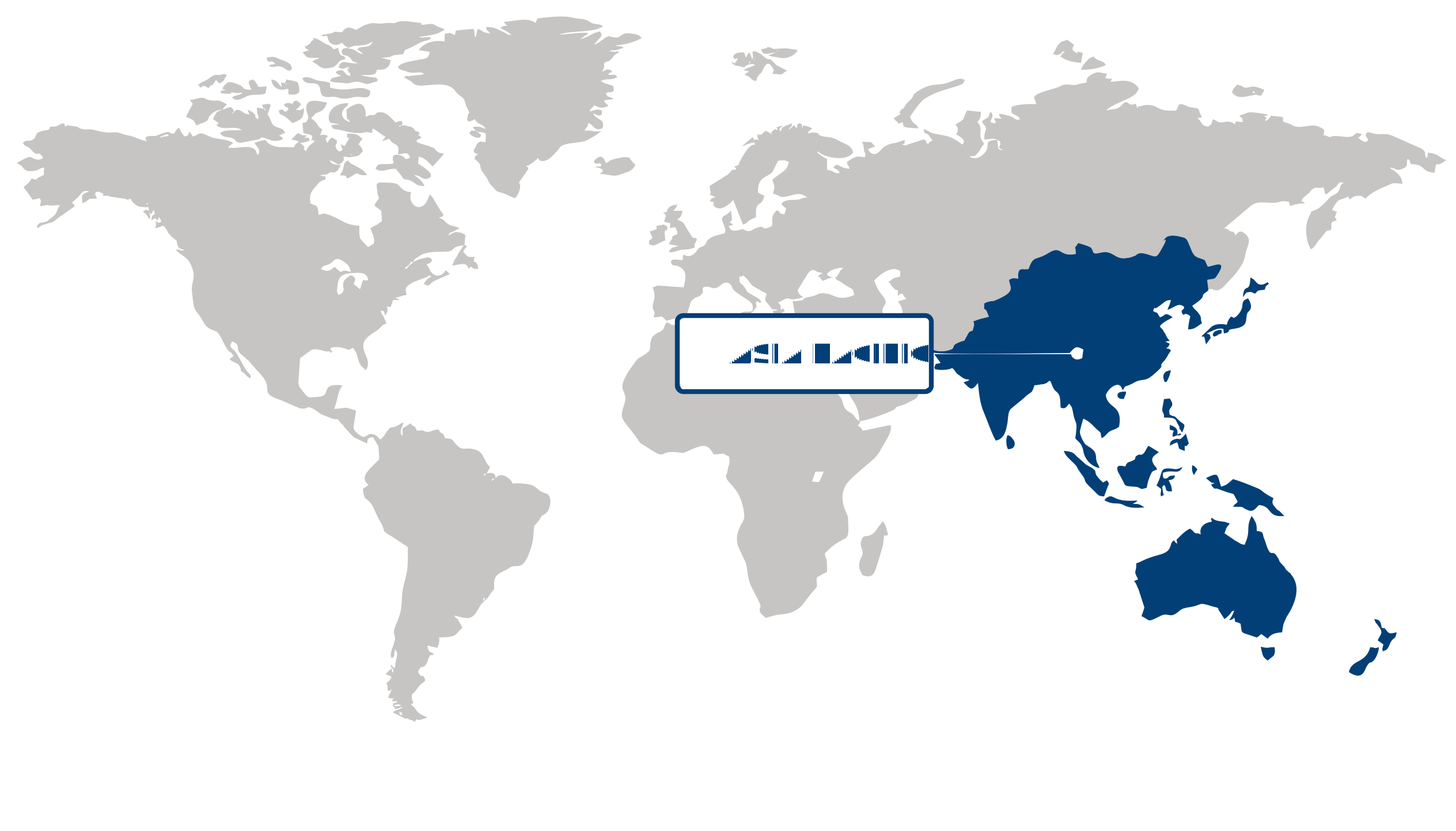
Asia Pacific (Largest Region)
Holding the largest share of the hot food processing equipment market at 37.74% in 2026, Asia Pacific benefits from expanding food manufacturing capacity, urbanization, and increasing demand for processed and convenience foods. Growth in foodservice operations and packaged food production is encouraging investment in efficient equipment for cooking, heating, frying, steaming, and other thermal processing applications. Manufacturers are also seeking technologies that improve production consistency, hygiene, energy efficiency, and throughput as food safety expectations become more stringent. The region’s expanding industrial base and growing consumption of prepared foods are creating sustained opportunities for modern hot food processing systems.
Europe (Fastest-Growing Region)
Europe is the fastest-growing region, supported by strong emphasis on food safety, production efficiency, automation, and sustainable processing practices. Food manufacturers are increasingly upgrading equipment to improve operational consistency while reducing energy use and minimizing waste. Demand for convenient and ready-to-eat food products is also encouraging processors to expand and modernize thermal production capabilities. Furthermore, technological developments in automated controls, hygienic equipment design, and process monitoring are helping food producers meet evolving quality requirements while improving productivity, strengthening the regional growth trajectory.
| Parameter | North America | Asia Pacific | Europe | Latin America | MEA |
|---|---|---|---|---|---|
| Innovation Hub i Scale Nascent Developing Advanced | |||||
| Cost-Sensitive Region i Scale Low Medium High | |||||
| Regulatory Environment i Scale Restrictive Neutral Supportive | |||||
| Demand Drivers i Scale Weak Moderate Strong | |||||
| Development Stage i Scale Emerging Developing Developed | |||||
| Adoption Rate i Scale Low Medium High | |||||
| New Entrants / Startups i Scale Sparse Moderate Dense | |||||
| Macro Indicators i Scale Weak Stable Strong |
Key Country Insights
Germany 🇩🇪
Precision Processing SystemsGermany prioritizes high-performance hot food processing equipment with advanced process controls and energy-efficient designs. Manufacturers continue integrating digital monitoring and hygienic engineering to improve production consistency across food processing facilities.
France 🇫🇷
Premium Food ProcessingFrance focuses on hot food processing equipment that supports consistent quality across bakery, dairy, and prepared food production. Equipment suppliers are introducing flexible processing systems that help manufacturers respond to changing product portfolios.
Italy 🇮🇹
Specialty Manufacturing SupportItaly continues investing in hot food processing equipment tailored to specialty food production and premium culinary products. Italian manufacturers value flexible thermal processing technologies that preserve product characteristics while improving operational efficiency.
Japan 🇯🇵
Compact Production InnovationJapan emphasizes compact, highly efficient hot food processing equipment suited to premium and convenience food manufacturing. Japanese processors are investing in automated thermal technologies that improve product quality while optimizing factory space.
South Korea 🇰🇷
Smart Factory IntegrationSouth Korea is accelerating the adoption of intelligent hot food processing equipment as food manufacturers modernize production facilities. Integrated automation, remote monitoring, and efficient heat management are becoming key purchasing priorities across processing plants.
United States 🇺🇸
Automation Investment FocusThe U.S. hot food processing equipment market is driven by food manufacturers upgrading production lines for higher throughput, energy efficiency, and food safety compliance. Equipment suppliers are expanding automated cooking, pasteurization, and thermal processing solutions to support large-scale operations.
Segment Leadership and Growth Trends
Hot Food Processing Equipment Market Share (%), by End-User, 2026
Go beyond the chart, access full insights & data tables
Request Free Sample ReportEnd-User Segment Analysis: Food Processing Industries (Largest Segment) vs Food Service Industry (Fastest-Growing Segment)
Food processing industries dominated the hot food processing equipment market with a 59.75% share in 2026, reflecting the extensive use of specialized equipment across large-scale food preparation and processing operations. These facilities require reliable and efficient systems to support consistent heating, cooking, processing, and handling of food products while maintaining productivity and quality standards. Increasing demand for processed and prepared foods, together with the need for greater operational efficiency and process consistency, continues to reinforce equipment adoption within food processing facilities.
The food service industry is emerging as the fastest-growing end-user segment, supported by expanding demand for prepared meals, restaurant offerings, institutional food services, and convenient hot-food solutions. Food service operators increasingly require equipment that can deliver consistent preparation quality while improving speed and operational efficiency. Growing emphasis on streamlined kitchen workflows, menu diversification, food quality, and labor efficiency is encouraging investment in modern hot food processing equipment across food service establishments.
Mode of Operation Segment Analysis: Automatic (Largest Segment) vs Semi-automatic (Fastest-Growing Segment)
The automatic segment accounted for the largest share of the hot food processing equipment market at 57.54% in 2026, driven by the need for consistent processing performance, improved operational efficiency, and reduced dependence on manual intervention. Automated equipment can provide greater process control and repeatability while supporting higher operational throughput. Food processors and commercial operators are increasingly focused on standardizing production activities and maintaining consistent food quality, strengthening demand for automated processing solutions.
Semi-automatic equipment is expected to experience the fastest growth as operators seek a balance between process automation and operational flexibility. These systems can reduce manual workload while retaining a degree of operator control, making them suitable for businesses with varied production requirements or more moderate automation needs. Increasing efforts to improve productivity, manage labor requirements, and modernize food preparation processes are supporting greater adoption of semi-automatic equipment.
| Segment | Sub-Segment | Largest Segment | Fastest Growing |
|---|---|---|---|
| End-User | Food Processing Industries, Food Service Industry, Household | Food Processing Industries | Food Service Industry |
| Mode of Operation | Automatic, Semi-automatic, Manual | Automatic | Semi-automatic |
| Type | Baking Equipment, Evaporation Equipment, Pasteurization Equipment, Dehydration Equipment, Roasting & Grilling Equipment, Frying Equipment, Sterilization Equipment, Blanching Equipment, Others | Baking Equipment | Dehydration Equipment |
Competitive Landscape and Market Positioning
Prominent players in the hot food processing equipment market:
1. GEA Group AG (Germany)
2. Bühler AG (Switzerland)
3. Marel hf. (Iceland)
4. The Middleby Corporation (U.S.)
5. JBT Corporation (U.S.)
6. Alfa Laval AB (Sweden)
7. SPX FLOW Inc. (U.S.)
8. Tetra Laval International S.A. (Switzerland)
9. Heat and Control Inc. (U.S.)
10. TNA Solutions Pty Ltd. (Australia)
The hot food processing equipment market is advancing with increasing demand for efficiency and automation in food production systems. In the hot food processing equipment market, technological upgrades are improving processing speed and consistency. Continuous innovation in thermal and mechanical systems is enhancing product quality. The push for scalable production solutions is driving modernization across food processing facilities.
| Company | Market Share | Company Revenue | Revenue CAGR (%) | Product Portfolio | Geographic Presence | Innovation / R&D Focus | Strategic Developments |
|---|---|---|---|---|---|---|---|
| GEA Group AG (Germany) | |||||||
| Bühler AG (Switzerland) | |||||||
| Marel hf. (Iceland) | |||||||
| The Middleby Corporation (U.S.) | |||||||
| JBT Corporation (U.S.) | |||||||
| Alfa Laval AB (Sweden) | |||||||
| SPX FLOW Inc. (U.S.) | |||||||
| Tetra Laval International S.A. (Switzerland) | |||||||
| Heat and Control Inc. (U.S.) | |||||||
| TNA Solutions Pty Ltd. (Australia). |
Industry Development/News
| Company Name | Date | Key Development |
|---|---|---|
| Tetra Pak | Nov-25 | Tetra Pak launched the Integrated Heat Pump system for pasteurization, designed to combine heating and cooling functions and recover process heat for reuse. The system reduces energy consumption by up to 77% in beverage and dairy processing, supporting efficiency improvements and sustainability in thermal food processing operations. |
| SPX FLOW | Oct-25 | SPX FLOW introduced the APV Infusion UHT system featuring SteamRecycle technology, enabling full capture and reuse of steam generated during processing. The system reduces energy and water usage while maintaining high-temperature processing efficiency in dairy and plant-based beverage manufacturing. |
| Alfa Laval | Jan-25 | Alfa Laval launched Extend, a heat exchanger add-on technology that uses electrical current to reduce biofilm buildup in pasteurization systems. The solution extends cleaning intervals and lowers energy and water consumption, improving operational efficiency in dairy processing applications. |
| Bühler Group | Jan-25 | Bühler Group acquired puffing technology from Swiss manufacturer CEREX, expanding its food processing equipment portfolio. The technology enhances cereal and snack production capabilities while improving energy efficiency and yield performance in industrial food processing applications. |
| Marel | Feb-23 | Marel launched the MS 2750 filleting machine for salmon and trout processing, enabling higher throughput and improved yield efficiency. The system reduces labor dependency and strengthens Marel’s positioning in automated seafood processing equipment through enhanced operational productivity. |
| Marel | May-22 | Marel opened a demonstration and learning facility in Scotland to showcase fish processing technologies and equipment solutions. The facility enhances customer engagement and supports adoption of automated processing systems in seafood manufacturing through live demonstrations and technical training. |
| SPX FLOW | Apr-21 | SPX FLOW acquired Philadelphia Mixing Solutions to strengthen its industrial mixing and processing equipment capabilities. The acquisition enhances its technological expertise and service offerings in food and beverage processing equipment markets, supporting broader industrial mixing applications. |
Customize Your Report
Explore examples of how this report can be tailored to different research needs, including custom segments, additional topics or chapters, and related reports. Click a section of the wheel or its numbered marker to explore the available options.
Hot Food Processing Equipment Market — Custom Segments
| Segment | Sub-Segment |
|---|---|
| Food Category Processed | Meat & Seafood, Dairy & Dairy Alternatives, Bakery & Confectionery, Fruits & Vegetables, Ready-to-Eat & Prepared Foods |
| Energy Source | Electric, Gas-Fired, Steam, Hybrid Energy Systems |
| Installation Configuration | Standalone Equipment, Integrated Processing Lines, Modular Systems |
Hot Food Processing Equipment Market — Custom TOC
| Custom Chapter | Custom Details |
|---|---|
| Foodservice Automation Adoption Assessment |
|
| Commercial Kitchen Modernization Trends |
|
| End-User Investment Prioritization Analysis |
|
Need a different cut of the data?
Request Custom ResearchWhat is the current size of the hot food processing equipment market?
How is the hot food processing equipment industry size expected to evolve during the forecast period?
How is automation influencing equipment investment decisions in the hot food processing equipment market?
Why is demand for packaged and fast foods driving investment in hot food processing equipment?
Why do Food Processing Industries lead the hot food processing equipment market?
Which mode of operation is growing the fastest in the hot food processing equipment market?
Why does Asia Pacific lead the hot food processing equipment market?
What is driving the rapid growth of the hot food processing equipment market in Europe?
Who are the leading players in the hot food processing equipment landscape?
Our Clients
"The report provided a thorough look at market trends, technological advancements, and the competitive landscape. The depth of insights was really valuable."
ITC Limited
"We would highly recommend Fundamental Business Insights & Consulting to anyone looking for reliable, detailed, and comprehensive market research in the Food industry."
Tyson Foods
"The clarity and presentation of the information were commendable. The report was delivered timely, which made the overall experience smooth and convenient."
Mondelēz International
Our Research Team & Methodology
Every Fundamental Business Insights report is built by a dedicated vertical research team, validated through a structured primary-and-secondary methodology, and reviewed for accuracy before it reaches you.
Research Team Overview
Prepared by the Food & Beverage Research Team
Delivery
Published
Demand
Available
Support
Trust & Compliance
Research Domains
10 coverage areasResearch Intelligence
| Source | Reference |
|---|---|
| Food and Agriculture Organization (FAO) | www.fao.org |
| World Health Organization (WHO) | www.who.int |
| U.S. Food & Drug Administration (FDA) | www.fda.gov |
| European Food Safety Authority (EFSA) | www.efsa.europa.eu |
| U.S. Department of Agriculture (USDA) | www.usda.gov |
| Codex Alimentarius Commission | www.fao.org/fao-who-codexalimentarius |
| International Organization for Standardization (ISO) | www.iso.org |
| AOAC INTERNATIONAL | www.aoac.org |
| Institute of Food Technologists (IFT) | www.ift.org |
| International Dairy Foods Association (IDFA) | www.idfa.org |
| International Sweeteners Association (ISA) | www.sweeteners.org |
| International Probiotics Association (IPA) | internationalprobiotics.org |
| Good Food Institute (GFI) | gfi.org |
| American Feed Industry Association (AFIA) | www.afia.org |
| International Feed Industry Federation (IFIF) | ifif.org |
| Specialty Food Association (SFA) | www.specialtyfood.com |
| Brewers Association | www.brewersassociation.org |
| International Bottled Water Association (IBWA) | bottledwater.org |
| International Alliance for Dietary/Food Supplement Associations (IADSA) | www.iadsa.org |
| OECD Agriculture & Food | www.oecd.org/agriculture |
Research Workflow & Quality Assurance
Data Collection
Verified information gathered through primary and secondary research.
Data Triangulation
Cross-validation using multiple independent data sources.
Forecast Modelling
Market estimates developed using historical trends and analytical models.
Analyst Validation
Findings reviewed by domain experts for accuracy and consistency.
Editorial & Quality Review
Final editorial, quality, and compliance checks before publication.
Final Publication
Released after successful completion of the internal review process.
Report Coverage
📊 Market Assessment
- Market Size & Forecast
- Market Segmentation
- Regional Analysis
- Growth Drivers & Challenges
- Market Dynamics
🏢 Competitive Intelligence
- Competitive Landscape
- Company Profiles
- Competitive Benchmarking
- Mergers & Acquisitions
- Market Share Analysis or Key Company Strategies
🔍 Strategic Analysis
- Value Chain Analysis
- Porter's Five Forces
- PESTLE Analysis
- Pricing Trends
- Supply-Demand Analysis
🚀 Future Outlook
- Technology Landscape
- Regulatory Landscape
- Investment & Funding Landscape
- Emerging Opportunities
- Future Market Outlook
Have a question about this report or need a custom scope?
Request Customization