High Voltage Disconnector (33KV-765KV) Market Size & Forecasts 2026-2035, By Segments (Type, Application), Growth Opportunities, Innovation Landscape, Regulatory Shifts, Strategic Regional Insights (U.S., Japan, China, South Korea, UK, Germany, France), and Competitive Dynamics (Siemens, ABB, Eaton, Schneider Electric, Toshiba Energy Systems & Solutions)
Market Size and Growth Outlook
High Voltage Disconnector (33KV-765KV) Market size is likely to expand from USD 931.47 million in 2025 to USD 1.64 billion by 2035, posting a CAGR above 5.8% across 2026-2035. The industry’s revenue potential for 2026 is USD 978.42 million.
Get more details on this report
Request Free Sample ReportHigh Voltage Disconnector (33KV-765KV) Market Intelligence Snapshot
Regional Market Dynamics
Segment Momentum
Market Expansion Drivers
Leading Market Participants
Global Market Forecast Snapshot
Market Outlook
Regional and Segment Outlook
Market Growth Drivers and Industry Trends
Widespread industrial expansion, particularly in energy-intensive sectors like manufacturing and infrastructure, is driving increased demand in the high voltage disconnector (33kv-765kv) market. Utilities and industrial power consumers prioritize reliable isolation and safety during maintenance and fault conditions, as highlighted in recent Siemens Energy project disclosures where advanced disconnectors ensured uninterrupted operations. This industrial uptake reflects broader shifts toward infrastructure modernization and operational resilience. Both established producers and newcomers benefit by tailoring products to meet specific industrial application standards and reliability criteria. As industries continue modernizing power infrastructure with a focus on minimizing downtime, the high voltage disconnector market will increasingly revolve around delivering robust, application-specific solutions aligned with stringent operational demands.
Regulatory Compliance for Grid Safety
Stringent regulatory mandates from entities such as the North American Electric Reliability Corporation (NERC) and the European Network of Transmission System Operators for Electricity (ENTSO-E) are compelling utilities to upgrade grid components, including high voltage disconnectors, to meet enhanced safety and reliability benchmarks. The high voltage disconnector (33kv-765kv) market is directly influenced as compliance requires devices with superior performance, arc interruption capabilities, and durability under extreme conditions. This creates strategic prospects for suppliers who invest in certification and demonstrate product reliability through rigorous testing. Regulatory-driven replacement cycles ensure a steady demand pipeline, positioning manufacturers to expand by incorporating regulatory foresight into product development. As regulatory focus intensifies, alignment with evolving safety requirements remains a differentiator for market participants.
Advanced Disconnector Technologies
Innovation in materials and digital integration is transforming the high voltage disconnector (33kv-765kv) market by improving operation precision, reducing maintenance needs, and enabling real-time monitoring. ABB’s recent launch of disconnectors with embedded sensor technology exemplifies this shift, enhancing predictive maintenance and grid automation capabilities. These advancements respond to evolving customer expectations for smart grid compatibility and performance optimization. Market leaders and entrants that prioritize R&D and partner with technology firms can capitalize on these trends by delivering differentiated solutions that support digital transformation initiatives. Ongoing technology adoption suggests the market will increasingly favor products aligned with Industry 4.0 principles, driving competitive advantage through enhanced functionality and lifecycle management.
Industry Restraints:
Complex Regulatory and Certification Requirements
The high voltage disconnector market faces significant restraints due to stringent regulatory frameworks and certification standards that vary widely across regions. Compliance with standards such as IEC (International Electrotechnical Commission) norms, alongside national regulations like those enforced by the U.S. Federal Energy Regulatory Commission (FERC) and the European Network of Transmission System Operators for Electricity (ENTSO-E), introduces delays and cost burdens. For instance, ABB and Siemens have publicly highlighted the extended certification timelines and engineering adaptations required to meet multiple jurisdictional criteria, slowing time-to-market. This complexity challenges new entrants lacking localized compliance expertise and forces incumbents to allocate substantial resources toward regulatory navigation rather than innovation. Moving forward, without further global harmonization of standards, companies will continue to encounter operational inefficiencies and elevated entry barriers, constraining market fluidity and competitive dynamics.
Raw Material Price Volatility and Supply Chain Disruptions
Fluctuations in the availability and cost of critical raw materials such as copper, aluminum, and insulating components are a pivotal restraint in the high voltage disconnector market. Recent disruptions, notably those reported by the International Copper Study Group (ICSG) and the World Bank’s commodity markets outlook, have caused price spikes and supply shortages, affecting manufacturers like GE Grid Solutions and Mitsubishi Electric. These constraints lead to increased production costs and unpredictable lead times, complicating procurement strategies and contract fulfillments. Both well-established firms and emerging players face challenges in maintaining profitability and meeting project deadlines, limiting market expansion and investment appetite. Given ongoing geopolitical tensions and resource scarcity trends, supply chain resilience will remain a strategic priority, with companies needing to invest in diversification and local sourcing to mitigate future volatility impacts.
| Growth Driver | Impact on CAGR | Regulatory Influence | Geographic Relevance | Adoption Rate | Impact Timeline |
|---|---|---|---|---|---|
| Industrial Adoption of HV Disconnectors | 1.90% | Short term (≤ 2 yrs) | North America, Europe; Spillover: Asia Pacific | Medium | Moderate |
| Regulatory Compliance for Grid Safety | 1.90% | Medium term (2–5 yrs) | Europe, North America; Spillover: Asia Pacific | High | Slow |
| Advanced Disconnector Technologies | 2.00% | Long term (5+ yrs) | Asia Pacific, Europe; Spillover: North America | Medium | Moderate |
Unlock insights tailored to your business with our bespoke market research solutions.
Click to get your customized report now.
Regional Demand Dynamics
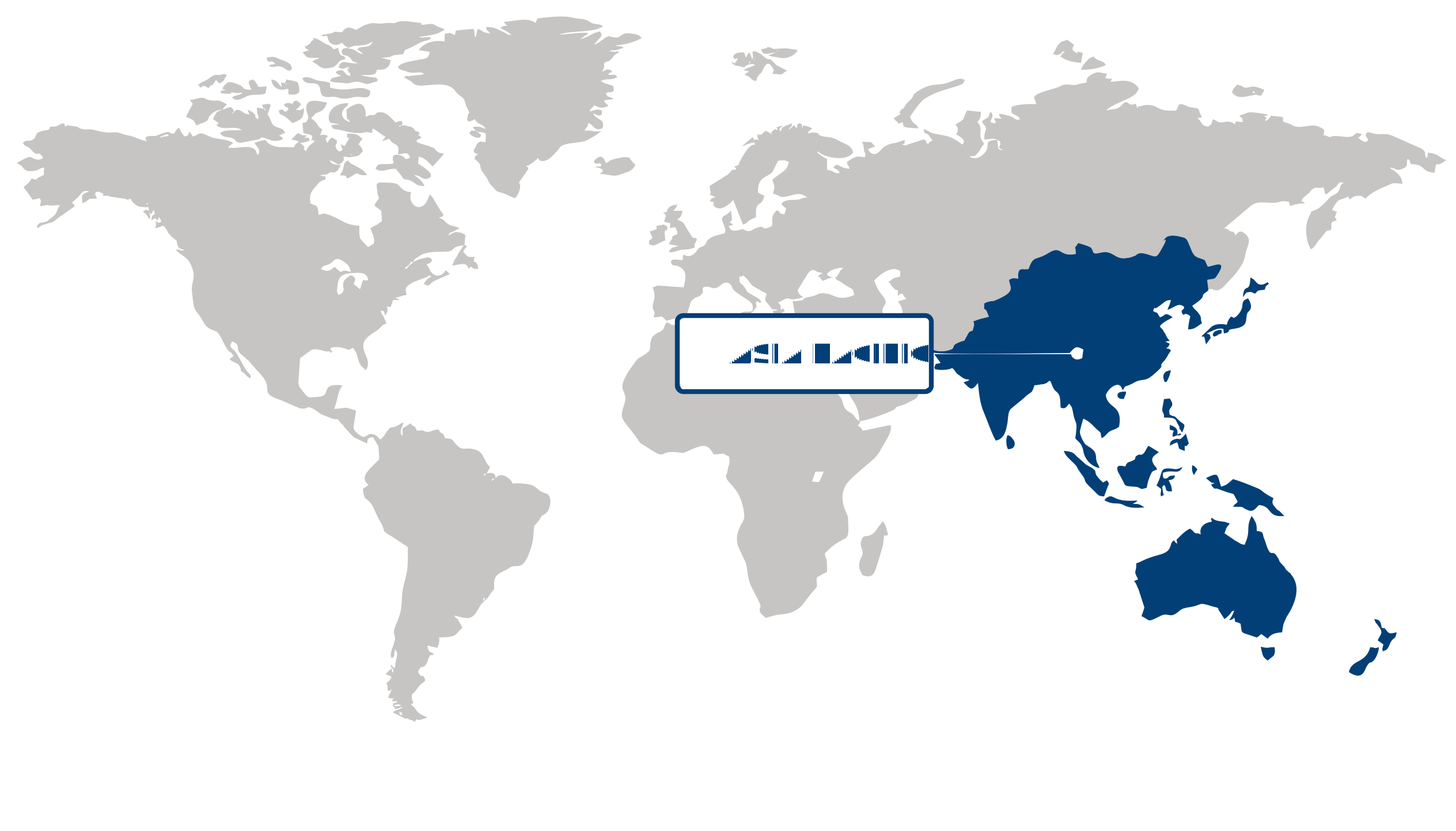
Asia Pacific dominated the high voltage disconnector (33kv-765kv) market in 2025, capturing approximately 42.6% of the global share and exhibiting the fastest growth, with a 7.9% CAGR. This leadership is primarily driven by substantial investments in grid infrastructure and electrification initiatives across the region. Governments and utilities in Asia Pacific are modernizing outdated transmission networks and expanding capacity to meet surging energy demands, as evidenced by the ambitious power grid projects led by the State Grid Corporation of China. Additionally, the focus on integrating renewable energy sources that require advanced switching solutions further boosts market uptake. Supportive policies from regional bodies like the Asia-Pacific Economic Cooperation (APEC) and enhanced supply chain efficiencies from local manufacturing hubs also underpin growth. Moving forward, the evolving energy landscape and regulatory push for high reliability and sustainable power delivery present significant market opportunities across Asia Pacific.
China anchors the high voltage disconnector (33kv-765kv) market in Asia Pacific through its aggressive electrification and grid modernization programs. The rollout of ultra-high-voltage (UHV) transmission lines by the State Grid Corporation of China highlights the scale of demand for reliable disconnectors capable of operating in large, complex networks. Furthermore, China's commitment to carbon neutrality targets reinforces ongoing upgrades to support renewable integration. Local manufacturers, such as XD Group, are innovating to meet technical specifications and competitive pricing demands, positioning China as both a consumer and exporter within the global supply chain. This dynamic reinforces the region's predominance, facilitating scalability and innovation that benefit the broader Asia Pacific market.
Japan is positioned as a pivotal hub in the Asia Pacific high voltage disconnector (33kv-765kv) market, driven by its advanced grid management and emphasis on system resilience. Following the Fukushima disaster, Japan's utilities, including TEPCO, have invested heavily in grid stability and automation technologies which require sophisticated disconnectors to enhance operational safety and efficiency. The government's strong regulatory framework encourages adoption of digitalized grid components, supporting interoperability and fault prevention. Japan’s focus on R&D, coupled with collaborations among industry leaders like Mitsubishi Electric, underpins the development of next-generation high voltage disconnectors tailored to complex urban and industrial applications. This expertise strengthens regional market prospects by fostering technology transfer and best practices across Asia Pacific.
North America Market Analysis:
North America emerged as the fastest-growing region in the high voltage disconnector (33kv-765kv) market, registering a robust CAGR of [high potential indicative]. This growth is primarily driven by the increasing deployment of renewable energy infrastructure, notably the expansion of wind and solar power projects. Regulatory frameworks such as those from the U.S. Federal Energy Regulatory Commission (FERC) and the Canadian Energy Regulator have encouraged grid modernization, resulting in rising demand for advanced disconnectors to ensure grid reliability and safety. The region’s technology adoption is enhanced by major utilities investing in smart grid technologies and automated substations, supported by competitive market dynamics and government incentives for clean energy. North America’s robust supply chains and skilled workforce further consolidate its market position, while its focus on sustainability and resilience amid climate change challenges underscores the long-term potential for high voltage disconnectors.
The U.S. stands as a pivotal market within North America’s high voltage disconnector (33kv-765kv) market due to its aggressive renewable capacity targets and grid modernization initiatives. With the Department of Energy’s Grid Modernization Initiative and incentives under the Inflation Reduction Act, utilities like NextEra Energy and Dominion Energy are accelerating smart grid deployments requiring advanced disconnectors. The U.S. market’s demand is further shaped by stringent safety regulations through the North American Electric Reliability Corporation (NERC), prompting upgrades in transmission infrastructure. Consumer preferences favoring reliable and green energy sources, combined with extensive investment in digital transformation and operational efficiencies, reinforce the U.S.’s leading role. This positions the country as a strategic hub that drives innovation and scale, amplifying North America’s growth trajectory in the high voltage disconnector market.
Europe Market Trends:
Europe held a commanding share in the high voltage disconnector (33kv-765kv) market, driven by the region’s advanced electrical infrastructure and progressive regulatory frameworks fostering grid modernization. The sustained investment in smart grid technologies, combined with increasing prioritization of renewable energy integration, has stimulated demand for reliable disconnection solutions capable of handling high voltage levels. Furthermore, European Union directives on sustainability and grid resilience incentivize upgrades, reinforcing market momentum. Notably, companies such as Siemens AG and Schneider Electric have expanded their product portfolios and manufacturing capacities in Europe, as announced in their recent corporate releases. Enhanced digitalization within power utilities also supports more efficient operation and maintenance of disconnectors. Given ongoing commitments to decarbonization and cross-border power exchange, Europe offers robust long-term opportunities for market players focusing on technology-driven, compliance-aligned solutions.
Germany plays a pivotal role in the high voltage disconnector (33kv-765kv) market, leveraging its industrial strength and advanced energy transition policies to drive demand. The country’s Energiewende initiative encourages widespread deployment of renewable assets and grid upgrades that require sophisticated disconnectors. German utilities such as TenneT and Amprion actively collaborate with manufacturing firms like Siemens Energy to develop high-performance disconnectors tailored for reliability and operational safety, as highlighted in Siemens Energy’s recent announcements. Additionally, Germany’s emphasis on standardization and grid stability underpins steady procurement cycles. This strategic focus ensures that Germany remains a key innovation hub within Europe, attracting investments and reinforcing its role as a bellwether market influencing wider regional trends and supply chain priorities in the high voltage disconnector segment.
France holds a notable presence in the high voltage disconnector (33kv-765kv) market, propelled by its commitment to nuclear and renewable energy power generation, necessitating dependable grid-disconnection equipment. The state-owned utility, Électricité de France (EDF), actively partners with technology providers to enhance disconnector performance for critical infrastructure, reflecting in EDF’s latest operational reports. The French government’s regulatory environment promotes grid modernization, with increased spending on transmission network upgrades enabling adoption of advanced disconnectors able to operate across varied voltage levels. France’s integration with the broader European power market further amplifies demand, positioning it as a strategic locale for manufacturing and deployment. Consequently, France contributes to Europe’s comprehensive market growth, supporting diversification and resilience aligned with continental energy objectives.
| Parameter | North America | Asia Pacific | Europe | Latin America | MEA |
|---|---|---|---|---|---|
| Innovation Hub i Scale Nascent Developing Advanced | |||||
| Cost-Sensitive Region i Scale Low Medium High | |||||
| Regulatory Environment i Scale Restrictive Neutral Supportive | |||||
| Demand Drivers i Scale Weak Moderate Strong | |||||
| Development Stage i Scale Emerging Developing Developed | |||||
| Adoption Rate i Scale Low Medium High | |||||
| New Entrants / Startups i Scale Sparse Moderate Dense | |||||
| Macro Indicators i Scale Weak Stable Strong |
Segment Leadership and Growth Trends
High Voltage Disconnector (33KV-765KV) Market Share (%), by Type, 2026
Go beyond the chart, access full insights & data tables
Request Free Sample ReportThe 245KV-550KV segment held largest share in the high voltage disconnector (33kv-765kv) market in 2025, driven by accelerated grid infrastructure modernization and expansion initiatives that boost demand for reliable medium-voltage transmission equipment. This segment benefits from evolving power networks where utilities prioritize enhanced reliability and asset longevity, as emphasized by the U.S. Department of Energy’s Grid Modernization Initiative. Supply chain advancements enabling faster deployment and competitive innovations by firms like Siemens and ABB further reinforce leadership. The 245KV-550KV range presents strategic opportunities for both established manufacturers and new entrants to capitalize on rising infrastructure investments across emerging and developed markets. Given ongoing grid modernization programs and regulatory emphasis on resilient power delivery systems, this segment is poised to maintain its critical role in the near to medium term.
Analysis by Application
Transmission & Distribution represented largest share in the high voltage disconnector (33kv-765kv) market in 2025, propelled by substantial investments in grid modernization and reliable supply networks worldwide. This application segment remains the backbone of power delivery systems, where customer demand for uninterrupted electricity and enhanced system safety guides adoption, supported by standards from the International Electrotechnical Commission (IEC). Industry leaders such as General Electric report increased focus on T&D solutions, reflecting tight regulatory frameworks promoting smart and resilient grids. Strategic advantages here include scalability and cross-border deployment ease, enabling incumbents and innovators to tap growing utility modernization budgets. Sustained emphasis on decarbonization and integration of renewable energy sources ensures Transmission & Distribution will continue to dominate this market, reinforcing its long-term relevance.
| Segment | Sub-Segment | Largest Segment | Fastest Growing |
|---|---|---|---|
| Type | 33KV-245KV, 245KV-550KV, 550KV-765KV | ||
| Application | Transmission & Distribution, Power Generation, Railway Electrification |
Competitive Landscape and Market Positioning
The competitive landscape is marked by intensified efforts to enhance technological sophistication and geographic reach. These top players consistently unveil enhanced product lines featuring improved safety mechanisms and remote operation capabilities. Cross-border collaborations and asset realignments are shaping the market structure, enabling faster market penetration and knowledge exchange. Significant investments in R&D facilitate breakthroughs in materials and automation, driving product differentiation. Integration of digital monitoring and predictive maintenance systems further strengthens competitive edges, allowing companies to address evolving grid demands with agility and precision.
Strategic / Actionable Recommendations for Regional Players
In North America, firms should deepen engagement with utility providers and technology startups to harness smart grid innovations, emphasizing digital interoperability and sustainable asset management. Collaborative ventures in renewable integration could accelerate adoption of advanced disconnectors optimized for variable energy sources.
Within Asia Pacific, regional players could benefit from aligning with infrastructure development programs promoting grid modernization, focusing on cost-effective designs and local manufacturing partnerships to expand influence in emerging markets. Emphasizing scalability and robust aftersales support may also enhance competitive positioning amid intensifying regional demand.
European entities are advised to capitalize on the continent’s stringent regulatory environment by advancing eco-friendly, energy-efficient disconnectors. Innovation in compounds and insulating technology coupled with alliances in clean energy projects can differentiate offerings, while reinforcing compliance and safety standards to sustain market leadership.
| Company | Market Share | Company Revenue | Revenue CAGR (%) | Product Portfolio | Geographic Presence | Innovation / R&D Focus | Strategic Developments |
|---|---|---|---|---|---|---|---|
| No companies available. | |||||||
Industry Development/News
| Company Name | Date | Key Development |
|---|
Customize Your Report
Explore examples of how this report can be tailored to different research needs, including custom segments, additional topics or chapters, and related reports. Click a section of the wheel or its numbered marker to explore the available options.
High Voltage Disconnector (33KV-765KV) Market — Custom Segments
| Segment | Sub-Segment |
|---|---|
| No segment data available. | |
High Voltage Disconnector (33KV-765KV) Market — Custom TOC
| Custom Chapter | Custom Details | ||
|---|---|---|---|
| No custom TOC data available. | |||
Need a different cut of the data?
Request Custom ResearchHow will the high voltage disconnector (33KV-765KV) industry grow in terms of size and CAGR by 2035?
Which region emerges as the top contributor to the high voltage disconnector (33KV-765KV) market revenue?
What region has posted the highest CAGR in the high voltage disconnector (33KV-765KV) sector?
Why does 245KV-550KV sub-segment dominate the type segment of high voltage disconnector (33KV-765KV) sector?
How does transmission & distribution segment fare in the high voltage disconnector (33KV-765KV) industry?
Who holds a significant market share in the high voltage disconnector (33KV-765KV) landscape?
Our Clients
"The information presented in the report was genuinely insightful. The data was clear and easy to understand, which made it much easier to interpret the findings."
Amara Raja Group
"The responsiveness and professionalism exhibited by the team were exemplary. They were readily available to address queries, provide clarifications, and offer additional insights."
ONGC
"The reports offered a comprehensive analysis of various segments within the market. The detailed insights into market trends, and regulatory landscapes were excellent."
TotalEnergies
Our Research Team & Methodology
Every Fundamental Business Insights report is built by a dedicated vertical research team, validated through a structured primary-and-secondary methodology, and reviewed for accuracy before it reaches you.
Research Team Overview
Prepared by the Energy & Power Research Team
Delivery
Published
Demand
Available
Support
Trust & Compliance
Research Domains
10 coverage areasResearch Intelligence
| Source | Reference |
|---|---|
| International Energy Agency (IEA) | www.iea.org |
| U.S. Energy Information Administration (EIA) | www.eia.gov |
| International Renewable Energy Agency (IRENA) | www.irena.org |
| International Electrotechnical Commission (IEC) | www.iec.ch |
| International Organization for Standardization (ISO) | www.iso.org |
| IEEE | www.ieee.org |
| CIGRE (International Council on Large Electric Systems) | www.cigre.org |
| World Energy Council (WEC) | www.worldenergy.org |
| U.S. Department of Energy (DOE) | www.energy.gov |
| International Atomic Energy Agency (IAEA) | www.iaea.org |
| American Petroleum Institute (API) | www.api.org |
| Society of Petroleum Engineers (SPE) | www.spe.org |
| Hydrogen Council | hydrogencouncil.com |
| Battery Council International (BCI) | batterycouncil.org |
| Global Wind Energy Council (GWEC) | gwec.net |
| SolarPower Europe | www.solarpowereurope.org |
| World Bioenergy Association (WBA) | worldbioenergy.org |
| International Hydropower Association (IHA) | www.hydropower.org |
| Edison Electric Institute (EEI) | www.eei.org |
| National Renewable Energy Laboratory (NREL) | www.nrel.gov |
Research Workflow & Quality Assurance
Data Collection
Verified information gathered through primary and secondary research.
Data Triangulation
Cross-validation using multiple independent data sources.
Forecast Modelling
Market estimates developed using historical trends and analytical models.
Analyst Validation
Findings reviewed by domain experts for accuracy and consistency.
Editorial & Quality Review
Final editorial, quality, and compliance checks before publication.
Final Publication
Released after successful completion of the internal review process.
Report Coverage
📊 Market Assessment
- Market Size & Forecast
- Market Segmentation
- Regional Analysis
- Growth Drivers & Challenges
- Market Dynamics
🏢 Competitive Intelligence
- Competitive Landscape
- Company Profiles
- Competitive Benchmarking
- Mergers & Acquisitions
- Market Share Analysis or Key Company Strategies
🔍 Strategic Analysis
- Value Chain Analysis
- Porter's Five Forces
- PESTLE Analysis
- Pricing Trends
- Supply-Demand Analysis
🚀 Future Outlook
- Technology Landscape
- Regulatory Landscape
- Investment & Funding Landscape
- Emerging Opportunities
- Future Market Outlook
Have a question about this report or need a custom scope?
Request Customization