Heat Sealable Packaging Market Size & Growth Forecast 2027–2036, By Segments (Material Type, Type, Application, End Use Industry), Regional Demand Trends (North America, Asia Pacific, Europe), Key Country Insights (U.S., Japan, South Korea, Germany, France, Italy), and Competitive Landscape
Market Size and Growth Outlook
Heat Sealable Packaging Market size was assessed at USD 201.45 Billion in 2026 and is poised to grow at 5.4% CAGR between 2027 and 2036, attaining USD 340.86 Billion by 2036. The industry revenue for 2027 is calculated at USD 210.52 Billion.
Get more details on this report
Request Free Sample ReportHeat Sealable Packaging Market Intelligence Snapshot
Regional Market Dynamics
- Asia Pacific held 38.88% in 2026, driven by expanding food, beverage, pharmaceutical, and consumer goods industries and growing demand for efficient packaging formats.
- North America is projected to grow fastest as demand for packaged foods, healthcare products, material efficiency, recyclability, and flexible packaging innovation increases.
Segment Momentum
- Pouches lead the market because they combine lightweight construction, flexible design, and efficient material use with secure heat-sealed closures that protect products from leakage, contamination, and external exposure.
- Paper is the fastest-growing material segment as sustainability goals and advances in coatings and barrier technologies improve the performance of heat-sealable paper for a wider range of packaging applications.
Market Expansion Drivers
- Rising food and beverage demand driving heat-sealable packaging adoption for freshness and safety
- Growth of e-commerce logistics increasing demand for durable and tamper-proof packaging solutions
- Sustainability-focused packaging innovations driving recyclable and low-plastic heat seal material development
Leading Market Participants
- Leading players in the heat sealable packaging market include Amcor plc (Switzerland), Berry Global Inc. (United States), Mondi Group (United Kingdom), Huhtamaki Oyj (Finland), Constantia Flexibles Group GmbH (Austria), ProAmpac LLC (United States), Coveris Holdings S.A. (Luxembourg), Glenroy Inc. (United States), Jindal Poly Films Ltd. (India), UPM-Kymmene Corporation (Finland)
Global Market Forecast Snapshot
Market Outlook
- 2026 Market Size: USD 201.45 Billion
- 2027 Estimated Market Size: USD 210.52 Billion
- Projected Market Size: USD 340.86 Billion by 2036
- Growth Forecast: 5.4% CAGR (2027-2036)
Regional and Segment Outlook
- Leading Regional Market: Asia Pacific
- High-Growth Regional Hub: North America
- Core Revenue Segment: Plastic (Material Type) | Impulse Sealing (Type) | Pouches (Application) | Food and Beverage (End Use Industry)
- Emerging Opportunity Segment: Paper (Material Type) | Clam Shell Sealing (Type) | Films (Application) | Pharmaceuticals (End Use Industry)
Market Growth Drivers and Industry Trends
Rising food and beverage demand driving heat-sealable packaging adoption for freshness and safety
Increasing consumption of packaged food and beverages is creating stronger requirements for packaging formats that preserve product quality and extend usability. The heat sealable packaging market growth is supported by manufacturers adopting heat-sealing technologies to provide secure closures, prevent contamination, and maintain freshness throughout storage and distribution. These packaging solutions offer reliable protection for a wide range of products, including ready-to-eat foods, beverages, and processed items where maintaining hygiene and shelf stability is essential.
Growth of e-commerce logistics increasing demand for durable and tamper-proof packaging solutions
Expansion of online retail channels is increasing pressure on packaging systems to withstand transportation challenges while ensuring product security. The heat sealable packaging market is benefiting from e-commerce growth as businesses require packaging solutions with stronger seals, improved resistance to handling damage, and visible tamper protection. Heat-sealed formats support efficient logistics operations by reducing leakage risks and maintaining package integrity across complex delivery networks.
Sustainability-focused packaging innovations driving recyclable and low-plastic heat seal material development
Growing environmental concerns are encouraging packaging manufacturers to develop more sustainable heat-sealing materials that reduce waste while maintaining functional performance. Sustainability-driven innovations will accelerate heat sealable packaging market adoption as companies explore recyclable structures, lightweight materials, and reduced-plastic alternatives. These advancements help address changing consumer expectations and regulatory pressures while allowing manufacturers to preserve the protective benefits associated with heat-sealed packaging formats.
| Growth Driver | Impact on CAGR | Regulatory Influence | Geographic Relevance | Adoption Rate | Impact Timeline |
|---|---|---|---|---|---|
| Rising food and beverage demand driving heat-sealable packaging adoption for freshness and safety | 2.1% | Moderate | Asia Pacific, North America | High | Near Term |
| Growth of e-commerce logistics increasing demand for durable and tamper-proof packaging solutions | 1.8% | Moderate | North America, Europe | High | Mid Term |
| Sustainability-focused packaging innovations driving recyclable and low-plastic heat seal material development | 1.6% | High | Europe, North America | High | Mid Term |
Unlock insights tailored to your business with our bespoke market research solutions.
Click to get your customized report now.
Regional Demand Dynamics
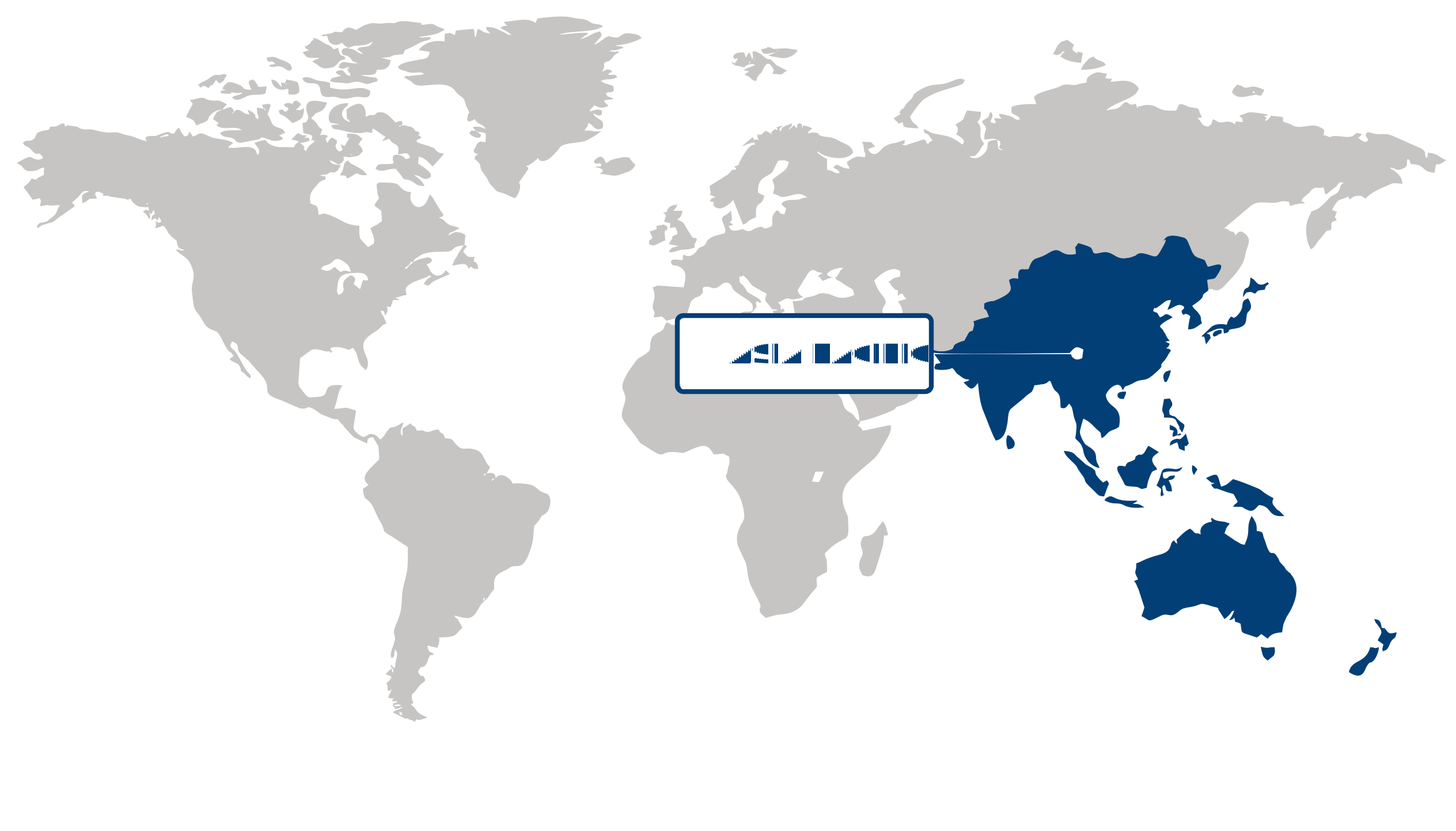
Asia Pacific (Largest Region)
Asia Pacific accounted for 38.88% of the heat sealable packaging market in 2026, reflecting strong demand from the region’s expanding food, beverage, pharmaceutical, and consumer goods industries. Rapid industrialization, urbanization, and the growth of organized retail are increasing the need for packaging formats that provide efficient sealing, product protection, and handling convenience. Manufacturers are also placing greater emphasis on lightweight and adaptable packaging solutions, supporting wider use of heat sealable materials across flexible and multilayer packaging applications.
North America (Fastest-Growing Region)
North America is expected to experience the fastest growth as manufacturers and retailers increasingly prioritize packaging efficiency, product protection, and material optimization. Demand for convenient packaged foods, healthcare products, and consumer goods is supporting the use of heat sealable formats, while sustainability considerations are encouraging packaging producers to improve material efficiency and recyclability. Continued innovation in flexible packaging structures and sealing technologies is creating additional opportunities for regional market expansion.
| Parameter | North America | Asia Pacific | Europe | Latin America | MEA |
|---|---|---|---|---|---|
| Innovation Hub i Scale Nascent Developing Advanced | |||||
| Cost-Sensitive Region i Scale Low Medium High | |||||
| Regulatory Environment i Scale Restrictive Neutral Supportive | |||||
| Demand Drivers i Scale Weak Moderate Strong | |||||
| Development Stage i Scale Emerging Developing Developed | |||||
| Adoption Rate i Scale Low Medium High | |||||
| New Entrants / Startups i Scale Sparse Moderate Dense | |||||
| Macro Indicators i Scale Weak Stable Strong |
Key Country Insights
United States 🇺🇸
Flexible Packaging InnovationThe U.S. market emphasizes high-performance heat sealable packaging for food, pharmaceuticals, and e-commerce applications. Brand owners are adopting recyclable and high-barrier materials that deliver secure sealing, longer shelf life, and compatibility with automated packaging lines.
Germany 🇩🇪
Sustainable Barrier SolutionsGermany is advancing heat sealable packaging with a focus on recyclable mono-material structures and efficient sealing technologies. Packaging manufacturers are aligning product development with circular economy objectives while maintaining product protection and processing efficiency.
Japan 🇯🇵
Precision Packaging QualityJapan prioritizes heat sealable packaging that offers consistent seal integrity for food, healthcare, and consumer goods. Manufacturers focus on material precision, compact packaging formats, and high-speed production compatibility to meet demanding quality expectations.
South Korea 🇰🇷
Consumer Packaging EnhancementSouth Korea is expanding the use of heat sealable packaging across packaged foods, cosmetics, and convenience products. Producers are investing in advanced sealing materials that improve packaging appearance, durability, and production efficiency for domestic and export markets.
France 🇫🇷
Premium Food PreservationFrance relies on heat sealable packaging to maintain freshness across processed foods, dairy products, and specialty consumer goods. Packaging suppliers are developing sustainable sealing solutions that balance product protection with evolving environmental requirements.
Italy 🇮🇹
Food Packaging PerformanceItaly's food processing sector is driving demand for heat sealable packaging with reliable sealing performance and attractive presentation. Manufacturers increasingly adopt advanced flexible packaging materials that support product quality and efficient packaging operations.
Segment Leadership and Growth Trends
Heat Sealable Packaging Market Share (%), by Material Type, 2026
Go beyond the chart, access full insights & data tables
Request Free Sample ReportMaterial Type Segment Analysis: Plastic (Largest Segment) vs Paper (Fastest-Growing Segment)
Plastic segment accounted for the largest share of the heat sealable packaging market, reaching 63.6% in 2026. Plastic materials offer strong heat-sealing performance, flexibility, lightweight characteristics, and compatibility with a wide range of packaging formats. These properties make plastic suitable for applications requiring reliable closures, product protection, and efficient high-speed packaging operations. The material's ability to support different barrier and performance requirements across food, consumer goods, and industrial packaging applications continues to reinforce its widespread use and leading market position.
Paper segment is anticipated to register the fastest growth over the forecast period. Growing emphasis on sustainable packaging solutions is encouraging manufacturers and brand owners to explore paper-based materials that can provide heat-sealing functionality while reducing reliance on conventional plastic packaging. Advances in coatings, barrier treatments, and material engineering are improving the performance of heat-sealable paper solutions, expanding their suitability across packaging applications. Increasing sustainability objectives and consumer preference for more environmentally responsible packaging are expected to further support the adoption of paper in the market.
Type Segment Analysis: Impulse Sealing (Largest Segment) vs Clam Shell Sealing (Fastest-Growing Segment)
Impulse sealing segment held the largest share of the heat sealable packaging market in 2026. The technology is widely used because it provides efficient and controlled sealing for a broad range of flexible packaging materials. Its suitability for diverse packaging operations, ease of integration into packaging equipment, and ability to create reliable closures support its continued adoption across multiple industries. The growing demand for secure, efficient, and cost-effective packaging processes is further strengthening the use of impulse sealing.
Clam shell sealing segment is expected to grow at the fastest pace over the forecast period. Clam shell packaging provides product visibility while offering protection against contamination, damage, and tampering, making it attractive for a variety of consumer and retail applications. Heat sealing enhances the integrity of these packages and can support secure closure requirements. As manufacturers seek packaging formats that combine product presentation, protection, and operational efficiency, increasing adoption of clam shell formats is expected to drive demand for this sealing technology.
Application Segment Analysis: Pouches (Largest Segment) vs Films (Fastest-Growing Segment)
Pouches segment dominated the heat sealable packaging market in 2026 and represented the largest application segment. Pouches offer lightweight construction, flexible design, efficient material utilization, and convenient handling, making them suitable for a broad range of packaged products. Heat sealing enables manufacturers to create secure closures that help protect contents from leakage, contamination, and external exposure. The continued shift toward convenient, portable, and resource-efficient packaging formats is supporting the widespread use of pouches and reinforcing their leading position.
Films segment is projected to register the fastest growth over the forecast period. Heat-sealable films provide flexibility in packaging design and can be used to create protective barriers for a wide range of products. Increasing demand for lightweight packaging and efficient material solutions is encouraging the use of films in applications requiring secure sealing and product protection. In addition, ongoing innovation in film structures and functional properties is expanding their suitability across packaging formats, supporting strong growth in this application segment.
| Segment | Sub-Segment | Largest Segment | Fastest Growing |
|---|---|---|---|
| Material Type | Plastic, Paper, Aluminum | Plastic | Paper |
| Type | Impulse Sealing, Clam Shell Sealing, Hot Bar Sealing, Others | Impulse Sealing | Clam Shell Sealing |
| Application | Pouches, Films, Trays, Others | Pouches | Films |
| End Use Industry | Food and Beverage, Consumer Goods, Pharmaceuticals, Industrial, Others | Food and Beverage | Pharmaceuticals |
Competitive Landscape and Market Positioning
Top players in the heat sealable packaging market:
- Amcor plc (Switzerland)
- Berry Global, Inc. (United States)
- Mondi Group (United Kingdom)
- Huhtamaki Oyj (Finland)
- Constantia Flexibles Group GmbH (Austria)
- ProAmpac LLC (United States)
- Coveris Holdings S.A. (Luxembourg)
- Glenroy, Inc. (United States)
- Jindal Poly Films Ltd. (India)
- UPM-Kymmene Corporation (Finland)
Packaging converters are shifting from cost-focused production toward differentiated solutions that balance sealing performance, material efficiency, and sustainability requirements. Established suppliers are expanding their capabilities through improved barrier technologies, recyclable structures, and application-specific designs to defend customer relationships as end users demand more adaptable packaging formats. Competition is increasingly shaped by the ability to integrate material innovation with manufacturing reliability, while emerging participants are finding opportunities through specialized solutions for food, healthcare, and consumer applications where performance requirements continue to evolve.
| Company | Market Share | Company Revenue | Revenue CAGR (%) | Product Portfolio | Geographic Presence | Innovation / R&D Focus | Strategic Developments |
|---|---|---|---|---|---|---|---|
| Amcor plc (Switzerland) | |||||||
| Berry Global Inc. (United States) | |||||||
| Mondi Group (United Kingdom) | |||||||
| Huhtamaki Oyj (Finland) | |||||||
| Constantia Flexibles Group GmbH (Austria) | |||||||
| ProAmpac LLC (United States) | |||||||
| Coveris Holdings S.A. (Luxembourg) | |||||||
| Glenroy Inc. (United States) | |||||||
| Jindal Poly Films Ltd. (India) | |||||||
| UPM-Kymmene Corporation (Finland) |
Industry Development/News
| Company Name | Date | Key Development |
|---|---|---|
| Delfort | Feb-25 | Delfort launched a specialized heat- and cold-sealable barrier paper tailored for temperature-sensitive applications such as ice cream and confectionery. The product offers an optimized alternative to conventional materials by providing high-performance barrier properties while supporting circular economy goals through its recyclable, lightweight fiber-based design. |
| Xeikon and Sappi | May-24 | Xeikon and Sappi collaborated to commercialize fully recyclable, paper-based candy packaging. By combining Xeikon’s TITON dry toner technology with Sappi’s heat-sealable Seal Silk paper, the partnership created a food-safe, plastic-free flexible packaging solution that eliminates the need for additional barrier layers or varnishes while maintaining high-quality print aesthetics. |
| UPM Specialty Papers | Apr-24 | UPM Specialty Papers partnered with Unipaco to introduce a recyclable, mono-material heat-sealable wrapper for salad and herb pots. The solution utilizes an ultra-thin coating on fiber-based substrates to meet stringent German 95/5 recyclability standards, demonstrating a scalable approach to replacing traditional plastic-based flexible packaging in food sectors. |
| Henkel and UPM Specialty Papers | May-23 | Henkel and UPM Specialty Papers co-developed two recyclable barrier paper solutions to advance sustainable flexible packaging. By integrating Henkel’s specialized heat-seal and barrier coatings with UPM’s fiber-based substrates, the partners delivered a turnkey solution that achieves grease resistance and heat sealability suitable for both food and non-food applications. |
Customize Your Report
Explore examples of how this report can be tailored to different research needs, including custom segments, additional topics or chapters, and related reports. Click a section of the wheel or its numbered marker to explore the available options.
Heat Sealable Packaging Market — Custom Segments
| Segment | Sub-Segment |
|---|---|
| Barrier Performance | Standard Barrier, Moisture Barrier, Oxygen Barrier, High Barrier |
| Sustainability Profile | Conventional, Recyclable, Compostable/Biodegradable, Recycled-Content |
| Automation Level | Manual, Semi-Automated, Fully Automated |
Heat Sealable Packaging Market — Custom TOC
| Custom Chapter | Custom Details |
|---|---|
| End-Use Conversion Opportunity Mapping |
|
| Material Substitution Economics |
|
| Sustainable Heat-Seal Solutions |
|
Need a different cut of the data?
Request Custom ResearchHow large is the heat sealable packaging market?
How is the heat sealable packaging industry expected to grow over the next 10 years?
How is e-commerce influencing investment in heat sealable packaging solutions?
Why are sustainable materials becoming a strategic focus in the heat sealable packaging market?
Why do pouches hold the largest share of the heat sealable packaging market?
Which material type is expected to grow the fastest in the heat sealable packaging market?
How does Asia Pacific maintain its leadership in heat sealable packaging?
Why is North America expected to see faster growth in heat sealable packaging?
Who holds a significant market share in the heat sealable packaging landscape?
Our Clients
"The report helped us understand emerging consumer trends in our product category. It clarified where to focus innovation for the next product launch."
LyondellBasell
"The regional forecast section was incredibly useful. We were able to identify two new potential partners in Europe thanks to the vendor mapping you included."
SABIC
"We appreciated how actionable the recommendations were. It guided us to improve supply chain resilience."
Olin Corporation
Our Research Team & Methodology
Every Fundamental Business Insights report is built by a dedicated vertical research team, validated through a structured primary-and-secondary methodology, and reviewed for accuracy before it reaches you.
Research Team Overview
Prepared by the Chemicals & Materials Research Team
Delivery
Published
Demand
Available
Support
Trust & Compliance
Research Domains
10 coverage areasResearch Intelligence
| Source | Reference |
|---|---|
| American Chemistry Council (ACC) | www.americanchemistry.com |
| European Chemical Industry Council (Cefic) | cefic.org |
| International Council of Chemical Associations (ICCA) | icca-chem.org |
| European Chemicals Agency (ECHA) | echa.europa.eu |
| U.S. Environmental Protection Agency (EPA) | www.epa.gov |
| ASTM International | www.astm.org |
| International Organization for Standardization (ISO) | www.iso.org |
| National Institute of Standards and Technology (NIST) | www.nist.gov |
| Plastics Industry Association (PLASTICS) | www.plasticsindustry.org |
| European Biplastics | www.european-bioplastics.org |
| The Adhesive and Sealant Council (ASC) | www.ascouncil.org |
| National Association of Corrosion Engineers (AMPP) | www.ampp.org |
| Society of Plastics Engineers (SPE) | www.4spe.org |
| International Fertilizer Association (IFA) | www.fertilizer.org |
| CropLife International | croplife.org |
| Packaging Europe | packagingeurope.com |
| Flexible Packaging Association (FPA) | www.flexpack.org |
| Battery Council International (BCI) | batterycouncil.org |
| International Copper Association (ICA) | internationalcopper.org |
| World Steel Association | worldsteel.org |
Research Workflow & Quality Assurance
Data Collection
Verified information gathered through primary and secondary research.
Data Triangulation
Cross-validation using multiple independent data sources.
Forecast Modelling
Market estimates developed using historical trends and analytical models.
Analyst Validation
Findings reviewed by domain experts for accuracy and consistency.
Editorial & Quality Review
Final editorial, quality, and compliance checks before publication.
Final Publication
Released after successful completion of the internal review process.
Report Coverage
📊 Market Assessment
- Market Size & Forecast
- Market Segmentation
- Regional Analysis
- Growth Drivers & Challenges
- Market Dynamics
🏢 Competitive Intelligence
- Competitive Landscape
- Company Profiles
- Competitive Benchmarking
- Mergers & Acquisitions
- Market Share Analysis or Key Company Strategies
🔍 Strategic Analysis
- Value Chain Analysis
- Porter's Five Forces
- PESTLE Analysis
- Pricing Trends
- Supply-Demand Analysis
🚀 Future Outlook
- Technology Landscape
- Regulatory Landscape
- Investment & Funding Landscape
- Emerging Opportunities
- Future Market Outlook
Have a question about this report or need a custom scope?
Request Customization