Healthcare Smart Card Reader Market Size & Growth Forecast 2027–2036, By Segments (Application, Interface Type, End-Use), Regional Demand Trends (North America, Asia Pacific, Europe), Key Country Insights (U.S., Japan, South Korea, Germany, France, Italy), and Competitive Landscape
Market Size and Growth Outlook
Healthcare Smart Card Reader Market size was over USD 1.45 billion in 2026 and is likely to grow at a 13.97% CAGR between 2027 and 2036, reaching USD 5.36 billion by 2036. The industry revenue for 2027 is assessed at USD 1.62 billion.
Get more details on this report
Request Free Sample ReportHealthcare Smart Card Reader Market Intelligence Snapshot
Regional Market Dynamics
- Europe leads through established healthcare digitization, widespread secure patient identification systems, and routine smart card integration across hospitals, clinics, and public health networks.
- Asia Pacific is projected to expand at a 16.24% CAGR as healthcare digitization accelerates, electronic health infrastructure expands, and providers adopt secure authentication for connected patient management.
Segment Momentum
- Identity & Other Sensitive Information Management held a 57.75% share in 2026 due to its routine role in patient identification, records access, and secure authentication workflows embedded across daily healthcare operations.
- Dual Interface-based is the fastest-growing interface type because it supports both contact and contactless interactions, improving compatibility across mixed healthcare infrastructures and easing technology transitions.
Market Expansion Drivers
- Increasing healthcare data security requirements driving deployment of secure smart card authentication systems.
- Rising adoption of electronic health records strengthening demand for contactless healthcare smart card readers.
- Expanding digital patient billing and verification systems accelerating healthcare payment authentication infrastructure.
Leading Market Participants
- Major companies in the healthcare smart card reader market include Thales Group (France), IDEMIA (France), HID Global Corporation (United States), Zebra Technologies Corporation (United States), NXP Semiconductors N.V. (Netherlands), Worldline SA (France), Advanced Card Systems Ltd. (Hong Kong), Identiv, Inc. (United States), FEITIAN Technologies Co., Ltd. (China), ELATEC GmbH (Germany).
Global Market Forecast Snapshot
Market Outlook
- 2026 Market Size: USD 1.45 billion
- 2027 Estimated Market Size: USD 1.62 billion.
- Projected Market Size: USD 5.36 billion by 2036
- Growth Forecast: 13.97% CAGR (2027-2036)
Regional and Segment Outlook
- Leading Regional Market: Europe
- High-Growth Regional Hub: Asia Pacific
- Core Revenue Segment: Identity & Other Sensitive Information Management (Application) | Contactless-based (Interface Type) | General Practitioners & Patients (End-Use)
- Emerging Opportunity Segment: Security & Access Management (Application) | Dual Interface-based (Interface Type) | General Practitioners & Patients (End-Use)
Market Growth Drivers and Industry Trends
Increasing healthcare data security requirements driving deployment of secure smart card authentication systems
Increasing requirements for healthcare data security are strengthening adoption of secure authentication solutions, supporting growth in the healthcare smart card reader market. Healthcare organizations require reliable methods for controlling access to sensitive information and validating user identities, creating greater demand for smart card-based authentication systems that can be integrated into secure digital workflows and access management processes.
Rising adoption of electronic health records strengthening demand for contactless healthcare smart card readers
The expansion of electronic health records is creating broader opportunities for the healthcare smart card reader market as healthcare providers increasingly rely on digital systems to manage patient information. Contactless smart card readers can support secure user authentication within these electronic environments, enabling healthcare personnel to access digital records through more streamlined authentication processes while maintaining controlled access to sensitive data.
Expanding digital patient billing and verification systems accelerating healthcare payment authentication infrastructure
Expansion of digital patient billing and verification systems is increasing the need for dependable authentication infrastructure, supporting the healthcare smart card reader market. As healthcare payment processes become more digitally managed, smart card readers can facilitate identity and payment verification within connected workflows, helping organizations strengthen authentication procedures across billing and patient verification activities.
| Growth Driver | Impact on CAGR | Regulatory Influence | Geographic Relevance | Adoption Rate | Impact Timeline |
|---|---|---|---|---|---|
| Growing adoption of smart card solutions in healthcare | 5.00% | Short term (≤ 2 yrs) | North America, Europe (spillover: Asia Pacific) | Medium | Fast |
| Integration with electronic medical records and security systems | 5.00% | Medium term (2–5 yrs) | Europe, Asia Pacific (spillover: North America) | Medium | Moderate |
| Expansion in hospital and clinic deployments | 4.50% | Long term (5+ yrs) | North America, Europe (spillover: Asia Pacific) | Medium | Slow |
| Increasing healthcare data security requirements driving deployment of secure smart card authentication systems | 2.00% | High | Europe, North America | High | Near Term |
| Rising adoption of electronic health records strengthening demand for contactless healthcare smart card readers | 1.80% | High | North America, Asia Pacific | High | Mid Term |
| Expanding digital patient billing and verification systems accelerating healthcare payment authentication infrastructure | 1.30% | Moderate | Europe, Asia Pacific | Medium | Mid Term |
Unlock insights tailored to your business with our bespoke market research solutions.
Click to get your customized report now.
Regional Demand Dynamics
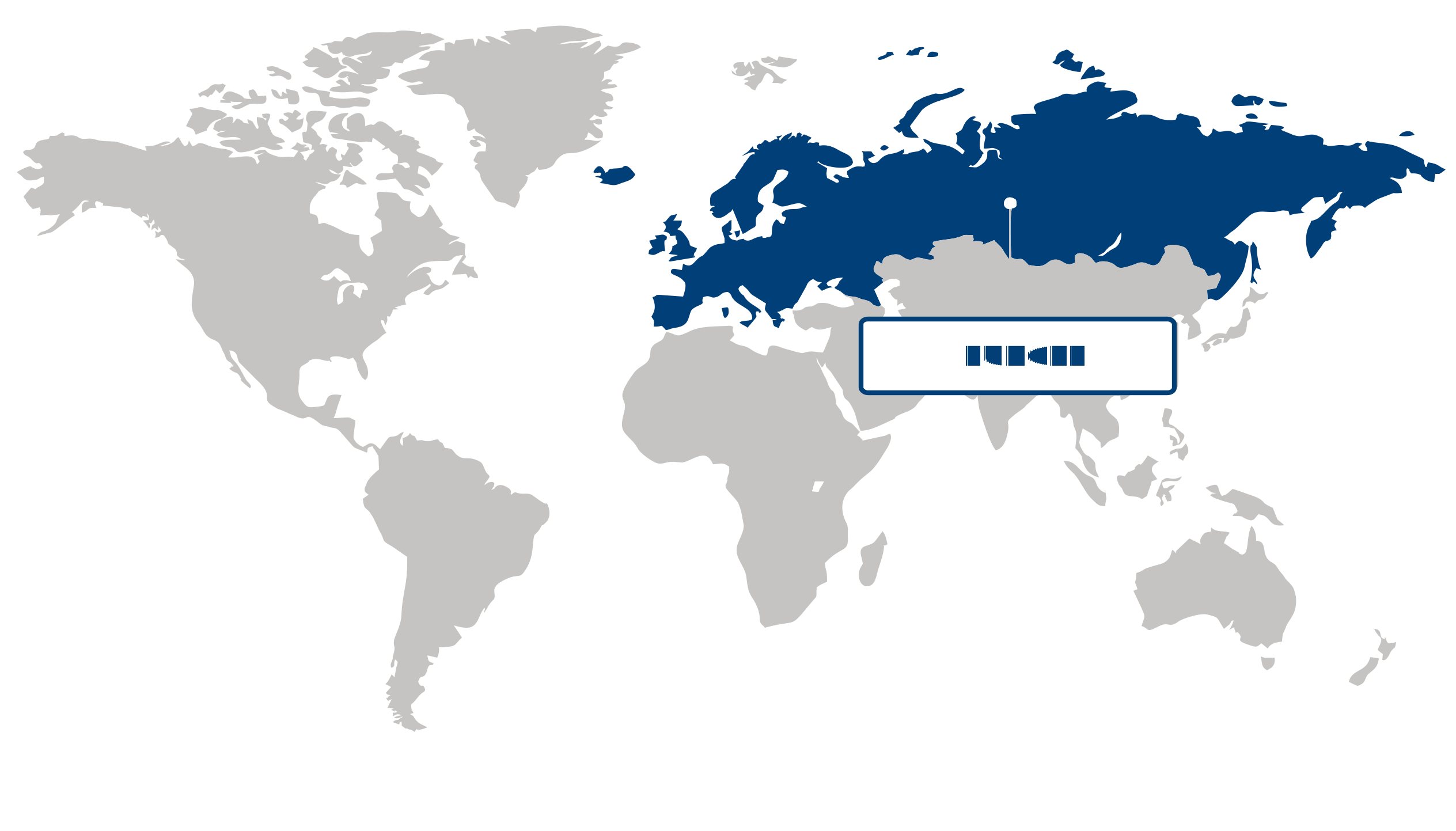
Europe (Largest Region)
Europe dominated the healthcare smart card reader market in 2026, supported by established digital healthcare infrastructure, strong emphasis on patient data security, and increasing adoption of electronic health management systems. Smart card readers are used to support secure identification, authentication, and access to sensitive healthcare information, making them relevant to hospitals, clinics, pharmacies, insurance processes, and other healthcare environments. The region’s focus on data privacy and secure handling of medical information is encouraging healthcare organizations to strengthen authentication mechanisms and protect access to digital records. Ongoing healthcare digitization is also increasing the need for reliable identity-management technologies that can integrate with electronic healthcare workflows. Investments in secure information systems and interoperability are further supporting adoption of smart card reader technologies across healthcare settings.
Asia Pacific (Fastest-Growing Region)
Asia Pacific is the fastest-growing region for the healthcare smart card reader market, driven by expanding digital healthcare infrastructure, increasing adoption of electronic medical records, and modernization of healthcare administration. As hospitals and healthcare providers transition toward digitally connected systems, secure patient and professional identification is becoming increasingly important for controlling access to medical information and services. Government-led digital health initiatives and investments in hospital information systems are creating additional opportunities for smart card-based authentication technologies. Growing concerns surrounding healthcare data security are also encouraging providers to adopt stronger identity verification and access-control solutions. The expansion of organized healthcare facilities and increasing integration of digital technologies into clinical and administrative processes are expected to support rapid market development across the region.
| Parameter | North America | Asia Pacific | Europe | Latin America | MEA |
|---|---|---|---|---|---|
| Innovation Hub i Scale Nascent Developing Advanced | |||||
| Cost-Sensitive Region i Scale Low Medium High | |||||
| Regulatory Environment i Scale Restrictive Neutral Supportive | |||||
| Demand Drivers i Scale Weak Moderate Strong | |||||
| Development Stage i Scale Emerging Developing Developed | |||||
| Adoption Rate i Scale Low Medium High | |||||
| New Entrants / Startups i Scale Sparse Moderate Dense | |||||
| Macro Indicators i Scale Weak Stable Strong |
Key Country Insights
Germany 🇩🇪
Secure Health InfrastructureGermany continues to advance healthcare smart card reader adoption through the digitalization of health insurance and patient information systems. Demand is centered on interoperable solutions that support secure access to medical data and compliance with stringent privacy requirements.
France 🇫🇷
Healthcare Access ModernizationFrance is modernizing patient access and reimbursement systems through wider use of healthcare smart card technologies. Healthcare organizations are investing in readers that enhance administrative efficiency and support secure handling of patient and insurance information.
Italy 🇮🇹
Administrative Efficiency SolutionsItaly is gradually strengthening healthcare digital infrastructure, creating demand for smart card readers that simplify patient registration and data verification processes. Market activity is focused on technologies that improve interoperability and reduce administrative complexity in healthcare facilities.
Japan 🇯🇵
Aging Care DigitizationJapan is integrating healthcare smart card readers into healthcare infrastructure to improve patient identification and administrative efficiency in an aging society. Providers are prioritizing technologies that simplify access to medical records and support coordinated care delivery.
South Korea 🇰🇷
Connected Healthcare SystemsSouth Korea's healthcare sector is adopting smart card reader technologies to facilitate digital patient services and secure information exchange. The market increasingly favors compact and integrated devices that can support expanding electronic healthcare ecosystems.
United States 🇺🇸
Digital Identity IntegrationThe U.S. healthcare smart card reader market is expanding alongside investments in secure patient identification and electronic health record access. Healthcare providers are deploying card-based authentication technologies to strengthen data security and streamline administrative workflows across care settings.
Segment Leadership and Growth Trends
Healthcare Smart Card Reader Market Share (%), by Application, 2026
Go beyond the chart, access full insights & data tables
Request Free Sample ReportApplication Segment Analysis: Identity & Other Sensitive Information Management (Largest Segment) vs Security & Access Management (Fastest-Growing Segment)
Identity & other sensitive information management held the largest share of the healthcare smart card reader market at 57.75% in 2026, supported by the growing need to securely authenticate patients, healthcare professionals, and authorized personnel while protecting sensitive medical information. Smart card readers enable controlled access to digital health records and identity credentials, strengthening data security and supporting compliance requirements as healthcare organizations increasingly transition toward interconnected digital information systems.
Security & access management is the fastest-growing application as healthcare facilities place greater emphasis on preventing unauthorized entry to systems, restricted areas, and sensitive resources. Smart card-based authentication provides an additional layer of identity verification, while increasing cybersecurity risks and the expansion of digitally connected healthcare infrastructure are encouraging providers to adopt more secure access-control mechanisms.
Interface Type Segment Analysis: Contactless-based (Largest Segment) vs Dual Interface-based (Fastest-Growing Segment)
Contactless-based smart card readers accounted for a 28.19% share of the healthcare smart card reader market in 2026, reflecting their convenience, rapid authentication, and suitability for healthcare environments where minimizing physical contact is important. Their ease of use supports applications involving patient identification, staff authentication, and secure access, while contactless workflows can improve operational efficiency at busy healthcare facilities.
The dual interface-based segment is advancing rapidly as healthcare organizations seek flexible authentication technologies that can support both contact and contactless smart card interactions. This versatility enables institutions to accommodate varied credential formats while maintaining secure identification processes, making dual-interface solutions increasingly relevant as healthcare systems modernize their access and identity infrastructure.
| Segment | Sub-Segment | Largest Segment | Fastest Growing |
|---|---|---|---|
| Application | Identity & Other Sensitive Information Management, Security & Access Management | Identity & Other Sensitive Information Management | Security & Access Management |
| Interface Type | Contact-based, Contactless-based, Dual Interface-based, Others | Contactless-based | Dual Interface-based |
| End-Use | General Practitioners & Patients, Other End-Use | General Practitioners & Patients | General Practitioners & Patients |
Competitive Landscape and Market Positioning
Top players in the healthcare smart card reader market:
1. Thales Group (France)
2. IDEMIA (France)
3. HID Global Corporation (United States)
4. Zebra Technologies Corporation (United States)
5. NXP Semiconductors N.V. (Netherlands)
6. Worldline SA (France)
7. Advanced Card Systems Ltd. (Hong Kong)
8. Identiv Inc. (United States)
9. FEITIAN Technologies Co. Ltd. (China)
10. ELATEC GmbH (Germany)
The healthcare smart card reader market is expanding due to rising demand for secure patient data access and authentication systems. Advanced biometric and encryption technologies are improving data protection and system reliability. Continuous innovation is enhancing interoperability across healthcare systems, while compliance requirements are shaping secure digital identity solutions.
| Company | Market Share | Company Revenue | Revenue CAGR (%) | Product Portfolio | Geographic Presence | Innovation / R&D Focus | Strategic Developments |
|---|---|---|---|---|---|---|---|
| Thales Group (France) | |||||||
| IDEMIA (France) | |||||||
| HID Global Corporation (United States) | |||||||
| Zebra Technologies Corporation (United States) | |||||||
| NXP Semiconductors N.V. (Netherlands) | |||||||
| Worldline SA (France) | |||||||
| Advanced Card Systems Ltd. (Hong Kong) | |||||||
| Identiv Inc. (United States) | |||||||
| FEITIAN Technologies Co. Ltd. (China) | |||||||
| ELATEC GmbH (Germany). |
Industry Development/News
| Company Name | Date | Key Development |
|---|---|---|
| TOPPAN Security | Jun-25 | TOPPAN Security completed the acquisition of Dzcard Group, significantly expanding its banking card manufacturing capacity and personalization infrastructure across Thailand, the Philippines, and India. The transaction strengthens regional production capabilities and supports scalable issuance of secure smart cards, reinforcing supply chain resilience for identity and healthcare-related smart card applications. |
| Identiv | Mar-25 | Identiv partnered with Novanta to integrate RFID inlays and reader technologies for healthcare OEMs, aiming to streamline device compliance and interoperability. The collaboration enhances integration of secure identification components in healthcare smart systems, strengthening Identiv’s position in embedded identity and access technologies across regulated medical environments. |
Customize Your Report
Explore examples of how this report can be tailored to different research needs, including custom segments, additional topics or chapters, and related reports. Click a section of the wheel or its numbered marker to explore the available options.
Healthcare Smart Card Reader Market — Custom Segments
| Segment | Sub-Segment |
|---|---|
| Healthcare Facility Type | Hospitals & Health Systems, Clinics & Physician Practices, Pharmacies, Diagnostic & Laboratory Centers, Long-Term Care & Rehabilitation Facilities |
| Procurement Model | Direct Purchase, Government & Institutional Procurement, Distributor & Reseller Procurement, Managed Equipment Procurement |
| Installation Type | Fixed/Integrated Installation, Desktop Installation, Mobile/Portable Installation, Embedded Installation |
Healthcare Smart Card Reader Market — Custom TOC
| Custom Chapter | Custom Details |
|---|---|
| Healthcare Digital Identity Adoption Analysis |
|
| Interoperability Opportunity Assessment |
|
| Hospital Security Transformation Assessment |
|
Need a different cut of the data?
Request Custom ResearchWhat is the current revenue of the healthcare smart card reader market?
What is the forecasted size of the healthcare smart card reader industry?
How are increasing healthcare data security requirements influencing adoption of smart card authentication systems?
How is the expansion of electronic health records impacting demand for healthcare smart card readers?
Why is Identity & Other Sensitive Information Management the largest application segment in the healthcare smart card reader market?
Which interface type is growing fastest in the healthcare smart card reader market?
Why is Europe the leading region in the healthcare smart card reader market?
What is driving healthcare smart card reader market growth in Asia Pacific?
Which companies are driving growth in the healthcare smart card reader landscape?
Our Clients
"The team took the time to understand our specific business needs and delivered a report that was well aligned with our objectives. Their expertise and understanding of the industry were clearly reflected in the quality and relevance of the insights provided."
Siemens Healthcare
"Our experience in acquiring the research report has been excellent. The depth of analysis, and actionable insights provided have been extremely valuable in supporting our ongoing R&D efforts."
GC Biopharma
"The report offered a comprehensive view of the market trends. The in-depth segmentation and analysis of emerging opportunities gave us a better understanding of the market."
Medtronic
Our Research Team & Methodology
Every Fundamental Business Insights report is built by a dedicated vertical research team, validated through a structured primary-and-secondary methodology, and reviewed for accuracy before it reaches you.
Research Team Overview
Prepared by the Healthcare & Medical Devices Research Team
Delivery
Published
Demand
Available
Support
Trust & Compliance
Research Domains
10 coverage areasResearch Intelligence
| Source | Reference |
|---|---|
| World Health Organization (WHO) | www.who.int |
| U.S. Food & Drug Administration (FDA) | www.fda.gov |
| European Medicines Agency (EMA) | www.ema.europa.eu |
| Centers for Disease Control and Prevention (CDC) | www.cdc.gov |
| National Institutes of Health (NIH) | www.nih.gov |
| National Center for Biotechnology Information (NCBI) | www.ncbi.nlm.nih.gov |
| PubMed | pubmed.ncbi.nlm.nih.gov |
| ClinicalTrials.gov | clinicaltrials.gov |
| International Organization for Standardization (ISO) | www.iso.org |
| ASTM International | www.astm.org |
| Advanced Medical Technology Association (AdvaMed) | www.advamed.org |
| Medical Device Innovation Consortium (MDIC) | mdic.org |
| Biotechnology Innovation Organization (BIO) | www.bio.org |
| International Federation of Pharmaceutical Manufacturers & Associations (IFPMA) | www.ifpma.org |
| U.S. Pharmacopeia (USP) | www.usp.org |
| European Directorate for the Quality of Medicines & HealthCare (EDQM) | www.edqm.eu |
| World Organisation for Animal Health (WOAH) | www.woah.org |
| American Hospital Association (AHA) | www.aha.org |
| OECD Health | www.oecd.org/health |
| World Bank Data | data.worldbank.org |
Research Workflow & Quality Assurance
Data Collection
Verified information gathered through primary and secondary research.
Data Triangulation
Cross-validation using multiple independent data sources.
Forecast Modelling
Market estimates developed using historical trends and analytical models.
Analyst Validation
Findings reviewed by domain experts for accuracy and consistency.
Editorial & Quality Review
Final editorial, quality, and compliance checks before publication.
Final Publication
Released after successful completion of the internal review process.
Report Coverage
📊 Market Assessment
- Market Size & Forecast
- Market Segmentation
- Regional Analysis
- Growth Drivers & Challenges
- Market Dynamics
🏢 Competitive Intelligence
- Competitive Landscape
- Company Profiles
- Competitive Benchmarking
- Mergers & Acquisitions
- Market Share Analysis or Key Company Strategies
🔍 Strategic Analysis
- Value Chain Analysis
- Porter's Five Forces
- PESTLE Analysis
- Pricing Trends
- Supply-Demand Analysis
🚀 Future Outlook
- Technology Landscape
- Regulatory Landscape
- Investment & Funding Landscape
- Emerging Opportunities
- Future Market Outlook
Have a question about this report or need a custom scope?
Request Customization