Hand Gesture Sensor Market Size & Forecasts 2026-2035, By Segments (Technology, Application, End-User), Growth Opportunities, Innovation Landscape, Regulatory Shifts, Strategic Regional Insights (U.S., Japan, China, South Korea, UK, Germany, France), and Competitive Dynamics (Synaptics, Microchip Technology, STMicroelectronics, NXP Semiconductors, Cypress Semiconductor)
Market Size and Growth Outlook
Hand Gesture Sensor Market size is projected to expand significantly, moving from USD 32.1 billion in 2025 to USD 169.44 billion by 2035, with a CAGR of 18.1% during the 2026-2035 forecast period. The expected revenue for 2026 is USD 37.27 billion.
Get more details on this report
Request Free Sample ReportHand Gesture Sensor Market Intelligence Snapshot
Regional Market Dynamics
Segment Momentum
Market Expansion Drivers
Leading Market Participants
Global Market Forecast Snapshot
Market Outlook
Regional and Segment Outlook
Market Growth Drivers and Industry Trends
The integration of hand gesture sensors in consumer electronics is substantially reshaping the hand gesture sensor market by enabling more intuitive and contactless user interfaces. Leading firms like Samsung and Apple have incorporated gesture controls in smartphones and wearables, responding to shifting consumer preferences for seamless, hygienic interaction modes. This trend is reinforced by advancements in artificial intelligence and sensor miniaturization, allowing enhanced accuracy and reduced device footprints as reported by the Consumer Technology Association (CTA). For incumbent manufacturers, this opens avenues to differentiate products while new entrants can leverage niche innovations such as gesture-based AR/VR controllers. The sustained push toward smart, connected devices ensures this driver will remain central, encouraging ongoing R&D investments and cross-sector collaborations.
Adoption in Automotive, Gaming, and Smart Devices
Widespread adoption of hand gesture sensors in automotive, gaming, and smart device sectors is fueling market momentum through enhanced user experience and safety features. Automotive leaders such as BMW and Tesla are integrating gesture recognition to reduce distraction and improve in-car controls, as highlighted in recent product launches. Similarly, gaming companies like Microsoft, with its Xbox Kinect technology, facilitate immersive, hands-free interaction that resonates with younger demographics. The hand gesture sensor market benefits from this diversification, enabling firms to tap into multiple high-growth verticals simultaneously. Strategic partnerships and ecosystem development will be critical as demand grows, supported by regulatory emphasis on safer automotive interfaces underscored by the National Highway Traffic Safety Administration (NHTSA).
Expansion in Industrial and Healthcare Applications
The expansion of hand gesture sensors into industrial and healthcare applications is redefining operational efficiency and hygiene standards within the hand gesture sensor market. Industrial automation firms such as Siemens and healthcare device manufacturers like Medtronic are adopting gesture interfaces for safer, touchless machine operation and sterile environments, respectively. This adoption addresses workforce safety concerns and infection control, which are becoming prioritized in post-pandemic regulatory frameworks as noted by the World Health Organization (WHO). Opportunities lie in developing ruggedized and highly precise sensors tailored for these critical environments. As industry standards evolve, both established players and startups can capitalize on producing specialized solutions that meet stringent compliance and reliability requirements, driving sustained market penetration.
Industry Restraints:
High Integration Complexity and Compatibility Issues
The hand gesture sensor market faces significant constraints due to the technological challenges involved in integrating sensors seamlessly with diverse devices and platforms. This complexity arises from varying hardware architectures, software environments, and communication protocols, which increase development time and costs while compromising user experience. For example, Apple’s difficulties in standardizing gesture controls across its device ecosystem, reported by multiple industry analyses such as those from Counterpoint Research, underscore these operational inefficiencies. The incompatibility negatively affects both incumbents and startups, with new entrants struggling to achieve interoperability, limiting deployment opportunities. As device manufacturers demand plug-and-play solutions to accelerate adoption, those unable to deliver face diminished market relevance. Moving forward, without industry-wide standardization efforts, integration hurdles will continue to restrain rapid scale-up, compelling players to invest heavily in R&D and collaborative frameworks to harmonize technologies.
Privacy Concerns and Regulatory Constraints
Privacy issues present a critical barrier, as hand gesture sensors often collect sensitive biometric data, invoking stringent regulations globally. The European Union’s General Data Protection Regulation (GDPR) and California Consumer Privacy Act (CCPA) impose rigorous requirements on data collection, processing, and user consent, amplifying compliance costs and market entry challenges. For instance, companies like Ultraleap have publicly highlighted the impact of these regulatory landscapes on their sensor deployment timelines. Such regulatory scrutiny intensifies consumer hesitation, particularly in sectors like healthcare and automotive, where data misuse fears are pronounced. Established firms must navigate complex legal frameworks that increase time-to-market, while newcomers face disproportionately high barriers to entry. Given escalating global emphasis on data privacy, these constraints will persist, driving innovation toward privacy-by-design sensors and compelling strategic partnerships with legal experts to maintain competitive positioning.
| Growth Driver | Impact on CAGR | Regulatory Influence | Geographic Relevance | Adoption Rate | Impact Timeline |
|---|---|---|---|---|---|
| Integration of hand gesture sensors in consumer electronics | 6.50% | Short term (≤ 2 yrs) | North America, Europe | Medium | Fast |
| Adoption in automotive, gaming, and smart devices | 6.00% | Medium term (2–5 yrs) | North America, Asia Pacific | Medium | Moderate |
| Expansion in industrial and healthcare applications | 5.60% | Long term (5+ yrs) | Asia Pacific, Europe | Low | Moderate |
Unlock insights tailored to your business with our bespoke market research solutions.
Click to get your customized report now.
Regional Demand Dynamics
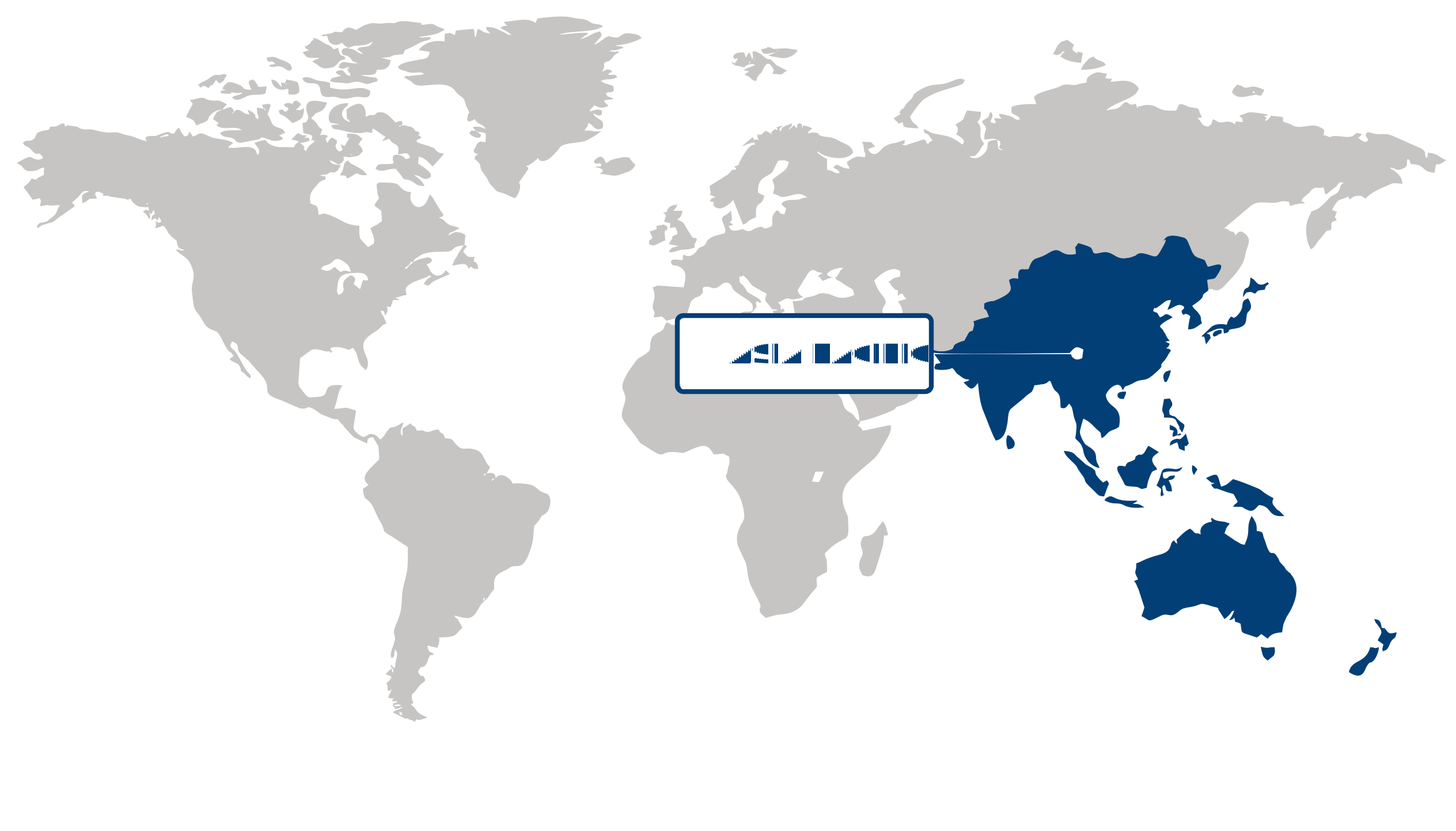
The Asia Pacific hand gesture sensor market captured over 38% of the global share in 2025, establishing itself as the largest market globally. This dominance is underpinned by the region’s robust electronics manufacturing ecosystem, rapid industrialization, and accelerating adoption of consumer electronics, particularly in augmented reality (AR) and virtual reality (VR) devices. For example, companies like Sony and Samsung have integrated advanced gesture sensors into their product portfolios, amplifying demand across households and enterprises. Government initiatives such as Singapore’s Smart Nation program also encourage digital transformation, fostering innovation in sensor technologies. The presence of extensive supply chain networks further facilitates swift product development and deployment. Looking ahead, Asia Pacific’s convergence of manufacturing excellence, tech-savvy consumers, and supportive policies positions it as a critical hub, offering substantial growth potential in the hand gesture sensor market.
Japan is positioned as a pivotal hub in the Asia Pacific hand gesture sensor market, leveraging its strong consumer electronics sector. The country’s leading corporations—including Panasonic and Sharp—are pioneering sensor integration in smart home and automotive applications, driven by a cultural affinity for technological precision and innovation. Regulatory frameworks promoting robotics and AI adoption, as championed by Japan’s Ministry of Economy, Trade and Industry (METI), further stimulate sensor deployment. This ecosystem enables Japan to not only meet domestic demand but also influence regional technology standards, enhancing Asia Pacific’s overall market growth in gesture sensing technology.
China anchors the hand gesture sensor market in Asia Pacific with its massive manufacturing capabilities and expanding AR/VR user base. Corporations such as Huawei and DJI are embedding gesture-sensing features into smartphones and drones, capitalizing on China’s vast consumer market. Government-led digital economy initiatives, including the Made in China 2025 strategy, prioritize advanced sensor technologies to boost technological self-reliance. The competitive intensity among Chinese firms accelerates innovation cycles, while urbanization and rising disposable incomes amplify consumer appetite for gesture-enabled devices. Hence, China’s dynamic environment reinforces Asia Pacific’s leading position in the hand gesture sensor market and underlines significant regional opportunities for investors and developers.
North America Market Analysis:
North America emerged as the fastest-growing region in the hand gesture sensor market, registering a rapid growth rate with a CAGR of 21.72%. This remarkable expansion is primarily driven by the early adoption of sensor technology, supported by robust research and development activities, and widespread integration across diverse sectors such as healthcare, automotive, and gaming. The region’s dynamic innovation landscape, reinforced by prominent entities like Intel and Microsoft, elevates demand for advanced gesture recognition systems, while regulatory frameworks from bodies like the U.S. Food and Drug Administration (FDA) facilitate technology adoption in medical devices. Additionally, increasing consumer preference for contactless interfaces amid evolving digital behaviors underscores North America’s sustainable market momentum. Looking ahead, the expansion of smart infrastructure and connected devices will further cement North America’s role as a pivotal growth hub in the global hand gesture sensor market, offering strategic opportunities for investors and technology innovators.
The United States stands as a critical driver of North America’s hand gesture sensor market, leveraging its leadership role in early technological adoption and extensive R&D capabilities. Robust financial backing from governmental agencies such as the National Science Foundation, coupled with major industry players like Google and Apple pushing gesture-based interfaces in consumer electronics, highlights a conducive environment for rapid market growth. U.S.-based healthcare firms are increasingly deploying gesture sensors to enhance touchless patient monitoring and surgical systems, signifying a shift in purchasing behavior and technology use. Furthermore, automotive manufacturers including Tesla and General Motors incorporate these sensors into advanced driver-assistance systems, demonstrating the country’s competitive positioning and innovation prowess. This synergy between diverse applications and technological expertise in the U.S. reinforces North America’s leadership and underscores significant regional opportunities.
Canada complements the U.S. by showing growing consumer interest in intuitive user experiences and government support for digital transformation initiatives. Canadian telecommunication providers like Bell Canada have initiated pilot programs integrating gesture sensors in smart home automation, reflecting regional trends in tech adoption and supply chain readiness. Additionally, the Canadian healthcare sector’s push for minimally invasive technologies, influenced by directives from Health Canada, promotes the use of hand gesture sensors in patient care. This evolving demand profile, coupled with an innovation-driven workforce, sharpens Canada’s role in solidifying North America’s market dominance while opening avenues for cross-border collaborations and scalable deployments within the hand gesture sensor market.
Europe Market Trends:
Europe maintained a notable presence in the hand gesture sensor market, exhibiting moderate growth driven by increased adoption across healthcare, automotive, and consumer electronics sectors. The region benefits from progressive regulatory frameworks promoting IoT integration and digital innovation, coupled with strong government initiatives supporting Industry 4.0 advancements, as highlighted by the European Commission’s Digital Strategy. Additionally, Europe’s emphasis on sustainability is pushing manufacturers to incorporate energy-efficient sensing technologies, further stimulating demand. The well-established supply networks and high concentration of innovative tech firms in hubs like Berlin and Paris facilitate rapid deployment and customization of hand gesture solutions. These factors position Europe as an attractive market for continued investment and technological evolution, reflecting robust potential for expanding applications and cross-sector integration in the hand gesture sensor market.
Germany holds a pivotal role in Europe’s hand gesture sensor market, propelled by its automotive industry's transition to smart, touchless interfaces that enhance safety and user experience. Companies such as Bosch and Continental have pioneered integrating gesture control systems into vehicles, supported by Germany’s strong engineering workforce and stringent automotive safety regulations overseen by the Federal Motor Transport Authority (KBA). Furthermore, Germany’s commitment to digitization in manufacturing, under initiatives like Industrie 4.0, underscores growing demand for advanced sensor technologies. This positions Germany as a key driver for innovation and scaled adoption in the region, reinforcing Europe’s strategic potential in the hand gesture sensor market through industrial leadership and comprehensive regulatory support.
France emerges as a significant player in Europe’s hand gesture sensor market, fueled by its expanding consumer electronics sector and government-backed innovation programs. The French Public Investment Bank (BPI France) has increased funding for startups developing next-gen sensory devices, accelerating advancements in user interface technologies for smart homes and wearables. Moreover, the French Agency for the Environment and Energy Management (ADEME) benefits manufacturers incorporating eco-friendly sensor designs, aligning with national sustainability priorities. The vibrant tech ecosystem in Paris fosters collaboration between research institutions and enterprises, enhancing the commercialization of gesture recognition solutions. France’s strategic focus on consumer-centric innovation and environmental standards reinforces its role in amplifying Europe’s growth trajectory in the hand gesture sensor market.
| Parameter | North America | Asia Pacific | Europe | Latin America | MEA |
|---|---|---|---|---|---|
| Innovation Hub i Scale Nascent Developing Advanced | |||||
| Cost-Sensitive Region i Scale Low Medium High | |||||
| Regulatory Environment i Scale Restrictive Neutral Supportive | |||||
| Demand Drivers i Scale Weak Moderate Strong | |||||
| Development Stage i Scale Emerging Developing Developed | |||||
| Adoption Rate i Scale Low Medium High | |||||
| New Entrants / Startups i Scale Sparse Moderate Dense | |||||
| Macro Indicators i Scale Weak Stable Strong |
Segment Leadership and Growth Trends
Hand Gesture Sensor Market Share (%), by Technology, 2026
Go beyond the chart, access full insights & data tables
Request Free Sample ReportTouchless Gesture Recognition held the largest share in the hand gesture sensor market in 2025, driven primarily by rising demand for contact-free human-machine interaction solutions in consumer electronics and automotive sectors. This segment benefits from growing customer preference for hygienic, user-friendly interfaces amid heightened health awareness and regulatory encouragement of touchless technologies, as highlighted by regulatory updates from the U.S. Food and Drug Administration promoting contactless controls in medical devices. Supply chain advancements in optical components and competition among sensor manufacturers also fuel rapid innovation. Strategic adoption of touchless interfaces offers both incumbents and startups opportunities to differentiate through enhanced user experiences. Given ongoing digital transformation trends and rising automation adoption, the touchless segment is positioned to sustain its leadership due to its adaptability across diverse environments and evolving consumer expectations.
Analysis by Application
Image Sensors represented the largest share in the hand gesture sensor market in 2025, largely because of the increased deployment of image-based gesture detection in smart devices and interactive systems. The segment leads due to its high accuracy and versatility, which align well with demands in high-performance consumer electronics and automotive applications. Market leaders like Sony Corporation have contributed innovations in compact image sensors, advancing smartphone and infotainment capabilities. Adoption is further reinforced by the trend toward AI integration for improved gesture recognition accuracy, driven by investments from technology consortia such as the Semiconductor Industry Association. Image sensors provide a scalable platform for manufacturers seeking to embed sophisticated gesture controls, creating strategic entry points for new entrants focusing on AI-enhanced solutions. Sustained improvements in sensor resolution and processing power ensure this segment remains integral in the near to medium term.
Analysis by End-User
Consumer Electronics represented the largest share in the hand gesture sensor market in 2025, reflecting widespread integration of gesture control technologies across smartphones, wearables, smart TVs, and other connected devices. This segment’s prominence is supported by strong consumer demand for intuitive, hands-free interaction modes and manufacturers’ strategic focus on enhancing user engagement, as demonstrated by Samsung Electronics’ integration of gesture sensors in its Galaxy lineup. The growing emphasis on device miniaturization and energy efficiency aligns with sustainability priorities and regulatory frameworks promoting low-power electronics. Additionally, shifting user demographics toward tech-savvy younger generations reinforce the expansion of gesture-enabled features. For both established consumer electronics firms and innovative startups, this segment offers robust growth avenues through continual hardware-software convergence. Given accelerating digital lifestyle adoption, consumer electronics will persist as a primary driver of hand gesture sensor market expansion.
| Segment | Sub-Segment | Largest Segment | Fastest Growing |
|---|---|---|---|
| Technology | Touchless Gesture Recognition, Touch-Based Gesture Recognition | ||
| Application | Ultrasonic Sensors, Image Sensors, Capacitive Sensors, Electric Field Sensors, others | ||
| End-User | Gaming & Entertainment, Automotive, Consumer Electronics, Industrial Automation, Healthcare, Others |
Competitive Landscape and Market Positioning
The competitive environment is characterized by dynamic collaborations and technological advancements among these leaders. Efforts to integrate hand gesture sensors with sophisticated signal processing and AI-driven interpretation have become central, as evidenced by targeted enhancements and new product introductions. Strategic moves encompass reinforcing supply chains, cultivating developer ecosystems, and expanding into adjacent fields such as automotive interfaces and augmented reality. These initiatives reinforce competitive differentiation, driving broader application penetration and accelerating innovation cycles while solidifying market footholds.
Strategic / Actionable Recommendations for Regional Players
In North America, companies could strengthen market presence by cultivating deeper alliances with emerging technology startups to harness breakthroughs in machine learning that complement sensor capabilities. Expanding partnerships within automotive and consumer electronics sectors could unlock new pathways for adoption and integrated solutions.
Within the Asia Pacific, tapping into fast-growing industrial and smart home sectors may prove lucrative, supported by collaborations with local research institutions to adapt gesture recognition technology to region-specific user behaviors. Embracing edge computing advancements can also elevate sensor responsiveness and energy efficiency.
For European players, intensifying cross-border cooperative ventures focused on standardization and interoperability may enhance credibility and facilitate scale. Prioritizing investments in environmentally sustainable manufacturing and sensor miniaturization aligns with regional regulatory priorities and premium market demands.
| Company | Market Share | Company Revenue | Revenue CAGR (%) | Product Portfolio | Geographic Presence | Innovation / R&D Focus | Strategic Developments |
|---|---|---|---|---|---|---|---|
| No companies available. | |||||||
Industry Development/News
| Company Name | Date | Key Development |
|---|
Customize Your Report
Explore examples of how this report can be tailored to different research needs, including custom segments, additional topics or chapters, and related reports. Click a section of the wheel or its numbered marker to explore the available options.
Hand Gesture Sensor Market — Custom Segments
| Segment | Sub-Segment |
|---|---|
| No segment data available. | |
Hand Gesture Sensor Market — Custom TOC
| Custom Chapter | Custom Details | ||
|---|---|---|---|
| No custom TOC data available. | |||
Need a different cut of the data?
Request Custom ResearchHow much is the hand gesture sensor industry expected to grow by 2035?
Which geographical region leads the hand gesture sensor market market?
Which area is showing the greatest surge in hand gesture sensor sector?
How much is the touchless gesture recognition segment expected to grow in the hand gesture sensor industry beyond 2025?
What factors give image sensors segment a competitive edge in the hand gesture sensor sector?
Which is the largest sub-segment within the end-user segment for hand gesture sensor industry?
Which companies are driving growth in the hand gesture sensor landscape?
Our Clients
"Working with FBI has been a good experience. The market report provided a holistic view, covering everything from emerging trends to potential risks."
Semtech Corporation
"The experience was highly positive. The team showcased remarkable flexibility in adapting to our specific needs and delivered report that perfectly aligned with all our requirements."
TSMC
"What really stood out to me was how clearly and promptly the Fundamental Business Insights team communicated throughout. It made the collaboration feel effortless."
NXP Semiconductors
Our Research Team & Methodology
Every Fundamental Business Insights report is built by a dedicated vertical research team, validated through a structured primary-and-secondary methodology, and reviewed for accuracy before it reaches you.
Research Team Overview
Prepared by the Electronics & Semiconductors Research Team
Delivery
Published
Demand
Available
Support
Trust & Compliance
Research Domains
10 coverage areasResearch Intelligence
| Source | Reference |
|---|---|
| Semiconductor Industry Association (SIA) | www.semiconductors.org |
| SEMI | www.semi.org |
| JEDEC Solid State Technology Association | www.jedec.org |
| IEEE | www.ieee.org |
| IPC – Association Connecting Electronics Industries | www.ipc.org |
| International Electrotechnical Commission (IEC) | www.iec.ch |
| International Organization for Standardization (ISO) | www.iso.org |
| U.S. Bureau of Industry and Security (BIS) | www.bis.gov |
| U.S. Patent and Trademark Office (USPTO) | www.uspto.gov |
| European Patent Office (EPO) | www.epo.org |
| Taiwan Semiconductor Industry Association (TSIA) | www.tsia.org.tw |
| World Semiconductor Trade Statistics (WSTS) | www.wsts.org |
| International Energy Agency (IEA) | www.iea.org |
| GSMA | www.gsma.com |
| 3GPP | www.3gpp.org |
| ITU (International Telecommunication Union) | www.itu.int |
| Omdia (public insights) | omdia.tech.informa.com |
| Display Supply Chain Consultants (DSCC) | www.displaysupplychain.com |
| U.S. Department of Energy (DOE) | www.energy.gov |
| NIST (National Institute of Standards and Technology) | www.nist.gov |
Research Workflow & Quality Assurance
Data Collection
Verified information gathered through primary and secondary research.
Data Triangulation
Cross-validation using multiple independent data sources.
Forecast Modelling
Market estimates developed using historical trends and analytical models.
Analyst Validation
Findings reviewed by domain experts for accuracy and consistency.
Editorial & Quality Review
Final editorial, quality, and compliance checks before publication.
Final Publication
Released after successful completion of the internal review process.
Report Coverage
📊 Market Assessment
- Market Size & Forecast
- Market Segmentation
- Regional Analysis
- Growth Drivers & Challenges
- Market Dynamics
🏢 Competitive Intelligence
- Competitive Landscape
- Company Profiles
- Competitive Benchmarking
- Mergers & Acquisitions
- Market Share Analysis or Key Company Strategies
🔍 Strategic Analysis
- Value Chain Analysis
- Porter's Five Forces
- PESTLE Analysis
- Pricing Trends
- Supply-Demand Analysis
🚀 Future Outlook
- Technology Landscape
- Regulatory Landscape
- Investment & Funding Landscape
- Emerging Opportunities
- Future Market Outlook
Have a question about this report or need a custom scope?
Request Customization