Halal Food and Beverage Market Size & Growth Forecast 2027–2036, By Segments (Distribution Channel, Product), Regional Demand Trends (North America, Asia Pacific, Europe), Key Country Insights (U.S., Japan, South Korea, Germany, France, Italy), and Competitive Landscape
Market Size and Growth Outlook
Halal Food and Beverage Market size was worth USD 904.82 billion in 2026 and is expected to grow at a 3.42% CAGR between 2027 and 2036, attaining USD 1.27 trillion by 2036. The industry revenue for 2027 is calculated at USD 930.88 billion.
Get more details on this report
Request Free Sample ReportHalal Food and Beverage Market Intelligence Snapshot
Regional Market Dynamics
- Asia Pacific captured 58.49% of the market in 2026, supported by a large Muslim population, strong domestic consumption, and broad availability of halal products across retail and foodservice channels.
- Europe is projected to grow at a 4.22% CAGR as halal-certified products gain wider distribution through mainstream retail, supported by increasing consumer demand and expanding manufacturer participation.
Segment Momentum
- Hypermarkets and supermarkets captured a 72.48% share in 2026 by offering broad certified halal assortments, convenient one-stop shopping, and visible product authentication that strengthens consumer trust.
- Grain Products are the fastest-growing segment as demand rises for halal-certified staple foods across packaged and ready-to-cook formats that support frequent household consumption and broader retail expansion.
Market Expansion Drivers
- Expanding global Muslim population increasing structured demand for certified halal food products.
- Rising mainstream acceptance of halal as trusted hygiene and food safety standard among consumers.
- Growth of plant-based halal product innovation expanding non-meat halal consumption categories.
Leading Market Participants
- Prominent companies in the halal food and beverage market include Nestlé S.A. (Switzerland), Cargill, Incorporated (United States), Unilever PLC (United Kingdom), American Halal Company, Inc. (United States), Midamar Corporation (United States), Al-Falah Halal Foods (United States), QL Foods Sdn. Bhd. (Malaysia), Prima Agri-Products Sdn. Bhd. (Malaysia), One World Foods Inc. (United States), BRF S.A. (Brazil).
Global Market Forecast Snapshot
Market Outlook
- 2026 Market Size: USD 904.82 billion
- 2027 Estimated Market Size: USD 930.88 billion.
- Projected Market Size: USD 1.27 trillion by 2036
- Growth Forecast: 3.42% CAGR (2027-2036)
Regional and Segment Outlook
- Leading Regional Market: Asia Pacific
- High-Growth Regional Hub: Europe
- Core Revenue Segment: Hypermarket & Supermarket (Distribution Channel) | Meat & Alternatives (Product)
- Emerging Opportunity Segment: Online (Distribution Channel) | Grain Products (Product)
Market Growth Drivers and Industry Trends
Expanding global Muslim population increasing structured demand for certified halal food products
A growing muslim consumer base will drive the halal food and beverage market as demand increasingly shifts toward products that meet clearly defined halal requirements. Expanding consumption across food and beverage categories is encouraging manufacturers and retailers to strengthen certified product offerings, improve availability, and incorporate halal compliance into sourcing and production practices.
Rising mainstream acceptance of halal as trusted hygiene and food safety standard among consumers
Broader consumer recognition of halal practices as associated with hygiene and food safety is supporting the halal food and beverage market beyond its traditional consumer base. As halal becomes more widely viewed as a trusted quality attribute, food producers and retailers are positioned to incorporate certification and transparent compliance into product offerings that appeal to consumers seeking reliable preparation and sourcing standards.
Growth of plant-based halal product innovation expanding non-meat halal consumption categories
Innovation in plant-based foods will boost the halal food and beverage market by creating additional consumption opportunities beyond conventional meat-based products. The development of plant-based offerings that satisfy halal requirements enables manufacturers to address demand for alternative food choices while expanding the range of certified products available across non-meat categories.
| Growth Driver | Impact on CAGR | Regulatory Influence | Geographic Relevance | Adoption Rate | Impact Timeline |
|---|---|---|---|---|---|
| Increasing halal food and beverage demand | 1.20% | Short term (≤ 2 yrs) | North America, Europe | Low | Fast |
| Technological improvements in halal food certification and processing | 1.20% | Medium term (2–5 yrs) | North America, Asia Pacific | Low | Moderate |
| Expansion of halal food supply chains in emerging markets | 1.30% | Long term (5+ yrs) | Asia Pacific, Middle East | Low | Slow |
| Expanding global Muslim population increasing structured demand for certified halal food products | 1.90% | High | Asia Pacific, Middle East & Africa | High | Near Term |
| Rising mainstream acceptance of halal as trusted hygiene and food safety standard among consumers | 1.60% | Moderate | Europe, Asia Pacific | High | Near Term |
| Growth of plant-based halal product innovation expanding non-meat halal consumption categories | 1.30% | Moderate | Asia Pacific, Europe, Middle East | Emerging | Mid Term |
Explore Growth Opportunities
Request Free Sample ReportRegional Demand Dynamics
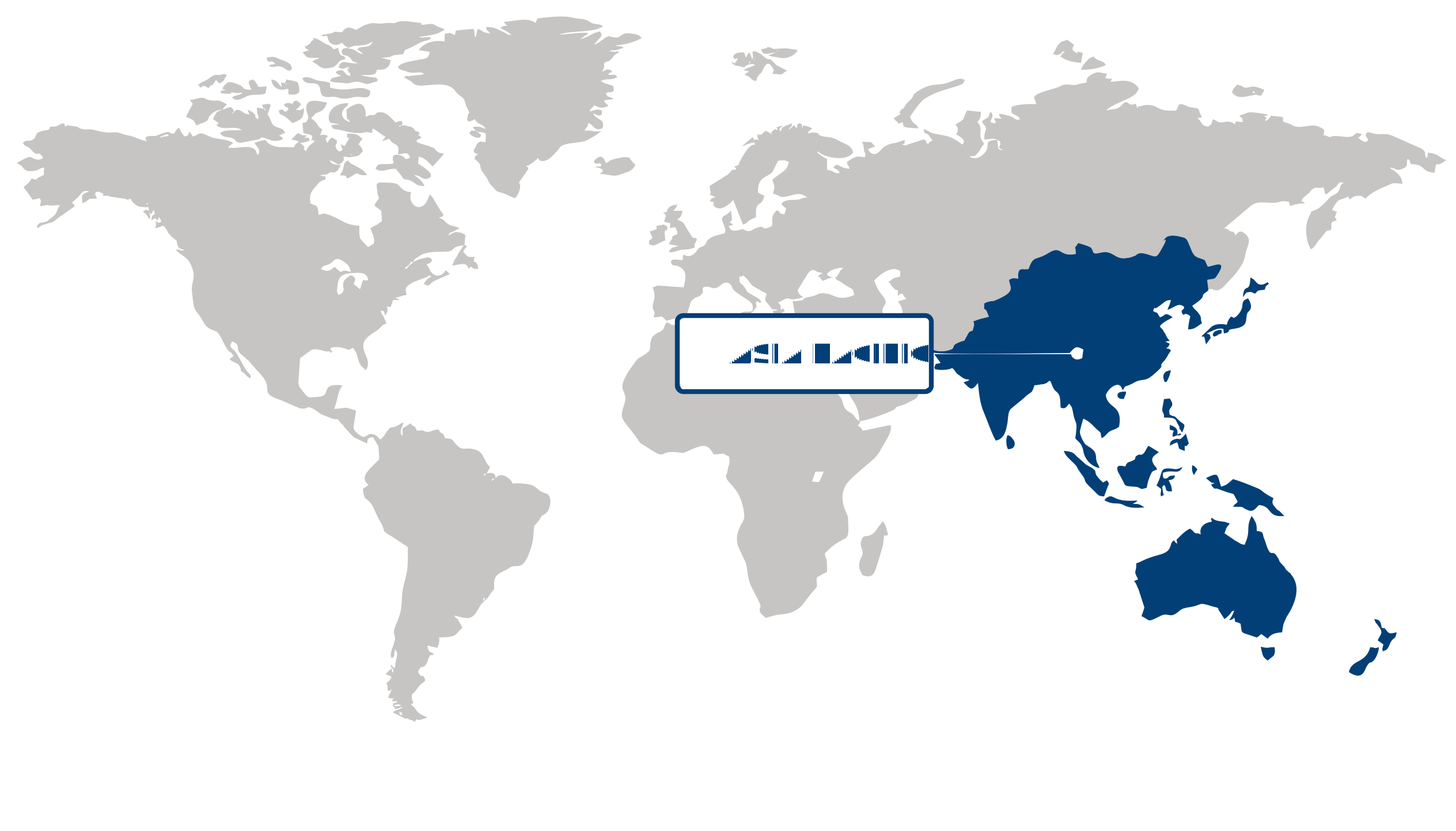
Asia Pacific (Largest Region)
Asia Pacific held the largest share of the halal food and beverage market at 58.49% in 2026, supported by its substantial muslim consumer population, established halal consumption practices, and expanding food-processing industry. Demand extends across packaged foods, beverages, meat products, snacks, and convenience foods as consumers increasingly seek products that align with religious requirements while also meeting expectations for quality, safety, and transparency. Urbanization and the expansion of organized retail and foodservice channels are broadening access to certified halal products, while rising disposable incomes are encouraging consumers to explore a wider range of premium and processed offerings. Growing halal certification infrastructure and stronger integration of halal standards into food manufacturing and distribution are further reinforcing the region's position.
Europe (Fastest-Growing Region)
Europe is the fastest-growing region for halal food and beverage, driven by increasing consumer diversity, expanding demand for certified products, and the growing availability of halal offerings through mainstream retail and foodservice channels. Halal consumption is becoming increasingly visible across both established muslim communities and younger, more diverse consumer groups, creating opportunities for manufacturers to broaden product portfolios. Greater emphasis on traceability, ingredient transparency, food safety, and ethical sourcing also complements halal purchasing considerations. The expansion of specialty food outlets alongside wider distribution through supermarkets and online channels is improving product accessibility, while European food producers are increasingly adapting formulations and packaging to serve varied dietary and cultural preferences.
| Parameter | North America | Asia Pacific | Europe | Latin America | MEA |
|---|---|---|---|---|---|
| Innovation Hub i Scale Nascent Developing Advanced | |||||
| Cost-Sensitive Region i Scale Low Medium High | |||||
| Regulatory Environment i Scale Restrictive Neutral Supportive | |||||
| Demand Drivers i Scale Weak Moderate Strong | |||||
| Development Stage i Scale Emerging Developing Developed | |||||
| Adoption Rate i Scale Low Medium High | |||||
| New Entrants / Startups i Scale Sparse Moderate Dense | |||||
| Macro Indicators i Scale Weak Stable Strong |
Key Country Insights
Germany 🇩🇪
Certified Product ExpansionGermany emphasizes trusted halal certification and consistent quality standards across processed foods and beverages. Food manufacturers broaden certified product portfolios to serve both domestic consumers and international trade opportunities.
France 🇫🇷
Premium Certified OfferingsFrance focuses on halal food and beverage products with strong certification credibility and premium quality positioning. Producers expand value-added offerings that align with changing consumer preferences and specialty retail demand.
Italy 🇮🇹
Export-Oriented ProductionItaly develops halal food and beverage products by adapting established food manufacturing capabilities to certified production standards. Businesses prioritize product authenticity, certification compliance, and wider access to international halal distribution channels.
Japan 🇯🇵
Tourism-Driven SupplyJapan strengthens halal food and beverage offerings to serve international visitors and growing domestic availability. Businesses expand certified food options while adapting products to local preferences and hospitality sector requirements.
South Korea 🇰🇷
Modern Retail AdoptionSouth Korea increases halal food and beverage availability through supermarkets, convenience stores, and food service channels. Companies invest in certification, product innovation, and accessible distribution to address evolving consumer expectations.
United States 🇺🇸
Diverse Consumer DemandThe U.S. halal food and beverage market benefits from expanding multicultural consumer demand and broader retail availability. Companies focus on certified products, transparent sourcing, and product diversification across packaged foods and beverages.
Segment Leadership and Growth Trends
Halal Food and Beverage Market Share (%), by Distribution Channel, 2026
Go beyond the chart, access full insights & data tables
Request Free Sample ReportDistribution Channel Segment Analysis: Hypermarket & Supermarket (Largest Segment) vs Online (Fastest-Growing Segment)
In the halal food and beverage market, the hypermarket & supermarket segment held the largest share of 72.48% in 2026, reflecting the importance of established retail channels for halal-certified food and beverage purchases. These outlets provide consumers with broad product assortments, convenient access, and greater visibility of halal-certified offerings across multiple categories. The ability to compare products in physical stores and the increasing availability of clearly identified halal products strengthen consumer confidence and support continued demand through organized retail.
The online distribution channel is positioned as the fastest-growing segment as digital purchasing increasingly expands access to halal products. Online platforms allow consumers to explore a wider selection of certified foods and beverages without being restricted by local store inventories. Convenient home delivery, easy product discovery, and the growing preference for digital shopping are supporting this channel's increasing relevance, particularly for consumers seeking specialized halal offerings.
Product Segment Analysis: Meat & Alternatives (Largest Segment) vs Grain Products (Fastest-Growing Segment)
Meat & alternatives accounted for the largest share of 54.18% in 2026 within the halal food and beverage market, making it a central product category for halal consumption. Demand is supported by the importance of meat-based foods in everyday diets and the need for reliable halal certification throughout sourcing and processing. The expansion of halal alternatives also broadens consumer choice while enabling producers and retailers to address changing dietary preferences without compromising halal requirements.
Grain products are emerging as the fastest-growing product segment, supported by their versatility across everyday meals and packaged food applications. Growing consumer interest in convenient staple foods, combined with greater availability of halal-certified grain-based products, is strengthening their market potential. Expansion across processed foods, bakery products, and other grain-based offerings further creates opportunities for manufacturers to diversify halal portfolios and reach a broader consumer base.
| Segment | Sub-Segment | Largest Segment | Fastest Growing |
|---|---|---|---|
| Distribution Channel | Hypermarket & Supermarket, Departmental Store, Online, Others | Hypermarket & Supermarket | Online |
| Product | Meat & Alternatives, Milk & Milk Products, Fruits & Vegetables, Grain Products, Others | Meat & Alternatives | Grain Products |
Unlock insights tailored to your business with our bespoke market research solutions.
Click to get your customized report now.
Competitive Landscape and Market Positioning
Prominent players in the halal food and beverage market:
1. Nestlé S.A. (Switzerland)
2. Cargill Incorporated (United States)
3. Unilever PLC (United Kingdom)
4. American Halal Company Inc. (United States)
5. Midamar Corporation (United States)
6. Al-Falah Halal Foods (United States)
7. QL Foods Sdn. Bhd. (Malaysia)
8. Prima Agri-Products Sdn. Bhd. (Malaysia)
9. One World Foods Inc. (United States)
10. BRF S.A. (Brazil)
Growing global awareness of dietary compliance standards and cultural consumption preferences is steadily influencing demand patterns within the halal food and beverage market, particularly across multicultural urban centers. Expansion into new geographic regions is becoming a key strategic direction as producers aim to align with diverse regulatory frameworks and certification requirements. In parallel, stronger distribution ecosystems are emerging through partnerships across production, certification, and retail channels, enabling smoother market penetration. Product innovation is increasingly aligned with health-conscious and clean-label expectations, leading to more diversified offerings across packaged and ready-to-consume segments. This evolving structure is reinforcing a more interconnected value chain while supporting sustained global market expansion.
| Company | Market Share | Company Revenue | Revenue CAGR (%) | Product Portfolio | Geographic Presence | Innovation / R&D Focus | Strategic Developments |
|---|---|---|---|---|---|---|---|
| Nestlé S.A. (Switzerland) | |||||||
| Cargill Incorporated (United States) | |||||||
| Unilever PLC (United Kingdom) | |||||||
| American Halal Company Inc. (United States) | |||||||
| Midamar Corporation (United States) | |||||||
| Al-Falah Halal Foods (United States) | |||||||
| QL Foods Sdn. Bhd. (Malaysia) | |||||||
| Prima Agri-Products Sdn. Bhd. (Malaysia) | |||||||
| One World Foods Inc. (United States) | |||||||
| BRF S.A. (Brazil). |
Industry Development/News
| Company Name | Date | Key Development |
|---|---|---|
| THAIFEX – Anuga Asia | Jun-26 | The 2026 edition of THAIFEX – Anuga Asia featured significant participation from the halal sector, with approximately 40% of exhibitors showcasing halal-certified products. This prominence underscores Thailand's strategic evolution as a regional hub for the global halal economy, facilitating greater visibility and commercial connectivity for halal-certified manufacturers within the international marketplace. |
| BRF S.A. | May-26 | BRF S.A. entered a strategic partnership with the Halal Products Development Co. to launch the "Sadia Halal" brand. This initiative focuses on high-value processed meat products tailored for the Middle East and North Africa, reflecting a strategic shift toward premiumization and localized product development to capture expanding consumer demand in Muslim-majority markets. |
| Malaysia | Apr-26 | The Malaysian government is advancing its industrial infrastructure through a proposal to expand halal parks across all states. By enhancing production capacity and streamlining certification governance, the initiative aims to reinforce Malaysia’s competitive position as a global halal hub, providing a structured ecosystem for both domestic and foreign investors to scale halal operations. |
| Brazil | Apr-26 | Brazil is actively diversifying its halal export portfolio, transitioning from a heavy reliance on commodity meat exports toward high-value manufactured and processed food goods. Through initiatives like the Anuga Select Brazil Halal Forum, the country is deepening trade relationships and positioning itself to meet the growing demand for diversified, halal-certified food products in Islamic markets. |
| Chicken Cottage | Feb-22 | Chicken Cottage expanded its international footprint into East Africa through a strategic franchising partnership with Express Kitchen, a subsidiary of AAH Limited. This agreement facilitates the rapid scaling of the brand's quick-service restaurant operations in the region, leveraging local infrastructure to deliver halal-compliant fast-food offerings to an emerging consumer base. |
| Crescent Foods | Aug-21 | Crescent Foods, a pioneer in premium hand-cut halal meat, implemented a turnkey foodservice program for U.S. university and college dining halls. This expansion effectively integrated halal-certified proteins—including beef, lamb, and poultry—into institutional food service channels, widening product availability and demonstrating a scalable model for meeting diverse dietary needs in mainstream campus environments. |
Customize Your Report
Explore examples of how this report can be tailored to different research needs, including custom segments, additional topics or chapters, and related reports. Click a section of the wheel or its numbered marker to explore the available options.
Halal Food and Beverage Market — Custom Segments
| Segment | Sub-Segment |
|---|---|
| Certification Type | Product-Level Halal Certification, Facility-Level Halal Certification, Supply Chain Halal Certification |
| Consumer Group | Muslim Consumers, Halal-Conscious Non-Muslim Consumers, Institutional & Foodservice Buyers |
| Price Tier | Economy, Mid-Range, Premium |
Halal Food and Beverage Market — Custom TOC
| Custom Chapter | Chapter Details |
|---|---|
| Halal Certification Ecosystem Analysis |
|
| Consumer Trust and Acceptance Assessment |
|
| Cross-Border Trade Opportunity Mapping |
|
Need a different cut of the data?
Request Custom ResearchHow much is the halal food and beverage market worth?
How is the halal food and beverage industry projected to perform over the next decade?
How is expanding global halal certification demand shaping purchasing behavior in food and beverage retail?
Why are plant-based and alternative product innovations gaining momentum in the halal food and beverage market?
Why do hypermarkets and supermarkets dominate the halal food and beverage market?
Which product segment is growing fastest in the halal food and beverage market?
Why is Asia Pacific the largest market for halal food and beverages?
What is driving the halal food and beverage market's growth in Europe?
What are the key competitors in the halal food and beverage landscape?
Our Clients
"The report provided a thorough look at market trends, technological advancements, and the competitive landscape. The depth of insights was really valuable."
ITC Limited
"We would highly recommend Fundamental Business Insights & Consulting to anyone looking for reliable, detailed, and comprehensive market research in the Food industry."
Tyson Foods
"The clarity and presentation of the information were commendable. The report was delivered timely, which made the overall experience smooth and convenient."
Mondelēz International
Our Research Team & Methodology
Every Fundamental Business Insights report is built by a dedicated vertical research team, validated through a structured primary-and-secondary methodology, and reviewed for accuracy before it reaches you.
Research Team Overview
Prepared by the Food & Beverage Research Team
Delivery
Published
Demand
Available
Support
Trust & Compliance
Research Intelligence
| Source | Reference |
|---|---|
| Food and Agriculture Organization (FAO) | www.fao.org |
| World Health Organization (WHO) | www.who.int |
| U.S. Food & Drug Administration (FDA) | www.fda.gov |
| European Food Safety Authority (EFSA) | www.efsa.europa.eu |
| U.S. Department of Agriculture (USDA) | www.usda.gov |
| Codex Alimentarius Commission | www.fao.org/fao-who-codexalimentarius |
| International Organization for Standardization (ISO) | www.iso.org |
| AOAC INTERNATIONAL | www.aoac.org |
| Institute of Food Technologists (IFT) | www.ift.org |
| International Dairy Foods Association (IDFA) | www.idfa.org |
| International Sweeteners Association (ISA) | www.sweeteners.org |
| International Probiotics Association (IPA) | internationalprobiotics.org |
| Good Food Institute (GFI) | gfi.org |
| American Feed Industry Association (AFIA) | www.afia.org |
| International Feed Industry Federation (IFIF) | ifif.org |
| Specialty Food Association (SFA) | www.specialtyfood.com |
| Brewers Association | www.brewersassociation.org |
| International Bottled Water Association (IBWA) | bottledwater.org |
| International Alliance for Dietary/Food Supplement Associations (IADSA) | www.iadsa.org |
| OECD Agriculture & Food | www.oecd.org/agriculture |
Research Workflow & Quality Assurance
Data Collection
Verified information gathered through primary and secondary research.
Data Triangulation
Cross-validation using multiple independent data sources.
Forecast Modelling
Market estimates developed using historical trends and analytical models.
Analyst Validation
Findings reviewed by domain experts for accuracy and consistency.
Editorial & Quality Review
Final editorial, quality, and compliance checks before publication.
Final Publication
Released after successful completion of the internal review process.
Report Coverage
📊 Market Assessment
- Market Size & Forecast
- Market Segmentation
- Regional Analysis
- Growth Drivers & Challenges
- Market Dynamics
🏢 Competitive Intelligence
- Competitive Landscape
- Company Profiles
- Competitive Benchmarking
- Mergers & Acquisitions
- Market Share Analysis or Key Company Strategies
🔍 Strategic Analysis
- Value Chain Analysis
- Porter's Five Forces
- PESTLE Analysis
- Pricing Trends
- Supply-Demand Analysis
🚀 Future Outlook
- Technology Landscape
- Regulatory Landscape
- Investment & Funding Landscape
- Emerging Opportunities
- Future Market Outlook
Have a question about this report or need a custom scope?
Request Customization