Greenhouse Market Size & Growth Forecast 2027–2036, By Segments (Type, Component, End User, Crop Category), Regional Demand Trends (North America, Asia Pacific, Europe), Key Country Insights (U.S., Japan, South Korea, Germany, France, Italy), and Competitive Landscape
Market Size and Growth Outlook
Greenhouse Market size was over USD 35.9 billion in 2026 and is likely to grow at a 10.36% CAGR between 2027 and 2036, surpassing USD 96.21 billion by 2036. The industry revenue for 2027 is calculated at USD 39.03 billion.
Get more details on this report
Request Free Sample ReportGreenhouse Market Intelligence Snapshot
Regional Market Dynamics
- Europe leads the market through its mature protected cultivation sector, extensive use of controlled-environment farming, and ongoing investment in greenhouse technology upgrades for year-round production.
- Asia Pacific is projected to grow at an 11.3% CAGR as growers adopt protected cultivation to improve productivity, manage weather risks, and meet rising food demand through controlled farming systems.
Segment Momentum
- Plastic held a 59.85% market share in 2026 because it offers cost-effective installation, flexibility across different climates, and practical suitability for both commercial and small-scale cultivation.
- Software is growing fastest as greenhouse operators increasingly adopt data-driven tools to optimize environmental conditions, resource use, and cultivation performance through improved monitoring and operational control.
Market Expansion Drivers
- Increasing food security concerns accelerating investment in controlled-environment agriculture infrastructure.
- Rising demand for locally grown produce expanding urban greenhouse farming operations.
- Growth of vertical farming technologies strengthening adoption of hydroponic greenhouse systems.
Leading Market Participants
- Leading companies in the greenhouse market include Netafim Limited (Israel), Berry Global Group, Inc. (United States), Certhon Group (Netherlands), Richel Group SA (France), Stuppy Greenhouse Manufacturing, Inc. (United States), Logiqs B.V. (Netherlands), Argus Control Systems Ltd. (Canada), Agra Tech, Inc. (United States), Luiten Greenhouses B.V. (Netherlands), Sotrafa S.A. (Spain).
Global Market Forecast Snapshot
Market Outlook
- 2026 Market Size: USD 35.9 billion
- 2027 Estimated Market Size: USD 39.03 billion.
- Projected Market Size: USD 96.21 billion by 2036
- Growth Forecast: 10.36% CAGR (2027-2036)
Regional and Segment Outlook
- Leading Regional Market: Europe
- High-Growth Regional Hub: Asia Pacific
- Core Revenue Segment: Plastic (Type) | Hardware (Component) | Commercial Growers (End User) | Fruits, Vegetables, & Herbs (Crop Category)
- Emerging Opportunity Segment: Glass (Type) | Software (Component) | Research and Educational Institutes (End User) | Flowers & Ornamentals (Crop Category)
Market Growth Drivers and Industry Trends
Increasing food security concerns accelerating investment in controlled-environment agriculture infrastructure
Growing concerns surrounding food availability, climate variability, water constraints, and disruptions to conventional agricultural production are encouraging investment in protected cultivation systems. The greenhouse market is benefiting from the increasing adoption of controlled-environment agriculture because greenhouses allow growers to manage temperature, humidity, irrigation, light, and other cultivation conditions more effectively than open-field farming. This controlled setting can reduce exposure to adverse weather and support more predictable crop production, particularly for high-value fruits, vegetables, and specialty crops. As governments, agricultural producers, and food businesses place greater emphasis on resilient food production systems, investment in greenhouse structures, climate-control equipment, irrigation solutions, and monitoring technologies is becoming increasingly relevant.
Rising demand for locally grown produce expanding urban greenhouse farming operations
Consumer interest in fresh, locally sourced produce is encouraging food producers to establish cultivation facilities closer to population centers. Within the greenhouse market, urban greenhouse farming provides an opportunity to shorten supply chains while producing vegetables and other perishable crops near consumers, reducing dependence on long-distance transportation and conventional agricultural land. The controlled nature of greenhouse cultivation also enables production in locations where outdoor farming may be constrained by limited arable land or unfavorable climatic conditions. Growing adoption of local food initiatives, direct-to-consumer distribution models, and urban agriculture is supporting the development of compact greenhouse operations near cities and densely populated communities.
Growth of vertical farming technologies strengthening adoption of hydroponic greenhouse systems
The integration of vertical cultivation approaches with greenhouse infrastructure is creating new possibilities for maximizing production from limited land resources. The greenhouse market is being strengthened as growers combine hydroponic systems, stacked cultivation methods, controlled irrigation, and environmental monitoring to improve resource utilization. Hydroponic production can reduce reliance on soil while enabling precise delivery of water and nutrients to crops, making it suitable for intensive cultivation environments. Advances in automated growing systems and environmental controls are further helping operators manage crop conditions across multiple cultivation layers within protected structures.
| Growth Driver | Impact on CAGR | Regulatory Influence | Geographic Relevance | Adoption Rate | Impact Timeline |
|---|---|---|---|---|---|
| Increasing food security concerns accelerating investment in controlled-environment agriculture infrastructure | 2.00% | High | Europe, Asia Pacific | High | Mid Term |
| Rising demand for locally grown produce expanding urban greenhouse farming operations | 1.80% | Moderate | North America, Europe | High | Near Term |
| Growth of vertical farming technologies strengthening adoption of hydroponic greenhouse systems | 1.50% | Moderate | Asia Pacific, North America | Emerging | Long Term |
Unlock insights tailored to your business with our bespoke market research solutions.
Click to get your customized report now.
Regional Demand Dynamics
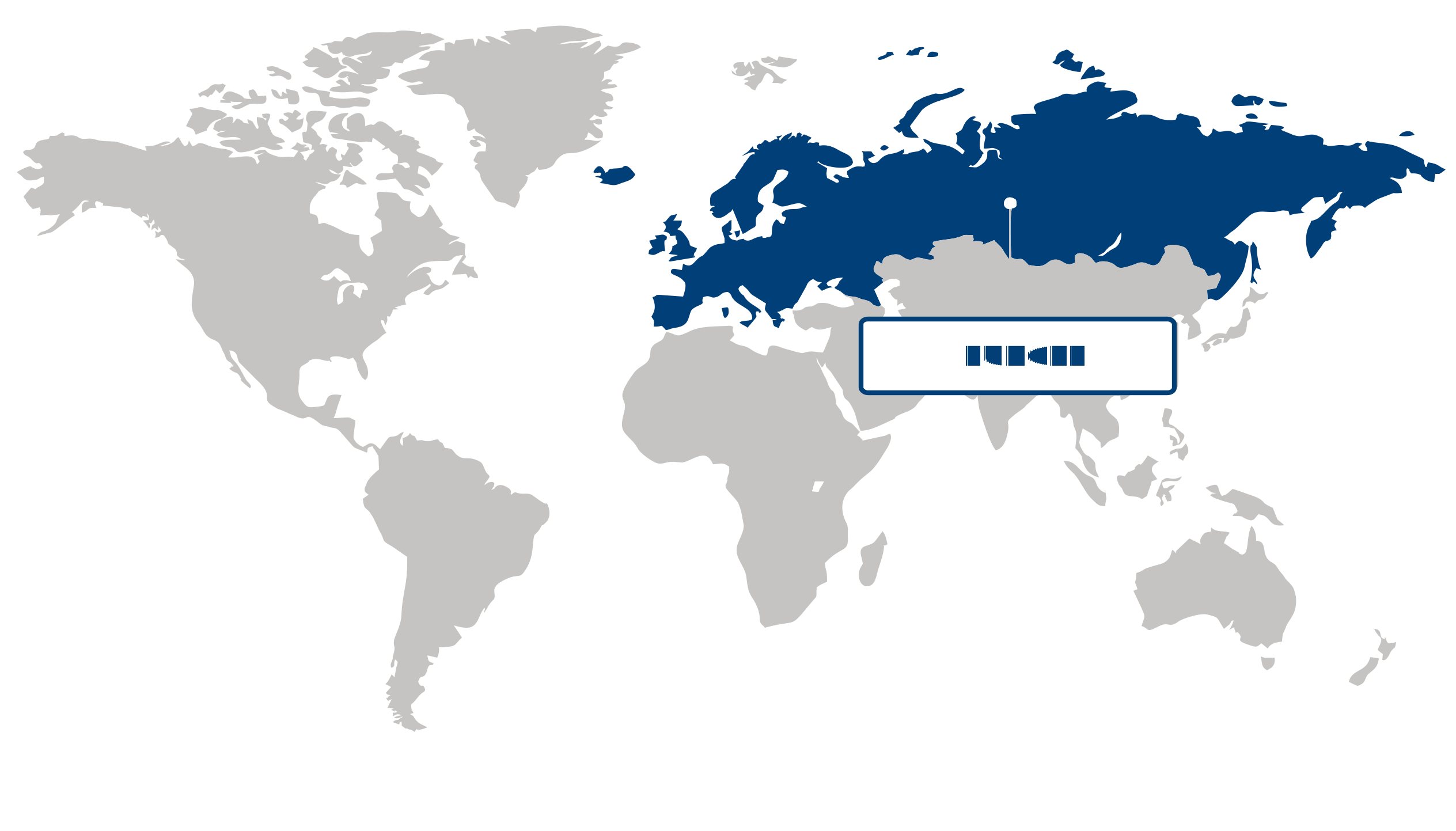
Europe (Largest Region)
Europe held the largest share of the greenhouse market in 2026, supported by advanced protected cultivation practices, strong agricultural technology adoption, and increasing emphasis on efficient food production. Greenhouses enable growers to maintain more consistent growing conditions, extend cultivation periods, and improve resource utilization, making them increasingly important as agriculture responds to changing climatic conditions and land constraints. The region's focus on sustainable farming is also encouraging the adoption of climate-controlled systems, precision irrigation, and energy-efficient greenhouse technologies. Established horticulture industries and growing demand for locally produced fruits, vegetables, and specialty crops further reinforce Europe's leading position.
Asia Pacific (Fastest-Growing Region)
Asia Pacific is the fastest-growing regional market, driven by rapid population growth, rising food demand, urbanization, and increasing pressure on agricultural land and water resources. Protected cultivation is gaining importance as growers seek to improve crop productivity and maintain more predictable yields despite variable weather conditions. Expanding investment in modern agriculture is encouraging the adoption of automated climate management, precision irrigation, and advanced cultivation systems. Rising consumer demand for fresh produce, combined with the development of organized agricultural supply chains and government support for modern farming practices, is creating favorable conditions for greenhouse expansion across the region.
| Parameter | North America | Asia Pacific | Europe | Latin America | MEA |
|---|---|---|---|---|---|
| Innovation Hub i Scale Nascent Developing Advanced | |||||
| Cost-Sensitive Region i Scale Low Medium High | |||||
| Regulatory Environment i Scale Restrictive Neutral Supportive | |||||
| Demand Drivers i Scale Weak Moderate Strong | |||||
| Development Stage i Scale Emerging Developing Developed | |||||
| Adoption Rate i Scale Low Medium High | |||||
| New Entrants / Startups i Scale Sparse Moderate Dense | |||||
| Macro Indicators i Scale Weak Stable Strong |
Key Country Insights
Germany 🇩🇪
Sustainable Cultivation SystemsGermany emphasizes greenhouse technologies that reduce energy consumption while improving production efficiency. The market encourages climate management innovations, automation, and resource-efficient cultivation practices for commercial horticulture operations.
France 🇫🇷
Premium Horticulture DevelopmentFrance supports greenhouse expansion through modern horticulture practices that improve crop quality and production flexibility. French growers increasingly invest in energy-efficient structures and precision cultivation systems to strengthen sustainable agricultural operations.
Italy 🇮🇹
Specialty Crop CultivationItaly utilizes greenhouse infrastructure to support high-value fruit, vegetable, and ornamental crop production. The Italian market increasingly adopts advanced irrigation, climate management, and protected cultivation technologies to improve product quality and operational efficiency.
Japan 🇯🇵
High-Efficiency ProductionJapan prioritizes greenhouse systems that maximize agricultural output within limited land availability. Japanese growers increasingly adopt precision climate control and automated cultivation technologies to improve productivity and crop quality throughout the year.
South Korea 🇰🇷
Smart Agriculture AdoptionSouth Korea is accelerating greenhouse modernization through smart agriculture technologies that enable real-time environmental monitoring and automated crop management. Investments focus on improving production efficiency while reducing labor intensity across commercial farming operations.
United States 🇺🇸
Controlled Environment FarmingThe U.S. greenhouse market is expanding through investments in controlled environment agriculture that improve crop consistency and resource efficiency. Growers increasingly adopt automation, climate control, and precision irrigation technologies to optimize year-round production.
Segment Leadership and Growth Trends
Greenhouse Market Share (%), by Type, 2026
Go beyond the chart, access full insights & data tables
Request Free Sample ReportType Segment Analysis: Plastic (Largest Segment) vs Glass (Fastest-Growing Segment)
Plastic greenhouses held the largest share of the greenhouse market at 59.85% in 2026, supported by their cost-effective construction, durability, and flexibility across diverse agricultural applications. Plastic coverings can provide effective environmental control while offering practical installation and maintenance characteristics. Their suitability for commercial cultivation, protected agriculture, and cultivation in regions with varying climatic conditions continues to support widespread adoption. Increasing interest in improving crop productivity and extending growing conditions is further sustaining demand for plastic greenhouse structures.
Glass greenhouses are expanding rapidly as growers place greater emphasis on controlled cultivation environments, light transmission, and long-term structural performance. Glass provides high transparency and can support optimized light availability for crops, making it attractive for advanced horticultural applications. Growing adoption of intensive cultivation practices, premium crop production, and technologically advanced greenhouse systems is contributing to increased interest in glass structures, particularly where growers prioritize durability and environmental control.
Component Segment Analysis: Hardware (Largest Segment) vs Software (Fastest-Growing Segment)
Hardware represented the largest component segment of the greenhouse market, accounting for 63% in 2026. Greenhouse operations depend on physical infrastructure such as structural systems, climate-control equipment, irrigation components, and other mechanisms required to maintain suitable growing conditions. Increasing adoption of protected cultivation and the need for reliable environmental management continue to generate demand for these core components, making hardware fundamental to greenhouse development and operation.
Software is emerging as the fastest-growing component as greenhouse operators increasingly incorporate digital technologies to improve monitoring, automation, and resource management. Software solutions can help coordinate environmental parameters and support data-driven cultivation decisions, improving operational visibility and control. Rising interest in smart agriculture, automated greenhouse management, and precision cultivation is accelerating the integration of software into modern protected farming systems.
| Segment | Sub-Segment | Largest Segment | Fastest Growing |
|---|---|---|---|
| Type | Glass, Plastic | Plastic | Glass |
| Component | Hardware, Software, Services | Hardware | Software |
| End User | Commercial Growers, Research and Educational Institutes, Retail Gardens, Others | Commercial Growers | Research and Educational Institutes |
| Crop Category | Fruits, Vegetables, & Herbs, Flowers & Ornamentals, Others | Fruits, Vegetables, & Herbs | Flowers & Ornamentals |
Competitive Landscape and Market Positioning
Major players in the greenhouse market:
1. Netafim Limited (Israel)
2. Berry Global Group Inc. (United States)
3. Certhon Group (Netherlands)
4. Richel Group SA (France)
5. Stuppy Greenhouse Manufacturing Inc. (United States)
6. Logiqs B.V. (Netherlands)
7. Argus Control Systems Ltd. (Canada)
8. Agra Tech Inc. (United States)
9. Luiten Greenhouses B.V. (Netherlands)
10. Sotrafa S.A. (Spain)
The greenhouse market is increasingly shaped by controlled environment agriculture and resource-efficient farming systems. Rising demand for sustainable food production is encouraging smart cultivation methods. Technological integration is improving yield predictability and environmental control.
| Company | Market Share | Company Revenue | Revenue CAGR (%) | Product Portfolio | Geographic Presence | Innovation / R&D Focus | Strategic Developments |
|---|---|---|---|---|---|---|---|
| Netafim Limited (Israel) | |||||||
| Berry Global Group Inc. (United States) | |||||||
| Certhon Group (Netherlands) | |||||||
| Richel Group SA (France) | |||||||
| Stuppy Greenhouse Manufacturing Inc. (United States) | |||||||
| Logiqs B.V. (Netherlands) | |||||||
| Argus Control Systems Ltd. (Canada) | |||||||
| Agra Tech Inc. (United States) | |||||||
| Luiten Greenhouses B.V. (Netherlands) | |||||||
| Sotrafa S.A. (Spain). |
Industry Development/News
| Company Name | Date | Key Development |
|---|---|---|
| Netafim | Mar-25 | Netafim, part of Orbia’s Precision Agriculture business, partnered with Virridy to expand its carbon credit initiatives beyond rice cultivation into crops such as alfalfa, sugar beet, and corn in Turkey. The initiative applies precision irrigation technologies to reduce greenhouse gas emissions while improving water efficiency and crop productivity, extending Netafim’s sustainability-linked agricultural solutions. |
| Netafim | Nov-24 | Netafim partnered with Bayer to enhance data-driven farming by simplifying agricultural data collection and enabling customized agronomic recommendations. The collaboration also strengthens integration across Netafim’s digital platforms, including HortiView and GrowSphere, supporting improved irrigation management, crop protection, and fertigation decisions to optimize resource efficiency and farm productivity. |
| Netafim | Oct-24 | Netafim partnered with Phytech Ltd to integrate real-time field data into its GrowSphere irrigation operating system. The collaboration leverages Phytech’s sensing technologies and Netafim’s distribution network to enhance irrigation monitoring, improve operational feedback loops, and enable more precise, data-driven decision-making for shared agricultural customers across irrigation-intensive farming systems. |
Customize Your Report
Explore examples of how this report can be tailored to different research needs, including custom segments, additional topics or chapters, and related reports. Click a section of the wheel or its numbered marker to explore the available options.
Greenhouse Market — Custom Segments
| Segment | Sub-Segment |
|---|---|
| Cultivation Environment | Controlled-Environment Agriculture, Conventional Greenhouse Cultivation, Hybrid Cultivation |
| Structure Scale | Small-Scale Greenhouses, Medium-Scale Greenhouses, Large-Scale Commercial Greenhouses, Mega-Scale Greenhouse Facilities |
| Construction Model | Permanent Greenhouses, Modular Greenhouses, Prefabricated Greenhouses, Mobile & Temporary Greenhouses |
Greenhouse Market — Custom TOC
| Custom Chapter | Custom Details |
|---|---|
| Controlled Agriculture Investment Outlook |
|
| Commercial Greenhouse Business Models |
|
| Climate-Resilient Greenhouse Farming Strategies |
|
Need a different cut of the data?
Request Custom ResearchWhat is the market valuation of greenhouse?
What is the forecasted size of the greenhouse industry?
How is the shift toward controlled-environment agriculture reshaping investment priorities in the greenhouse market?
Why is software adoption accelerating faster than traditional greenhouse hardware investments?
Why is plastic the largest type segment in the greenhouse market?
Why is software the fastest-growing component in the greenhouse market?
Why is Europe the leading greenhouse market?
What is driving greenhouse market growth in Asia Pacific?
Which companies dominate the greenhouse landscape?
Our Clients
"Your insights on workforce structures were spot-on. The analysis on mid-to-senior level roles validated some of our hiring decisions and highlighted gaps."
Ateliers De France
"The report gave us insights on competitors in the market. It helped our team refine our bidding strategy for upcoming contracts."
Clark Construction
"The reports provided a deep dive into market trends, and competitive landscape. The strategic insights and recommendations have been very helpful."
Rudolph and Sletten
Our Research Team & Methodology
Every Fundamental Business Insights report is built by a dedicated vertical research team, validated through a structured primary-and-secondary methodology, and reviewed for accuracy before it reaches you.
Research Team Overview
Prepared by the Construction & Manufacturing Research Team
Delivery
Published
Demand
Available
Support
Trust & Compliance
Research Domains
10 coverage areasResearch Intelligence
| Source | Reference |
|---|---|
| International Organization for Standardization (ISO) | www.iso.org |
| ASTM International | www.astm.org |
| National Institute of Standards and Technology (NIST) | www.nist.gov |
| International Code Council (ICC) | www.iccsafe.org |
| American Concrete Institute (ACI) | www.concrete.org |
| American Institute of Steel Construction (AISC) | www.aisc.org |
| Construction Industry Institute (CII) | www.construction-institute.org |
| Associated General Contractors of America (AGC) | www.agc.org |
| Association of Equipment Manufacturers (AEM) | www.aem.org |
| Building Owners and Managers Association (BOMA) | www.boma.org |
| American Society of Civil Engineers (ASCE) | www.asce.org |
| National Ready Mixed Concrete Association (NRMCA) | www.nrmca.org |
| International Facility Management Association (IFMA) | www.ifma.org |
| World Green Building Council (WorldGBC) | worldgbc.org |
| International Federation of Consulting Engineers (FIDIC) | fidic.org |
| International Labour Organization (ILO) | www.ilo.org |
| American Society of Mechanical Engineers (ASME) | www.asme.org |
| Society of Manufacturing Engineers (SME) | www.sme.org |
| National Association of Home Builders (NAHB) | www.nahb.org |
| European Construction Industry Federation (FIEC) | www.fiec.eu |
Research Workflow & Quality Assurance
Data Collection
Verified information gathered through primary and secondary research.
Data Triangulation
Cross-validation using multiple independent data sources.
Forecast Modelling
Market estimates developed using historical trends and analytical models.
Analyst Validation
Findings reviewed by domain experts for accuracy and consistency.
Editorial & Quality Review
Final editorial, quality, and compliance checks before publication.
Final Publication
Released after successful completion of the internal review process.
Report Coverage
📊 Market Assessment
- Market Size & Forecast
- Market Segmentation
- Regional Analysis
- Growth Drivers & Challenges
- Market Dynamics
🏢 Competitive Intelligence
- Competitive Landscape
- Company Profiles
- Competitive Benchmarking
- Mergers & Acquisitions
- Market Share Analysis or Key Company Strategies
🔍 Strategic Analysis
- Value Chain Analysis
- Porter's Five Forces
- PESTLE Analysis
- Pricing Trends
- Supply-Demand Analysis
🚀 Future Outlook
- Technology Landscape
- Regulatory Landscape
- Investment & Funding Landscape
- Emerging Opportunities
- Future Market Outlook
Have a question about this report or need a custom scope?
Request Customization