GPS (Positioning System) Chips Market Size & Forecasts 2026-2035, By Segments (Product Type, Application, End User), Growth Opportunities, Innovation Landscape, Regulatory Shifts, Strategic Regional Insights (U.S., Japan, China, South Korea, UK, Germany, France), and Competitive Dynamics (Qualcomm, Broadcom, MediaTek, STMicroelectronics, u-blox)
Market Size and Growth Outlook
GPS Chips Market size is projected to expand significantly, moving from USD 301.98 million in 2025 to USD 1.62 billion by 2035, with a CAGR of 18.3% during the 2026-2035 forecast period. The expected revenue for 2026 is USD 351.19 million.
Get more details on this report
Request Free Sample ReportGPS (Positioning System) Chips Market Intelligence Snapshot
Regional Market Dynamics
Segment Momentum
Market Expansion Drivers
Leading Market Participants
Global Market Forecast Snapshot
Market Outlook
Regional and Segment Outlook
Market Growth Drivers and Industry Trends
Widespread integration of location features into smartphones, wearables, and AR devices is accelerating the GPS (positioning system) chips market by shifting consumer expectations toward always-on, high-accuracy services. Product roadmaps from Apple and Samsung and continuous device launches by Garmin demonstrate suppliers embedding GNSS into form factors from watches to earbuds, while GSMA Intelligence has documented growing consumer appetite for location-rich services. That trend pressures chip suppliers to optimize cost, size, and power; incumbents can leverage scale and design wins, while new entrants can target niche form factors and ODM partnerships. Observable retail and product cadence suggests continued vertical integration between device OEMs and chip vendors.
Expansion of automotive and transportation tracking systems
Broader deployment of telematics, fleet management, and safety mandates is expanding the GPS (positioning system) chips market as vehicles and logistics operators demand resilient positioning. The European Commission’s eCall initiative and telematics programs from the U.S. Department of Transportation, alongside fleet announcements from Ford and Tesla, illustrate mandated and commercial drivers for precise location and vehicle tracking. Tier‑one suppliers such as Bosch and Continental are integrating advanced GNSS modules into vehicle platforms, creating opportunities for semiconductor incumbents to supply high-reliability parts and for startups to offer specialized sensor fusion and cybersecurity add‑ons. Given regulatory implementation and OEM procurement cycles, demand will remain anchored in vehicle programs and mobility services.
Next-gen GPS chip innovations for accuracy and low power
Advances in dual‑frequency, multi‑constellation reception and ultra‑low‑power architectures are reshaping the GPS (positioning system) chips market by enabling centimeter‑level location in power‑constrained devices. Industry moves—illustrated by u‑blox’s M10 series and product roadmaps from Qualcomm and Broadcom emphasizing multi‑band GNSS and energy efficiency—show suppliers turning technical differentiation into system‑level advantages. This opens strategic plays for established silicon houses to embed location capabilities into SoCs, while chiplet specialists and IP providers can win by offering optimized GNSS front‑ends and firmware. As multi‑constellation constellations (Galileo, GPS, GLONASS, BeiDou) increase operational availability, expect continued migration toward integrated, low‑power positioning solutions in consumer and industrial designs.
Industry Restraints:
Spectrum Regulation and Interference Constraints — Regulatory limits on GNSS spectrum use and rising incidents of jamming/spoofing materially slow chip innovation by forcing conservative designs and lengthy certification cycles. The Federal Communications Commission (FCC) and the International Telecommunication Union (ITU) have tightened coordination and interference rules, while the U.S. Department of Homeland Security Science and Technology Directorate (DHS S&T) has highlighted spoofing vulnerabilities in operational environments; the European Union Agency for the Space Programme (EUSPA) similarly emphasizes resilience for critical infrastructure. For incumbents this raises R&D and compliance costs; for entrants it creates a high bar for product approval and market trust. Expect continued regulatory emphasis on signal integrity and mandated resilience features to constrain low-cost, rapid iterations in the near to medium term.
Semiconductor Supply Chain Fragility and Export Controls — Concentration of advanced fabrication and export restrictions constrain availability and drive cost volatility for positioning chips, impeding time-to-market and design complexity. The Semiconductor Industry Association (SIA) and Taiwan Semiconductor Manufacturing Company (TSMC) have documented capacity tightness and long lead times, while the U.S. Department of Commerce Bureau of Industry and Security (BIS) export controls have complicated sourcing for China-facing suppliers; Qualcomm has publicly cited supply-chain impacts in earnings commentary. Established vendors with secured wafer agreements are better positioned to absorb disruption, whereas startups face procurement and price risk. Over the near to medium term, expect strategic supplier diversification, qualification delays, and more vertical integration to shape product roadmaps and competitive dynamics.
| Growth Driver | Impact on CAGR | Regulatory Influence | Geographic Relevance | Adoption Rate | Impact Timeline |
|---|---|---|---|---|---|
| Rising demand for GPS-enabled consumer electronics | 6.00% | Short term (≤ 2 yrs) | North America, Asia Pacific | Medium | Fast |
| Expansion of automotive and transportation tracking systems | 5.00% | Medium term (2–5 yrs) | Europe, North America | Medium | Moderate |
| Next-gen GPS chip innovations for accuracy and low power | 4.00% | Long term (5+ yrs) | Asia Pacific, Europe | Low | Slow |
Unlock insights tailored to your business with our bespoke market research solutions.
Click to get your customized report now.
Regional Demand Dynamics
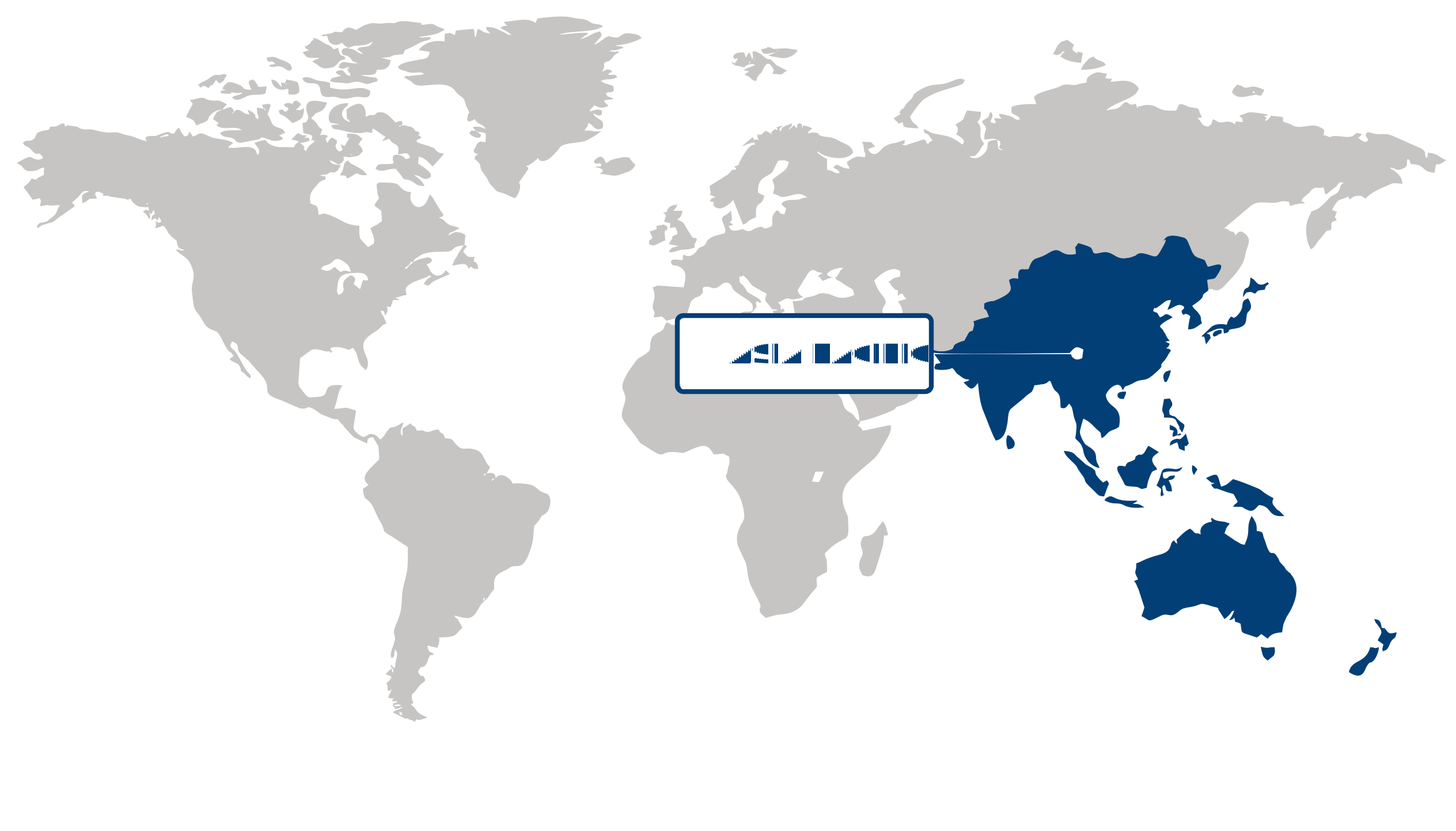
GPS (positioning system) chips market in Asia Pacific captured over 42.6% of the global market in 2025 and is expanding at a 21.96% CAGR, making it the largest and fastest-growing region. This leadership reflects the massive scale of smartphone assembly and the build-out of the BeiDou constellation: Hon Hai Precision Industry (Foxconn) and Pegatron volumes combined with China Satellite Navigation Office (CSNO) briefings on BeiDou capacity drive widespread multi-GNSS integration. MediaTek and Qualcomm press releases confirm chipset roadmaps adding BeiDou/GPS support, while the Chinese Ministry of Industry and Information Technology (MIIT) and OEMs such as Huawei Technologies are aligning procurement and product strategies. The confluence of scale, local supply chains and platform investment positions Asia Pacific for sustained growth in both high-volume and advanced GPS chip segments.
GPS (positioning system) chips market Japan is positioned as a pivotal hub in Asia Pacific through its focus on precision RF, low-power design and systems integration. Sony Semiconductor Solutions Corporation, Renesas Electronics Corporation and Murata Manufacturing publish targeted modules and RF front-end roadmaps aimed at automotive and industrial customers, and Japan’s Ministry of Economy, Trade and Industry (METI) programs for IoT and automotive electronics reinforce supplier specialization. Strong certification practices and OEM partnerships create premium demand for accuracy and reliability, offering regional partners high-margin opportunities and complementing Asia Pacific’s volume-driven segments.
GPS (positioning system) chips market China anchors regional scale via concentrated smartphone manufacturing and state-backed GNSS strategy. Hon Hai Precision Industry (Foxconn) and Pegatron drive assembly volumes while China Satellite Navigation Office (CSNO) and China National Space Administration announcements on BeiDou expansion accelerate device-level adoption; Qualcomm and MediaTek press releases show chipset makers enabling BeiDou/GPS multimode receivers. OEMs such as Huawei Technologies Co., Ltd. and Xiaomi leverage local supply chains and provincial procurement incentives to embed advanced GNSS features, reinforcing Asia Pacific’s appeal to suppliers targeting large-scale deployment and localized feature differentiation.
North America Market Analysis:
North America held a substantial share in the GPS (positioning system) chips market, supported by broad deployment across smartphones, automotive telematics, precision agriculture, and defense programs. Large local OEMs and IC vendors—Qualcomm and Broadcom among them—regularly highlight integrated GNSS capabilities in product announcements, while Garmin’s device portfolio and Apple’s location-service enhancements drive consumer expectations; public initiatives such as the U.S. Department of Transportation’s connected-vehicle pilots and the U.S. Space Force’s GPS modernization efforts further sustain demand. Supply-chain depth, proximity to major end-market customers, and strong R&D investment make the region a hub for high-precision, multi-band receiver development, creating sustained opportunities for suppliers focused on integration, power efficiency, and resilience.
The U.S. is the primary market center in North America for the GPS (positioning system) chips market, concentrating demand from consumer electronics, ADAS and telematics, and defense buyers. Technology leaders such as Qualcomm (product disclosures), Apple (product announcements), and Garmin (corporate releases) drive premium feature adoption, while policy actions—illustrated by the U.S. Department of Commerce’s CHIPS and Science Act incentives and procurement signals from the U.S. Space Force—shape local investment and production choices. Regulatory attention to vehicle safety from the National Highway Traffic Safety Administration and federal grants for connected infrastructure amplify demand for certified, robust GNSS solutions, making the U.S. a strategic launchpad for differentiated, compliant chipsets that scale across North America.
Europe Market Trends:
The GPS (positioning system) chips market in North America has maintained notable presence and is showing moderate growth driven by diversified end‑markets and policy incentives. Demand from automotive ADAS, consumer handsets and wearables, commercial drones, and defense modernization—illustrated by U.S. Space Force GPS III program activity—fuels adoption while Federal Communications Commission spectrum actions and CHIPS Act incentives from the U.S. Department of Commerce reshape supply and investment flows. Product roadmaps and multi‑band GNSS emphasis in Qualcomm and Broadcom announcements, and deployment examples from Garmin devices, underscore technical progression. These dynamics position North America as a high‑value opportunity for differentiated, high‑performance GNSS chipsets and integrated solutions.
The GPS (positioning system) chips market in the United States remains the primary regional engine, anchored by large OEMs and public procurement. U.S. demand is concentrated in smartphone and automotive integration (evidenced by Apple and Qualcomm device platforms), defense and space modernization through the U.S. Space Force, and FAA‑driven unmanned aircraft integration programs; procurement and R&D commitments from these institutions drive higher‑margin multi‑band and anti‑jamming chip requirements. For investors and suppliers, the implication is to prioritize partnerships with U.S. OEMs and defense primes and to align roadmaps with federal procurement cycles.
The GPS (positioning system) chips market in Canada plays a complementary, niche‑driven role focused on industrial, agricultural, and geospatial applications. Transport Canada regulatory steps for UAVs, Natural Resources Canada mapping initiatives, and strong demand from mining and precision agriculture firms favor robust, ruggedized GNSS modules and local systems integration. Canadian research partnerships and procurement patterns favor reliability and integration services over mass mobile volumes; strategic entrants can capture share by targeting vertical solutions and collaborating with Canadian integrators to serve cross‑border North American projects.
| Parameter | North America | Asia Pacific | Europe | Latin America | MEA |
|---|---|---|---|---|---|
| Innovation Hub i Scale Nascent Developing Advanced | |||||
| Cost-Sensitive Region i Scale Low Medium High | |||||
| Regulatory Environment i Scale Restrictive Neutral Supportive | |||||
| Demand Drivers i Scale Weak Moderate Strong | |||||
| Development Stage i Scale Emerging Developing Developed | |||||
| Adoption Rate i Scale Low Medium High | |||||
| New Entrants / Startups i Scale Sparse Moderate Dense | |||||
| Macro Indicators i Scale Weak Stable Strong |
Segment Leadership and Growth Trends
GPS (Positioning System) Chips Market Share (%), by Product Type, 2026
Go beyond the chart, access full insights & data tables
Request Free Sample ReportProfessional type represented largest share of the GPS (positioning system) chips market in 2025 within the Product Type segments. Leadership is driven by high‑precision, multi‑band functionality required for automotive, aerospace and industrial use cases; vendors such as Trimble and u‑blox and chipset makers like Qualcomm have emphasized multi‑band GNSS in product announcements as enabling accuracy and robustness. Demand patterns for safety‑critical positioning, tighter regulatory safety standards and supply‑chain collaborations with Tier‑1 integrators reinforce incumbents, while startups can capture niche RTK and sensor‑fusion opportunities. Continued investments in ADAS, autonomous systems and industrial automation underpin near‑to‑medium‑term relevance.
Analysis by Application
Navigation held largest share of the GPS (positioning system) chips market in 2025 within the Application segments. Growth is propelled by expanding navigation use across automotive, mobile and transport fleets, reflected in ecosystem activity from Google Maps, TomTom and policy support from the U.S. Department of Transportation for connected mobility pilots. Consumer preference for seamless location services, logistics digitization and mapping platform partnerships shape procurement and competitive dynamics. This creates strategic openings for map providers, semiconductor suppliers and software integrators to bundle services, and continued rollout of connected vehicle and smart‑city programs will sustain demand.
Analysis by End User
Consumer electronics dominated the GPS (positioning system) chips market in 2025 within the End User segments. The segment leads because GPS functionality is ubiquitous in smartphones, wearables and consumer IoT—examples include Apple’s iPhone and Apple Watch product features and Qualcomm’s GNSS capabilities in mobile platforms—driving scale, power‑efficiency optimization and competitive supplier consolidation. Demographic adoption, demand for location‑based services and sustainability pressures on battery life and sourcing influence design choices. Established OEMs and nimble device makers can monetize location features and services, and growth in AR, fitness tracking and pervasive LBS supports sustained relevance.
| Segment | Sub-Segment | Largest Segment | Fastest Growing |
|---|---|---|---|
| Product Type | Simple Type, Professional Type, Others | ||
| Application | Navigation, Mobile Phone, Others | ||
| End User | Consumer Electronics, Automotive, Military and Defense, Transportation, Aerospace, Others |
Competitive Landscape and Market Positioning
The competitive environment is defined by portfolio enrichment, tighter chip-to-module integration, and intensified emphasis on multi-constellation, low-power, and high-precision designs. Top players are strengthening system-level propositions through targeted partnerships and bolt-on capabilities, refreshing silicon with enhanced positioning and anti-interference features, and embedding software and sensor-fusion stacks to win platform deals. These moves compress differentiation toward integrated suppliers while opening niches for specialists who combine certification depth and regional supply agility.
Strategic / Actionable Recommendations for Regional Players
Leverage proximity to major OEMs and hyperscalers by embedding high-precision, low-power positioning into edge compute and sensor-fusion stacks; pursue selective technical tie-ups to secure system-level design wins with automotive and industrial integrators.
Align closely with large device manufacturers and module houses to optimize cost-performance for mobile and IoT volumes; shorten time-to-market through local partnerships and component sourcing to capture mass-market share.
Differentiate through compliance-focused, automotive-grade offerings and robust anti-jamming/multi-constellation capabilities; engage with vehicle suppliers and standards groups to accelerate certification and position for safety-critical applications.
| Company | Market Share | Company Revenue | Revenue CAGR (%) | Product Portfolio | Geographic Presence | Innovation / R&D Focus | Strategic Developments |
|---|---|---|---|---|---|---|---|
| No companies available. | |||||||
Industry Development/News
| Company Name | Date | Key Development |
|---|
Customize Your Report
Explore examples of how this report can be tailored to different research needs, including custom segments, additional topics or chapters, and related reports. Click a section of the wheel or its numbered marker to explore the available options.
GPS (Positioning System) Chips Market — Custom Segments
| Segment | Sub-Segment |
|---|---|
| No segment data available. | |
GPS (Positioning System) Chips Market — Custom TOC
| Custom Chapter | Custom Details | ||
|---|---|---|---|
| No custom TOC data available. | |||
Need a different cut of the data?
Request Custom ResearchHow much revenue does the GPS chips market generate?
How much is the GPS (positioning system) chips industry expected to grow by 2035?
In which region is the GPS (positioning system) chips market share the greatest?
What is the fastest growing region in the GPS chips sector?
Why does professional type sub-segment dominate the product type segment of GPS (positioning system) chips sector?
How much is the navigation segment expected to grow in the GPS (positioning system) chips industry beyond 2025?
What factors give consumer electronics segment a competitive edge in the GPS (positioning system) chips sector?
What are the prominent companies operating in the GPS (positioning system) chips landscape?
Our Clients
"Working with FBI has been a good experience. The market report provided a holistic view, covering everything from emerging trends to potential risks."
Semtech Corporation
"The experience was highly positive. The team showcased remarkable flexibility in adapting to our specific needs and delivered report that perfectly aligned with all our requirements."
TSMC
"What really stood out to me was how clearly and promptly the Fundamental Business Insights team communicated throughout. It made the collaboration feel effortless."
NXP Semiconductors
Our Research Team & Methodology
Every Fundamental Business Insights report is built by a dedicated vertical research team, validated through a structured primary-and-secondary methodology, and reviewed for accuracy before it reaches you.
Research Team Overview
Prepared by the Electronics & Semiconductors Research Team
Delivery
Published
Demand
Available
Support
Trust & Compliance
Research Domains
10 coverage areasResearch Intelligence
| Source | Reference |
|---|---|
| Semiconductor Industry Association (SIA) | www.semiconductors.org |
| SEMI | www.semi.org |
| JEDEC Solid State Technology Association | www.jedec.org |
| IEEE | www.ieee.org |
| IPC – Association Connecting Electronics Industries | www.ipc.org |
| International Electrotechnical Commission (IEC) | www.iec.ch |
| International Organization for Standardization (ISO) | www.iso.org |
| U.S. Bureau of Industry and Security (BIS) | www.bis.gov |
| U.S. Patent and Trademark Office (USPTO) | www.uspto.gov |
| European Patent Office (EPO) | www.epo.org |
| Taiwan Semiconductor Industry Association (TSIA) | www.tsia.org.tw |
| World Semiconductor Trade Statistics (WSTS) | www.wsts.org |
| International Energy Agency (IEA) | www.iea.org |
| GSMA | www.gsma.com |
| 3GPP | www.3gpp.org |
| ITU (International Telecommunication Union) | www.itu.int |
| Omdia (public insights) | omdia.tech.informa.com |
| Display Supply Chain Consultants (DSCC) | www.displaysupplychain.com |
| U.S. Department of Energy (DOE) | www.energy.gov |
| NIST (National Institute of Standards and Technology) | www.nist.gov |
Research Workflow & Quality Assurance
Data Collection
Verified information gathered through primary and secondary research.
Data Triangulation
Cross-validation using multiple independent data sources.
Forecast Modelling
Market estimates developed using historical trends and analytical models.
Analyst Validation
Findings reviewed by domain experts for accuracy and consistency.
Editorial & Quality Review
Final editorial, quality, and compliance checks before publication.
Final Publication
Released after successful completion of the internal review process.
Report Coverage
📊 Market Assessment
- Market Size & Forecast
- Market Segmentation
- Regional Analysis
- Growth Drivers & Challenges
- Market Dynamics
🏢 Competitive Intelligence
- Competitive Landscape
- Company Profiles
- Competitive Benchmarking
- Mergers & Acquisitions
- Market Share Analysis or Key Company Strategies
🔍 Strategic Analysis
- Value Chain Analysis
- Porter's Five Forces
- PESTLE Analysis
- Pricing Trends
- Supply-Demand Analysis
🚀 Future Outlook
- Technology Landscape
- Regulatory Landscape
- Investment & Funding Landscape
- Emerging Opportunities
- Future Market Outlook
Have a question about this report or need a custom scope?
Request Customization