Gold Tin Eutectic Alloy Solder Market Size & Forecasts 2026-2035, By Segments (Type, Application), Growth Opportunities, Innovation Landscape, Regulatory Shifts, Strategic Regional Insights (U.S., Japan, China, South Korea, UK, Germany, France), and Competitive Dynamics (Indium Corporation, Kester, Nihon Superior, Senju Metal Industry, Aim Solder)
Market Size and Growth Outlook
Gold Tin Eutectic Alloy Solder Market size is expected to advance from USD 8.18 billion in 2025 to USD 13.58 billion by 2035, registering a CAGR of more than 5.2% across 2026-2035. By 2026, the industry is anticipated to generate USD 8.55 billion in revenue.
Get more details on this report
Request Free Sample ReportGold Tin Eutectic Alloy Solder Market Intelligence Snapshot
Regional Market Dynamics
Segment Momentum
Market Expansion Drivers
Leading Market Participants
Global Market Forecast Snapshot
Market Outlook
Regional and Segment Outlook
Market Growth Drivers and Industry Trends
The sustained order flow from Boeing and Airbus for avionics, combined with recurring consumer-product cycles led by Apple Inc. and Samsung Electronics Co., Ltd., is elevating requirements for reliable interconnects and thus tightening demand dynamics in the gold tin eutectic alloy solder market. Procurement standards issued by NASA and the U.S. Department of Defense emphasize traceability and qualification, shifting buyer behavior toward proven alloy systems. Established suppliers can leverage long-term aerospace qualification to lock in margins, while new entrants can pursue niche certification services and supply-chain agility. Given ongoing aircraft backlogs and frequent consumer hardware refreshes, demand signals for qualified eutectic solutions are likely to remain visible in procurement pipelines.
Advancements in high-reliability solder formulations
Material innovators such as Indium Corporation and Henkel are introducing alloy and flux systems that improve wetting, thermal tolerance, and joint integrity, directly impacting adoption patterns in the gold tin eutectic alloy solder market. Standards activity from IPC (Association Connecting Electronics Industries) and qualification requirements from the U.S. Department of Defense are pushing suppliers to demonstrate elevated reliability performance, influencing R&D priorities and vendor selection. Incumbents can monetize IP and scale qualification services, while newcomers can compete on specialized chemistries and test-service offerings. As industry certification processes and published reliability criteria evolve, buyers will progressively favor suppliers that can document lifecycle performance.
Expansion in miniaturized and high-density electronics
Roadmaps from Intel Corporation and Taiwan Semiconductor Manufacturing Company (TSMC), and advanced-device launches by Apple Inc., are driving denser package geometries and finer pitch interconnects that increase the technical premium for materials in the gold tin eutectic alloy solder market. PCB fabricators and contract manufacturers adapting to high-density interconnect (HDI) and advanced packaging standards signal shifts in process requirements and assembly competence. Large material suppliers can invest in specialized process support and reflow profiles to retain OEM relationships, while agile entrants can capture share by offering niche micro-joining services and localized technical support. Observable commitments to advanced packaging from leading fabs suggest sustained alignment between miniaturization trends and demand for qualified eutectic solder solutions.
Industry Restraints:
Raw-material Price Volatility and Supply Concentration: Gold-tin eutectic solder economics are tightly constrained by pronounced gold price volatility and geographically concentrated tin supply, which raise input costs and procurement risk for manufacturers. World Gold Council and the London Bullion Market Association (LBMA) demonstrate persistent price swings driven by macro demand and investment flows, while the International Tin Association highlights production concentration in Indonesia, China, and Myanmar; U.S. Department of the Treasury actions and UNCTAD trade analyses have documented how sanctions and COVID-era disruptions exacerbate tin availability. Strategically, incumbent suppliers can mitigate through hedging, long-term metal contracts, or vertical integration, whereas new entrants face capital and margin pressure from volatile raw-material procurement. Near term, geopolitical tension and investor-driven metal demand will keep cost and sourcing risk a chronic restraint, forcing continued supplier diversification and contractual risk management.
Regulatory and Qualification Burdens: Stringent environmental, chemical and high-reliability qualification regimes slow adoption and raise implementation costs for AuSn eutectic solder. The European Commission RoHS Directive and European Chemicals Agency (ECHA) REACH requirements impose compliance and documentation burdens, IPC workmanship standards govern process controls, and Indium Corporation technical bulletins note the need for controlled, often fluxless vacuum processes for AuSn bonding. NASA Goddard Space Flight Center and other aerospace agencies demand lengthy qualification and traceability for space electronics, creating lengthy approval cycles. As a result, established firms with certification expertise and lab capacity gain a competitive advantage while newcomers face substantial upfront certification expense. Looking ahead, regulatory scrutiny and sector-specific qualification will remain a high barrier to scale, prompting continued investment in compliance infrastructure and selective use in critical, high-margin applications.
| Growth Driver | Impact on CAGR | Regulatory Influence | Geographic Relevance | Adoption Rate | Impact Timeline |
|---|---|---|---|---|---|
| Increasing demand in electronics and aerospace applications | 2.00% | Short term (≤ 2 yrs) | North America, Asia Pacific | Medium | Fast |
| Advancements in high-reliability solder formulations | 1.50% | Medium term (2–5 yrs) | Europe, North America | Medium | Moderate |
| Expansion in miniaturized and high-density electronics | 1.20% | Long term (5+ yrs) | Asia Pacific, Europe; Spillover: North America | Low | Slow |
Unlock insights tailored to your business with our bespoke market research solutions.
Click to get your customized report now.
Regional Demand Dynamics
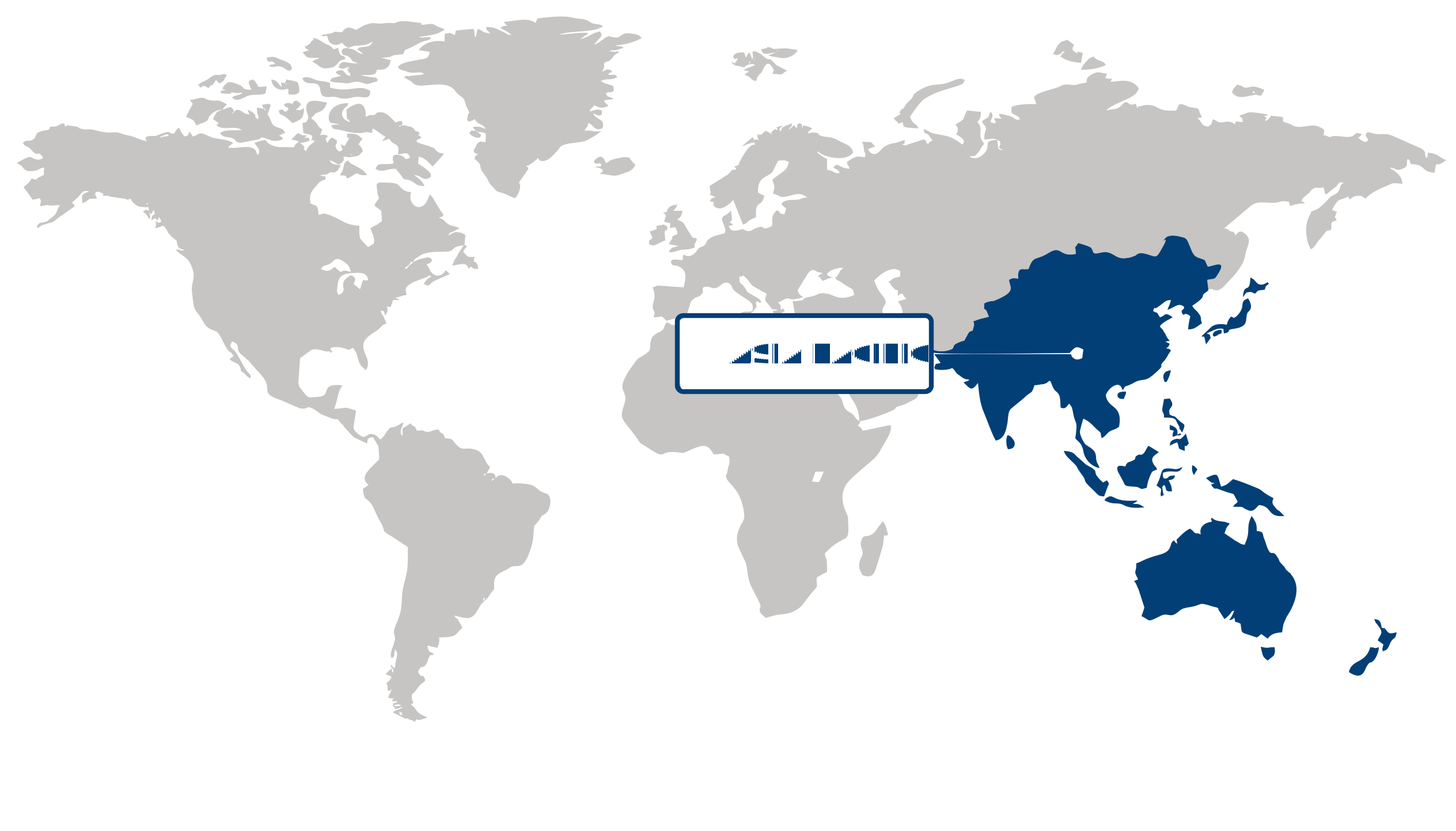
Asia Pacific captured approximately 55% of the global gold tin eutectic alloy solder market in 2025 and, with a 6% CAGR, stands as the largest and fastest-growing region; this leadership is rooted in concentrated semiconductor and electronics assembly capacity and expanding OSAT activity across the region. Major players and disclosures — Taiwan Semiconductor Manufacturing Company (TSMC) capacity expansions, Samsung Electronics production scaling, and ASE Technology Holding OSAT investment announcements — substantiate rising assembly throughput and higher yield requirements that favor eutectic solders. Policies from the Ministry of Industry and Information Technology (China) and targeted support from Japan’s Ministry of Economy, Trade and Industry (METI) further reinforce localized supply chains and quality standards. Given ongoing device miniaturization and industrial electrification, APAC presents sustained, high-value adoption opportunities for investors and suppliers.
Japan is positioned as a pivotal hub in Asia Pacific for the gold tin eutectic alloy solder market, leveraging a concentration of high-reliability electronics OEMs and materials-focused suppliers. Ministry of Economy, Trade and Industry (Japan) initiatives to bolster semiconductor supply resilience, coupled with product strategies from Renesas Electronics and Murata Manufacturing Co., Ltd., drive demand for solder solutions that meet automotive and industrial reliability requirements. Close collaboration between Japanese assemblers and specialty materials firms tightens specification cycles and accelerates qualification, offering premium-margin prospects for solder formulators and niche OSAT partnerships that reinforce regional leadership.
China anchors the Asia Pacific market for the gold tin eutectic alloy solder market, delivering scale through dense contract manufacturing clusters and growing domestic OSAT capacity. Support from the Ministry of Industry and Information Technology (China), capacity expansion at foundries such as SMIC, and packaging growth from JCET Group illustrate how volume-driven assembly and local qualification programs are expanding solder consumption. Cost-competitive manufacturing, intense local competition, and regulatory emphasis on supply-chain security create opportunities for suppliers that can combine scale, consistent quality, and sustainability credentials, strengthening China’s role in sustaining APAC market growth.
North America Market Analysis:
North America experienced lucrative growth in the gold tin eutectic alloy solder market, supported by a convergence of semiconductor reshoring, defense modernization, and increased medical- and photonics-grade electronics demand. Policy stimuli such as the CHIPS and Science Act (U.S. Department of Commerce) are catalyzing new wafer and packaging capacity in the region, while mission-critical programs and procurement standards from the U.S. Department of Defense and technical guidance available on the NASA Technical Reports Server (NTRS) underline the continued preference for AuSn in high-reliability joins. Suppliers are responding with tighter quality controls and local inventories to reduce lead times, and major OEMs’ announcements on domestic capacity expansion signal durable commercial demand. Taken together, these dynamics position North America as a strategic market offering premium, defense- and space-qualified opportunities for gold tin eutectic alloy solder suppliers and integrators.
U.S. serves as the principal innovation and procurement hub in the gold tin eutectic alloy solder market, where federal incentives and corporate capital expenditures reinforce domestic uptake. The U.S. Department of Commerce’s CHIPS incentives and Intel’s recent U.S. fabrication investment announcements have increased local packaging and assembly activity, while defense prime contractors such as Lockheed Martin and Raytheon Technologies publicly emphasize high-reliability sourcing tied to MIL specifications. Concurrently, FDA-regulated medical-device manufacturers (for example, Medtronic) require traceable materials and validated processes that favor AuSn for longevity and biocompatibility. Strategically, U.S. policy-driven demand and stringent procurement requirements create a reliable customer base that amplifies North American supplier scale and specialization in gold tin eutectic alloy solder solutions.
Europe Market Trends:
gold tin eutectic alloy solder market held a substantial share in North America, underpinned by deep aerospace and defense procurement, a concentration of advanced electronics manufacturing, and resilient capital investment patterns. Evidence includes NASA technical publications documenting Au–Sn use in spaceborne assemblies and U.S. Department of Defense procurement guidance favoring high-reliability solders; IPC standards and U.S. Department of Commerce trade data reflect strong commercial demand from semiconductor packaging and medical devices. Regulatory attention from the U.S. Environmental Protection Agency on material lifecycle and several corporate press releases from major OEMs citing reliability-driven material choices further illustrate the region’s preference for Au–Sn solutions, positioning North America for ongoing premium-solder opportunities as complex systems proliferate.
gold tin eutectic alloy solder market in the United States plays a lead role as the regional innovation and procurement hub, where semiconductor advanced packaging and defense reliability requirements drive adoption. U.S. Department of Defense contracts and IPC standardization initiatives create predictable demand corridors, while announcements from large electronics OEMs and packaging suppliers (reflected in press releases and conference disclosures) show migration to eutectic Au–Sn for high-reliability joints. The strategic implication is that U.S. manufacturing scale and procurement policies will continue to anchor regional supply chains and justify investment in upstream metallurgical capacity.
gold tin eutectic alloy solder market in Canada occupies a specialized but influential role, concentrated in aerospace, medical devices, and research-driven manufacturing. National Research Council Canada studies on intermetallic behavior and Aerospace Industries Association of Canada commentary on supply‑chain resilience highlight targeted technology adoption; Health Canada regulatory oversight supports safe materials management. Canada’s strength in niche, certified assemblies and collaborative R&D creates opportunity for suppliers to win higher‑margin, qualification‑heavy workstreams that complement broader North American demand.
| Parameter | North America | Asia Pacific | Europe | Latin America | MEA |
|---|---|---|---|---|---|
| Innovation Hub i Scale Nascent Developing Advanced | |||||
| Cost-Sensitive Region i Scale Low Medium High | |||||
| Regulatory Environment i Scale Restrictive Neutral Supportive | |||||
| Demand Drivers i Scale Weak Moderate Strong | |||||
| Development Stage i Scale Emerging Developing Developed | |||||
| Adoption Rate i Scale Low Medium High | |||||
| New Entrants / Startups i Scale Sparse Moderate Dense | |||||
| Macro Indicators i Scale Weak Stable Strong |
Segment Leadership and Growth Trends
Gold Tin Eutectic Alloy Solder Market Share (%), by Type, 2026
Go beyond the chart, access full insights & data tables
Request Free Sample ReportPreform Solder represented largest share of the gold tin eutectic alloy solder market in 2025, reflecting its preferred form factor for consistent, high-reliability joints in microelectronics and aerospace assemblies. Leadership stems from its fit with the largest segment growth driver — strong use in high-reliability microelectronics and aerospace — as reinforced by NASA Jet Propulsion Laboratory materials notes and ASTM International guidance on solder preforms; these sources highlight geometric control, reduced voiding and predictable thermal mass. Preference for repeatable yields, stringent defense and space qualification pathways, and supplier investments in automated placement favor incumbents while opening niche design and service opportunities for agile entrants. Given continuing avionics and space program procurement cycles and stricter reliability standards, preform demand should stay durable near term.
Analysis by Application
Electronics held largest share of the gold tin eutectic alloy solder market in 2025, driven by rising requirements for high-performance soldering in semiconductor packaging and optoelectronics. This leadership aligns with the largest segment growth driver — demand from semiconductor packaging and optoelectronics — and is evidenced by Intel packaging briefs and TSMC technology roadmaps emphasizing advanced interconnect reliability, together with IPC J-STD-001 standards that shape manufacturing practice. Shifts toward miniaturization, higher I/O density, and supply-chain qualification programs favor suppliers that can certify consistency; established material suppliers gain scale advantages while specialized formulators can capture niche optoelectronic segments. Ongoing advances in packaging and sustained demand for reliable photonic and chip-scale assemblies point to continued relevance in the near to medium term.
| Segment | Sub-Segment | Largest Segment | Fastest Growing |
|---|---|---|---|
| Type | Bar Solder, Wire Solder, Flux-Cored Solder, Paste Solder, Preform Solder | ||
| Application | Automotive, Electronics, Aerospace, Telecommunications, Medical Equipment |
Competitive Landscape and Market Positioning
The competitive environment is marked by targeted moves to enhance application fit and supply continuity: several leaders are broadening alloy portfolios and tightening collaboration with EMS and semiconductor customers, while others are extending technical support, qualification services, and localized production footprints. Joint development efforts, selective portfolio consolidations, and heavier investment in process control and plating technologies are reshaping differentiation—driving faster validation cycles, higher switching costs for buyers, and clearer segmentation between commodity and high‑reliability offerings across the Top 10.
Strategic / Actionable Recommendations for Regional Players
North America: Prioritize closer engagements with defense, aerospace, and semiconductor OEMs to embed materials early in qualification workflows, expand localized R&D on process controls and reliability testing, and align supply agreements to demonstrate responsiveness to high‑value customers.
Asia Pacific: Accelerate capacity flexibility and partnerships with large EMS and consumer electronics assemblers, focus development on fine‑pitch and high‑throughput plating practices, and invest in automation and qualification services tailored to automotive and telecom suppliers.
Europe: Leverage chemical formulation expertise and sustainability credentials to win industrial and aerospace contracts, collaborate with surface‑treatment and electronics system providers for integrated solutions, and deploy digital traceability and compliance capabilities to ease customer qualification burdens.
| Company | Market Share | Company Revenue | Revenue CAGR (%) | Product Portfolio | Geographic Presence | Innovation / R&D Focus | Strategic Developments |
|---|---|---|---|---|---|---|---|
| No companies available. | |||||||
Industry Development/News
| Company Name | Date | Key Development |
|---|
Customize Your Report
Explore examples of how this report can be tailored to different research needs, including custom segments, additional topics or chapters, and related reports. Click a section of the wheel or its numbered marker to explore the available options.
Gold Tin Eutectic Alloy Solder Market — Custom Segments
| Segment | Sub-Segment |
|---|---|
| No segment data available. | |
Gold Tin Eutectic Alloy Solder Market — Custom TOC
| Custom Chapter | Custom Details | ||
|---|---|---|---|
| No custom TOC data available. | |||
Need a different cut of the data?
Request Custom ResearchWhat is the current revenue of the gold tin eutectic alloy solder market?
What is the projected value of the gold tin eutectic alloy solder industry by 2035?
Which territory dominates the gold tin eutectic alloy solder market share rankings?
In which region is the gold tin eutectic alloy solder sector expanding at the quickest pace?
Why does preform solder sub-segment dominate the type segment of gold tin eutectic alloy solder sector?
How does electronics segment fare in the gold tin eutectic alloy solder industry?
Which companies are driving growth in the gold tin eutectic alloy solder landscape?
Our Clients
"Working with FBI has been a good experience. The market report provided a holistic view, covering everything from emerging trends to potential risks."
Semtech Corporation
"The experience was highly positive. The team showcased remarkable flexibility in adapting to our specific needs and delivered report that perfectly aligned with all our requirements."
TSMC
"What really stood out to me was how clearly and promptly the Fundamental Business Insights team communicated throughout. It made the collaboration feel effortless."
NXP Semiconductors
Our Research Team & Methodology
Every Fundamental Business Insights report is built by a dedicated vertical research team, validated through a structured primary-and-secondary methodology, and reviewed for accuracy before it reaches you.
Research Team Overview
Prepared by the Electronics & Semiconductors Research Team
Delivery
Published
Demand
Available
Support
Trust & Compliance
Research Domains
10 coverage areasResearch Intelligence
| Source | Reference |
|---|---|
| Semiconductor Industry Association (SIA) | www.semiconductors.org |
| SEMI | www.semi.org |
| JEDEC Solid State Technology Association | www.jedec.org |
| IEEE | www.ieee.org |
| IPC – Association Connecting Electronics Industries | www.ipc.org |
| International Electrotechnical Commission (IEC) | www.iec.ch |
| International Organization for Standardization (ISO) | www.iso.org |
| U.S. Bureau of Industry and Security (BIS) | www.bis.gov |
| U.S. Patent and Trademark Office (USPTO) | www.uspto.gov |
| European Patent Office (EPO) | www.epo.org |
| Taiwan Semiconductor Industry Association (TSIA) | www.tsia.org.tw |
| World Semiconductor Trade Statistics (WSTS) | www.wsts.org |
| International Energy Agency (IEA) | www.iea.org |
| GSMA | www.gsma.com |
| 3GPP | www.3gpp.org |
| ITU (International Telecommunication Union) | www.itu.int |
| Omdia (public insights) | omdia.tech.informa.com |
| Display Supply Chain Consultants (DSCC) | www.displaysupplychain.com |
| U.S. Department of Energy (DOE) | www.energy.gov |
| NIST (National Institute of Standards and Technology) | www.nist.gov |
Research Workflow & Quality Assurance
Data Collection
Verified information gathered through primary and secondary research.
Data Triangulation
Cross-validation using multiple independent data sources.
Forecast Modelling
Market estimates developed using historical trends and analytical models.
Analyst Validation
Findings reviewed by domain experts for accuracy and consistency.
Editorial & Quality Review
Final editorial, quality, and compliance checks before publication.
Final Publication
Released after successful completion of the internal review process.
Report Coverage
📊 Market Assessment
- Market Size & Forecast
- Market Segmentation
- Regional Analysis
- Growth Drivers & Challenges
- Market Dynamics
🏢 Competitive Intelligence
- Competitive Landscape
- Company Profiles
- Competitive Benchmarking
- Mergers & Acquisitions
- Market Share Analysis or Key Company Strategies
🔍 Strategic Analysis
- Value Chain Analysis
- Porter's Five Forces
- PESTLE Analysis
- Pricing Trends
- Supply-Demand Analysis
🚀 Future Outlook
- Technology Landscape
- Regulatory Landscape
- Investment & Funding Landscape
- Emerging Opportunities
- Future Market Outlook
Have a question about this report or need a custom scope?
Request Customization