Glass Mold Market Size & Forecasts 2026-2035, By Segments (Mold Type, End-User), Growth Opportunities, Innovation Landscape, Regulatory Shifts, Strategic Regional Insights (U.S., Japan, China, South Korea, UK, Germany, France), and Competitive Dynamics (Emhart Teknologies, Otto Hofstetter AG, HORN Glass Industries, Wiegand-Glas, Tschorn)
Market Size and Growth Outlook
Glass Mold Market size is forecast to climb from USD 939.84 million in 2025 to USD 1.58 billion by 2035, expanding at a CAGR of over 5.3% during 2026-2035. Industry revenue in 2026 is projected at USD 982.99 million.
Get more details on this report
Request Free Sample ReportGlass Mold Market Intelligence Snapshot
Regional Market Dynamics
Segment Momentum
Market Expansion Drivers
Leading Market Participants
Global Market Forecast Snapshot
Market Outlook
Regional and Segment Outlook
Market Growth Drivers and Industry Trends
Growth in single-serve and premium glass containers driven by brand initiatives and packaging regulation is expanding demand for specialized tooling; the European Commission’s Packaging and Packaging Waste Directive and sustainability commitments from Coca-Cola Company and Nestlé signal continued emphasis on reusable and fully recyclable formats. This dynamic reshapes the glass mold market by favoring molds that support lightweighting, novelty shapes, and faster changeovers to serve seasonal SKUs. Established moldmakers can scale standardized, high-throughput lines and offer sustainability-certified tooling, while new entrants can win niche contracts with bespoke designs and regional just-in-time services. Observable regulatory momentum and major brand roadmaps point to sustained demand for innovative packaging molds.
Increasing Automotive Glass Applications
Automakers are integrating larger, multifunctional glass elements—panoramic roofs, HUD-capable windshields, sensor-friendly glazing—illustrated by product strategies from Tesla, Inc., BMW Group, and Toyota Motor Corporation, which increases requirements for precision tooling and surface quality. The shift intensifies pressure on the glass mold market for tight-tolerance, thermally stable molds and integrated finishing processes to meet safety and optical standards cited by Euro NCAP and vehicle OEM specifications. Incumbents can differentiate through validated process control and Tier-1 OEM partnerships; newcomers can capture value by offering specialized coatings, inspection technologies, or regionalized capacity. Given current vehicle design trends and OEM announcements, demand for advanced automotive glass molds will remain an area of technical investment.
Technological Improvements in Mold Design
Adoption of generative design, simulation, and additive manufacturing—demonstrated by Autodesk (Autodesk Moldflow, generative workflows), Siemens Digital Industries (NX and digital twin solutions), and EOS for AM tooling—reduces lead times and enables complex geometries that were previously impractical. These advances transform the glass mold market by lowering prototyping costs, improving lifecycle simulation, and enabling modular inserts for quicker iteration. Large suppliers can leverage digital twins and end-to-end PLM to offer premium, data-backed services; start-ups can exploit 3D-printed core/drill inserts and cloud-based design services to win low-volume, high-complexity work. Continued rollout of software-integrated toolchains and industrial AM equipment indicates an accelerating shift toward digitally enabled mold production.
Industry Restraints:
Supply Chain Constraints for Specialty Tool Steels and Components: The glass mold market is constrained by long lead times and limited availability of high-performance tool steels, precision CNC components, and imported subassemblies, which slows tooling refresh and increases production cycle times. The World Steel Association has documented supply tightness for specialty steels, and Maersk has repeatedly reported port congestion and container shortages that raise delivery variability. For manufacturers this raises working-capital burdens and forces longer qualification cycles for alternate suppliers; for new entrants it creates higher up-front inventory and onboarding costs. Strategically, firms are pushed toward supplier diversification, local sourcing, or vertical integration. Near term, persistent logistics volatility and material tightness—absent major capacity additions—will continue to limit responsiveness and raise procurement-driven risk premiums for glass mold producers.
Environmental and Regulatory Compliance Pressures: Stricter emissions and energy-efficiency requirements are increasing the cost and complexity of mold production, particularly for heat-treatment and high-energy machining processes. The European Commission’s Green Deal initiatives, the U.S. Environmental Protection Agency’s industrial emissions focus, and enforcement actions from the China Ministry of Ecology and Environment signal tighter permitting and compliance monitoring for energy-intensive facilities. This compels capital investment in cleaner furnaces and monitoring systems, advantaging larger incumbents able to finance retrofits while raising entry barriers for smaller shops. Strategically, firms must weigh capex for decarbonization against margin pressure; in the medium term, regulatory tightening will accelerate consolidation and favor suppliers that can certify lower-carbon production or offer modular outsourcing to compliance-burdened customers.
| Growth Driver | Impact on CAGR | Regulatory Influence | Geographic Relevance | Adoption Rate | Impact Timeline |
|---|---|---|---|---|---|
| Expansion of beverage and food packaging | 2.00% | Short term (≤ 2 yrs) | Europe, North America | Medium | Fast |
| Increasing automotive glass applications | 1.50% | Medium term (2–5 yrs) | Asia Pacific, North America | Low | Moderate |
| Technological improvements in mold design | 1.00% | Long term (5+ yrs) | Europe (Primary), Asia Pacific (Spillover) | Low | Slow |
Unlock insights tailored to your business with our bespoke market research solutions.
Click to get your customized report now.
Regional Demand Dynamics
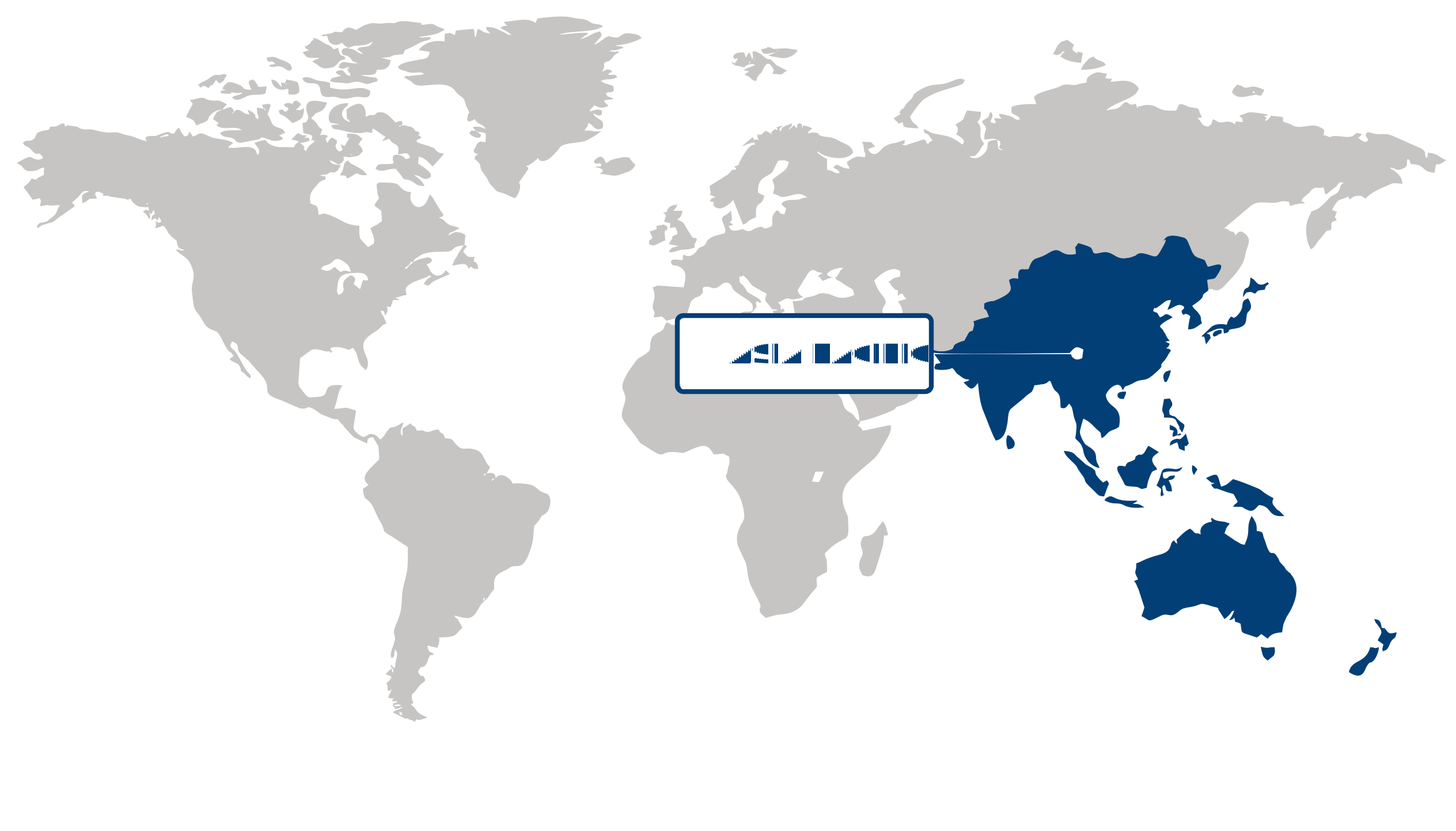
Asia Pacific captured over 41% of the global glass mold market in 2025 and is the largest regional hub, driven chiefly by high-volume glass container production in major manufacturing centers such as China and India. Rapid scale-up in container lines, investments in automated forming and energy-efficiency, and rising demand for beverage and pharmaceutical packaging underpin leadership—supported by data from the China National Bureau of Statistics on industrial glass output and production policy signals from the Ministry of Commerce & Industry, Government of India. Corporate moves by large regional manufacturers and suppliers illustrate commercial momentum. Given continued industrial investment and supply-chain consolidation, the region presents sustained opportunities for suppliers of high-throughput and sustainable mold solutions.
Japan is positioned as a pivotal hub in Asia Pacific for the glass mold market, supplying high-precision tooling and process innovation that service premium beverage, pharmaceutical, and electronics customers. Japan’s emphasis on advanced materials and precision engineering is reflected in technology investments by AGC Inc. and Nippon Electric Glass and policy support from the Ministry of Economy, Trade and Industry (METI). These capabilities make Japan a strategic partner for scale manufacturers in China and India seeking quality upgrades, enabling cross-border supplier partnerships that reinforce regional value chains.
China anchors Asia Pacific manufacturing for the glass mold market, providing the volume backbone through extensive container production, clustered suppliers, and cost-efficient tooling scale-up. Production and capacity trends reported by the China National Bureau of Statistics and industrial guidance from the Ministry of Industry and Information Technology of the People’s Republic of China align with corporate expansion by major glass producers. For investors and strategists, China’s scale and India-linked demand dynamics create platforms for modular capacity investments, localized service networks, and long-term supply contracts that amplify regional market capture.
Europe Market Analysis:
glass mold market in Europe emerged as the fastest-growing region at a CAGR of 6.36%, propelled by strong demand for premium glass packaging in the beverage and cosmetics sectors. Premiumization by brands and regulatory shifts toward recyclability—highlighted in the European Commission Circular Economy Action Plan—are raising technical and aesthetic requirements for molds; L'Oréal's packaging sustainability commitments and capacity moves by Ardagh Group and Verallia illustrate commercial demand for higher-precision, decorative tooling. Combined with investments in automation and digital mold design from regional suppliers, Europe offers concentrated demand and supplier capability. This mix creates near-term opportunities for specialized tooling, digital inspection, and low-carbon material choices that capture luxury and sustainability-led procurement.
glass mold market in Germany anchors European precision tooling capability and a strong premium beverage and specialty cosmetics supply base. Beiersdorf's packaging initiatives and statements from the Verband Deutscher Maschinen- und Anlagenbau (VDMA) on advanced tooling underscore a national focus on high-precision, repeatable mold production; the Umweltbundesamt’s recycling and packaging guidelines further tilt procurement toward glass. Germany’s Mittelstand mold makers and advanced machine-tool ecosystem enable tight lead times and custom finishes demanded by premium brewers and niche cosmetics houses. Strategically, Germany serves as a manufacturing hub where tooling quality and proximity to upstream brands reinforce regional leadership in premium glass mold solutions.
glass mold market in France benefits from close alignment with luxury cosmetics and spirits clusters where packaging is a key brand differentiator. L'Oréal and several luxury groups (e.g., LVMH) have public commitments around premium, sustainable packaging, and Verallia’s French operations emphasize innovation in decorative and lightweight glass containers—signals that demand for complex, high-value molds will persist. ADEME’s guidance on circular packaging further supports glass adoption in premium segments. France’s concentration of brand owners and specialist glassmakers makes it a focal market for decorative finishes, collaborative design-to-mold services, and pilot programs linking sustainability targets to tooling specifications, reinforcing Europe-wide growth dynamics.
North America Market Trends:
North America maintained notable presence in the glass mold market, anchored by dense container and specialty-glass manufacturing hubs that support packaging, pharmaceutical, and industrial demand. Demand shifts toward sustainable packaging and circularity—highlighted by the Glass Packaging Institute’s advocacy for recyclability—and regulatory and energy-efficiency priorities reflected in U.S. Environmental Protection Agency guidance have prompted modernization of tooling and process controls. Supply-chain resiliency and reshoring incentives noted by the U.S. Department of Commerce have accelerated capital deployment, while manufacturers such as Owens-Illinois (O-I) have announced plant investments and modernization in North America. These dynamics create near-term opportunities in high-precision molds, retrofit services, and eco-design tooling for investors and suppliers.
The U.S. serves as the regional growth engine in the glass mold market, where automation, additive tooling prototypes, and high-specification molds are concentrating activity. Corporate press releases from Corning Incorporated and Owens-Illinois illustrate capacity investments and product-application expansion, and SelectUSA and the U.S. Department of Commerce point to continued manufacturing investment attraction. Skilled workforce initiatives and supplier clusters in key states are enabling faster technology adoption and shorter lead times, implying that U.S.-focused partnerships and localized supply strategies will be strategic levers for regional scale and innovation.
| Parameter | North America | Asia Pacific | Europe | Latin America | MEA |
|---|---|---|---|---|---|
| Innovation Hub i Scale Nascent Developing Advanced | |||||
| Cost-Sensitive Region i Scale Low Medium High | |||||
| Regulatory Environment i Scale Restrictive Neutral Supportive | |||||
| Demand Drivers i Scale Weak Moderate Strong | |||||
| Development Stage i Scale Emerging Developing Developed | |||||
| Adoption Rate i Scale Low Medium High | |||||
| New Entrants / Startups i Scale Sparse Moderate Dense | |||||
| Macro Indicators i Scale Weak Stable Strong |
Segment Leadership and Growth Trends
Glass Mold Market Share (%), by Mold Type, 2026
Go beyond the chart, access full insights & data tables
Request Free Sample ReportOrdinary cast iron mold held largest share in the glass mold market in 2025, driven by the widespread use of inexpensive ordinary cast iron molds for mass‑production of glass containers globally. This segment leads among mold segments because low capital and maintenance costs, compatibility with existing forming lines, and ease of refurbishment support high-volume operations and resilient supply chains. Industry participants such as Emhart Glass and the European Container Glass Federation (FEVE) note continued deployment of robust, low-cost tooling in container plants. Strategic advantages include aftermarket refurbishment services for incumbents and niche tooling innovations for new entrants; sustained relevance is expected as producers prioritize cost-efficiency and repairable tooling in circular packaging systems.
Analysis by End-User
Food & Beverages represented largest share in the glass mold market in 2025, driven by increasing demand for glass moulds from the food & beverages industry as consumer preference for premium, sustainable glass packaging rises, boosting production of bottles and containers. This segment leads within end‑user segments because brand premiumization, recyclability mandates and retail shifts toward reusable packaging increase run-rates for specialty molds. Organizations such as the European Commission (packaging directives) and the Ellen MacArthur Foundation (circular economy advocacy), alongside supplier signals from Owens-Illinois, reinforce the move to glass. Opportunities include partnerships with beverage leaders for bespoke molds and lightweighting solutions for entrants; the segment should remain central as regulatory and consumer pressures favor recyclable, premium packaging.
| Segment | Sub-Segment | Largest Segment | Fastest Growing |
|---|---|---|---|
| Mold Type | Alloy Cast Iron Mold, Ordinary Cast Iron Mold | ||
| End-User | Food & Beverages, Healthcare, Chemicals |
Competitive Landscape and Market Positioning
The competitive landscape reflects concentrated moves to broaden capabilities and shorten development cycles: leading firms have integrated complementary capabilities, expanded service footprints, and introduced next-generation tooling and digital design flows. Sustained emphasis on automation, surface engineering, and faster prototyping is differentiating suppliers, while coordinated access to end customers and enhanced aftercare offerings are reinforcing retention; collectively these initiatives push technical differentiation and elevate entry thresholds for smaller vendors.
Strategic / Actionable Recommendations for Regional Players
In North America prioritize tighter engagement with OEMs and bottlers through co-development and rapid prototyping, adopt digital simulation and on‑demand machining to reduce lead times, and scale regional capacity selectively to capture time-sensitive orders.
In Asia Pacific leverage volume production strengths by embedding advanced CNC and surface treatments, pursue selective commercial partnerships with regional packagers to access high-growth segments, and focus on pharmaceutical and specialty container niches where precision commands premium returns.
In Europe build on precision-engineering heritage by accelerating end-to-end digital design-to-manufacture workflows, deepen value-added service and customization offerings, and collaborate with regional toolmakers to protect margins against low-cost competition.
| Company | Market Share | Company Revenue | Revenue CAGR (%) | Product Portfolio | Geographic Presence | Innovation / R&D Focus | Strategic Developments |
|---|---|---|---|---|---|---|---|
| No companies available. | |||||||
Industry Development/News
| Company Name | Date | Key Development |
|---|
Customize Your Report
Explore examples of how this report can be tailored to different research needs, including custom segments, additional topics or chapters, and related reports. Click a section of the wheel or its numbered marker to explore the available options.
Glass Mold Market — Custom Segments
| Segment | Sub-Segment |
|---|---|
| No segment data available. | |
Glass Mold Market — Custom TOC
| Custom Chapter | Custom Details | ||
|---|---|---|---|
| No custom TOC data available. | |||
Need a different cut of the data?
Request Custom ResearchWhat is the market valuation of glass mold?
What is the forecasted size of the glass mold industry?
Which territory demonstrates the strongest presence in the glass mold market?
Which region leads in terms of year-over-year growth for the glass mold sector?
Where is the ordinary cast iron mold segment seeing the strongest adoption within the glass mold industry?
When did food & beverages sub-segment emerge as the largest sub-segment in the end-user segment of glass mold sector?
Which companies dominate the glass mold landscape?
Our Clients
"Your insights on workforce structures were spot-on. The analysis on mid-to-senior level roles validated some of our hiring decisions and highlighted gaps."
Ateliers De France
"The report gave us insights on competitors in the market. It helped our team refine our bidding strategy for upcoming contracts."
Clark Construction
"The reports provided a deep dive into market trends, and competitive landscape. The strategic insights and recommendations have been very helpful."
Rudolph and Sletten
Our Research Team & Methodology
Every Fundamental Business Insights report is built by a dedicated vertical research team, validated through a structured primary-and-secondary methodology, and reviewed for accuracy before it reaches you.
Research Team Overview
Prepared by the Construction & Manufacturing Research Team
Delivery
Published
Demand
Available
Support
Trust & Compliance
Research Domains
10 coverage areasResearch Intelligence
| Source | Reference |
|---|---|
| International Organization for Standardization (ISO) | www.iso.org |
| ASTM International | www.astm.org |
| National Institute of Standards and Technology (NIST) | www.nist.gov |
| International Code Council (ICC) | www.iccsafe.org |
| American Concrete Institute (ACI) | www.concrete.org |
| American Institute of Steel Construction (AISC) | www.aisc.org |
| Construction Industry Institute (CII) | www.construction-institute.org |
| Associated General Contractors of America (AGC) | www.agc.org |
| Association of Equipment Manufacturers (AEM) | www.aem.org |
| Building Owners and Managers Association (BOMA) | www.boma.org |
| American Society of Civil Engineers (ASCE) | www.asce.org |
| National Ready Mixed Concrete Association (NRMCA) | www.nrmca.org |
| International Facility Management Association (IFMA) | www.ifma.org |
| World Green Building Council (WorldGBC) | worldgbc.org |
| International Federation of Consulting Engineers (FIDIC) | fidic.org |
| International Labour Organization (ILO) | www.ilo.org |
| American Society of Mechanical Engineers (ASME) | www.asme.org |
| Society of Manufacturing Engineers (SME) | www.sme.org |
| National Association of Home Builders (NAHB) | www.nahb.org |
| European Construction Industry Federation (FIEC) | www.fiec.eu |
Research Workflow & Quality Assurance
Data Collection
Verified information gathered through primary and secondary research.
Data Triangulation
Cross-validation using multiple independent data sources.
Forecast Modelling
Market estimates developed using historical trends and analytical models.
Analyst Validation
Findings reviewed by domain experts for accuracy and consistency.
Editorial & Quality Review
Final editorial, quality, and compliance checks before publication.
Final Publication
Released after successful completion of the internal review process.
Report Coverage
📊 Market Assessment
- Market Size & Forecast
- Market Segmentation
- Regional Analysis
- Growth Drivers & Challenges
- Market Dynamics
🏢 Competitive Intelligence
- Competitive Landscape
- Company Profiles
- Competitive Benchmarking
- Mergers & Acquisitions
- Market Share Analysis or Key Company Strategies
🔍 Strategic Analysis
- Value Chain Analysis
- Porter's Five Forces
- PESTLE Analysis
- Pricing Trends
- Supply-Demand Analysis
🚀 Future Outlook
- Technology Landscape
- Regulatory Landscape
- Investment & Funding Landscape
- Emerging Opportunities
- Future Market Outlook
Have a question about this report or need a custom scope?
Request Customization