Geothermal Heat Pump Market Size & Growth Forecast 2027–2036, By Segments (Type, Application), Regional Demand Trends (North America, Asia Pacific, Europe), Key Country Insights (U.S., Japan, South Korea, Germany, France, Italy), and Competitive Landscape
Market Size and Growth Outlook
Geothermal Heat Pump Market size was estimated at USD 14.12 billion in 2026 and is projected to grow at a 5.32% CAGR from 2027 to 2036, exceeding USD 23.71 billion by 2036. The industry revenue for 2027 is calculated at USD 14.75 billion.
Get more details on this report
Request Free Sample ReportGeothermal Heat Pump Market Intelligence Snapshot
Regional Market Dynamics
- Asia Pacific accounts for 40.10% share due to large construction activity, expanding urban infrastructure, and steady demand for efficient heating and cooling systems across residential and commercial projects.
- Europe is growing at a 6.44% CAGR, driven by energy-efficient building adoption, renovation activity, and increasing alignment between decarbonization goals and ground-source heating solutions.
Segment Momentum
- Closed Loop held an 81.19% share in 2026 because it offers reliable performance across diverse site conditions and operates independently of local water availability and quality constraints.
- Commercial is the fastest-growing application segment as larger buildings seek efficient year-round climate control and stronger lifecycle cost management, making long-term operating savings more attractive.
Market Expansion Drivers
- Growing demand for energy-efficient heating and cooling systems accelerating geothermal heat pump adoption.
- Government subsidies and tax incentives promoting installation of renewable geothermal heating technologies.
- Rising carbon emission reduction targets increasing investment in low-impact building energy systems.
Leading Market Participants
- Leading players in the geothermal heat pump market include Daikin Industries Ltd. (Japan), Carrier Global Corporation (United States), Trane Technologies plc (Ireland), Stiebel Eltron GmbH & Co. KG (Germany), Vaillant Group (Germany), Viessmann Climate Solutions SE (Germany), NIBE Industrier AB (Sweden), Robert Bosch Thermotechnology GmbH (Germany), ClimateMaster Inc. (United States), Glen Dimplex Group (Ireland).
Global Market Forecast Snapshot
Market Outlook
- 2026 Market Size: USD 14.12 billion
- 2027 Estimated Market Size: USD 14.75 billion.
- Projected Market Size: USD 23.71 billion by 2036
- Growth Forecast: 5.32% CAGR (2027-2036)
Regional and Segment Outlook
- Leading Regional Market: Asia Pacific
- High-Growth Regional Hub: Europe
- Core Revenue Segment: Closed Loop (Type) | Residential (Application)
- Emerging Opportunity Segment: Open Loop (Type) | Commercial (Application)
Market Growth Drivers and Industry Trends
Growing demand for energy-efficient heating and cooling systems accelerating geothermal heat pump adoption
The pursuit of lower-energy building operations is increasing interest in technologies that can provide efficient heating and cooling throughout the year, supporting the geothermal heat pump market. Geothermal heat pumps use the relatively stable temperature of the ground as a thermal energy source, enabling buildings to transfer heat rather than relying solely on conventional fuel-based heating or electrically intensive cooling equipment. Their ability to serve both heating and cooling requirements within a single system makes them particularly relevant to residential, commercial, and institutional buildings seeking improved energy performance and more consistent indoor temperature management.
Government subsidies and tax incentives promoting installation of renewable geothermal heating technologies
Financial support from governments is helping reduce the initial investment barrier associated with geothermal heating and cooling installations, strengthening the geothermal heat pump market by improving project economics for property owners. Subsidies, tax incentives, rebates, and other policy mechanisms can offset equipment and installation costs, making geothermal systems more accessible to consumers and building developers considering renewable energy technologies. Such measures also encourage contractors and building stakeholders to incorporate geothermal solutions into energy-efficiency projects where upfront capital requirements might otherwise limit adoption.
Rising carbon emission reduction targets increasing investment in low-impact building energy systems
Stronger efforts to reduce building-related emissions are encouraging investment in heating and cooling technologies with lower environmental impacts, creating favorable conditions for the geothermal heat pump market. Geothermal systems can reduce reliance on conventional fossil-fuel heating and support more efficient building energy management, making them relevant to decarbonization strategies across residential and commercial properties. As building owners and developers seek to align energy infrastructure with emissions reduction objectives, geothermal technology is increasingly considered within projects focused on improving operational efficiency and reducing the carbon intensity of heating and cooling.
| Growth Driver | Impact on CAGR | Regulatory Influence | Geographic Relevance | Adoption Rate | Impact Timeline |
|---|---|---|---|---|---|
| Growing demand for energy-efficient heating and cooling systems accelerating geothermal heat pump adoption | 2.00% | Moderate | North America, Asia Pacific | High | Near Term |
| Government subsidies and tax incentives promoting installation of renewable geothermal heating technologies | 1.80% | High | North America, Europe | High | Mid Term |
| Rising carbon emission reduction targets increasing investment in low-impact building energy systems | 1.50% | High | Europe, Asia Pacific | Emerging | Long Term |
Unlock insights tailored to your business with our bespoke market research solutions.
Click to get your customized report now.
Regional Demand Dynamics
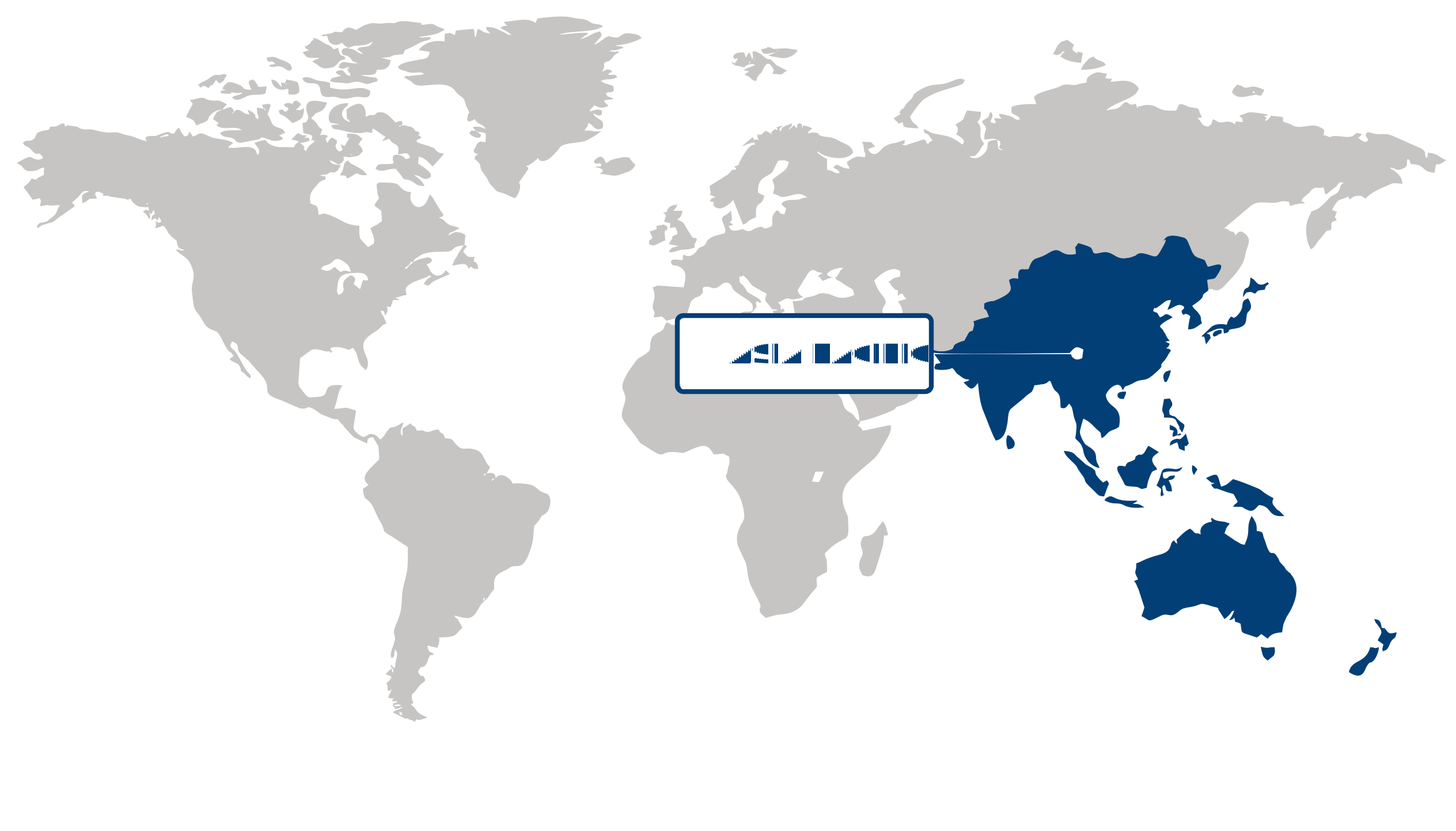
Asia Pacific (Largest Region)
Holding the largest share of the geothermal heat pump market at 40.10% in 2026, Asia Pacific benefits from expanding urbanization, rising energy demand, and growing interest in efficient heating and cooling technologies. Increasing efforts to reduce dependence on conventional energy sources are supporting the adoption of geothermal systems for residential, commercial, and institutional buildings. The region’s diverse climatic conditions and expanding construction activity also create opportunities for ground-source systems that can provide consistent thermal performance while supporting energy-efficiency and decarbonization objectives.
Europe (Fastest-Growing Region)
Europe represents the fastest-growing region, driven by strong emphasis on building decarbonization, renewable heating, and improved energy efficiency. Government efforts to reduce greenhouse-gas emissions and modernize heating systems are creating favorable conditions for geothermal technologies. Rising demand for low-carbon space heating and cooling, combined with the renovation of existing buildings and development of energy-efficient new construction, is strengthening the role of geothermal heat pumps within Europe’s transition toward more sustainable building energy systems.
| Parameter | North America | Asia Pacific | Europe | Latin America | MEA |
|---|---|---|---|---|---|
| Innovation Hub i Scale Nascent Developing Advanced | |||||
| Cost-Sensitive Region i Scale Low Medium High | |||||
| Regulatory Environment i Scale Restrictive Neutral Supportive | |||||
| Demand Drivers i Scale Weak Moderate Strong | |||||
| Development Stage i Scale Emerging Developing Developed | |||||
| Adoption Rate i Scale Low Medium High | |||||
| New Entrants / Startups i Scale Sparse Moderate Dense | |||||
| Macro Indicators i Scale Weak Stable Strong |
Key Country Insights
Germany 🇩🇪
Efficient Building IntegrationGermany prioritizes geothermal heat pump deployment in energy-efficient residential and commercial buildings. The market increasingly integrates geothermal systems with low-temperature heating networks and renovation projects to improve long-term energy performance.
France 🇫🇷
Low-Carbon Heating ExpansionFrance is strengthening the role of geothermal heat pumps within sustainable building renovation programs. The market favors systems that complement renewable heating strategies while improving long-term building energy performance across residential and commercial sectors.
Italy 🇮🇹
Climate-Adaptive SolutionsItaly adopts geothermal heat pump systems that address diverse regional climate conditions and building types. Market participants increasingly tailor installations for residential renovation projects where energy efficiency and year-round comfort remain key purchasing considerations.
Japan 🇯🇵
Space-Efficient InstallationsJapan focuses on geothermal heat pump solutions designed for space-constrained urban developments and institutional buildings. Local suppliers continue refining compact system designs that improve installation flexibility while supporting efficient year-round climate control.
South Korea 🇰🇷
Public Infrastructure AdoptionSouth Korea is expanding geothermal heat pump installations across public facilities and mixed-use developments. The market emphasizes integrated energy management solutions that enhance operational efficiency and reduce dependence on conventional heating systems.
United States 🇺🇸
Residential Retrofit FocusThe U.S. geothermal heat pump market is supported by building electrification initiatives and replacement of aging HVAC systems. Developers and installers are emphasizing scalable residential retrofit projects while expanding contractor expertise and ground-loop installation capabilities.
Segment Leadership and Growth Trends
Geothermal Heat Pump Market Share (%), by Type, 2026
Go beyond the chart, access full insights & data tables
Request Free Sample ReportType Segment Analysis: Closed Loop (Largest Segment) vs Open Loop (Fastest-Growing Segment)
In the geothermal heat pump market, the closed loop segment accounted for an 81.19% share in 2026, maintaining a clear leadership position because of its dependable operating characteristics and broad suitability for residential and commercial heating and cooling systems. Closed loop configurations circulate a heat-transfer fluid through buried piping, allowing geothermal systems to exchange heat with the ground without relying directly on groundwater availability. This makes the technology attractive in locations where consistent system performance, long-term operation, and reduced dependence on local water conditions are important considerations. Its flexibility in horizontal, vertical, and other installation configurations also supports deployment across different property conditions. Growing interest in energy-efficient heating and cooling technologies, combined with efforts to reduce reliance on conventional fossil-fuel-based systems, continues to reinforce demand for closed loop geothermal solutions.
The open loop segment is experiencing faster growth as interest increases in geothermal systems that can utilize accessible groundwater resources for heat exchange. Open loop configurations can provide an effective approach where suitable groundwater conditions and regulatory frameworks support their installation, offering opportunities for efficient heating and cooling in appropriate locations. Increasing awareness of geothermal technology as an alternative to conventional HVAC systems is encouraging consideration of open loop solutions, particularly in areas with favorable water resources. The segment's growth is also connected to broader efforts to improve building energy performance and adopt lower-emission heating and cooling technologies, although site suitability and water-management requirements remain important factors influencing deployment.
Application Segment Analysis: Residential (Largest Segment) vs Commercial (Fastest-Growing Segment)
The residential segment led the geothermal heat pump market with a 52.36% share in 2026, reflecting the growing application of geothermal systems for household heating and cooling requirements. Geothermal heat pumps provide an energy-efficient approach to maintaining indoor comfort by utilizing relatively stable ground temperatures for heat exchange, helping homeowners reduce dependence on conventional heating and cooling equipment. Increasing awareness of energy efficiency, interest in lower operating costs, and the transition toward more sustainable residential energy systems are supporting adoption. The ability of geothermal heat pumps to provide both heating and cooling from a single integrated system further strengthens their appeal for residential buildings seeking efficient year-round climate control.
Commercial applications are expanding at a faster pace as businesses, institutions, and property developers increasingly evaluate energy-efficient HVAC technologies for buildings with substantial and continuous heating and cooling requirements. Geothermal heat pumps can support commercial facilities seeking to improve energy performance while reducing dependence on conventional heating and cooling systems. The growing focus on sustainable building practices, operational efficiency, and lower environmental impact is encouraging the integration of geothermal technologies into new and upgraded commercial properties. Commercial buildings can also benefit from the long-term operating characteristics of geothermal systems, supporting their increasing relevance as organizations pursue more efficient and environmentally responsible building infrastructure.
| Segment | Sub-Segment | Largest Segment | Fastest Growing |
|---|---|---|---|
| Type | Closed Loop, Open Loop | Closed Loop | Open Loop |
| Application | Residential, Commercial, Industrial | Residential | Commercial |
Competitive Landscape and Market Positioning
Key companies in the geothermal heat pump market:
1. Daikin Industries Ltd. (Japan)
2. Carrier Global Corporation (United States)
3. Trane Technologies plc (Ireland)
4. Stiebel Eltron GmbH & Co. KG (Germany)
5. Vaillant Group (Germany)
6. Viessmann Climate Solutions SE (Germany)
7. NIBE Industrier AB (Sweden)
8. Robert Bosch Thermotechnology GmbH (Germany)
9. ClimateMaster Inc. (United States)
10. Glen Dimplex Group (Ireland)
The geothermal heat pump market is experiencing strong momentum as energy-efficient heating and cooling solutions gain wider acceptance across residential and commercial infrastructure projects. Industry stakeholders are investing in smart geothermal systems equipped with advanced monitoring and automation capabilities to improve energy management. Continuous research focused on improving installation efficiency and long-term system performance is also accelerating innovation in the geothermal heat pump market.
| Company | Market Share | Company Revenue | Revenue CAGR (%) | Product Portfolio | Geographic Presence | Innovation / R&D Focus | Strategic Developments |
|---|---|---|---|---|---|---|---|
| Daikin Industries Ltd. (Japan) | |||||||
| Carrier Global Corporation (United States) | |||||||
| Trane Technologies plc (Ireland) | |||||||
| Stiebel Eltron GmbH & Co. KG (Germany) | |||||||
| Vaillant Group (Germany) | |||||||
| Viessmann Climate Solutions SE (Germany) | |||||||
| NIBE Industrier AB (Sweden) | |||||||
| Robert Bosch Thermotechnology GmbH (Germany) | |||||||
| ClimateMaster Inc. (United States) | |||||||
| Glen Dimplex Group (Ireland). |
Industry Development/News
| Company Name | Date | Key Development |
|---|---|---|
| Dig Energy | Oct-25 | Dig Energy raised new capital to accelerate the commercialization of its proprietary compact fluid-based drilling technology tailored for shallow geothermal applications. This investment is strategically significant for improving drilling efficiency and reducing deployment costs, which are critical barriers to the wider adoption of geothermal heating and cooling systems in residential and commercial sectors. |
| Amazon | Jul-25 | Amazon integrated a large-scale geothermal heating and cooling system into its new Japanese fulfillment center to complement a 5.5 MW solar installation. By utilizing geothermal technology to reduce HVAC energy consumption by approximately 30%, this development underscores the adoption of geothermal solutions in industrial logistics infrastructure to meet corporate sustainability and operational efficiency targets. |
| QHeat | Oct-24 | QHeat announced a strategic international expansion to deploy its patented coaxial flow geothermal technology to markets outside of Finland. This initiative represents a concerted effort to scale its proprietary geothermal solutions globally, targeting increased adoption of its specialized heat transfer technology in new geographic regions and diversifying the company’s commercial reach. |
| Bosch | Jun-24 | Bosch commissioned a geothermal heat pump system at its manufacturing facility in Braga, Portugal, as part of a transition to fossil fuel-free operations. This implementation serves as a strategic pilot for utilizing large-scale geothermal heat pumps to enhance industrial energy efficiency, reflecting a broader trend of manufacturers adopting sustainable climate control technologies in their operational footprints. |
| Dandelion Energy | Nov-22 | Dandelion Energy secured USD 70 million in funding from NGP’s energy transition division and Lennar to scale its U.S. residential geothermal operations. The capital supports the expansion of the company’s specialized drilling infrastructure and downstream service network, facilitating broader adoption of residential geothermal heating and cooling systems through increased deployment capacity and operational footprint. |
Customize Your Report
Explore examples of how this report can be tailored to different research needs, including custom segments, additional topics or chapters, and related reports. Click a section of the wheel or its numbered marker to explore the available options.
Geothermal Heat Pump Market — Custom Segments
| Segment | Sub-Segment |
|---|---|
| Installation Configuration | Horizontal Ground Loop, Vertical Ground Loop, Pond/Lake Loop, Direct-Exchange Systems |
| Compressor Technology | Scroll Compressor, Reciprocating Compressor, Rotary Compressor, Variable-Speed Compressor |
| Distribution Channel | Direct Sales, HVAC Distributors, Specialized Geothermal Contractors, Online Channels |
Geothermal Heat Pump Market — Custom TOC
| Custom Chapter | Custom Details |
|---|---|
| Building Retrofit Opportunity Assessment |
|
| Incentive Program Impact and Funding Landscape |
|
| Commercial and Institutional Project Pipeline Assessment |
|
Need a different cut of the data?
Request Custom ResearchWhat is the market valuation of geothermal heat pump?
What is the forecasted size of the geothermal heat pump industry?
How are government incentives accelerating geothermal heat pump adoption?
Why are lifecycle cost considerations driving geothermal heat pump investments?
Why does the closed loop segment dominate the geothermal heat pump market?
How is commercial adoption influencing growth in the geothermal heat pump market?
Why does Asia Pacific hold the largest share in the geothermal heat pump market?
What is supporting Europe’s fastest growth in geothermal heat pumps?
Which companies dominate the geothermal heat pump landscape?
Our Clients
"The information presented in the report was genuinely insightful. The data was clear and easy to understand, which made it much easier to interpret the findings."
Amara Raja Group
"The responsiveness and professionalism exhibited by the team were exemplary. They were readily available to address queries, provide clarifications, and offer additional insights."
ONGC
"The reports offered a comprehensive analysis of various segments within the market. The detailed insights into market trends, and regulatory landscapes were excellent."
TotalEnergies
Our Research Team & Methodology
Every Fundamental Business Insights report is built by a dedicated vertical research team, validated through a structured primary-and-secondary methodology, and reviewed for accuracy before it reaches you.
Research Team Overview
Prepared by the Energy & Power Research Team
Delivery
Published
Demand
Available
Support
Trust & Compliance
Research Domains
10 coverage areasResearch Intelligence
| Source | Reference |
|---|---|
| International Energy Agency (IEA) | www.iea.org |
| U.S. Energy Information Administration (EIA) | www.eia.gov |
| International Renewable Energy Agency (IRENA) | www.irena.org |
| International Electrotechnical Commission (IEC) | www.iec.ch |
| International Organization for Standardization (ISO) | www.iso.org |
| IEEE | www.ieee.org |
| CIGRE (International Council on Large Electric Systems) | www.cigre.org |
| World Energy Council (WEC) | www.worldenergy.org |
| U.S. Department of Energy (DOE) | www.energy.gov |
| International Atomic Energy Agency (IAEA) | www.iaea.org |
| American Petroleum Institute (API) | www.api.org |
| Society of Petroleum Engineers (SPE) | www.spe.org |
| Hydrogen Council | hydrogencouncil.com |
| Battery Council International (BCI) | batterycouncil.org |
| Global Wind Energy Council (GWEC) | gwec.net |
| SolarPower Europe | www.solarpowereurope.org |
| World Bioenergy Association (WBA) | worldbioenergy.org |
| International Hydropower Association (IHA) | www.hydropower.org |
| Edison Electric Institute (EEI) | www.eei.org |
| National Renewable Energy Laboratory (NREL) | www.nrel.gov |
Research Workflow & Quality Assurance
Data Collection
Verified information gathered through primary and secondary research.
Data Triangulation
Cross-validation using multiple independent data sources.
Forecast Modelling
Market estimates developed using historical trends and analytical models.
Analyst Validation
Findings reviewed by domain experts for accuracy and consistency.
Editorial & Quality Review
Final editorial, quality, and compliance checks before publication.
Final Publication
Released after successful completion of the internal review process.
Report Coverage
📊 Market Assessment
- Market Size & Forecast
- Market Segmentation
- Regional Analysis
- Growth Drivers & Challenges
- Market Dynamics
🏢 Competitive Intelligence
- Competitive Landscape
- Company Profiles
- Competitive Benchmarking
- Mergers & Acquisitions
- Market Share Analysis or Key Company Strategies
🔍 Strategic Analysis
- Value Chain Analysis
- Porter's Five Forces
- PESTLE Analysis
- Pricing Trends
- Supply-Demand Analysis
🚀 Future Outlook
- Technology Landscape
- Regulatory Landscape
- Investment & Funding Landscape
- Emerging Opportunities
- Future Market Outlook
Have a question about this report or need a custom scope?
Request Customization