Geotextiles Market Size & Growth Forecast 2027–2036, By Segments (Material, Product, Application Type), Regional Demand Trends (North America, Asia Pacific, Europe), Key Country Insights (U.S., Japan, South Korea, Germany, France, Italy), and Competitive Landscape
Market Size and Growth Outlook
Geotextiles Market size was assessed at USD 8.86 billion in 2026 and is poised to grow at a 6.27% CAGR between 2027 and 2036, exceeding USD 16.28 billion by 2036. The industry revenue for 2027 is estimated at USD 9.33 billion.
Get more details on this report
Request Free Sample ReportGeotextiles Market Intelligence Snapshot
Regional Market Dynamics
- Asia Pacific accounted for 57.12% of the market in 2026, driven by extensive infrastructure construction, water management projects, erosion control applications, and demand for cost-effective ground engineering solutions.
- Europe is forecast to grow at a 7.57% CAGR as infrastructure rehabilitation, drainage improvements, and environmentally sensitive civil engineering projects increase adoption of technically specified geotextiles.
Segment Momentum
- Synthetic materials accounted for an 86.93% share in 2026 because they provide durability, tensile strength, and long service life, making them the preferred choice for large-scale civil engineering and infrastructure projects.
- Woven geotextiles are the fastest-growing product segment as demand increases for high-strength reinforcement materials used in construction and ground stabilization projects requiring superior load-bearing performance.
Market Expansion Drivers
- Rapid urbanization and infrastructure expansion driving large-scale civil engineering applications.
- Increasing adoption of cost-effective soil stabilization and erosion control solutions in construction.
- Government-backed infrastructure programs boosting long-term geosynthetic material deployment.
Leading Market Participants
- Key companies in the geotextiles market include Koninklijke Ten Cate B.V. (Netherlands), NAUE GmbH & Co. KG (Germany), HUESKER Synthetic GmbH (Germany), Officine Maccaferri S.p.A. (Italy), Fibertex Nonwovens A/S (Denmark), AGRU America Inc. (United States), Propex Operating Company, LLC (United States), TENAX Group S.r.l. (Italy), Sioen Industries NV (Belgium), Berry Global Inc. (United States).
Global Market Forecast Snapshot
Market Outlook
- 2026 Market Size: USD 8.86 billion
- 2027 Estimated Market Size: USD 9.33 billion.
- Projected Market Size: USD 16.28 billion by 2036
- Growth Forecast: 6.27% CAGR (2027-2036)
Regional and Segment Outlook
- Leading Regional Market: Asia Pacific
- High-Growth Regional Hub: Europe
- Core Revenue Segment: Synthetic (Material) | Non-Woven (Product) | Asphalt Overlays (Application Type)
- Emerging Opportunity Segment: Natural (Material) | Woven (Product) | Separation & Stabilization (Application Type)
Market Growth Drivers and Industry Trends
Rapid urbanization and infrastructure expansion driving large-scale civil engineering applications
Rapid urban development is increasing the need for durable transportation networks, drainage systems, foundations, land development, and other civil engineering infrastructure. The geotextiles market will be propelled by the growing use of engineered textile materials in projects where soil separation, filtration, reinforcement, and drainage are required to improve construction performance. As cities expand and infrastructure projects extend into areas with challenging soil conditions, geotextiles can provide practical methods for stabilizing construction sites and managing interactions between soil and structural materials. Their application across roads, railways, retaining structures, drainage systems, and other infrastructure projects also allows engineers to address multiple site requirements within integrated construction designs.
Increasing adoption of cost-effective soil stabilization and erosion control solutions in construction
Construction projects are increasingly focused on controlling material requirements and improving the durability of infrastructure while managing overall project costs. Geotextiles market demand is rising as contractors and engineers adopt these materials for soil stabilization, erosion management, separation, and reinforcement in applications where conventional construction approaches may require greater quantities of aggregate or more intensive site preparation. By improving soil performance and limiting displacement or erosion, geotextiles can help support stable foundations and protect exposed surfaces during construction and operation. Their versatility across slopes, embankments, roadways, drainage channels, and other structures makes them useful for addressing site-specific ground conditions while supporting efficient construction practices.
Government-backed infrastructure programs boosting long-term geosynthetic material deployment
Public investment in transportation, urban development, water management, and other infrastructure is creating sustained opportunities for materials that improve project durability and construction efficiency. Government-backed infrastructure programs will support the geotextiles market as large civil engineering projects incorporate geosynthetic solutions for reinforcement, filtration, drainage, separation, and erosion control. The use of these materials can help infrastructure planners manage difficult ground conditions and improve the functional performance of roads, railways, embankments, and other public assets. Long-term infrastructure development also encourages standardized engineering practices and broader familiarity with geosynthetic materials among contractors and project designers, supporting their integration into a wider range of publicly funded construction activities.
| Growth Driver | Impact on CAGR | Regulatory Influence | Geographic Relevance | Adoption Rate | Impact Timeline |
|---|---|---|---|---|---|
| Expanding infrastructure & construction activities | 2.50% | Short term (≤ 2 yrs) | Asia Pacific, North America (spillover: Europe) | Medium | Fast |
| Road & railway development boosting geotextiles | 2.20% | Medium term (2–5 yrs) | Europe, Asia Pacific (spillover: Latin America) | Medium | Moderate |
| Sustainability & regulatory push for soil protection | 2.00% | Long term (5+ yrs) | Europe, North America (spillover: Asia Pacific) | High | Slow |
| Rapid urbanization and infrastructure expansion driving large-scale civil engineering applications | 2.20% | Moderate | Asia Pacific, Middle East & Africa | High | Near Term |
| Increasing adoption of cost-effective soil stabilization and erosion control solutions in construction | 1.70% | Moderate | Asia Pacific, Europe, North America | High | Near Term |
| Government-backed infrastructure programs boosting long-term geosynthetic material deployment | 1.30% | High | Asia Pacific, Europe | Medium | Mid Term |
Unlock insights tailored to your business with our bespoke market research solutions.
Click to get your customized report now.
Regional Demand Dynamics
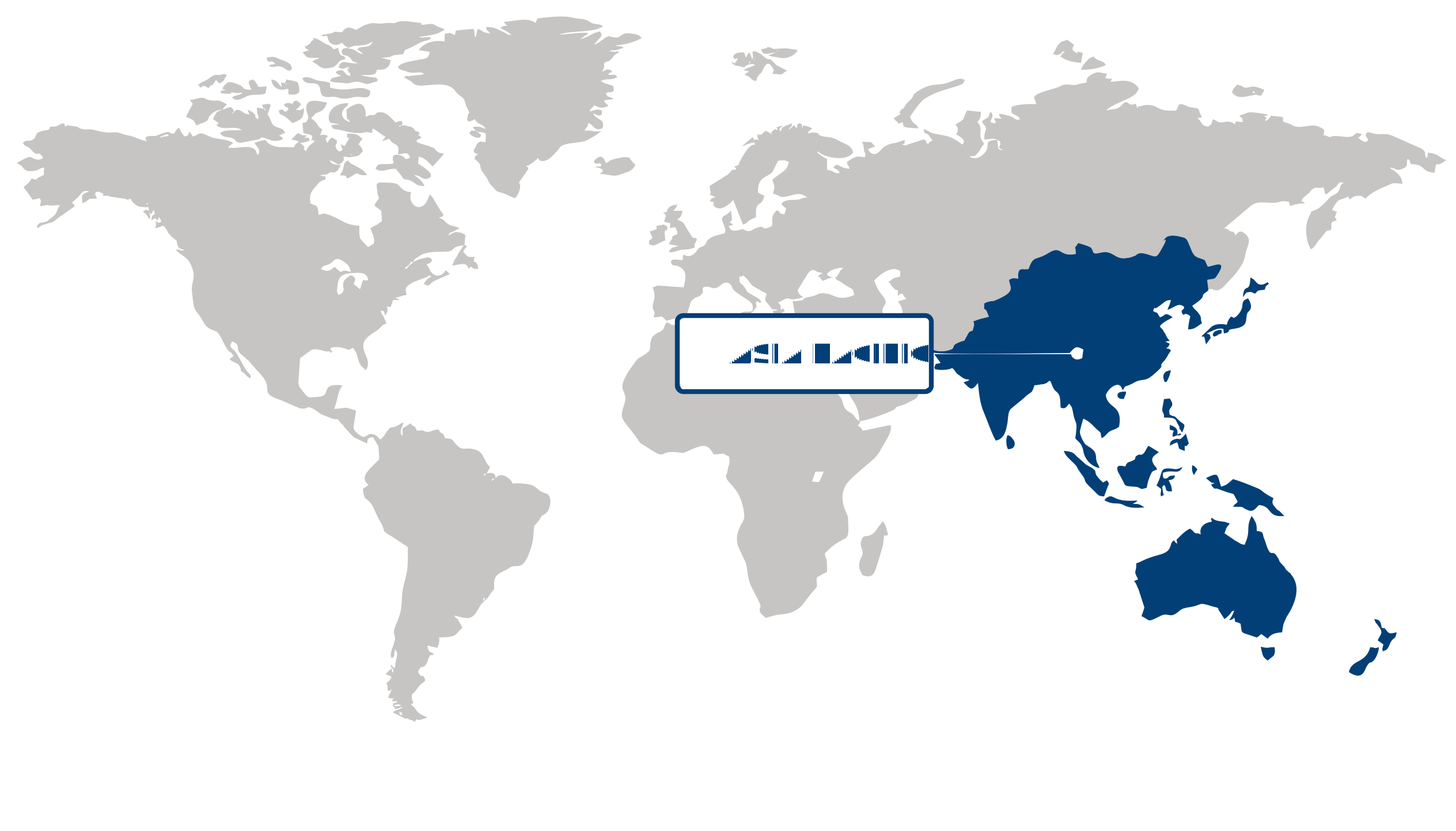
Asia Pacific (Largest Region)
The geotextiles market was led by Asia Pacific, which accounted for a 57.12% share in 2026, supported by extensive infrastructure development, urbanization, and demand for materials that improve the performance and durability of civil engineering projects. Large-scale transportation, construction, drainage, and soil stabilization activities are strengthening the use of geotextiles, while infrastructure modernization continues to support regional demand.
Europe (Fastest-Growing Region)
Europe is the fastest-growing region, reflecting increasing emphasis on sustainable infrastructure, environmental protection, and efficient construction practices. Geotextiles are gaining relevance in applications involving erosion control, drainage, soil reinforcement, and resource-efficient infrastructure development. Greater focus on durable and environmentally responsible construction solutions is creating additional opportunities for market expansion across the region.
| Parameter | North America | Asia Pacific | Europe | Latin America | MEA |
|---|---|---|---|---|---|
| Innovation Hub i Scale Nascent Developing Advanced | |||||
| Cost-Sensitive Region i Scale Low Medium High | |||||
| Regulatory Environment i Scale Restrictive Neutral Supportive | |||||
| Demand Drivers i Scale Weak Moderate Strong | |||||
| Development Stage i Scale Emerging Developing Developed | |||||
| Adoption Rate i Scale Low Medium High | |||||
| New Entrants / Startups i Scale Sparse Moderate Dense | |||||
| Macro Indicators i Scale Weak Stable Strong |
Key Country Insights
Germany 🇩🇪
Engineered Civil SolutionsGermany prioritizes technically advanced geotextiles for road construction, rail infrastructure, and environmental engineering applications. German contractors increasingly adopt durable and sustainable materials that improve soil stabilization while meeting stringent engineering and regulatory requirements.
France 🇫🇷
Sustainable Ground EngineeringFrance incorporates geotextiles into sustainable civil engineering projects that emphasize erosion control and efficient water management. French infrastructure developers increasingly specify recyclable and high-performance materials to improve project durability while supporting environmental objectives.
Italy 🇮🇹
Transport Network EnhancementItaly utilizes geotextiles to strengthen transport infrastructure, retaining structures, and drainage systems. Italian engineering firms continue adopting specialized geosynthetic products that improve soil performance and reduce long-term maintenance requirements across infrastructure projects.
Japan 🇯🇵
Resilient Terrain ApplicationsJapan integrates geotextiles into slope stabilization, flood protection, and earthquake-resilient infrastructure projects. The country's focus on long-term asset reliability encourages demand for engineered geosynthetic solutions that enhance structural performance under challenging environmental conditions.
South Korea 🇰🇷
Urban Infrastructure SupportSouth Korea is expanding the use of geotextiles in transportation, land development, and water management projects. Local demand is supported by advanced construction techniques that prioritize efficient ground reinforcement and extended infrastructure service life.
United States 🇺🇸
Infrastructure ReinforcementThe U.S. geotextiles market emphasizes durable materials for transportation, erosion control, and drainage projects. Infrastructure modernization and resilient construction practices continue to encourage wider adoption of high-performance geotextiles across public works and private developments.
Segment Leadership and Growth Trends
Geotextiles Market Share (%), by Material, 2026
Go beyond the chart, access full insights & data tables
Request Free Sample ReportMaterial Segment Analysis: Synthetic (Largest Segment) vs Natural (Fastest-Growing Segment)
Synthetic geotextiles dominated the geotextiles market, accounting for an 86.93% share in 2026. Their strong position is attributed to the durability, tensile strength, chemical resistance, and consistent performance offered by polymer-based materials in demanding civil engineering environments. Synthetic geotextiles are widely used for separation, filtration, drainage, reinforcement, and erosion control, where resistance to moisture and prolonged exposure to challenging site conditions is essential. Natural geotextiles are the fastest-growing material segment as infrastructure developers increasingly consider biodegradable materials for applications where temporary reinforcement, erosion control, and environmental compatibility are priorities. Growing attention to sustainable construction practices and the use of renewable materials is creating additional opportunities for natural fibers in geotechnical applications.
Product Segment Analysis: Non-Woven (Largest Segment) vs Woven (Fastest-Growing Segment)
Non-Woven geotextiles accounted for the largest share of the geotextiles market, reaching 63.54% in 2026. Their widespread adoption is supported by strong filtration, drainage, and separation capabilities, making them suitable for road construction, drainage systems, landscaping, and erosion-control applications. Their flexible structure and ability to allow fluid movement while preventing unwanted soil migration make them valuable in projects where hydraulic performance is a key consideration. Woven geotextiles are the fastest-growing product segment as infrastructure projects increasingly require materials capable of providing higher tensile reinforcement and load-bearing support. Their structural strength and dimensional stability make them particularly suitable for applications involving soil stabilization, roadway reinforcement, embankments, and other projects where mechanical performance is critical.
| Segment | Sub-Segment | Largest Segment | Fastest Growing |
|---|---|---|---|
| Material | Natural, Synthetic | Synthetic | Natural |
| Product | Woven, Non-Woven, Knitted | Non-Woven | Woven |
| Application Type | Erosion Control, Reinforcement, Drainage System, Lining System, Asphalt Overlays, Separation & Stabilization, Silt Fences | Asphalt Overlays | Separation & Stabilization |
Competitive Landscape and Market Positioning
Key companies in the geotextiles market:
1. Koninklijke Ten Cate B.V. (Netherlands)
2. NAUE GmbH & Co. KG (Germany)
3. HUESKER Synthetic GmbH (Germany)
4. Officine Maccaferri S.p.A. (Italy)
5. Fibertex Nonwovens A/S (Denmark)
6. AGRU America Inc. (United States)
7. Propex Operating Company LLC (United States)
8. TENAX Group S.r.l. (Italy)
9. Sioen Industries NV (Belgium)
10. Berry Global Inc. (United States)
The geotextiles market is expanding due to rising infrastructure development and environmental engineering applications. Material innovation is improving soil stabilization, drainage efficiency, and erosion control. The geotextiles market is also witnessing increased adoption in sustainable construction practices. Growth is strongly linked to large-scale civil engineering projects.
| Company | Market Share | Company Revenue | Revenue CAGR (%) | Product Portfolio | Geographic Presence | Innovation / R&D Focus | Strategic Developments |
|---|---|---|---|---|---|---|---|
| Koninklijke Ten Cate B.V. (Netherlands) | |||||||
| NAUE GmbH & Co. KG (Germany) | |||||||
| HUESKER Synthetic GmbH (Germany) | |||||||
| Officine Maccaferri S.p.A. (Italy) | |||||||
| Fibertex Nonwovens A/S (Denmark) | |||||||
| AGRU America Inc. (United States) | |||||||
| Propex Operating Company LLC (United States) | |||||||
| TENAX Group S.r.l. (Italy) | |||||||
| Sioen Industries NV (Belgium) | |||||||
| Berry Global Inc. (United States). |
Industry Development/News
| Company Name | Date | Key Development |
|---|---|---|
| Arvind Limited | May-26 | Arvind Limited acquired a 61% stake in U.S.-based Dalco-GFT for $136 million to expand its global footprint in advanced materials. This strategic investment enhances the company’s capabilities in high-performance and engineered textiles, strengthening its competitive position within international geotextile and technical textile market segments. |
| USFibers | May-26 | USFibers secured strategic investment from Glisco Partners and Orion Infrastructure Capital to scale production capacity and enhance technical infrastructure. The capital infusion supports the company’s objective to improve operational efficiency as a vertically integrated producer of polyester staple fiber, directly impacting the supply chain for geotextiles and related technical textile applications. |
| First Graphene | Apr-26 | First Graphene acquired manufacturing, intellectual property, and development assets from Ionic Industries and Imagine Intelligent Materials. This consolidation integrates specialized graphene-based coating technologies into the company’s portfolio, enabling the development of high-performance surface solutions specifically for technical textiles and advanced geotextile applications. |
| Strata Geosystems | Feb-26 | Strata Geosystems acquired India-based Venus Interlinings, a manufacturer of advanced non-woven geotextiles. This acquisition serves as a market entry into the non-woven segment, significantly expanding the company’s manufacturing capacity and reinforcing its vertical footprint in the technical textiles value chain for infrastructure and geosynthetic applications. |
| Whizzo | Jan-26 | Whizzo raised $15 million in a Series A funding round to scale its technical textiles contract development and manufacturing organization (CDMO) platform. The investment is earmarked for expanding materials science research, strengthening manufacturing networks, and accelerating the commercialization of high-performance textile solutions tailored for industrial and geotextile applications. |
| Geofabrics Australasia | Aug-24 | Geofabrics Australasia acquired Bayset to consolidate its distribution and product capabilities across Australia and New Zealand. The integration enhances the company’s regional infrastructure, improving its operational ability to deliver comprehensive geotechnical solutions and increasing its market reach in the competitive geosynthetics and geotextiles landscape. |
| Berk önüm | Mar-24 | Berk önüm inaugurated a new manufacturing facility in the Mary province to specialize in polyester and polypropylene fiber production. This capacity expansion strengthens the upstream raw material supply chain for technical textiles, providing essential materials for regional production of high-performance geotextiles and industrial fiber products. |
Customize Your Report
Explore examples of how this report can be tailored to different research needs, including custom segments, additional topics or chapters, and related reports. Click a section of the wheel or its numbered marker to explore the available options.
Geotextiles Market — Custom Segments
| Segment | Sub-Segment |
|---|---|
| Infrastructure Project Type | Roads & Highways, Railways, Airports, Water Management & Dams, Landfills & Waste Management, Coastal & Marine Infrastructure |
| Distribution Channel | Direct Sales, Specialty Distributors, Construction Material Distributors, Online & E-commerce Channels |
| Installation Method | Mechanically Installed, Ballasted & Anchored, Adhered & Bonded, Integrated During Pavement or Soil Construction |
Geotextiles Market — Custom TOC
| Custom Chapter | Custom Details |
|---|---|
| Infrastructure Development Opportunity Assessment |
|
| Circular Economy Pathways for Geotextiles |
|
| Public Infrastructure Procurement Landscape |
|
Need a different cut of the data?
Request Custom ResearchHow big is the geotextiles market?
How will the geotextiles industry grow in terms of size and CAGR by 2036?
How are large-scale infrastructure programs influencing the adoption of geotextiles in civil engineering projects?
Why is the shift toward woven geotextiles gaining momentum in high-load construction applications?
Why do synthetic materials dominate the geotextiles market?
Which product segment is expanding the fastest in the geotextiles market?
What supports Asia Pacific's leadership in the geotextiles market?
Why is Europe the fastest-growing region for geotextiles?
Who are the major participants shaping the geotextiles landscape?
Our Clients
"Your insights on workforce structures were spot-on. The analysis on mid-to-senior level roles validated some of our hiring decisions and highlighted gaps."
Ateliers De France
"The report gave us insights on competitors in the market. It helped our team refine our bidding strategy for upcoming contracts."
Clark Construction
"The reports provided a deep dive into market trends, and competitive landscape. The strategic insights and recommendations have been very helpful."
Rudolph and Sletten
Our Research Team & Methodology
Every Fundamental Business Insights report is built by a dedicated vertical research team, validated through a structured primary-and-secondary methodology, and reviewed for accuracy before it reaches you.
Research Team Overview
Prepared by the Construction & Manufacturing Research Team
Delivery
Published
Demand
Available
Support
Trust & Compliance
Research Domains
10 coverage areasResearch Intelligence
| Source | Reference |
|---|---|
| International Organization for Standardization (ISO) | www.iso.org |
| ASTM International | www.astm.org |
| National Institute of Standards and Technology (NIST) | www.nist.gov |
| International Code Council (ICC) | www.iccsafe.org |
| American Concrete Institute (ACI) | www.concrete.org |
| American Institute of Steel Construction (AISC) | www.aisc.org |
| Construction Industry Institute (CII) | www.construction-institute.org |
| Associated General Contractors of America (AGC) | www.agc.org |
| Association of Equipment Manufacturers (AEM) | www.aem.org |
| Building Owners and Managers Association (BOMA) | www.boma.org |
| American Society of Civil Engineers (ASCE) | www.asce.org |
| National Ready Mixed Concrete Association (NRMCA) | www.nrmca.org |
| International Facility Management Association (IFMA) | www.ifma.org |
| World Green Building Council (WorldGBC) | worldgbc.org |
| International Federation of Consulting Engineers (FIDIC) | fidic.org |
| International Labour Organization (ILO) | www.ilo.org |
| American Society of Mechanical Engineers (ASME) | www.asme.org |
| Society of Manufacturing Engineers (SME) | www.sme.org |
| National Association of Home Builders (NAHB) | www.nahb.org |
| European Construction Industry Federation (FIEC) | www.fiec.eu |
Research Workflow & Quality Assurance
Data Collection
Verified information gathered through primary and secondary research.
Data Triangulation
Cross-validation using multiple independent data sources.
Forecast Modelling
Market estimates developed using historical trends and analytical models.
Analyst Validation
Findings reviewed by domain experts for accuracy and consistency.
Editorial & Quality Review
Final editorial, quality, and compliance checks before publication.
Final Publication
Released after successful completion of the internal review process.
Report Coverage
📊 Market Assessment
- Market Size & Forecast
- Market Segmentation
- Regional Analysis
- Growth Drivers & Challenges
- Market Dynamics
🏢 Competitive Intelligence
- Competitive Landscape
- Company Profiles
- Competitive Benchmarking
- Mergers & Acquisitions
- Market Share Analysis or Key Company Strategies
🔍 Strategic Analysis
- Value Chain Analysis
- Porter's Five Forces
- PESTLE Analysis
- Pricing Trends
- Supply-Demand Analysis
🚀 Future Outlook
- Technology Landscape
- Regulatory Landscape
- Investment & Funding Landscape
- Emerging Opportunities
- Future Market Outlook
Have a question about this report or need a custom scope?
Request Customization