GaN Industrial Devices Market Size & Forecasts 2026-2035, By Segments (Device Type, Voltage Range, Application, Vertical), Growth Opportunities, Innovation Landscape, Regulatory Shifts, Strategic Regional Insights (U.S., Japan, China, South Korea, UK, Germany, France), and Competitive Dynamics (Efficient Power Conversion, Wolfspeed, Infineon Technologies, GaN Systems, Qorvo)
Market Size and Growth Outlook
GaN Industrial Devices Market size is projected to expand significantly, moving from USD 26.94 billion in 2025 to USD 52.5 billion by 2035, with a CAGR of 6.9% during the 2026-2035 forecast period. The expected revenue for 2026 is USD 28.57 billion.
Get more details on this report
Request Free Sample ReportGaN Industrial Devices Market Intelligence Snapshot
Regional Market Dynamics
Segment Momentum
Market Expansion Drivers
Leading Market Participants
Global Market Forecast Snapshot
Market Outlook
Regional and Segment Outlook
Market Growth Drivers and Industry Trends
Broad deployment of GaN in server power supplies, EV chargers, and motor drives is reshaping demand dynamics for the gan industrial devices market; product announcements from Infineon Technologies and GaN Systems highlight real-world replacements of silicon MOSFETs in high-frequency converters, and U.S. Department of Energy programs supporting power electronics research validate broader adoption drivers. This creates opportunities for incumbents to retrofit existing module portfolios and for new entrants to supply specialized switching IP and subsystem integration. Given continuing OEM migration and visible commercial deployments, expect steady incorporation of GaN into industrial power architectures.
Technological Improvements in GaN Device Efficiency and Thermal Management
Advances in epitaxial processes, packaging and thermal interfaces evidenced by product releases from Efficient Power Conversion (EPC) and technical papers in IEEE conferences are materially improving on-resistance and heat dissipation, accelerating acceptance within the gan industrial devices market. These innovations make GaN viable for dense power stacks and reduce system-level cooling costs, enabling established semiconductor manufacturers to differentiate on integrated solutions while startups can capture niche cooling or driver technologies. With successive product generations and peer-reviewed validation, thermal and efficiency gains will continue to lower barriers for industrial integration.
Standardization and Regulatory Compliance for GaN Power Devices
Progress on qualification frameworks by Underwriters Laboratories (UL), International Electrotechnical Commission (IEC), and Automotive Electronics Council (AEC) for wide-bandgap and power components is reducing certification risk in the gan industrial devices market; engagement by STMicroelectronics and Rohm Semiconductor in standards discussions provides industry-aligned test cases. Clearer compliance pathways accelerate procurement by regulated OEMs and create a market for certified modules, allowing incumbents to leverage compliance as a sales advantage while entrants can offer pre-certified, plug-and-play modules. As standards mature and certification case studies accumulate, GaN adoption in regulated industrial supply chains will become increasingly routinized.
Industry Restraints:
Epitaxy and Substrate Supply Bottlenecks
High-quality GaN epitaxy and large, defect-free substrates are a choke point that raises unit costs and constrains scalable capacity; limited MOCVD tool availability and wafer supply increase cycle times and yield variability, slowing deployment in industrial systems with tight reliability requirements. Suppliers such as Veeco Instruments have publicly cited elevated tool demand for GaN production, while substrate producers like Sumitomo Electric and II‑VI Incorporated have signaled capacity constraints for advanced wafers; GaN device companies including GaN Systems and Navitas Semiconductor report ramp challenges tied to upstream material availability. Strategically, vertically integrated incumbents can absorb supply risk, but fabless entrants face longer qualification lead times and margin pressure. Absent substantial capital expansion in MOCVD and substrate capacity, these bottlenecks will continue to temper growth in the near to medium term.
Automotive and Safety Qualification Timelines
Lengthy qualification cycles and functional‑safety requirements materially slow adoption of GaN in industrial and mobility applications where ISO 26262 compliance and AEC‑style testing are mandatory, creating adoption barriers for products that must demonstrate long-term reliability. Standards bodies such as ISO (ISO 26262) and the Automotive Electronics Council (AEC) set rigorous testing regimes, and major semiconductor vendors like Infineon Technologies and STMicroelectronics have publicly emphasized multi‑year qualification programs for power devices. For market participants, established suppliers with test labs and customer relationships gain advantage, while startups must absorb time‑to‑market and certification costs. This restraint will remain a gating factor for broad industrial electrification and automotive integration through the medium term, favoring players who invest in certification and long-term reliability data.
| Growth Driver | Impact on CAGR | Regulatory Influence | Geographic Relevance | Adoption Rate | Impact Timeline |
|---|---|---|---|---|---|
| Adoption in power electronics and industrial switching applications | 2.50% | Short term (≤ 2 yrs) | Asia Pacific, North America | Medium | Fast |
| Technological improvements in GaN device efficiency and thermal management | 2.00% | Medium term (2–5 yrs) | Europe, Asia Pacific | Low | Moderate |
| Standardization and regulatory compliance for GaN power devices | 1.50% | Long term (5+ yrs) | North America, Europe | High | Slow |
Unlock insights tailored to your business with our bespoke market research solutions.
Click to get your customized report now.
Regional Demand Dynamics
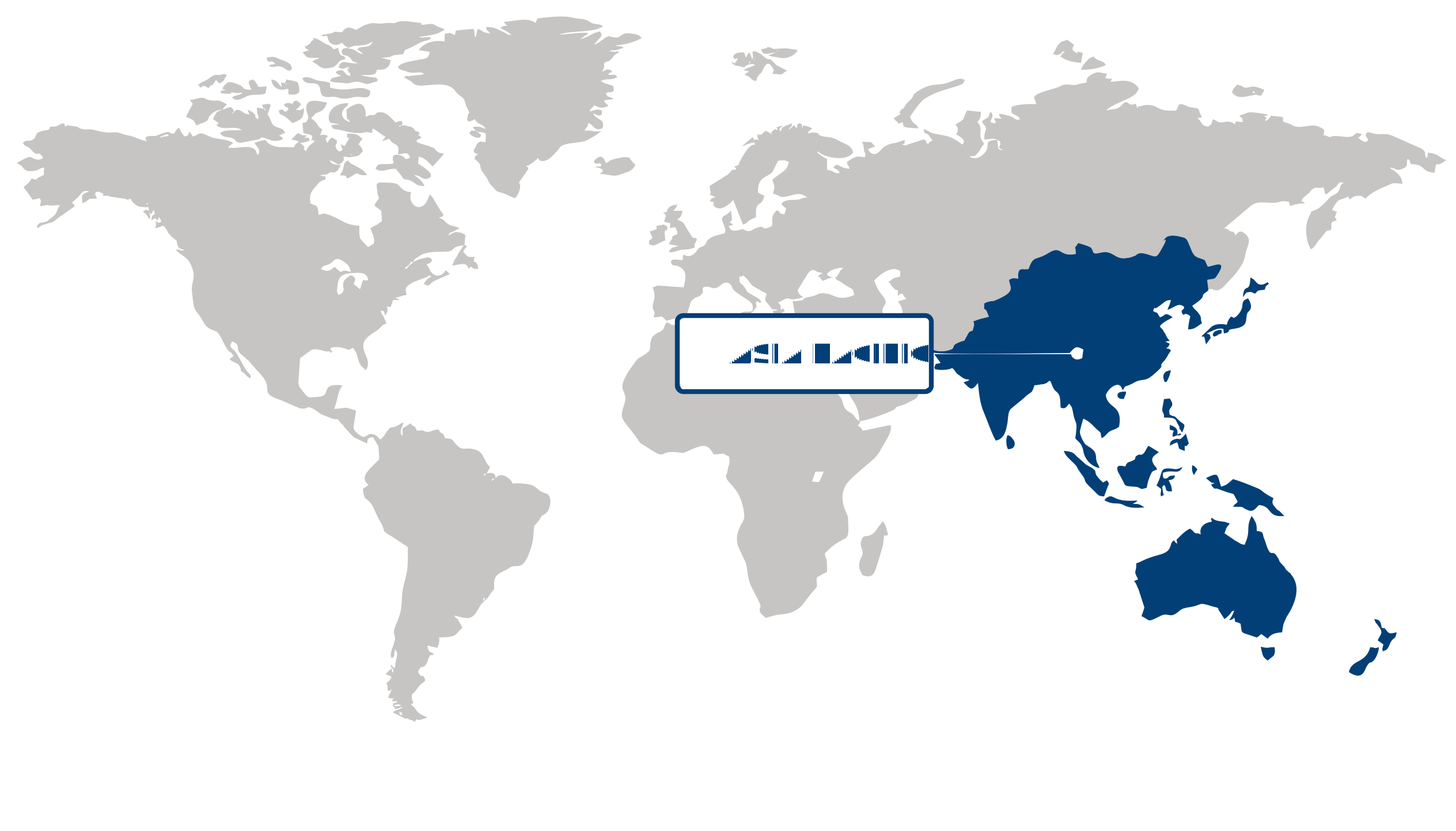
captured over 38.2% of the global market in 2025 and, at a 10.35% CAGR, is the largest and fastest-growing region in the gan industrial devices market. This leadership is rooted in rising electronics manufacturing and accelerated 5G infrastructure deployment across APAC, which increases demand for high-efficiency GaN power amplifiers and converters; GSMA’s Mobile Economy Asia Pacific documents rapid 5G rollouts, the Ministry of Industry and Information Technology (MIIT) reports sustained electronics output growth, and capacity expansions by Taiwan Semiconductor Manufacturing Company (TSMC) and Foxconn Technology Group corroborate industrial scaling. Policy incentives, localized supply chains and intensified R&D are shortening adoption cycles in telecom, data centers and factory automation, creating large addressable opportunities for component suppliers and system integrators across the region. Given scale and procurement momentum, APAC remains a priority market for commercial GaN deployment and strategic partnerships.
Japan is positioned as a pivotal hub in Asia Pacific for the gan industrial devices market, combining advanced systems engineering with targeted government support to accelerate GaN integration in industrial power systems and 5G equipment. The Ministry of Economy, Trade and Industry (METI) has promoted semiconductor and energy-efficiency initiatives, and product releases from ROHM Co., Ltd. demonstrate active domestic supplier engagement in GaN technologies. Japan’s emphasis on reliability and standards makes it a preferred venue for high-margin pilot projects and certified deployments, offering suppliers opportunities to validate solutions before regional scale-up.
China anchors the regional market for the gan industrial devices market, propelled by massive electronics production and one of the fastest national 5G rollouts, which drives outsized demand for GaN RF and power modules. MIIT statistics on electronics manufacturing, China Mobile announcements on base-station expansion, and Foxconn Technology Group’s capacity investments illustrate both demand pull and manufacturing scale. Domestic ODMs and system integrators are prioritizing cost-effective GaN modules for consumer electronics, EV charging and telecom gear, positioning China as the primary source of volume adoption and partnership opportunities for manufacturers and assemblers targeting broader APAC penetration.
North America Market Analysis:
North America held a commanding share in the gan industrial devices market, driven by dense industrial electrification, data-center power-efficiency upgrades and policy-backed semiconductor investment; strong demand from utilities, manufacturing automation and telecom infrastructure has concentrated spending and innovation in the region. Public incentives and industrial-scale commitments—illustrated by the U.S. Department of Commerce’s CHIPS-related programs and Semiconductor Industry Association reporting on North American manufacturing expansion—have supported local capacity and supplier ecosystems. Corporate moves such as Wolfspeed’s manufacturing investments and GaN Systems’ commercial device rollouts provide concrete evidence of commercialization momentum. Given resilient industrial demand, concentrated R&D and growing procurement from hyperscalers and OEMs, North America offers sustained opportunities for scale-up, localization of supply chains and high-margin systems integration in gan industrial devices market.
The U.S. remains the regional innovation and investment hub in the gan industrial devices market, where federal funding, defense and hyperscaler demand accelerate adoption and domestic capacity. Federal initiatives from the U.S. Department of Commerce and U.S. Department of Energy have de-risked capital for fabs and pilot lines, while Efficient Power Conversion (EPC) and GaN Systems have announced product and partnership milestones targeting data-center and industrial power stages. Defense and telecom procurement patterns cited by the U.S. Department of Defense and industry releases are nudging suppliers toward qualification and scale. For investors and strategists, the U.S. role translates into concentrated opportunities to partner on commercialization, secure qualified supply, and deploy GaN-enabled systems that reinforce North America’s regional leadership in gan industrial devices market.
Europe Market Trends:
Maintained a substantial share in the gan industrial devices market, North America combines robust manufacturing capability, strong OEM demand for higher-efficiency power conversion, and coordinated public support that sustain its leadership. Adoption is driven by industrial electrification and data-center power-density requirements, while the CHIPS and Science Act and funding from the U.S. Department of Energy have catalyzed domestic capacity and R&D investments. Market incumbents and research centers—Wolfspeed and GaN Systems, alongside work at the National Renewable Energy Laboratory—provide concrete examples of commercialization and validation cited in press releases and agency statements. Efficient logistics, skilled engineering talent, and competitive intensity position the region to capture expanded industrial, defense, and grid modernization deployments over the coming cycle.
Served as the primary engine of the gan industrial devices market, the United States combines scale manufacturing, large industrial OEM demand, and procurement-led adoption that shorten commercialization timelines. Policy levers such as the CHIPS and Science Act and DOE funding have been invoked in Wolfspeed capacity-expansion communications and referenced by system integrators when selecting suppliers. Domestic fabrication and assembly hubs reduce lead times and concentrate supplier competition, favoring vertically integrated players and firms with U.S.-based supply agreements. Strategic implication: prioritizing partners or assets with U.S. production footprints aligns with near-term industrial contract pipelines and utility-scale modernization projects.
Acting as an innovation hub in the gan industrial devices market, Canada leverages specialist design firms and public research to deliver differentiated system-level solutions despite smaller volume production. Ottawa-based GaN Systems has highlighted OEM partnerships in corporate press releases, and the National Research Council Canada together with Innovation, Science and Economic Development Canada provide commercialization support that accelerates prototype-to-production transitions. Concentrated talent in power-semiconductor design and close university–industry links favor integration for mining electrification, EV fast charging, and energy-storage inverters. Strategic implication: engaging Canadian design houses or licensing Canadian IP can speed product differentiation for North American industrial customers.
| Parameter | North America | Asia Pacific | Europe | Latin America | MEA |
|---|---|---|---|---|---|
| Innovation Hub i Scale Nascent Developing Advanced | |||||
| Cost-Sensitive Region i Scale Low Medium High | |||||
| Regulatory Environment i Scale Restrictive Neutral Supportive | |||||
| Demand Drivers i Scale Weak Moderate Strong | |||||
| Development Stage i Scale Emerging Developing Developed | |||||
| Adoption Rate i Scale Low Medium High | |||||
| New Entrants / Startups i Scale Sparse Moderate Dense | |||||
| Macro Indicators i Scale Weak Stable Strong |
Segment Leadership and Growth Trends
GaN Industrial Devices Market Share (%), by Device Type, 2026
Go beyond the chart, access full insights & data tables
Request Free Sample ReportPower represented largest share in 2025 of the gan industrial devices market, driven by superior efficiency and power density that make GaN favorable for industrial power electronics. This leadership links directly to the segment’s growth driver—higher efficiency and power density—and is reinforced by product briefs and press releases from Infineon Technologies, Navitas Semiconductor, and Efficient Power Conversion (EPC) highlighting reduced losses and compact form factors. Customer demand for energy-efficient, space‑constrained designs, OEM preferences for integrated modules, and U.S. Department of Energy emphasis on electrification further support adoption. Established suppliers can scale integrated solutions while startups can capture niche module and IP roles, and ongoing topology and packaging improvements suggest sustained relevance in the near term.
Analysis by Voltage Range
200-600 volt held largest share in 2025 of the gan industrial devices market, reflecting the mid-voltage range favored for EV traction, onboard charging and many PV inverters. The segment’s lead is propelled by widespread adoption in electric vehicles and renewable energy systems, as noted in analyses from the National Renewable Energy Laboratory (NREL) and International Energy Agency (IEA), and by engineering disclosures from EV and inverter OEMs such as Tesla and ABB. Supply‑chain choices between GaN and SiC, grid interconnection standards, and OEM preferences for compact, efficient architectures create opportunities for incumbent semiconductor vendors and agile startups specializing in 400 V platforms, keeping this segment strategically important.
Analysis by Application
Supply & Inverter dominated the gan industrial devices market in 2025 as data centers and renewable deployments prioritized efficient power conversion to lower losses and improve system density. The growth driver—demand for efficient power conversion in data centers and renewables—is evidenced by sustainability reports and technical publications from Google, Microsoft, and Amazon Web Services and product roadmaps from Schneider Electric and Siemens emphasizing higher-efficiency power supplies and inverter designs. Trends in PUE reduction, regulatory efficiency targets, and demand for digitally managed power systems create openings for established power-assembly providers and modular GaN specialists, and continued data center expansion and renewable integration will sustain demand in the near to medium term.
| Segment | Sub-Segment | Largest Segment | Fastest Growing |
|---|---|---|---|
| Device Type | Power, RF Power | ||
| Voltage Range | <200 volt, 200-600 volt, >600 volt | ||
| Application | Supply & Inverter, Power Drivers, Radio Frequency | ||
| Vertical | Industrial, Telecommunications, Renewable, Automotive, Military, Defense and Aerospace, Consumer & Enterprise, Medical |
Competitive Landscape and Market Positioning
The competitive landscape is marked by deliberate capability expansion and ecosystem alignment among the top companies. Several have broadened portfolios via targeted corporate integrations and co-development arrangements, refreshed product roadmaps emphasizing higher-voltage and RF stacks, and enhanced fabrication and packaging capabilities to support volume and reliability requirements. Such moves sharpen differentiation, accelerate time-to-adoption in industrial end markets, and force peers to balance scale with specialized technology leadership to retain system-level relevance.
Strategic / Actionable Recommendations for Regional Players
North America: Leverage local system integrators and test houses to shorten validation cycles, embed advanced driver and control ecosystems, and pursue supply-chain verticalization to defend against competitor scale while capturing premium industrial and data center end-use cases.
Asia Pacific: Forge deeper commercial ties with module and equipment OEMs, prioritize manufacturability improvements and advanced packaging adoption, and focus on automotive and renewable-energy equipment segments where localized collaboration accelerates qualification and uptake.
Europe: Emphasize application-specific reliability and certification pathways, collaborate with automation and industrial controls partners to co-develop turnkey solutions, and combine device innovation with strong aftermarket and service propositions to differentiate in conservative industrial procurement environments.
| Company | Market Share | Company Revenue | Revenue CAGR (%) | Product Portfolio | Geographic Presence | Innovation / R&D Focus | Strategic Developments |
|---|---|---|---|---|---|---|---|
| No companies available. | |||||||
Industry Development/News
| Company Name | Date | Key Development |
|---|
Customize Your Report
Explore examples of how this report can be tailored to different research needs, including custom segments, additional topics or chapters, and related reports. Click a section of the wheel or its numbered marker to explore the available options.
GaN Industrial Devices Market — Custom Segments
| Segment | Sub-Segment |
|---|---|
| No segment data available. | |
GaN Industrial Devices Market — Custom TOC
| Custom Chapter | Custom Details | ||
|---|---|---|---|
| No custom TOC data available. | |||
Need a different cut of the data?
Request Custom ResearchWhat is the current size of the GaN industrial devices market?
How much is the GaN industrial devices industry expected to grow by 2035?
Which region captures the largest portion of the GaN industrial devices market value?
Which area is showing the greatest surge in GaN industrial devices sector?
Why is the power segment leading in the GaN industrial devices industry?
Why does 200-600 volt sub-segment dominate the voltage range segment of GaN industrial devices sector?
How much is the supply & inverter segment expected to grow in the GaN industrial devices industry beyond 2025?
What factors give automotive segment a competitive edge in the GaN industrial devices sector?
Who are the leading players in the GaN industrial devices landscape?
Our Clients
"Working with FBI has been a good experience. The market report provided a holistic view, covering everything from emerging trends to potential risks."
Semtech Corporation
"The experience was highly positive. The team showcased remarkable flexibility in adapting to our specific needs and delivered report that perfectly aligned with all our requirements."
TSMC
"What really stood out to me was how clearly and promptly the Fundamental Business Insights team communicated throughout. It made the collaboration feel effortless."
NXP Semiconductors
Our Research Team & Methodology
Every Fundamental Business Insights report is built by a dedicated vertical research team, validated through a structured primary-and-secondary methodology, and reviewed for accuracy before it reaches you.
Research Team Overview
Prepared by the Electronics & Semiconductors Research Team
Delivery
Published
Demand
Available
Support
Trust & Compliance
Research Domains
10 coverage areasResearch Intelligence
| Source | Reference |
|---|---|
| Semiconductor Industry Association (SIA) | www.semiconductors.org |
| SEMI | www.semi.org |
| JEDEC Solid State Technology Association | www.jedec.org |
| IEEE | www.ieee.org |
| IPC – Association Connecting Electronics Industries | www.ipc.org |
| International Electrotechnical Commission (IEC) | www.iec.ch |
| International Organization for Standardization (ISO) | www.iso.org |
| U.S. Bureau of Industry and Security (BIS) | www.bis.gov |
| U.S. Patent and Trademark Office (USPTO) | www.uspto.gov |
| European Patent Office (EPO) | www.epo.org |
| Taiwan Semiconductor Industry Association (TSIA) | www.tsia.org.tw |
| World Semiconductor Trade Statistics (WSTS) | www.wsts.org |
| International Energy Agency (IEA) | www.iea.org |
| GSMA | www.gsma.com |
| 3GPP | www.3gpp.org |
| ITU (International Telecommunication Union) | www.itu.int |
| Omdia (public insights) | omdia.tech.informa.com |
| Display Supply Chain Consultants (DSCC) | www.displaysupplychain.com |
| U.S. Department of Energy (DOE) | www.energy.gov |
| NIST (National Institute of Standards and Technology) | www.nist.gov |
Research Workflow & Quality Assurance
Data Collection
Verified information gathered through primary and secondary research.
Data Triangulation
Cross-validation using multiple independent data sources.
Forecast Modelling
Market estimates developed using historical trends and analytical models.
Analyst Validation
Findings reviewed by domain experts for accuracy and consistency.
Editorial & Quality Review
Final editorial, quality, and compliance checks before publication.
Final Publication
Released after successful completion of the internal review process.
Report Coverage
📊 Market Assessment
- Market Size & Forecast
- Market Segmentation
- Regional Analysis
- Growth Drivers & Challenges
- Market Dynamics
🏢 Competitive Intelligence
- Competitive Landscape
- Company Profiles
- Competitive Benchmarking
- Mergers & Acquisitions
- Market Share Analysis or Key Company Strategies
🔍 Strategic Analysis
- Value Chain Analysis
- Porter's Five Forces
- PESTLE Analysis
- Pricing Trends
- Supply-Demand Analysis
🚀 Future Outlook
- Technology Landscape
- Regulatory Landscape
- Investment & Funding Landscape
- Emerging Opportunities
- Future Market Outlook
Have a question about this report or need a custom scope?
Request Customization