Functional Textile Finishing Chemicals Market Size & Growth Forecast 2027–2036, By Segments (Product), Regional Demand Trends (North America, Asia Pacific, Europe), Key Country Insights (U.S., Japan, South Korea, Germany, France, Italy), and Competitive Landscape
Market Size and Growth Outlook
Functional Textile Finishing Chemicals Market size was valued at USD 4.1 billion in 2026 and is anticipated to grow at a 5.04% CAGR from 2027 to 2036, exceeding USD 6.7 billion by 2036. The industry revenue for 2027 is estimated at USD 4.27 billion.
Get more details on this report
Request Free Sample ReportFunctional Textile Finishing Chemicals Market Intelligence Snapshot
Regional Market Dynamics
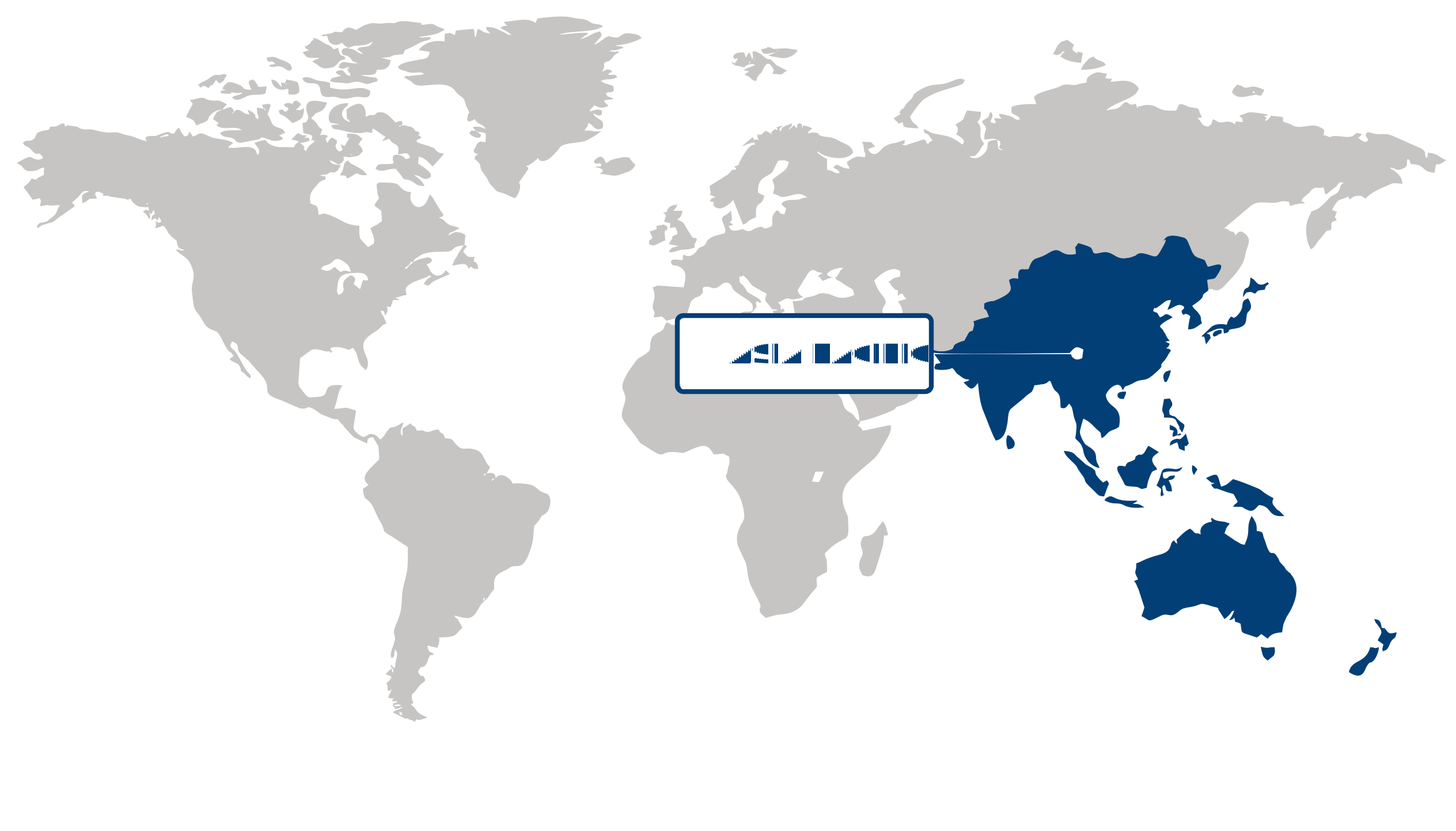
- Asia Pacific accounted for 55.97% of the market in 2026, supported by its large textile manufacturing base, extensive fabric processing activity, and established supply networks serving diverse textile applications.
- North America is projected to grow at a 6.1% CAGR as demand rises for technical textiles and performance-oriented finishing solutions that meet advanced functionality and compliance requirements.
Segment Momentum
- Repellent and Release accounted for 23.65% of the market in 2026 because its stain resistance, water repellency, and easy-clean properties are widely used across apparel, home textiles, and industrial fabrics.
- Antimicrobial /Anti-inflammatory is the fastest-growing segment as demand rises for textiles offering hygiene, odor control, and protective performance in health-conscious and performance-focused applications.
Market Expansion Drivers
- Rising demand for protective antimicrobial textiles in apparel and healthcare applications.
- Expanding Asia Pacific textile manufacturing driving large-scale functional finishing consumption.
- Growing shift toward eco-friendly nano-coated smart textiles enhancing performance attributes.
Leading Market Participants
- Leading players in the functional textile finishing chemicals market include BASF SE (Germany), Dow Inc. (United States), Huntsman Corporation (United States), Evonik Industries AG (Germany), Archroma Management LLC (Switzerland), Rudolf GmbH (Germany), Covestro AG (Germany), Tanatex Chemicals B.V. (Netherlands), Wacker Chemie AG (Germany), Solvay S.A. (Belgium).
Global Market Forecast Snapshot
Market Outlook
- 2026 Market Size: USD 4.1 billion
- 2027 Estimated Market Size: USD 4.27 billion.
- Projected Market Size: USD 6.7 billion by 2036
- Growth Forecast: 5.04% CAGR (2027-2036)
Regional and Segment Outlook
- Leading Regional Market: Asia Pacific
- High-Growth Regional Hub: North America
- Core Revenue Segment: Repellent and Release (Product)
- Emerging Opportunity Segment: Antimicrobial /Anti-inflammatory (Product)
Market Growth Drivers and Industry Trends
Rising demand for protective antimicrobial textiles in apparel and healthcare applications
Increasing awareness of hygiene, infection control, and textile protection is driving greater use of antimicrobial finishing technologies across apparel and healthcare products. In the functional textile finishing chemicals market, antimicrobial finishes are being applied to fabrics to inhibit the growth of microorganisms and provide additional protective functionality beyond conventional textile properties. Healthcare textiles, protective garments, uniforms, bedding, and selected apparel products can benefit from finishes that help maintain textile hygiene during use, particularly in applications where repeated exposure to moisture and microorganisms is a concern. Growing interest in performance-oriented clothing and specialized healthcare fabrics is encouraging textile manufacturers to integrate antimicrobial functionality into fabric finishing processes, increasing demand for chemical solutions capable of delivering durable and application-specific performance.
Expanding Asia Pacific textile manufacturing driving large-scale functional finishing consumption
The rapid expansion of textile production capacity across asia pacific is strengthening demand for finishing chemicals as manufacturers increasingly incorporate specialized performance characteristics into fabrics. Large textile manufacturing bases support substantial consumption of chemicals used during fabric treatment, dyeing, coating, and finishing, while rising production of apparel, home textiles, technical fabrics, and industrial textiles is creating opportunities for functional finishes. Growth in the functional textile finishing chemicals market is further supported by manufacturers seeking to differentiate textile products through properties such as antimicrobial protection, water repellency, durability, softness, and enhanced surface performance. The combination of established textile supply chains, expanding production capabilities, and increasing adoption of value-added textile treatments is contributing to broader consumption of functional finishing formulations across regional manufacturing operations.
Growing shift toward eco-friendly nano-coated smart textiles enhancing performance attributes
The textile industry's movement toward more sustainable and technologically advanced materials is increasing interest in nano-enabled finishing solutions that can provide multiple performance benefits with targeted surface treatment. Eco-friendly nano-coatings can enhance textile characteristics such as protection, durability, water management, stain resistance, or antimicrobial performance while supporting the development of smart and high-functionality fabrics. Within the functional textile finishing chemicals market, this transition is encouraging manufacturers to explore finishing technologies that combine advanced material performance with reduced environmental impact and improved resource efficiency. Research and development in nano-engineered textile surfaces is also broadening the potential applications of functional finishes in apparel, healthcare, sportswear, technical textiles, and other specialized fabric categories where enhanced performance characteristics are increasingly valued.
| Growth Driver | Impact on CAGR | Regulatory Influence | Geographic Relevance | Adoption Rate | Impact Timeline |
|---|---|---|---|---|---|
| Growing demand for functional textile finishing chemicals | 1.80% | Short term (≤ 2 yrs) | North America, Europe | Medium | Fast |
| Technological advancements in textile finishing processes | 1.80% | Medium term (2–5 yrs) | North America, Asia Pacific | Low | Moderate |
| Expansion of textile industry in emerging markets | 1.80% | Long term (5+ yrs) | Asia Pacific, Latin America | Low | Slow |
| Rising demand for protective antimicrobial textiles in apparel and healthcare applications | 2.20% | High | Asia Pacific, North America | High | Near Term |
| Expanding Asia Pacific textile manufacturing driving large-scale functional finishing consumption | 2.00% | Moderate | Asia Pacific | High | Near Term |
| Growing shift toward eco-friendly nano-coated smart textiles enhancing performance attributes | 1.50% | High | Europe, North America | Emerging | Mid Term |
Unlock insights tailored to your business with our bespoke market research solutions.
Click to get your customized report now.
Regional Demand Dynamics
Asia Pacific (Largest Region)
In the functional textile finishing chemicals market, Asia Pacific held the largest share of 55.97% in 2026, reflecting the region's extensive textile manufacturing base, strong export-oriented production, and concentration of fabric processing and garment manufacturing activities. The widespread adoption of advanced finishing treatments is being encouraged by demand for textiles with properties such as moisture management, antimicrobial performance, stain resistance, softness, and enhanced durability. Manufacturers are also responding to greater emphasis on product differentiation and higher-value textile applications, particularly in technical, sportswear, home furnishing, and performance apparel segments. Expanding investments in modern dyeing and finishing facilities, combined with the availability of established textile supply chains and skilled processing capabilities, continue to reinforce Asia Pacific's market position.
North America (Fastest-Growing Region)
North America is projected to be the fastest-growing region as textile manufacturers and downstream brands increasingly prioritize performance, durability, and sustainability in finished fabrics. Demand for functional textile finishing chemicals is being supported by expanding applications in protective clothing, healthcare textiles, sportswear, and specialized industrial fabrics where enhanced material performance is important. Growing attention to environmentally preferable formulations is also encouraging the development and adoption of finishing technologies that reduce harmful chemical inputs, water consumption, and processing impacts. Investments in advanced textile technologies and reshoring of selected manufacturing activities are creating additional opportunities for sophisticated finishing solutions, while stringent product and environmental requirements are encouraging suppliers to develop higher-performance and more compliant chemical formulations.
| Parameter | North America | Asia Pacific | Europe | Latin America | MEA |
|---|---|---|---|---|---|
| Innovation Hub i Scale Nascent Developing Advanced | |||||
| Cost-Sensitive Region i Scale Low Medium High | |||||
| Regulatory Environment i Scale Restrictive Neutral Supportive | |||||
| Demand Drivers i Scale Weak Moderate Strong | |||||
| Development Stage i Scale Emerging Developing Developed | |||||
| Adoption Rate i Scale Low Medium High | |||||
| New Entrants / Startups i Scale Sparse Moderate Dense | |||||
| Macro Indicators i Scale Weak Stable Strong |
Key Country Insights
Germany 🇩🇪
Sustainable Process DevelopmentGermany emphasizes environmentally responsible textile finishing solutions for technical and industrial fabrics. German chemical producers continue developing low-emission, water-efficient finishing formulations that align with stringent manufacturing and environmental standards.
France 🇫🇷
Luxury Textile EnhancementFrance integrates functional textile finishing chemicals into premium fashion, luxury textiles, and technical fabric manufacturing. French producers increasingly emphasize high-value finishing technologies that combine product performance with environmentally responsible production practices.
Italy 🇮🇹
Premium Fabric FinishingItaly leverages functional textile finishing chemicals to enhance premium fabrics used in fashion, upholstery, and industrial textiles. Italian manufacturers continue adopting advanced finishing solutions that improve fabric aesthetics, durability, and processing efficiency while supporting sustainable production goals.
Japan 🇯🇵
Precision Functional CoatingsJapan focuses on advanced textile finishing chemicals that enhance comfort, durability, and specialized fabric performance. Japanese manufacturers continue investing in innovative coating technologies for automotive, healthcare, and premium apparel applications requiring consistent quality.
South Korea 🇰🇷
Advanced Apparel SolutionsSouth Korea supports demand for functional textile finishing chemicals through its strong apparel and technical textile industries. South Korean suppliers are expanding specialty finishes that improve moisture management, antimicrobial performance, and fabric durability for premium textile products.
United States 🇺🇸
Performance Textile InnovationThe U.S. functional textile finishing chemicals market is driven by demand for high-performance apparel, medical textiles, and protective fabrics. Manufacturers in the U.S. are prioritizing durable, sustainable, and PFAS-alternative finishing technologies to meet evolving customer and regulatory expectations.
Segment Leadership and Growth Trends
Functional Textile Finishing Chemicals Market Share (%), by Product, 2026
Go beyond the chart, access full insights & data tables
Request Free Sample ReportProduct Segment Analysis: Repellent and Release (Largest Segment) vs Antimicrobial /Anti-inflammatory (Fastest-Growing Segment)
The repellent and release segment represented the largest share of the functional textile finishing chemicals market, accounting for 23.65% share in 2026, driven by demand for textiles with enhanced surface performance and easier-care characteristics. Repellent finishes can improve resistance to water, oils, stains, and other external substances, while release-oriented treatments help maintain fabric appearance and simplify cleaning and maintenance. These properties are valuable across apparel, outdoor textiles, home furnishings, and other applications where durability and practical performance influence product selection. Growing expectations for textiles that combine comfort and aesthetics with functional protection are encouraging manufacturers to incorporate finishing chemicals that provide longer-lasting and more useful surface characteristics.
The antimicrobial /anti-inflammatory segment is the fastest-growing segment as textile manufacturers increasingly respond to demand for fabrics offering enhanced hygiene and skin-comfort properties. Antimicrobial finishes can help control the growth of microorganisms on textile surfaces, making them relevant for apparel, healthcare textiles, activewear, and other applications where cleanliness and odor management are important. Interest in functional fabrics with wellness-oriented attributes is also encouraging the development of finishes designed to provide additional comfort and skin-related benefits. As consumers and end users place greater emphasis on hygiene, freshness, and performance-enhanced textiles, demand for antimicrobial and anti-inflammatory finishing solutions is gaining momentum.
| Segment | Sub-Segment | Largest Segment | Fastest Growing |
|---|---|---|---|
| Product | Antimicrobial /Anti-inflammatory, Flame Retardant, Repellent and Release, Temperature Regulation, Durable Press/Wrinkle Resistant, Others | Repellent and Release | Antimicrobial /Anti-inflammatory |
Competitive Landscape and Market Positioning
Key companies in the functional textile finishing chemicals market:
1. BASF SE (Germany)
2. Dow Inc. (United States)
3. Huntsman Corporation (United States)
4. Evonik Industries AG (Germany)
5. Archroma Management LLC (Switzerland)
6. Rudolf GmbH (Germany)
7. Covestro AG (Germany)
8. Tanatex Chemicals B.V. (Netherlands)
9. Wacker Chemie AG (Germany)
10. Solvay S.A. (Belgium)
Innovation in the functional textile finishing chemicals market is driven by performance-enhancing formulations and eco-friendly chemical development. Continuous research is improving fabric durability and functional properties. Demand for sustainable textile processing is shaping product design strategies. The functional textile finishing chemicals market is progressing toward greener and high-performance textile solutions.
| Company | Market Share | Company Revenue | Revenue CAGR (%) | Product Portfolio | Geographic Presence | Innovation / R&D Focus | Strategic Developments |
|---|---|---|---|---|---|---|---|
| BASF SE (Germany) | |||||||
| Dow Inc. (United States) | |||||||
| Huntsman Corporation (United States) | |||||||
| Evonik Industries AG (Germany) | |||||||
| Archroma Management LLC (Switzerland) | |||||||
| Rudolf GmbH (Germany) | |||||||
| Covestro AG (Germany) | |||||||
| Tanatex Chemicals B.V. (Netherlands) | |||||||
| Wacker Chemie AG (Germany) | |||||||
| Solvay S.A. (Belgium). |
Industry Development/News
| Company Name | Date | Key Development |
|---|---|---|
| Unifi, Inc. | Feb-25 | Unifi, Inc. launched Integr8™, a spandex-free stretch yarn made with REPREVE® recycled polyester, designed to combine elasticity, softness, and moisture management. The product expands sustainable textile material options and enhances performance yarn offerings, supporting broader adoption of recycled fiber-based functional textiles in apparel applications. |
| HeiQ Materials AG | May-22 | HeiQ Materials AG and Alchemie Technology developed HeiQ Life, a botanical odor-control textile finishing solution using digital finishing technology. The system significantly reduces water and energy consumption compared to conventional finishing methods and is designed for broad textile applicability, strengthening sustainable chemical processing capabilities in the textile finishing sector. |
| Wacker Chemie AG | Jun-19 | Wacker Chemie AG expanded its silicone elastomer production capacity in China to 7,000 metric tons annually. The investment enhances regional supply of high-consistency silicone rubber used in textile applications, improving availability of performance chemical inputs across the Asia-Pacific textile finishing and materials ecosystem. |
| Archroma | May-19 | Archroma launched Appretan NTR, a water-based textile coating binder derived from renewable natural ingredients. The product expands the company’s sustainable finishing chemicals portfolio and supports the transition toward bio-based and environmentally compatible textile processing solutions within industrial coating applications. |
Customize Your Report
Explore examples of how this report can be tailored to different research needs, including custom segments, additional topics or chapters, and related reports. Click a section of the wheel or its numbered marker to explore the available options.
Functional Textile Finishing Chemicals Market — Custom Segments
| Segment | Sub-Segment |
|---|---|
| Textile Substrate | Cotton, Polyester, Nylon, Wool, Blended Fabrics, Other Textiles |
| Application Method | Pad-Dry-Cure, Exhaust, Coating, Spray, Foam Application |
| End-use Industry | Apparel, Home Textiles, Technical Textiles, Automotive Textiles, Healthcare Textiles |
Functional Textile Finishing Chemicals Market — Custom TOC
| Custom Chapter | Custom Details |
|---|---|
| Sustainable Textile Chemistry Transition |
|
| Bio-Based Finishing Solutions Roadmap |
|
| Brand and Retail Sustainability Requirements |
|
Need a different cut of the data?
Request Custom ResearchHow large is the functional textile finishing chemicals market?
What is the anticipated CAGR of the functional textile finishing chemicals industry?
How is rising demand for antimicrobial textile performance reshaping procurement priorities in the functional textile finishing chemicals market?
How is large-scale textile manufacturing in Asia Pacific influencing functional finishing chemical adoption patterns?
Why is Repellent and Release the leading product segment in the functional textile finishing chemicals market?
Which product segment is growing the fastest in the functional textile finishing chemicals market?
Why does Asia Pacific dominate the functional textile finishing chemicals market?
What is fueling market growth in North America?
Who holds a significant market share in the functional textile finishing chemicals landscape?
Our Clients
"The report helped us understand emerging consumer trends in our product category. It clarified where to focus innovation for the next product launch."
LyondellBasell
"The regional forecast section was incredibly useful. We were able to identify two new potential partners in Europe thanks to the vendor mapping you included."
SABIC
"We appreciated how actionable the recommendations were. It guided us to improve supply chain resilience."
Olin Corporation
Our Research Team & Methodology
Every Fundamental Business Insights report is built by a dedicated vertical research team, validated through a structured primary-and-secondary methodology, and reviewed for accuracy before it reaches you.
Research Team Overview
Prepared by the Chemicals & Materials Research Team
Delivery
Published
Demand
Available
Support
Trust & Compliance
Research Domains
10 coverage areasResearch Intelligence
| Source | Reference |
|---|---|
| American Chemistry Council (ACC) | www.americanchemistry.com |
| European Chemical Industry Council (Cefic) | cefic.org |
| International Council of Chemical Associations (ICCA) | icca-chem.org |
| European Chemicals Agency (ECHA) | echa.europa.eu |
| U.S. Environmental Protection Agency (EPA) | www.epa.gov |
| ASTM International | www.astm.org |
| International Organization for Standardization (ISO) | www.iso.org |
| National Institute of Standards and Technology (NIST) | www.nist.gov |
| Plastics Industry Association (PLASTICS) | www.plasticsindustry.org |
| European Biplastics | www.european-bioplastics.org |
| The Adhesive and Sealant Council (ASC) | www.ascouncil.org |
| National Association of Corrosion Engineers (AMPP) | www.ampp.org |
| Society of Plastics Engineers (SPE) | www.4spe.org |
| International Fertilizer Association (IFA) | www.fertilizer.org |
| CropLife International | croplife.org |
| Packaging Europe | packagingeurope.com |
| Flexible Packaging Association (FPA) | www.flexpack.org |
| Battery Council International (BCI) | batterycouncil.org |
| International Copper Association (ICA) | internationalcopper.org |
| World Steel Association | worldsteel.org |
Research Workflow & Quality Assurance
Data Collection
Verified information gathered through primary and secondary research.
Data Triangulation
Cross-validation using multiple independent data sources.
Forecast Modelling
Market estimates developed using historical trends and analytical models.
Analyst Validation
Findings reviewed by domain experts for accuracy and consistency.
Editorial & Quality Review
Final editorial, quality, and compliance checks before publication.
Final Publication
Released after successful completion of the internal review process.
Report Coverage
📊 Market Assessment
- Market Size & Forecast
- Market Segmentation
- Regional Analysis
- Growth Drivers & Challenges
- Market Dynamics
🏢 Competitive Intelligence
- Competitive Landscape
- Company Profiles
- Competitive Benchmarking
- Mergers & Acquisitions
- Market Share Analysis or Key Company Strategies
🔍 Strategic Analysis
- Value Chain Analysis
- Porter's Five Forces
- PESTLE Analysis
- Pricing Trends
- Supply-Demand Analysis
🚀 Future Outlook
- Technology Landscape
- Regulatory Landscape
- Investment & Funding Landscape
- Emerging Opportunities
- Future Market Outlook
Have a question about this report or need a custom scope?
Request Customization