Fuel Cell Electric Buses Market Size & Growth Forecast 2027–2036, By Segments (Fuel Cell Type, Bus Type, Application, Range, End Users), Regional Demand Trends (North America, Asia Pacific, Europe), Key Country Insights (U.S., Japan, South Korea, Germany, France, Italy), and Competitive Landscape
Market Size and Growth Outlook
Fuel Cell Electric Buses Market size was valued at USD 1.74 Billion in 2026 and is anticipated to grow at 12.48% CAGR from 2027 to 2036, attaining USD 5.64 Billion by 2036. The industry revenue for 2027 is calculated at USD 1.93 Billion.
Get more details on this report
Request Free Sample ReportFuel Cell Electric Buses Market Intelligence Snapshot
Regional Market Dynamics
- Asia Pacific held 45.58% of the market in 2026, supported by clean transportation investment, hydrogen infrastructure development, urban mobility needs, and zero-emission initiatives.
- Europe is growing fastest as governments and transit operators invest in hydrogen infrastructure, fleet replacement, zero-emission mobility, and public transport decarbonization.
Segment Momentum
- PEMFC accounted for 83.99% of the market in 2026 and was also the fastest-growing fuel cell type, supported by high efficiency, quick start-up capability, reliable power output, and suitability for zero-emission bus operations.
- Transit buses held a 61.44% share in 2026 and were also the fastest-growing segment, driven by predictable routes, centralized hydrogen fueling, and increasing investment in sustainable public transportation systems.
Market Expansion Drivers
- Government incentives accelerating adoption of zero-emission hydrogen bus fleets
- Rising environmental regulations driving fleet electrification and hydrogen infrastructure expansion
- Advancements in hydrogen fuel cell efficiency improving commercial deployment viability
Leading Market Participants
- Prominent players in the fuel cell electric buses market include Toyota Motor Corporation (Japan), Hyundai Motor Company (South Korea), Ballard Power Systems Inc. (Canada), Daimler Truck AG (Germany), BYD Company Limited (China), Solaris Bus & Coach S.A. (Poland), New Flyer Industries Inc. (Canada), Wrightbus (UK), Ceres Power Holdings plc (UK), Iveco S.p.A. (Italy)
Global Market Forecast Snapshot
Market Outlook
- 2026 Market Size: USD 1.74 Billion
- 2027 Estimated Market Size: USD 1.93 Billion
- Projected Market Size: USD 5.64 Billion by 2036
- Growth Forecast: 12.48% CAGR (2027-2036)
Regional and Segment Outlook
- Leading Regional Market: Asia Pacific
- High-Growth Regional Hub: Europe
- Core Revenue Segment: Proton Exchange Membrane Fuel Cell (PEMFC) (Fuel Cell Type) | Transit Buses (Bus Type) | Intracity (Application) | 150 to 300 Miles (Range) | Public Transit Authorities (End Users)
- Emerging Opportunity Segment: Proton Exchange Membrane Fuel Cell (PEMFC) (Fuel Cell Type) | Transit Buses (Bus Type) | Intracity (Application) | Above 300 Miles (Range) | Public Transit Authorities (End Users)
Market Growth Drivers and Industry Trends
Government incentives accelerating adoption of zero-emission hydrogen bus fleets
Supportive public policies and financial assistance programs are encouraging transit authorities to replace conventional diesel buses with cleaner alternatives, creating favorable conditions that will drive the fuel cell electric buses market growth. Purchase subsidies, tax incentives, grants for fleet modernization, and funding for hydrogen refueling infrastructure help reduce the initial investment associated with fuel cell buses, making adoption more economically viable for public transportation agencies. These initiatives also encourage manufacturers to expand production capacity and introduce vehicles tailored to regional transportation requirements. In addition, government-backed demonstration projects and public procurement programs are increasing operator confidence in hydrogen-powered public transit solutions.
Rising environmental regulations driving fleet electrification and hydrogen infrastructure expansion
Stricter emission standards and air quality regulations are compelling public transport operators to accelerate the transition toward low-emission mobility solutions. The fuel cell electric buses market benefits from this regulatory environment as transport agencies increasingly invest in hydrogen-powered fleets to comply with evolving environmental requirements while maintaining operational flexibility on longer routes. At the same time, investments in hydrogen production, storage, distribution, and refueling infrastructure are improving ecosystem readiness for wider commercial deployment. The combined development of regulatory frameworks and supporting infrastructure is enabling transit operators to integrate hydrogen-powered buses into broader sustainable transportation strategies.
Advancements in hydrogen fuel cell efficiency improving commercial deployment viability
Continuous improvements in fuel cell technology are enhancing vehicle performance, operational reliability, and energy efficiency, making hydrogen-powered buses increasingly attractive for commercial applications. This technological progress will propel the fuel cell electric buses market growth by extending driving range, improving power output, and reducing maintenance requirements across demanding transit operations. Manufacturers are also advancing fuel cell stack durability, hydrogen storage systems, and energy management technologies to improve overall vehicle performance under varying operating conditions. These innovations support greater fleet utilization while strengthening the practical suitability of fuel cell buses for urban and intercity public transportation services.
| Growth Driver | Impact on CAGR | Regulatory Influence | Geographic Relevance | Adoption Rate | Impact Timeline |
|---|---|---|---|---|---|
| Government incentives accelerating adoption of zero-emission hydrogen bus fleets | 2.1% | High | Europe, Asia Pacific | High | Near Term |
| Rising environmental regulations driving fleet electrification and hydrogen infrastructure expansion | 2% | High | North America, Europe | High | Mid Term |
| Advancements in hydrogen fuel cell efficiency improving commercial deployment viability | 1.7% | Moderate | Asia Pacific, North America | Medium | Mid Term |
Unlock insights tailored to your business with our bespoke market research solutions.
Click to get your customized report now.
Regional Demand Dynamics
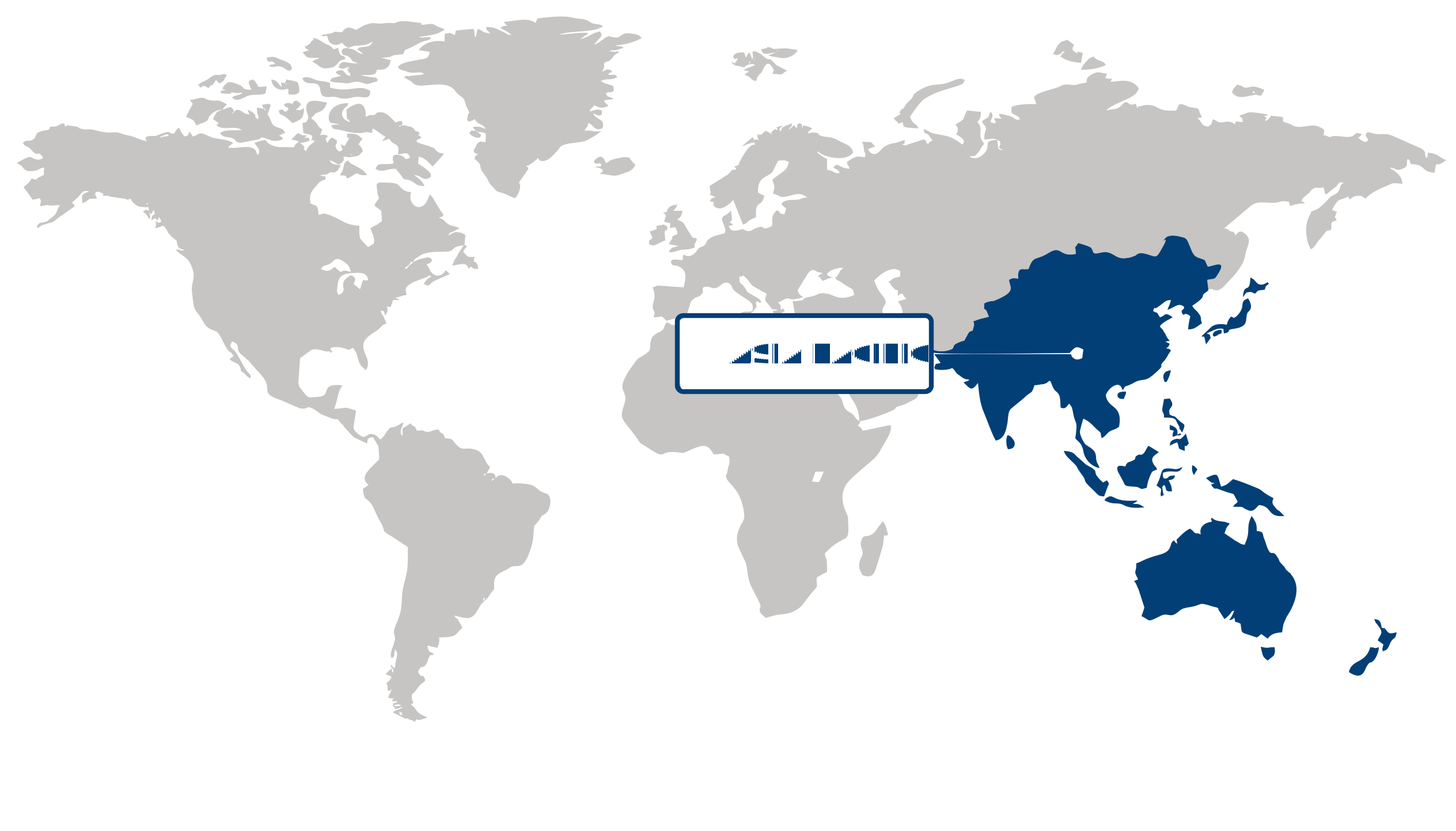
Asia Pacific (Largest Region)
Asia Pacific accounted for 45.58% of the fuel cell electric buses market in 2026, supported by strong investments in clean public transportation, expanding urban mobility requirements, and government efforts to reduce transportation emissions. The region's rapidly growing cities are creating greater demand for sustainable buses capable of supporting high-volume passenger transportation while reducing dependence on conventional fuels. Hydrogen infrastructure development, investments in fuel cell technology, and public-sector initiatives promoting zero-emission mobility are strengthening the regional ecosystem. In addition, the presence of established automotive and energy industries is supporting technological development and deployment of fuel cell buses across urban and regional transit applications.
Europe (Fastest-Growing Region)
Europe is projected to experience the fastest growth as governments and public transport operators intensify efforts to decarbonize bus fleets and meet increasingly stringent emissions requirements. Growing investments in hydrogen production, refueling infrastructure, and zero-emission public transportation are improving the commercial environment for fuel cell buses. The technology is particularly attractive for longer routes and intensive transit operations where operational range and rapid refueling can be important considerations. Furthermore, public procurement programs and fleet replacement initiatives are encouraging transit authorities to introduce cleaner vehicles, while broader efforts to integrate renewable energy with transportation are supporting the development of hydrogen-based mobility ecosystems.
| Parameter | North America | Asia Pacific | Europe | Latin America | MEA |
|---|---|---|---|---|---|
| Innovation Hub i Scale Nascent Developing Advanced | |||||
| Cost-Sensitive Region i Scale Low Medium High | |||||
| Regulatory Environment i Scale Restrictive Neutral Supportive | |||||
| Demand Drivers i Scale Weak Moderate Strong | |||||
| Development Stage i Scale Emerging Developing Developed | |||||
| Adoption Rate i Scale Low Medium High | |||||
| New Entrants / Startups i Scale Sparse Moderate Dense | |||||
| Macro Indicators i Scale Weak Stable Strong |
Key Country Insights
United States 🇺🇸
Hydrogen Transit AdoptionThe U.S. fuel cell electric buses market is advancing through transit agencies seeking zero-emission fleet solutions with extended operating range. Organizations in the U.S. increasingly evaluate hydrogen infrastructure, vehicle reliability, and lifecycle performance when planning fleet investments.
Germany 🇩🇪
Hydrogen Mobility IntegrationGermany continues to expand fuel cell electric bus deployment alongside broader hydrogen mobility initiatives and clean public transport strategies. Transit operators in Germany prioritize dependable fuel cell systems, efficient refueling infrastructure, and long-term fleet performance.
Japan 🇯🇵
Hydrogen Technology DeploymentJapan promotes fuel cell electric buses as part of its long-term hydrogen transportation ecosystem while supporting cleaner urban mobility. Transit authorities in Japan emphasize operational reliability, infrastructure coordination, and continuous improvement in fuel cell vehicle efficiency.
South Korea 🇰🇷
Clean Fleet TransitionSouth Korea is accelerating the deployment of fuel cell electric buses through coordinated investment in hydrogen production and refueling infrastructure. Bus operators in South Korea increasingly focus on integrating zero-emission vehicles into regular transit operations while maintaining service reliability.
France 🇫🇷
Public Transport DecarbonizationFrance continues to evaluate fuel cell electric buses for public transport systems seeking practical zero-emission alternatives on demanding routes. Transit agencies in France emphasize hydrogen infrastructure readiness, vehicle durability, and efficient fleet management to support long-term operations.
Italy 🇮🇹
Alternative Fuel ExpansionItaly is gradually incorporating fuel cell electric buses into public transport modernization initiatives aimed at diversifying zero-emission mobility solutions. Transit operators in Italy increasingly assess hydrogen-powered fleets based on operational flexibility, infrastructure availability, and route suitability.
Segment Leadership and Growth Trends
Fuel Cell Electric Buses Market Share (%), by Fuel Cell Type, 2026
Go beyond the chart, access full insights & data tables
Request Free Sample ReportFuel Cell Type Segment Analysis: Proton Exchange Membrane Fuel Cell (PEMFC) (Largest & Fastest-Growing Segment)
The fuel cell electric buses market was dominated by the proton exchange membrane fuel cell (PEMFC) segment, which accounted for 83.99% of the market share in 2026 and also emerged as the fastest-growing segment. PEMFC technology is widely preferred due to its high efficiency, relatively quick start-up capability, and suitability for transportation applications requiring frequent operational cycles. Its ability to provide reliable power output while supporting zero-emission mobility objectives has made it the preferred fuel cell technology for bus manufacturers and transit operators. Continued advancements in hydrogen infrastructure and fuel cell performance are further reinforcing the segment’s leadership position.
Bus Type Segment Analysis: Transit Buses (Largest & Fastest-Growing Segment)
Holding the largest share of 61.44% in 2026, the transit buses segment led the fuel cell electric buses market and also represented the fastest-growing category. Transit buses are at the forefront of hydrogen-powered public transportation deployment due to their predictable routes, centralized fueling requirements, and significant contribution to urban mobility. Transit agencies are increasingly adopting fuel cell electric buses to reduce emissions while maintaining operational flexibility and long driving ranges. Growing investment in sustainable public transportation systems continues to support strong demand for fuel cell-powered transit buses.
Application Segment Analysis: Intracity (Largest & Fastest-Growing Segment)
The intracity application segment was the largest segment in the fuel cell electric buses market in 2026 and also recorded the fastest growth. Demand is being driven by the increasing need for clean and efficient transportation solutions within urban environments, where reducing emissions and improving air quality have become key priorities. Fuel cell electric buses are well suited for intracity operations because they combine zero tailpipe emissions with the ability to support intensive daily service schedules. As cities continue to expand sustainable transit initiatives and hydrogen mobility programs, the adoption of fuel cell electric buses for intracity transportation is expected to strengthen further.
| Segment | Sub-Segment | Largest Segment | Fastest Growing |
|---|---|---|---|
| Fuel Cell Type | Proton Exchange Membrane Fuel Cell (PEMFC), Solid Oxide Fuel Cell (SOFC), Direct Methanol Fuel Cell (DMFC) | Proton Exchange Membrane Fuel Cell (PEMFC) | Proton Exchange Membrane Fuel Cell (PEMFC) |
| Bus Type | Shuttle Buses, Transit Buses, Articulated/High-capacity Buses, Coach Buses | Transit Buses | Transit Buses |
| Application | Intracity, Intercity | Intracity | Intracity |
| Range | Below 150 Miles, 150 to 300 Miles, Above 300 Miles | 150 to 300 Miles | Above 300 Miles |
| End Users | Public Transit Authorities, Private Transportation Companies, Tour Operators | Public Transit Authorities | Public Transit Authorities |
Competitive Landscape and Market Positioning
Top players in the fuel cell electric buses market:
- Toyota Motor Corporation (Japan)
- Hyundai Motor Company (South Korea)
- Ballard Power Systems, Inc. (Canada)
- Daimler Truck AG (Germany)
- BYD Company Limited (China)
- Solaris Bus & Coach S.A. (Poland)
- New Flyer Industries, Inc. (Canada)
- Wrightbus (UK)
- Ceres Power Holdings plc (UK)
- Iveco S.p.A. (Italy)
The fuel cell electric buses market is entering a more technology-driven competitive phase as participants focus on improving range capability, energy efficiency, and operational feasibility for commercial transit applications. Vehicle manufacturers, technology providers, and infrastructure-focused participants are competing to establish integrated solutions that overcome challenges associated with clean transportation adoption. Competitive advantage is shifting toward expertise in fuel cell integration, system durability, and fleet deployment strategies rather than vehicle manufacturing alone. Companies that can align vehicle performance with broader hydrogen infrastructure development are better positioned to capture emerging opportunities within public transportation networks.
| Company | Market Share | Company Revenue | Revenue CAGR (%) | Product Portfolio | Geographic Presence | Innovation / R&D Focus | Strategic Developments |
|---|---|---|---|---|---|---|---|
| Toyota Motor Corporation (Japan) | |||||||
| Hyundai Motor Company (South Korea) | |||||||
| Ballard Power Systems Inc. (Canada) | |||||||
| Daimler Truck AG (Germany) | |||||||
| BYD Company Limited (China) | |||||||
| Solaris Bus & Coach S.A. (Poland) | |||||||
| New Flyer Industries Inc. (Canada) | |||||||
| Wrightbus (UK) | |||||||
| Ceres Power Holdings plc (UK) | |||||||
| Iveco S.p.A. (Italy) |
Industry Development/News
| Company Name | Date | Key Development |
|---|---|---|
| FASTECH | Jun-26 | FASTECH and Bosch Rexroth were selected by SamTrans to design and deploy a high-capacity hydrogen refueling station in California. The infrastructure project is designed to support a fleet of up to 175 fuel cell electric buses, marking a significant expansion of large-scale hydrogen transit operations. |
| Ballard Power Systems | Mar-26 | Ballard Power Systems signed an agreement with New Flyer to supply 50 MW of hydrogen fuel cells. The components will power fuel cell-electric buses operating across the United States and Canada, strengthening the scale and deployment of zero-emission regional public transit networks. |
| Metro do Porto | Mar-26 | Metro do Porto commercially deployed hydrogen-powered public transport in Porto by launching its MetroBus Bus Rapid Transit system. The transit system utilizes CAETANO H2.City Gold fuel cell buses, establishing active municipal fuel cell operations within the region. |
| Cochin International Airport | Feb-26 | Cochin International Airport deployed India's first hydrogen-powered airport passenger buses. The fleet deployment is structurally supported by dedicated, on-site green hydrogen production infrastructure, advancing specialized zero-emission mobility applications within specialized airport transit operations. |
| CaetanoBus | Sep-25 | CaetanoBus expanded its European operational footprint by delivering five H2.City Gold fuel cell electric buses into the Finnish hydrogen mobility market. The geographic expansion supports the adoption of regional hydrogen-powered public transport networks across Northern Europe. |
| MCV | May-25 | MCV placed an order with Hexagon Purus to supply hydrogen storage tanks for its upcoming European fuel cell bus model. This component integration follows MCV's previous selection of Ballard fuel cell modules, advancing the commercial development of its next-generation hydrogen bus platform. |
| Hexagon Purus | Dec-24 | Hexagon Purus secured a supply agreement from New Flyer to deliver hydrogen storage cylinders for fuel cell-electric transit buses scheduled for 2025 production. The agreement solidifies the long-term component supply chain partnership between the two transit manufacturers. |
| New Flyer | Oct-24 | New Flyer secured a firm order from SamTrans for 108 Xcelsior Charge FC hydrogen fuel cell-electric transit buses. The transaction represents one of the largest single fuel cell bus procurements to date, significantly expanding the scale of hydrogen-powered public transit in California. |
| North County Transit District | Oct-24 | North County Transit District initiated the construction of an 8 million dollar hydrogen fueling station. The infrastructure investment supports the operational transition of its BREEZE bus fleet to zero-emission hydrogen fuel cell operations by establishing localized refueling capacity. |
| Bharat Benz | Jul-23 | Bharat Benz and Reliance Industries collaboratively introduced India's first luxury intercity hydrogen fuel cell bus. The joint vehicle development represents a material technological advancement for long-distance green mobility applications using integrated fuel cell systems. |
Customize Your Report
Explore examples of how this report can be tailored to different research needs, including custom segments, additional topics or chapters, and related reports. Click a section of the wheel or its numbered marker to explore the available options.
Fuel Cell Electric Buses Market — Custom Segments
| Segment | Sub-Segment |
|---|---|
| Procurement Model | Direct Purchase, Leasing, Public-Private Partnership |
| Fleet Deployment Scale | Small Fleets, Medium Fleets, Large Fleets |
| Hydrogen Refueling Model | On-site Refueling, Depot-based Refueling, Public Hydrogen Stations |
Fuel Cell Electric Buses Market — Custom TOC
| Custom Chapter | Custom Details |
|---|---|
| Installed Base Modernization Opportunity Analysis |
|
| Greenfield and Brownfield Investment Outlook |
|
| Predictive Maintenance Adoption Landscape |
|
Need a different cut of the data?
Request Custom ResearchWhat is the current size of the fuel cell electric buses market?
How much is the fuel cell electric buses industry expected to grow by 2036?
How are government incentives accelerating growth in the fuel cell electric buses market?
Why are advances in hydrogen fuel cell technology strengthening commercial deployment of fuel cell electric buses?
Why is Proton Exchange Membrane Fuel Cell (PEMFC) the leading technology in the fuel cell electric buses market?
Which bus type is seeing the strongest growth in the fuel cell electric buses market?
Why does Asia Pacific lead the fuel cell electric buses market?
What is driving faster fuel cell electric bus growth in Europe?
Who are the leading players in the fuel cell electric buses landscape?
Our Clients
"The team surpassed our expectations with the report depth. The actionable insights provided proved crucial in navigating market challenges."
Tata Motors
"We found the report to be very informative. The expertise and attention to market nuances significantly influenced our business direction."
DENSO Corporation
"The consumer survey findings were quite good. We now have a clearer picture of the customer churning and retention strategy."
HL Mando
Our Research Team & Methodology
Every Fundamental Business Insights report is built by a dedicated vertical research team, validated through a structured primary-and-secondary methodology, and reviewed for accuracy before it reaches you.
Research Team Overview
Prepared by the Automotive & Transportation Research Team
Delivery
Published
Demand
Available
Support
Trust & Compliance
Research Domains
10 coverage areasResearch Intelligence
| Source | Reference |
|---|---|
| International Organization of Motor Vehicle Manufacturers (OICA) | www.oica.net |
| SAE International | www.sae.org |
| International Energy Agency (IEA) | www.iea.org |
| International Transport Forum (ITF) | www.itf-oecd.org |
| International Road Federation (IRF) | www.irf.global |
| International Organization for Standardization (ISO) | www.iso.org |
| United Nations Economic Commission for Europe (UNECE) | unece.org |
| National Highway Traffic Safety Administration (NHTSA) | www.nhtsa.gov |
| U.S. Department of Transportation (USDOT) | www.transportation.gov |
| European Automobile Manufacturers' Association (ACEA) | www.acea.auto |
| Society of Indian Automobile Manufacturers (SIAM) | www.siam.in |
| International Air Transport Association (IATA) | www.iata.org |
| International Civil Aviation Organization (ICAO) | www.icao.int |
| International Maritime Organization (IMO) | www.imo.org |
| International Union of Railways (UIC) | uic.org |
| American Public Transportation Association (APTA) | www.apta.com |
| International Federation of Robotics (IFR) | ifr.org |
| CharIN | www.charin.global |
| World Shipping Council | www.worldshipping.org |
| International Federation of Freight Forwarders Associations (FIATA) | fiata.org |
Research Workflow & Quality Assurance
Data Collection
Verified information gathered through primary and secondary research.
Data Triangulation
Cross-validation using multiple independent data sources.
Forecast Modelling
Market estimates developed using historical trends and analytical models.
Analyst Validation
Findings reviewed by domain experts for accuracy and consistency.
Editorial & Quality Review
Final editorial, quality, and compliance checks before publication.
Final Publication
Released after successful completion of the internal review process.
Report Coverage
📊 Market Assessment
- Market Size & Forecast
- Market Segmentation
- Regional Analysis
- Growth Drivers & Challenges
- Market Dynamics
🏢 Competitive Intelligence
- Competitive Landscape
- Company Profiles
- Competitive Benchmarking
- Mergers & Acquisitions
- Market Share Analysis or Key Company Strategies
🔍 Strategic Analysis
- Value Chain Analysis
- Porter's Five Forces
- PESTLE Analysis
- Pricing Trends
- Supply-Demand Analysis
🚀 Future Outlook
- Technology Landscape
- Regulatory Landscape
- Investment & Funding Landscape
- Emerging Opportunities
- Future Market Outlook
Have a question about this report or need a custom scope?
Request Customization