Fragrance Product Market Size & Growth Forecast 2027–2036, By Segments (Distribution Channel, Fragrance Type, Product Type), Regional Demand Trends (North America, Asia Pacific, Europe), Key Country Insights (U.S., Japan, South Korea, Germany, France, Italy), and Competitive Landscape
Market Size and Growth Outlook
Fragrance Product Market size was estimated at USD 86.04 Billion in 2026 and is projected to grow at 5.72% CAGR from 2027 to 2036, reaching USD 150.06 Billion by 2036. The industry revenue for 2027 is assessed at USD 90.22 Billion.
Get more details on this report
Request Free Sample ReportFragrance Product Market Intelligence Snapshot
Regional Market Dynamics
- Europe led in 2026, supported by strong premium beauty demand, established fragrance culture, mature cosmetics infrastructure, and broad specialty, department-store, and digital retail access.
- Asia Pacific is growing fastest as rising incomes, urbanization, social media influence, and expanding retail and e-commerce increase demand for premium and personalized fragrances.
Segment Momentum
- Indirect sales lead the market and are also the fastest-growing channel, supported by the broad reach of supermarkets, beauty retailers, department stores, and e-commerce platforms that improve product visibility and consumer accessibility.
- Natural fragrances are the fastest-growing segment as consumers increasingly prefer naturally derived, clean-label, and sustainable products, encouraging manufacturers to expand premium, plant-based fragrance offerings.
Market Expansion Drivers
- Rising disposable income boosting premium fragrance and personal care spending
- Growing self-care and grooming trends increasing daily fragrance usage frequency
- Increasing demand for clean-label and natural fragrance formulations driving product reformulation
Leading Market Participants
- Leading companies in the fragrance product market include Givaudan SA (Switzerland), Firmenich International SA (Switzerland), International Flavors & Fragrances Inc. (United States), Symrise AG (Germany), Estée Lauder Companies Inc. (United States), L’Oréal S.A. (France), Coty Inc. (United States), Chanel Limited (France), LVMH Moët Hennessy Louis Vuitton SE (France), Procter & Gamble Company (United States)
Global Market Forecast Snapshot
Market Outlook
- 2026 Market Size: USD 86.04 Billion
- 2027 Estimated Market Size: USD 90.22 Billion
- Projected Market Size: USD 150.06 Billion by 2036
- Growth Forecast: 5.72% CAGR (2027-2036)
Regional and Segment Outlook
- Leading Regional Market: Europe
- High-Growth Regional Hub: Asia Pacific
- Core Revenue Segment: Indirect Sales (Distribution Channel) | Synthetic Fragrance (Fragrance Type) | Personal Care & Beauty (Product Type)
- Emerging Opportunity Segment: Indirect Sales (Distribution Channel) | Natural Fragrance (Fragrance Type) | Fine Fragrance and Perfume (Product Type)
Market Growth Drivers and Industry Trends
Rising disposable income boosting premium fragrance and personal care spending
Higher disposable incomes are encouraging consumers to allocate a larger share of their spending toward premium personal care products that offer enhanced quality, exclusivity, and sensory appeal. The fragrance product market is benefiting from this trend as shoppers increasingly seek fine fragrances, luxury body mists, and premium scented personal care products that reflect evolving lifestyle preferences. Premiumization is prompting manufacturers to introduce sophisticated fragrance collections, distinctive packaging, and higher-quality ingredient blends designed to appeal to consumers seeking elevated everyday experiences. Expanding retail availability across specialty stores, department stores, and digital platforms is further supporting access to premium fragrance offerings.
Growing self-care and grooming trends increasing daily fragrance usage frequency
Changing lifestyle habits and increasing attention to personal wellness are encouraging consumers to incorporate fragrances into their daily grooming routines rather than reserving them for occasional use. Growing emphasis on personal presentation will propel the fragrance product market growth by increasing the frequency of fragrance application across multiple product categories, including perfumes, deodorants, body sprays, and scented skincare products. Consumers are also exploring fragrance layering techniques and personalized scent combinations that encourage the purchase of complementary products within broader personal care routines. This shift reflects the integration of fragrance into everyday wellness, confidence, and self-expression practices across diverse consumer segments.
Increasing demand for clean-label and natural fragrance formulations driving product reformulation
Consumer preference for ingredient transparency and naturally derived formulations is encouraging manufacturers to reformulate fragrance products using botanical extracts, essential oils, and responsibly sourced raw materials. As expectations for cleaner formulations continue to rise, the fragrance product market is witnessing increased investment in ingredient innovation, formulation refinement, and supply chain transparency. Brands are focusing on reducing the use of controversial synthetic ingredients while improving disclosure practices to strengthen consumer trust and meet evolving purchasing preferences. Product development efforts are also emphasizing biodegradable ingredients and environmentally responsible sourcing practices that align with broader sustainability expectations.
| Growth Driver | Impact on CAGR | Regulatory Influence | Geographic Relevance | Adoption Rate | Impact Timeline |
|---|---|---|---|---|---|
| Rising disposable income boosting premium fragrance and personal care spending | 2% | Low | Asia Pacific, North America | High | Near Term |
| Growing self-care and grooming trends increasing daily fragrance usage frequency | 1.7% | Low | Europe, North America | High | Near Term |
| Increasing demand for clean-label and natural fragrance formulations driving product reformulation | 1.5% | Moderate | Europe, Asia Pacific | Medium | Mid Term |
Explore Growth Opportunities
Request Free Sample ReportRegional Demand Dynamics
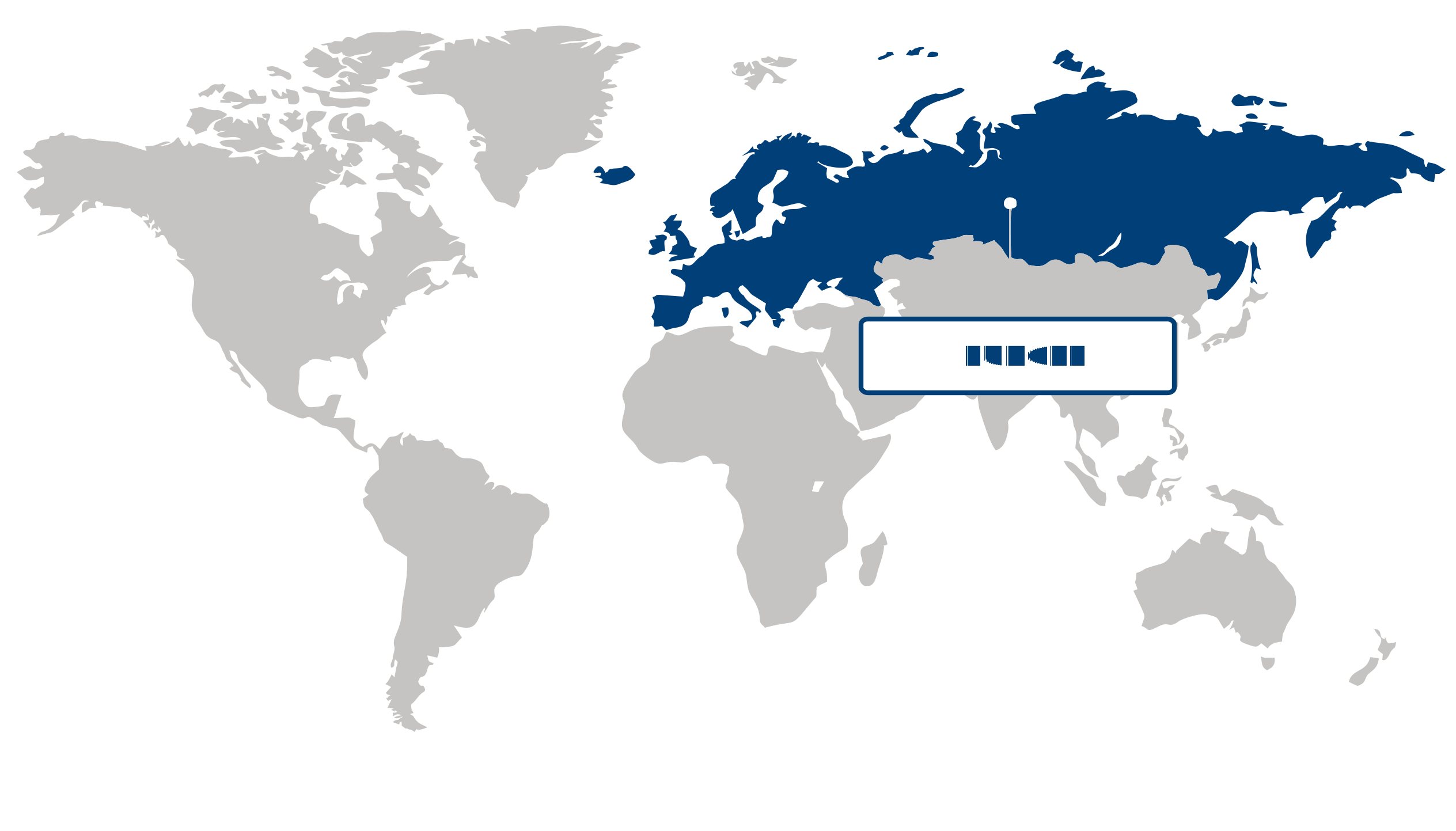
Europe (Largest Region)
Europe maintained the leading position in the fragrance product market in 2026, supported by strong consumer interest in premium personal care, established fragrance culture, and sustained demand for differentiated scents and luxury-oriented products. The region’s mature beauty and cosmetics ecosystem also encourages innovation across formulations, packaging, and product positioning, while consumers increasingly value distinctive fragrances, quality ingredients, and products aligned with personal identity and lifestyle preferences. Strong retail infrastructure and broad availability across specialty stores, department stores, and digital channels further reinforce the region’s market position.
Asia Pacific (Fastest-Growing Region)
Asia Pacific is projected to register the fastest growth, driven by rising disposable incomes, expanding middle-class populations, and growing consumer exposure to international beauty and personal care trends. Increasing urbanization and the influence of social media are broadening fragrance adoption among younger consumers, while greater interest in premium and personalized products is creating new opportunities across both mass-market and luxury segments. The expansion of organized retail and e-commerce is also improving product accessibility, supporting wider adoption across emerging markets in the region.
| Parameter | North America | Asia Pacific | Europe | Latin America | MEA |
|---|---|---|---|---|---|
| Innovation Hub i Scale Nascent Developing Advanced | |||||
| Cost-Sensitive Region i Scale Low Medium High | |||||
| Regulatory Environment i Scale Restrictive Neutral Supportive | |||||
| Demand Drivers i Scale Weak Moderate Strong | |||||
| Development Stage i Scale Emerging Developing Developed | |||||
| Adoption Rate i Scale Low Medium High | |||||
| New Entrants / Startups i Scale Sparse Moderate Dense | |||||
| Macro Indicators i Scale Weak Stable Strong |
Key Country Insights
United States 🇺🇸
Premium Brand ExpansionThe U.S. fragrance product market is driven by premium product launches, personalization, and strong omnichannel retail strategies. Brands invest in distinctive scent development, sustainable packaging, and digital consumer engagement to broaden market appeal.
Germany 🇩🇪
Ingredient Quality EmphasisGermany prioritizes fragrance products with high-quality ingredients, transparent formulations, and responsible sourcing practices. Manufacturers combine technical expertise with sustainable production to meet evolving consumer expectations.
Japan 🇯🇵
Refined Consumer PreferencesJapan favors fragrance products featuring subtle scent profiles, elegant packaging, and consistent product quality. Companies develop sophisticated formulations that align with premium personal care and lifestyle purchasing trends.
South Korea 🇰🇷
Trend-Driven InnovationSouth Korea combines fragrance products with beauty and lifestyle branding supported by digital commerce and influencer marketing. Companies introduce seasonal collections and distinctive scent concepts to maintain consumer interest.
France 🇫🇷
Luxury Fragrance HeritageFrance continues to emphasize craftsmanship, premium formulations, and creative scent development within the fragrance product market. Brands invest in sustainable ingredient sourcing while preserving distinctive fragrance identities for domestic and international consumers.
Italy 🇮🇹
Artisan Scent DevelopmentItaly strengthens its fragrance product market through artisanal formulation, premium design, and collaborations with luxury lifestyle brands. Manufacturers focus on distinctive olfactory experiences and refined packaging that enhance product differentiation.
Segment Leadership and Growth Trends
Fragrance Product Market Share (%), by Distribution Channel, 2026
Go beyond the chart, access full insights & data tables
Request Free Sample ReportDistribution Channel Segment Analysis: Indirect Sales (Largest & Fastest-Growing Segment)
The indirect sales segment led the fragrance product market in 2026 while also representing the fastest-growing distribution channel. Its dominance is supported by the extensive reach of supermarkets, specialty retailers, department stores, beauty outlets, and e-commerce platforms, which provide consumers with convenient access to a wide variety of fragrance products. The continued expansion of organized retail networks and omnichannel sales strategies is expected to strengthen product visibility and consumer accessibility, reinforcing the segment's market leadership.
Fragrance Type Segment Analysis: Synthetic Fragrance (Largest Segment) vs Natural Fragrance (Fastest-Growing Segment)
The synthetic fragrance segment held the largest share in 2026 due to its consistent quality, broad scent variety, and cost-efficient production. Synthetic fragrance ingredients allow manufacturers to develop stable formulations with long-lasting performance while ensuring reliable availability for high-volume production. Their flexibility in creating diverse fragrance profiles has made them a preferred choice across multiple consumer and industrial applications.
The natural fragrance segment is anticipated to record the fastest growth in the fragrance product market as consumers increasingly seek products formulated with naturally derived ingredients. Growing awareness of clean-label formulations, sustainability, and plant-based alternatives is encouraging manufacturers to expand their portfolios of natural fragrance solutions. Rising demand for premium and environmentally conscious products is expected to further support the growth of this segment.
Product Type Segment Analysis: Personal Care & Beauty (Largest Segment) vs Fine Fragrance and Perfume (Fastest-Growing Segment)
The personal care & beauty product segment accounted for the largest share in 2026, supported by the widespread incorporation of fragrances into skincare, haircare, cosmetics, and personal hygiene products. Increasing consumer focus on grooming, wellness, and premium beauty experiences has encouraged manufacturers to enhance product differentiation through distinctive fragrance formulations. The consistent demand for scented personal care products continues to sustain the segment's dominant position.
In the fragrance product market, the fine fragrance and perfume segment is expected to witness the fastest growth, driven by rising consumer preference for premium and personalized fragrances. Expanding disposable incomes, evolving fashion trends, and growing interest in luxury personal care products are encouraging greater adoption of premium perfumes. Continuous product innovation and increasing demand for unique fragrance experiences are expected to accelerate the expansion of this segment.
| Segment | Sub-Segment | Largest Segment | Fastest Growing |
|---|---|---|---|
| Distribution Channel | Direct Sales, Indirect Sales | Indirect Sales | Indirect Sales |
| Fragrance Type | Natural Fragrance, Synthetic Fragrance | Synthetic Fragrance | Natural Fragrance |
| Product Type | Personal Care & Beauty, Household Products, Industrial Essence, Fine Fragrance and Perfume, Others | Personal Care & Beauty | Fine Fragrance and Perfume |
Unlock insights tailored to your business with our bespoke market research solutions.
Click to get your customized report now.
Competitive Landscape and Market Positioning
Key companies in the fragrance product market:
- Givaudan SA (Switzerland)
- Firmenich International SA (Switzerland)
- International Flavors & Fragrances, Inc. (United States)
- Symrise AG (Germany)
- Estée Lauder Companies, Inc. (United States)
- L’Oréal S.A. (France)
- Coty, Inc. (United States)
- Chanel Limited (France)
- LVMH Moët Hennessy Louis Vuitton SE (France)
- Procter & Gamble Company (United States)
Consumer preferences are driving a more segmented competitive environment in the fragrance product market, where manufacturers are refining portfolios to address diverse lifestyle, wellness, and personalization trends across premium and everyday product categories. Product development is increasingly centered on distinctive scent creation, ingredient transparency, and longer-lasting formulations, encouraging continuous innovation rather than reliance on established fragrance profiles. At the same time, expanding digital commerce and direct consumer engagement are changing how brands build loyalty, prompting greater investment in personalized experiences, flexible product ranges, and responsive supply chains that can adapt quickly to shifting demand patterns.
| Company | Market Share | Company Revenue | Revenue CAGR (%) | Product Portfolio | Geographic Presence | Innovation / R&D Focus | Strategic Developments |
|---|---|---|---|---|---|---|---|
| Givaudan SA (Switzerland) | |||||||
| Firmenich International SA (Switzerland) | |||||||
| International Flavors & Fragrances Inc. (United States) | |||||||
| Symrise AG (Germany) | |||||||
| Estée Lauder Companies Inc. (United States) | |||||||
| L’Oréal S.A. (France) | |||||||
| Coty Inc. (United States) | |||||||
| Chanel Limited (France) | |||||||
| LVMH Moët Hennessy Louis Vuitton SE (France) | |||||||
| Procter & Gamble Company (United States) |
Industry Development/News
| Company Name | Date | Key Development |
|---|---|---|
| Coty Inc. | Nov-25 | Coty Inc. introduced Chloé Rose Naturelle Intense, featuring the company’s first refillable perfume bottle system. This launch represents a strategic shift toward sustainable packaging solutions, aiming to reduce the environmental footprint of luxury fragrance products throughout their lifecycle while aligning with growing consumer preferences for circular product models. |
| Chanel SA | Jul-25 | Chanel SA expanded its fragrance distribution strategy by launching the Gabrielle Chanel Eau de Parfum as an online-exclusive product. This move highlights a targeted approach to balancing digital-first retail growth with conventional travel and domestic market distribution channels for its luxury fragrance portfolio. |
| Maogeping Beauty | May-25 | Maogeping Beauty debuted its "Fragrantly" concept, positioning fragrance as an integrated component of a broader beauty and cultural experience. This initiative reflects a strategic move to differentiate its product offerings by blending scent creation with artistic lifestyle concepts to attract consumer interest in the premium lifestyle segment. |
| Agilex | Jan-25 | Agilex finalized a corporate rebranding and organizational integration initiative, consolidating multiple fragrance entities under one identity. This restructuring was designed to streamline the company’s innovation pipeline and improve speed-to-market capabilities for its fragrance ingredient and product development operations. |
| Firmenich | Jan-25 | Firmenich launched "emotiOn," a proprietary fragrance concept integrating artificial intelligence and neuroscience. By applying advanced sensory research to product development, the company aims to innovate fragrance formulations that target specific emotional well-being and social connection outcomes, reflecting a shift toward tech-enabled scent design. |
| USHOPAL | Jan-24 | USHOPAL acquired an equity stake in premium Chinese fragrance brand DOCUMENTS. This marks the company's first direct investment in a domestic brand, signaling a strategic effort to strengthen its portfolio and operational presence within the high-end fragrance segment. |
| Dollar General | Jan-24 | Dollar General introduced its Club92 home fragrance line, comprising candles, wax melts, and reed diffusers. Developed in partnership with Slatkin + Co., this launch represents a strategic expansion of the retailer’s private-label home fragrance offerings to capture mid-market consumer demand. |
Customize Your Report
Explore examples of how this report can be tailored to different research needs, including custom segments, additional topics or chapters, and related reports. Click a section of the wheel or its numbered marker to explore the available options.
Fragrance Product Market — Custom Segments
| Segment | Sub-Segment |
|---|---|
| Price Tier | Mass-Market, Premium, Luxury |
| Product Format | Spray, Roll-On, Solid, Oil-Based, Other Formats |
| Brand Positioning | Mass-Market Brands, Premium Brands, Luxury Brands, Niche and Indie Brands |
Fragrance Product Market — Custom TOC
| Custom Chapter | Custom Details |
|---|---|
| Consumer Scent Preference Intelligence |
|
| Omnichannel Discovery & Conversion Strategy |
|
| Sustainable Scent Portfolio Transition |
|
Need a different cut of the data?
Request Custom ResearchWhat is the market size of fragrance product?
How is the fragrance product industry expected to grow over the next 10 years?
How are changing consumer lifestyles influencing demand in the fragrance product market?
Why are clean-label formulations becoming a strategic focus for fragrance manufacturers?
Why do indirect sales lead the fragrance product market?
Which fragrance type is growing the fastest in the fragrance product market?
Why does Europe lead the fragrance product market?
What is driving the fastest growth of fragrance products in Asia Pacific?
Which organizations are considered leaders in the fragrance product landscape?
Our Clients
"The report provided us with a clear direction, and the level of detail was beyond what we expected. I would definitely recommend their services to others."
Haier Appliances
"The collaboration with Fundamental Business Insights has added significant value to our decision-making process, and we look forward to continuing this partnership for our future market research requirements."
Luxottica Group S.p.A.
"The team at FBI delivered an exceptional research report. The insights on industry innovations were particularly impressive and added a lot of value to the overall report."
Nike
Our Research Team & Methodology
Every Fundamental Business Insights report is built by a dedicated vertical research team, validated through a structured primary-and-secondary methodology, and reviewed for accuracy before it reaches you.
Research Team Overview
Prepared by the Consumer Goods & Services Research Team
Delivery
Published
Demand
Available
Support
Trust & Compliance
Research Intelligence
Research Workflow & Quality Assurance
Data Collection
Verified information gathered through primary and secondary research.
Data Triangulation
Cross-validation using multiple independent data sources.
Forecast Modelling
Market estimates developed using historical trends and analytical models.
Analyst Validation
Findings reviewed by domain experts for accuracy and consistency.
Editorial & Quality Review
Final editorial, quality, and compliance checks before publication.
Final Publication
Released after successful completion of the internal review process.
Report Coverage
📊 Market Assessment
- Market Size & Forecast
- Market Segmentation
- Regional Analysis
- Growth Drivers & Challenges
- Market Dynamics
🏢 Competitive Intelligence
- Competitive Landscape
- Company Profiles
- Competitive Benchmarking
- Mergers & Acquisitions
- Market Share Analysis or Key Company Strategies
🔍 Strategic Analysis
- Value Chain Analysis
- Porter's Five Forces
- PESTLE Analysis
- Pricing Trends
- Supply-Demand Analysis
🚀 Future Outlook
- Technology Landscape
- Regulatory Landscape
- Investment & Funding Landscape
- Emerging Opportunities
- Future Market Outlook
Have a question about this report or need a custom scope?
Request Customization