FPS Game Market Size & Forecasts 2026-2035, By Segments (Application, Type), Growth Opportunities, Innovation Landscape, Regulatory Shifts, Strategic Regional Insights (U.S., Japan, China, South Korea, UK, Germany, France), and Competitive Dynamics (Activision Blizzard, Tencent, Electronic Arts, Valve Corporation, Ubisoft)
Market Size and Growth Outlook
FPS Game Market size is predicted to expand from USD 32.01 billion in 2025 to USD 56.79 billion by 2035, with growth underpinned by a CAGR above 5.9% between 2026 and 2035. The industry revenue outlook for 2026 is USD 33.65 billion.
Get more details on this report
Request Free Sample ReportFPS Game Market Intelligence Snapshot
Regional Market Dynamics
Segment Momentum
Market Expansion Drivers
Leading Market Participants
Global Market Forecast Snapshot
Market Outlook
Regional and Segment Outlook
Market Growth Drivers and Industry Trends
Expansion of live streaming and gaming platforms: Broader creator ecosystems and platform-level features are increasing discoverability and retention for FPS titles, embedding live content, clips, and commerce into player journeys and altering monetization in the FPS game market. Platforms such as Twitch, YouTube Gaming, and Facebook Gaming are rolling out creator tools, subscriptions, and integrated commerce that convert viewership into spend and fandom. incumbents can leverage platform partnerships to amplify IP and content, while newcomers can pursue creator-first launches to gain rapid visibility. The steady rollout of creator monetization features across Twitch and YouTube Gaming suggests streaming will remain central to player acquisition and community management.
Mobile FPS gaming adoption in emerging markets: Rapid adoption of mobile-first consumption in regions served by publishers such as Tencent, Garena, and Activision Blizzard is expanding player demographics and monetization models, bringing the FPS game market into lower-cost, high-volume environments where microtransactions and regional partners dominate. Successes like Tencent’s localized releases and Garena’s regional publishing approach illustrate the need for device optimization, localized content, and alternative payment integrations. Incumbents can scale IP through mobile adaptations and local partnerships; entrants can capture niche segments with lightweight engines and culturally resonant design. Publicized regional launches and publisher investments by Tencent and Garena indicate continued prioritization of mobile strategies and localization efforts.
Industry Restraints:
Monetization Regulation and Content Moderation: Regulatory scrutiny over loot boxes, in‑game purchases, and content moderation constrains FPS monetization design by raising compliance costs, increasing consumer distrust, and forcing operational changes to progression systems. The Belgian Gaming Commission’s rulings on loot boxes, the Federal Trade Commission’s inquiries, and the Entertainment Software Rating Board’s introduction of an “In‑Game Purchases” label illustrate concrete regulatory and reputational pressures, while China’s National Press and Publication Administration controls on approvals and minors’ playtime directly affect live‑service monetization. For incumbents such as Activision Blizzard, these constraints compel heavier investment in legal, product and moderation teams; for new entrants they narrow viable revenue models. Expect continued tightening and demand for transparent, auditable monetization mechanics in the near to medium term, pushing the market toward subscription and cosmetic‑focused models and clearer disclosures.
Platform Gatekeepers and Store Policy Constraints: Dominant digital storefronts, console certification regimes, and middleware policy shifts limit distribution flexibility, margin structure, and update cadence for FPS developers, slowing market responsiveness and innovation. The Epic Games litigation with Apple over App Store rules, Valve’s Steam market position, Sony Interactive Entertainment’s platform controls, the Competition and Markets Authority review of Microsoft’s proposed acquisition of Activision Blizzard, and the developer backlash to Unity Software’s runtime fee change all demonstrate how platform and middleware governance can abruptly alter economics and access. Established publishers can negotiate terms or leverage exclusives; smaller studios face elevated discovery and fee barriers. Expect platforms to retain leverage while regulatory and competitive pressures incrementally erode some practices, prompting more direct‑to‑consumer strategies and multi‑store distribution approaches.
| Growth Driver | Impact on CAGR | Regulatory Influence | Geographic Relevance | Adoption Rate | Impact Timeline |
|---|---|---|---|---|---|
| Rising popularity of competitive gaming and esports | 2.50% | Short term (≤ 2 yrs) | North America, Asia Pacific | Low | Fast |
| Expansion of live streaming and gaming platforms | 2.00% | Medium term (2–5 yrs) | Europe, North America | Low | Moderate |
| Mobile FPS gaming adoption in emerging markets | 1.40% | Long term (5+ yrs) | Asia Pacific, Europe; Spillover: North America | Low | Slow |
Explore Growth Opportunities
Request Free Sample ReportRegional Demand Dynamics
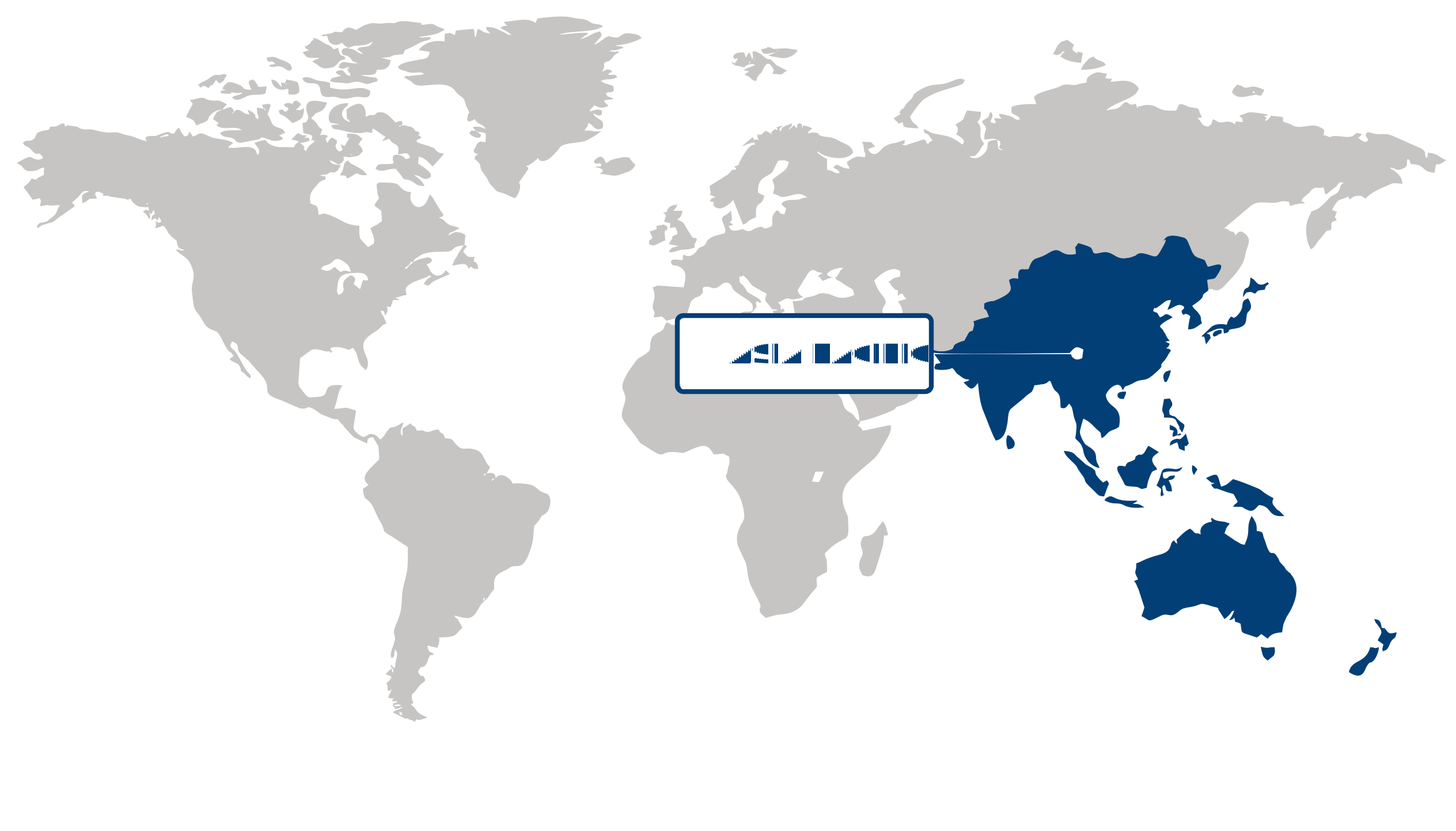
The FPS game market captured 46% of global share in Asia Pacific in 2025 and—at a 7% CAGR—is both the largest and fastest-growing region. Growth is anchored in expansive mobile and PC communities and APAC esports leadership, reinforced by ecosystem investments cited in Tencent press releases and Riot Games regional tournament announcements and supported by engagement metrics reported by Newzoo. Consumer shifts toward mobile-first spending, stronger connectivity and payment rails, evolving approval processes (National Press and Publication Administration), and publisher-led esports infrastructure are reducing go-to-market friction and boosting lifetime value. These combined dynamics make APAC a strategic landscape for scalable launches, live-ops monetization, and franchise-building over the next cycle.
China anchors the APAC market; the FPS game market in China is propelled by platform scale and mobile-first monetization, where Tencent and NetEase drive distribution and tournament sponsorship (Tencent annual reports; NetEase press releases). Fast 5G deployment supported by China Mobile and integrated social payments accelerate engagement, while oversight from the National Press and Publication Administration influences release timing and monetization design. Local publisher-funded leagues and large community ecosystems sustain retention and ARPU. Strategically, international publishers should prioritize localized partnerships and live-ops strategies to capture China’s depth and feed regional esports circuits.
Japan is positioned as a pivotal hub; the FPS game market in Japan benefits from premium console and PC spending, institutional support, and deep development talent. Sony Interactive Entertainment’s studio investments and Japan Esports Union (JeSU) activities signal rising competitive infrastructure, while developer talent pools at Capcom and Bandai Namco support high-quality, franchise-driven experiences. Player preferences for craftsmanship and IP loyalty drive higher ARPU for premium FPS titles, offering a complementary commercial pathway to APAC’s mobile-led growth. For investors, Japan provides exportable IP and a premium segment that strengthens regional portfolio diversification.
North America Market Analysis:
North America held a substantial share in the FPS game market, supported by high consumer spending across consoles, PC and mobile, a dense publisher ecosystem and mature esports and streaming channels. Demand is reinforced by subscription models and live-service monetization that favor frequent, high-engagement FPS franchises; the Entertainment Software Association’s annual report highlights strong U.S. and Canadian player engagement, and NPD Group tracking shows continued digital spend on premium FPS titles. Major platform and publisher strategies—from Microsoft and Sony Interactive Entertainment press releases on subscription and platform investment to Activision Blizzard and Electronic Arts portfolio activity—underscore commercial depth. Regulatory and content guidance from the ESRB also shapes monetization and access. Forward-looking, North America’s broadband infrastructure, developer talent pools and platform investments make it a high-opportunity region for scalable FPS monetization and distribution.
United States remains the core national market driving the region’s position in the FPS game market, with outsized per-capita spend, concentrated studio hubs and platform influence. U.S. consumer preferences favor live-service features and streaming integration—evident in Twitch and YouTube activity—and publishers such as Activision Blizzard and Electronic Arts, alongside Microsoft’s platform initiatives, tailor release and monetization strategies accordingly; NPD Group and the Entertainment Software Association data corroborate elevated U.S. spend and engagement. The Federal Trade Commission’s oversight of large industry transactions also affects strategic partnerships and consolidation dynamics. Strategically, the U.S. market’s scale, investment climate and talent concentration provide a gateway for regional rollout and innovation in FPS title monetization and competitive formats.
Europe Market Trends:
Europe experienced moderate growth in the FPS game market, supported by steady digital spending and platform concentration across PC and consoles. Consumer demand is diversifying toward live-service features and regionalized content while spending patterns favor downloadable content and microtransactions, per ISFE observations; platform gatekeeping and discovery dynamics are shaped by Valve’s Steam storefront and PEGI’s age-rating regime; and recent EU moves such as the European Commission’s Digital Services Act and Digital Markets Act have altered platform compliance and monetization pathways. Combined creative capacity and improving cloud delivery point to sustained commercial opportunity for publishers and service providers across Western Europe.
Germany functions as a key commercial and competitive center in the FPS game market, driven by a mature PC-centric player base and strong esports infrastructure. Local competitive dynamics and talent supply are reinforced by ESL’s esports ecosystem and GAME — Bundesverband der Games‑Branche e.V.’s industry advocacy, which help incubate competitive titles and tournament monetization models; Germany’s large LAN and esports audience also makes it an effective regional testbed for esports-first monetization and platform-rollout strategies. Strategic implication: success in Germany accelerates adoption across neighboring European markets.
France acts as an influential creative and publishing hub in the FPS game market, propelled by major studios and targeted public support. Ubisoft’s continued investment in multiplayer FPS franchises and the Centre national du cinéma et de l'image animée (CNC) funding programs, together with SELL’s market intelligence, sustain high-quality IP production and local developer capacity; cultural policies and strong studio pipelines enable premium, narrative-driven FPS that translate well to pan‑European releases. Strategic implication: France’s studio-led innovation and policy support strengthen regional IP pipelines and commercialization opportunities.
| Parameter | North America | Asia Pacific | Europe | Latin America | MEA |
|---|---|---|---|---|---|
| Innovation Hub i Scale Nascent Developing Advanced | |||||
| Cost-Sensitive Region i Scale Low Medium High | |||||
| Regulatory Environment i Scale Restrictive Neutral Supportive | |||||
| Demand Drivers i Scale Weak Moderate Strong | |||||
| Development Stage i Scale Emerging Developing Developed | |||||
| Adoption Rate i Scale Low Medium High | |||||
| New Entrants / Startups i Scale Sparse Moderate Dense | |||||
| Macro Indicators i Scale Weak Stable Strong |
Segment Leadership and Growth Trends
FPS Game Market Share (%), by Application, 2026
Go beyond the chart, access full insights & data tables
Request Free Sample ReportIndividual users dominated the FPS game market in 2025, capturing the largest share among segments in the Application category. Leadership reflects rising engagement among solo players and esports fans—seen in Twitch viewership trends and Activision Blizzard engagement reports—and is reinforced by ESL tournament activity and FaZe Clan community influence; publishers respond with live‑service features and refined matchmaking. Shifts in player preferences, competitive dynamics, and platform monetization models favor targeted retention strategies. Strategic opportunities exist for incumbents to expand live services and for emerging studios to build niche communities. Continued esports integration and streaming platform tie‑ins support near‑ to medium‑term relevance.
Analysis by Type
Mobile held largest share in the FPS game market in 2025 among segments within the Type category. This is driven by widespread smartphone penetration and mobile‑optimized titles, evidenced by Tencent’s PUBG Mobile and Activision’s Call of Duty Mobile distribution on the Apple App Store and Google Play, alongside mobile GPU advances from Qualcomm and engine support from Unity and Unreal. Consumer demand for accessible play, emerging‑market adoption, and 5G/cloud improvements reshape distribution and monetization. Opportunities include localized content, platform partnerships, and hardware‑software integration for both established publishers and agile entrants. Ongoing device and network enhancements indicate sustained mobile relevance.
| Segment | Sub-Segment | Largest Segment | Fastest Growing |
|---|---|---|---|
| Application | School Education, Competitive Game, Individual Users | ||
| Type | Mobile, PC, Home-Use Game Console |
Unlock insights tailored to your business with our bespoke market research solutions.
Click to get your customized report now.
Competitive Landscape and Market Positioning
The competitive landscape is marked by consolidation of studio portfolios, expanded go-to-market alignments and a steady stream of live-service releases that extend player lifecycles. Heavy emphasis on backend scalability, cloud deployment, anti‑cheat and AI tooling is redefining differentiation, while tighter integration with streaming, tournament ecosystems and user-generated content increases retention levers. These dynamics favor actors that can sustain rapid content cadence, large-scale live operations and cross-border publishing.
Strategic / Actionable Recommendations for Regional Players
North America: Prioritize alliances that deepen live‑ops and distribution reach, reinforce backend and anti‑cheat engineering, and adapt flagship IP for streaming and competitive circuits to guard share against global integrators.
Asia Pacific: Expand localized publishing arrangements, accelerate mobile‑first and hybrid free‑to‑play designs, and tap regional community platforms and influencer networks to turn strong domestic audiences into exportable IP.
Europe: Double down on narrative‑led premium experiences and technical R&D, partner with middleware and cloud providers for smoother launches, and nurture competitive and mod‑friendly ecosystems to boost discoverability.
| Company | Market Share | Company Revenue | Revenue CAGR (%) | Product Portfolio | Geographic Presence | Innovation / R&D Focus | Strategic Developments |
|---|---|---|---|---|---|---|---|
| No companies available. | |||||||
Industry Development/News
| Company Name | Date | Key Development |
|---|
Customize Your Report
Explore examples of how this report can be tailored to different research needs, including custom segments, additional topics or chapters, and related reports. Click a section of the wheel or its numbered marker to explore the available options.
FPS Game Market — Custom Segments
| Segment | Sub-Segment |
|---|---|
| No segment data available. | |
FPS Game Market — Custom TOC
| Custom Chapter | Custom Details | ||
|---|---|---|---|
| No custom TOC data available. | |||
Need a different cut of the data?
Request Custom ResearchWhat is the current size of the FPS game market?
What are the growth projections for the FPS game industry?
Which region shows the largest market footprint in the FPS game market?
Which geographical area is witnessing the highest growth rate in the FPS game sector?
Why does individual users sub-segment dominate the application segment of FPS game sector?
How does mobile segment fare in the FPS game industry?
Who are the leading players in the FPS game landscape?
Our Clients
"The report provided us with a clear direction, and the level of detail was beyond what we expected. I would definitely recommend their services to others."
Haier Appliances
"The collaboration with Fundamental Business Insights has added significant value to our decision-making process, and we look forward to continuing this partnership for our future market research requirements."
Luxottica Group S.p.A.
"The team at FBI delivered an exceptional research report. The insights on industry innovations were particularly impressive and added a lot of value to the overall report."
Nike
Our Research Team & Methodology
Every Fundamental Business Insights report is built by a dedicated vertical research team, validated through a structured primary-and-secondary methodology, and reviewed for accuracy before it reaches you.
Research Team Overview
Prepared by the Consumer Goods & Services Research Team
Delivery
Published
Demand
Available
Support
Trust & Compliance
Research Intelligence
Research Workflow & Quality Assurance
Data Collection
Verified information gathered through primary and secondary research.
Data Triangulation
Cross-validation using multiple independent data sources.
Forecast Modelling
Market estimates developed using historical trends and analytical models.
Analyst Validation
Findings reviewed by domain experts for accuracy and consistency.
Editorial & Quality Review
Final editorial, quality, and compliance checks before publication.
Final Publication
Released after successful completion of the internal review process.
Report Coverage
📊 Market Assessment
- Market Size & Forecast
- Market Segmentation
- Regional Analysis
- Growth Drivers & Challenges
- Market Dynamics
🏢 Competitive Intelligence
- Competitive Landscape
- Company Profiles
- Competitive Benchmarking
- Mergers & Acquisitions
- Market Share Analysis or Key Company Strategies
🔍 Strategic Analysis
- Value Chain Analysis
- Porter's Five Forces
- PESTLE Analysis
- Pricing Trends
- Supply-Demand Analysis
🚀 Future Outlook
- Technology Landscape
- Regulatory Landscape
- Investment & Funding Landscape
- Emerging Opportunities
- Future Market Outlook
Have a question about this report or need a custom scope?
Request Customization