Formaldehyde Market Size & Growth Forecast 2027–2036, By Segments (Derivatives, End-use), Regional Demand Trends (North America, Asia Pacific, Europe), Key Country Insights (U.S., Japan, South Korea, Germany, France, Italy), and Competitive Landscape
Market Size and Growth Outlook
Formaldehyde Market size was valued at USD 9.9 billion in 2026 and is projected to grow at a 4.94% CAGR from 2027 to 2036, reaching USD 16.03 billion by 2036. The industry revenue for 2027 is estimated at USD 10.31 billion.
Get more details on this report
Request Free Sample ReportFormaldehyde Market Intelligence Snapshot
Regional Market Dynamics
- Asia Pacific held a 56.70% share in 2026, supported by its extensive manufacturing base, integrated supply chains, and strong demand from chemicals, resins, and industrial processing industries.
- North America is projected to grow at a 6.55% CAGR, driven by investment in value-added chemical production, operational efficiency improvements, and reliable supply for downstream industrial applications.
Segment Momentum
- Urea Formaldehyde (UF) accounted for 40.6% of the market in 2026 due to its widespread use in wood-based panels and adhesive systems where cost efficiency and established processing are key priorities.
- Automotive is the fastest-growing end-use because manufacturers increasingly require durable, lightweight, resin-based materials that support efficient production and improved performance of vehicle components.
Market Expansion Drivers
- Strong construction sector demand for adhesives and engineered wood products.
- Expanding pharmaceutical and disinfectant applications driving chemical utilization.
- Shift toward low-toxicity substitutes accelerating green chemistry transition pressures.
Leading Market Participants
- Key players in the formaldehyde market include BASF SE (Germany), Hexion Inc. (USA), Celanese Corporation (USA), Georgia-Pacific Chemicals LLC (USA), Evonik Industries AG (Germany), Perstorp Holding AB (Sweden), Mitsubishi Gas Chemical Company, Inc. (Japan), Dynea AS (Norway), Formosa Plastics Corporation (Taiwan), OCI N.V. (Netherlands).
Global Market Forecast Snapshot
Market Outlook
- 2026 Market Size: USD 9.9 billion
- 2027 Estimated Market Size: USD 10.31 billion.
- Projected Market Size: USD 16.03 billion by 2036
- Growth Forecast: 4.94% CAGR (2027-2036)
Regional and Segment Outlook
- Leading Regional Market: Asia Pacific
- High-Growth Regional Hub: North America
- Core Revenue Segment: Urea Formaldehyde (UF) (Derivatives) | Building & Construction (End-use)
- Emerging Opportunity Segment: Phenol Formaldehyde (PF) (Derivatives) | Automotive (End-use)
Market Growth Drivers and Industry Trends
Strong construction sector demand for adhesives and engineered wood products
Strong activity in construction and building-related manufacturing will propel the formaldehyde market growth because formaldehyde-based resins are widely used in adhesives for engineered wood products, panels, and other construction materials. Demand for plywood, particleboard, medium-density fiberboard, and related products creates a substantial requirement for resin systems that provide bonding strength and durability. Continued residential and commercial construction, together with renovation and furniture manufacturing activity, supports the use of engineered wood materials where formaldehyde-based adhesive technologies remain important for efficient production and structural performance.
Expanding pharmaceutical and disinfectant applications driving chemical utilization
Beyond construction materials, broader pharmaceutical and disinfectant applications will boost formaldehyde market demand through its role as a chemical intermediate and antimicrobial agent in selected industrial and healthcare-related processes. Formaldehyde and formaldehyde-derived compounds are used in the manufacture of certain chemical products and can support disinfection and preservation applications where controlled antimicrobial action is required. Increasing requirements for pharmaceutical manufacturing inputs, laboratory materials, and sanitation solutions create additional consumption channels, particularly where established chemical processing systems rely on formaldehyde-based inputs.
Shift toward low-toxicity substitutes accelerating green chemistry transition pressures
Increasing scrutiny of formaldehyde exposure and emissions is placing pressure on the formaldehyde market as manufacturers and downstream users evaluate lower-emission formulations and alternative chemistries. Regulatory attention and customer preferences for safer building materials are encouraging the development of resins, adhesives, coatings, and other products designed to reduce harmful emissions while maintaining required performance characteristics. This transition is also stimulating research into bio-based feedstocks and alternative bonding technologies, influencing producers to improve process controls, emission management, and product formulations in response to evolving environmental and occupational requirements.
| Growth Driver | Impact on CAGR | Regulatory Influence | Geographic Relevance | Adoption Rate | Impact Timeline |
|---|---|---|---|---|---|
| Strong construction sector demand for adhesives and engineered wood products | 2.00% | High | Asia Pacific, North America | High | Near Term |
| Expanding pharmaceutical and disinfectant applications driving chemical utilization | 1.70% | High | North America, Europe | High | Near Term |
| Shift toward low-toxicity substitutes accelerating green chemistry transition pressures | 1.40% | High | Europe, North America | Emerging | Long Term |
Unlock insights tailored to your business with our bespoke market research solutions.
Click to get your customized report now.
Regional Demand Dynamics
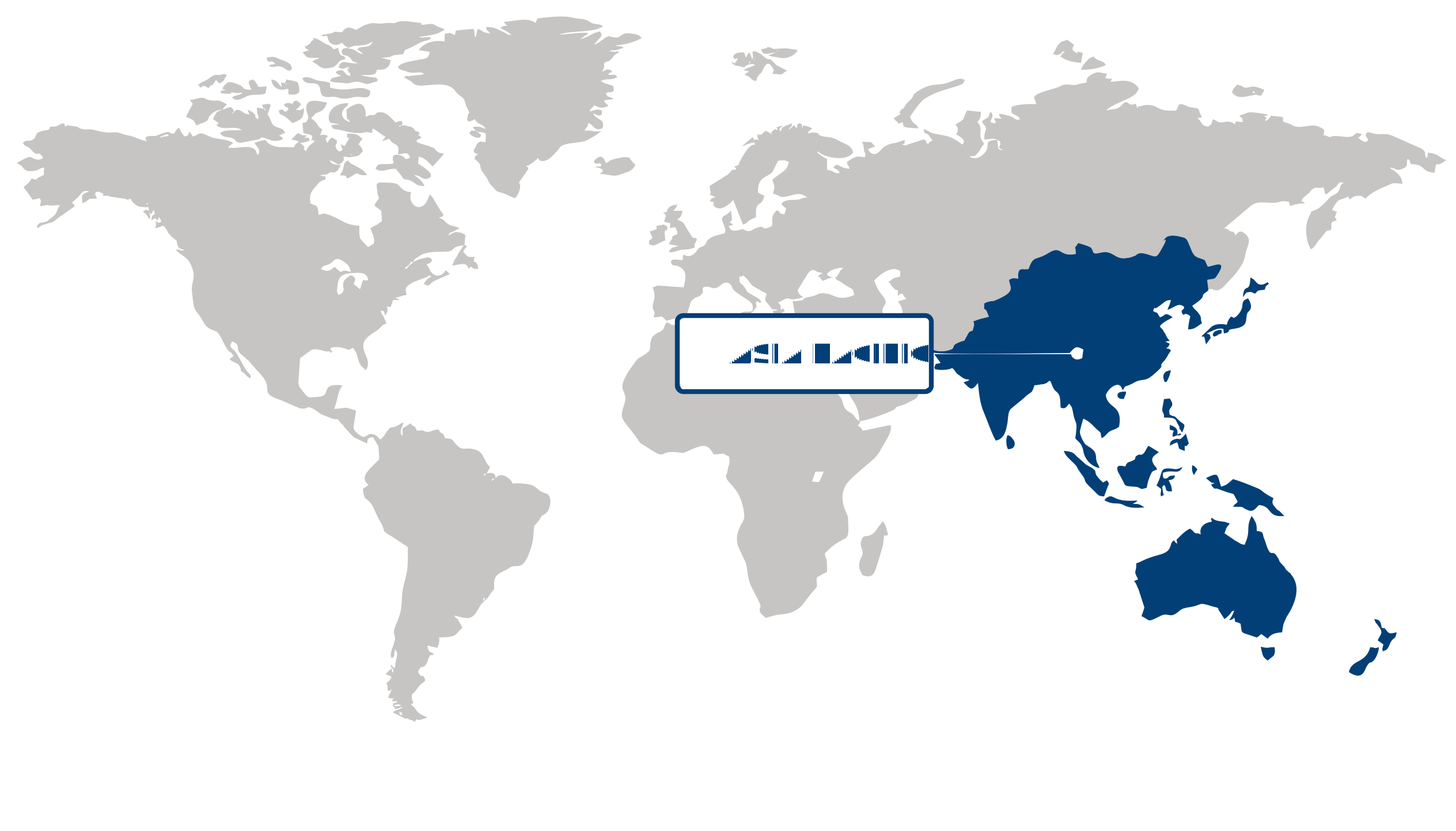
Asia Pacific (Largest Region)
Asia Pacific dominated the formaldehyde market with a 56.70% share in 2026, reflecting extensive chemical manufacturing activity and strong demand from construction, furniture, automotive, textiles, and other industrial sectors. Rapid urban development and expansion of residential and commercial construction are sustaining demand for formaldehyde-based resins and adhesives used in engineered wood products and building materials. The region's large manufacturing base also supports consumption in coatings, plastics, textiles, and chemical processing. Expanding industrial capacity, strong downstream production networks, and growing demand for processed and composite materials continue to reinforce the region's market leadership.
North America (Fastest-Growing Region)
North America represents the fastest-growing region, supported by investment in construction, renovation, manufacturing modernization, and advanced materials production. Demand for engineered wood products and industrial adhesives is contributing to formaldehyde consumption, while ongoing development of residential and commercial infrastructure creates additional opportunities. The region's mature chemical processing capabilities also support applications across multiple industrial sectors. At the same time, increasing emphasis on emissions management and safer chemical handling is encouraging manufacturers to adopt improved production technologies and formulations, supporting the evolution of the formaldehyde market toward more efficient and compliant applications.
| Parameter | North America | Asia Pacific | Europe | Latin America | MEA |
|---|---|---|---|---|---|
| Innovation Hub i Scale Nascent Developing Advanced | |||||
| Cost-Sensitive Region i Scale Low Medium High | |||||
| Regulatory Environment i Scale Restrictive Neutral Supportive | |||||
| Demand Drivers i Scale Weak Moderate Strong | |||||
| Development Stage i Scale Emerging Developing Developed | |||||
| Adoption Rate i Scale Low Medium High | |||||
| New Entrants / Startups i Scale Sparse Moderate Dense | |||||
| Macro Indicators i Scale Weak Stable Strong |
Key Country Insights
Germany 🇩🇪
Circular Chemistry FocusGermany is directing formaldehyde consumption toward high-value chemicals, automotive materials, and advanced coatings while tightening environmental standards. The German market increasingly prioritizes process efficiency and low-emission resin technologies to support industrial sustainability objectives.
France 🇫🇷
Sustainable Industrial InputsFrance is emphasizing environmentally compliant formaldehyde applications in construction materials and industrial chemicals. The French market is gradually shifting toward lower-emission products and process improvements that meet stricter environmental and occupational safety requirements.
Italy 🇮🇹
Manufacturing Value Chain SupportItaly's formaldehyde demand is supported by furniture production, wood processing, and industrial resins used across manufacturing sectors. Italian companies are focusing on reliable feedstock sourcing and improved resin performance to serve domestic producers of engineered products.
Japan 🇯🇵
Advanced Materials IntegrationJapan uses formaldehyde extensively in high-performance resins and specialty materials for electronics and precision manufacturing. Japanese producers are concentrating on product consistency and cleaner production technologies that align with the requirements of sophisticated downstream industries.
South Korea 🇰🇷
Electronics Supply LinkSouth Korea's formaldehyde market is closely tied to electronics, laminates, and industrial material production. Manufacturers in South Korea are investing in specialty resin applications and production optimization to support domestic manufacturing and export-oriented supply chains.
United States 🇺🇸
Specialty Resins HubThe U.S. formaldehyde market is shaped by demand from engineered wood products, insulation materials, and specialty resins used in construction and industrial applications. Producers in the U.S. are increasingly emphasizing lower-emission formulations and supply agreements with downstream chemical manufacturers.
Segment Leadership and Growth Trends
Formaldehyde Market Share (%), by Derivatives, 2026
Go beyond the chart, access full insights & data tables
Request Free Sample ReportDerivatives Segment Analysis: Urea Formaldehyde (UF) (Largest Segment) vs Phenol Formaldehyde (PF) (Fastest-Growing Segment)
Urea formaldehyde (UF) held the largest share of the formaldehyde market in 2026, accounting for 40.6% of the market, driven by its extensive use in engineered wood products and adhesive applications. UF resins provide strong bonding performance and cost efficiency, making them suitable for products such as particleboard, medium-density fiberboard, and related wood-based materials. Continued demand for engineered wood in furniture, interior applications, and construction supports consumption of UF-based resins and reinforces the segment's leading position.
Phenol formaldehyde (PF) is the fastest-growing derivatives segment, supported by its strong performance in applications requiring durability, heat resistance, and moisture tolerance. PF resins are particularly suited to demanding environments where adhesive integrity must be maintained under challenging operating conditions. Their use across construction materials, insulation-related products, and industrial applications is benefiting from demand for durable and high-performance materials, strengthening the segment's growth prospects.
End-use Segment Analysis: Building & Construction (Largest Segment) vs Automotive (Fastest-Growing Segment)
Building and construction represented the largest share of the formaldehyde market in 2026, accounting for 32.4% of the market, owing to extensive use of formaldehyde-based products in engineered wood, adhesives, resins, insulation, and other construction materials. Rising utilization of composite wood products and demand for durable, cost-effective building components sustain formaldehyde consumption across residential and commercial construction activities. The material's importance in manufacturing bonded wood products further reinforces its position within the construction value chain.
Automotive is the fastest-growing end-use segment as manufacturers increasingly use formaldehyde-derived materials in components requiring strength, durability, dimensional stability, and resistance to demanding operating conditions. Resin-based materials can contribute to lightweight interior and structural applications while supporting efficient manufacturing processes. Continued vehicle production, increasing material optimization, and demand for durable automotive components are creating additional opportunities for formaldehyde derivatives in this sector.
| Segment | Sub-Segment | Largest Segment | Fastest Growing |
|---|---|---|---|
| Derivatives | Urea Formaldehyde (UF), Phenol Formaldehyde (PF), Melamine Formaldehyde (MF), Polyacetal Resins, Pentaerythritol, 1,4 Butanediol, Methylenebis, Hexamethylenetetramine (HMTA), Others | Urea Formaldehyde (UF) | Phenol Formaldehyde (PF) |
| End-use | Building & Construction, Automotive, Furniture, Textile, Healthcare, Oil & Gas, Agriculture, Water Treatment, Cleaning Products, HVAC, Others | Building & Construction | Automotive |
Competitive Landscape and Market Positioning
Top players in the formaldehyde market:
1. BASF SE (Germany)
2. Hexion Inc. (USA)
3. Celanese Corporation (USA)
4. Georgia-Pacific Chemicals LLC (USA)
5. Evonik Industries AG (Germany)
6. Perstorp Holding AB (Sweden)
7. Mitsubishi Gas Chemical Company Inc. (Japan)
8. Dynea AS (Norway)
9. Formosa Plastics Corporation (Taiwan)
10. OCI N.V. (Netherlands)
The formaldehyde market is influenced by tightening environmental norms that are reshaping production and handling standards. Manufacturers are optimizing chemical processes to improve efficiency and reduce emissions. The formaldehyde market is also advancing through process modernization that enhances safety compliance and supports more controlled industrial usage.
| Company | Market Share | Company Revenue | Revenue CAGR (%) | Product Portfolio | Geographic Presence | Innovation / R&D Focus | Strategic Developments |
|---|---|---|---|---|---|---|---|
| BASF SE (Germany) | |||||||
| Hexion Inc. (USA) | |||||||
| Celanese Corporation (USA) | |||||||
| Georgia-Pacific Chemicals LLC (USA) | |||||||
| Evonik Industries AG (Germany) | |||||||
| Perstorp Holding AB (Sweden) | |||||||
| Mitsubishi Gas Chemical Company Inc. (Japan) | |||||||
| Dynea AS (Norway) | |||||||
| Formosa Plastics Corporation (Taiwan) | |||||||
| OCI N.V. (Netherlands). |
Industry Development/News
| Company Name | Date | Key Development |
|---|---|---|
| CalPlant | Feb-25 | The CalPlant MDF facility in Willows, California, has been placed back on the auction block. This restructuring of assets in the low-emission wood-based panel manufacturing segment creates uncertainty regarding future formaldehyde-reduced MDF production capacity within the North American building materials market. |
| Washington State | Feb-25 | The State of Washington finalized regulations restricting the sale and distribution of cosmetic products containing intentionally added formaldehyde or formaldehyde-releasing agents. These tightened consumer safety standards, effective September 2025, reflect an evolving regulatory landscape aimed at reducing direct human exposure to chemical hazards in personal care goods. |
| Dyson | Jan-25 | Dyson launched the Big+Quiet Formaldehyde BP06 air purifier, integrating specialized detection and catalytic removal technology. This development targets the residential indoor air safety segment, reflecting consumer demand for advanced filtration solutions capable of actively monitoring and eliminating airborne formaldehyde pollutants in domestic environments. |
| Xiaomi | Jan-25 | Xiaomi introduced the Mijia Air Purifier 5 Pro, featuring integrated formaldehyde sensing and multi-sensor air quality monitoring. By incorporating these capabilities into its consumer electronics portfolio, Xiaomi is positioning its hardware to address increasing public health concerns regarding indoor chemical pollutants and air quality management in urban residential settings. |
| Johnson Matthey plc | Dec-22 | Johnson Matthey expanded its manufacturing site in Perstorp, Sweden, to address rising global demand for formaldehyde. The project increased the facility's production capacity by approximately 50%, strengthening the company’s supply chain position and ability to support downstream industrial requirements for resins and chemical intermediates. |
| Hexion Inc. | Jul-22 | Hexion Inc. transitioned its formaldehyde production process at the Baytown, Texas facility to utilize bio-based methanol. This operational shift represents a strategic investment in sustainable manufacturing, aiming to reduce the carbon intensity of its formaldehyde output and align with broader industrial initiatives to lower emissions in the chemical supply chain. |
| Bakelite Synthetics | May-22 | Bakelite Synthetics completed the acquisition of Georgia-Pacific Chemicals, integrating the latter's complementary resin and formaldehyde technologies. This consolidation expanded Bakelite’s operational footprint across key end-use sectors, including building materials, transportation, and industrial chemical intermediates, significantly altering the competitive landscape for specialty resin suppliers. |
Customize Your Report
Explore examples of how this report can be tailored to different research needs, including custom segments, additional topics or chapters, and related reports. Click a section of the wheel or its numbered marker to explore the available options.
Formaldehyde Market — Custom Segments
| Segment | Sub-Segment |
|---|---|
| Production Process | Methanol Oxidation Process, Silver Catalyst Process, Metal Oxide Catalyst Process |
| Feedstock Source | Natural Gas-Based Methanol, Coal-Based Methanol, Biomass-Derived Methanol |
| Distribution Channel | Direct Sales, Chemical Distributors, Online & Specialty Chemical Platforms |
Formaldehyde Market — Custom TOC
| Custom Chapter | Custom Details |
|---|---|
| Regulatory Transition Impact Assessment |
|
| Low-Emission Product Adoption Roadmap |
|
| Alternative Feedstock Opportunity Analysis |
|
Need a different cut of the data?
Request Custom ResearchWhat is the market size of formaldehyde?
What is the anticipated CAGR of the formaldehyde industry?
How is demand from engineered wood and construction materials sustaining growth in the formaldehyde market?
What is driving the shift toward greener and low-toxicity alternatives in formaldehyde applications?
Why is Urea Formaldehyde (UF) the largest derivatives segment in the formaldehyde market?
Why is Automotive the fastest-growing end-use segment in the formaldehyde market?
Why is Asia Pacific the largest regional market for formaldehyde?
What factors are supporting formaldehyde market growth in North America?
Which organizations are considered leaders in the formaldehyde landscape?
Our Clients
"The report helped us understand emerging consumer trends in our product category. It clarified where to focus innovation for the next product launch."
LyondellBasell
"The regional forecast section was incredibly useful. We were able to identify two new potential partners in Europe thanks to the vendor mapping you included."
SABIC
"We appreciated how actionable the recommendations were. It guided us to improve supply chain resilience."
Olin Corporation
Our Research Team & Methodology
Every Fundamental Business Insights report is built by a dedicated vertical research team, validated through a structured primary-and-secondary methodology, and reviewed for accuracy before it reaches you.
Research Team Overview
Prepared by the Chemicals & Materials Research Team
Delivery
Published
Demand
Available
Support
Trust & Compliance
Research Domains
10 coverage areasResearch Intelligence
| Source | Reference |
|---|---|
| American Chemistry Council (ACC) | www.americanchemistry.com |
| European Chemical Industry Council (Cefic) | cefic.org |
| International Council of Chemical Associations (ICCA) | icca-chem.org |
| European Chemicals Agency (ECHA) | echa.europa.eu |
| U.S. Environmental Protection Agency (EPA) | www.epa.gov |
| ASTM International | www.astm.org |
| International Organization for Standardization (ISO) | www.iso.org |
| National Institute of Standards and Technology (NIST) | www.nist.gov |
| Plastics Industry Association (PLASTICS) | www.plasticsindustry.org |
| European Biplastics | www.european-bioplastics.org |
| The Adhesive and Sealant Council (ASC) | www.ascouncil.org |
| National Association of Corrosion Engineers (AMPP) | www.ampp.org |
| Society of Plastics Engineers (SPE) | www.4spe.org |
| International Fertilizer Association (IFA) | www.fertilizer.org |
| CropLife International | croplife.org |
| Packaging Europe | packagingeurope.com |
| Flexible Packaging Association (FPA) | www.flexpack.org |
| Battery Council International (BCI) | batterycouncil.org |
| International Copper Association (ICA) | internationalcopper.org |
| World Steel Association | worldsteel.org |
Research Workflow & Quality Assurance
Data Collection
Verified information gathered through primary and secondary research.
Data Triangulation
Cross-validation using multiple independent data sources.
Forecast Modelling
Market estimates developed using historical trends and analytical models.
Analyst Validation
Findings reviewed by domain experts for accuracy and consistency.
Editorial & Quality Review
Final editorial, quality, and compliance checks before publication.
Final Publication
Released after successful completion of the internal review process.
Report Coverage
📊 Market Assessment
- Market Size & Forecast
- Market Segmentation
- Regional Analysis
- Growth Drivers & Challenges
- Market Dynamics
🏢 Competitive Intelligence
- Competitive Landscape
- Company Profiles
- Competitive Benchmarking
- Mergers & Acquisitions
- Market Share Analysis or Key Company Strategies
🔍 Strategic Analysis
- Value Chain Analysis
- Porter's Five Forces
- PESTLE Analysis
- Pricing Trends
- Supply-Demand Analysis
🚀 Future Outlook
- Technology Landscape
- Regulatory Landscape
- Investment & Funding Landscape
- Emerging Opportunities
- Future Market Outlook
Have a question about this report or need a custom scope?
Request Customization