Forklift Market Size & Growth Forecast 2027–2036, By Segments (Class, Power Source, Type, Load Capacity, End Use), Regional Demand Trends (North America, Asia Pacific, Europe), Key Country Insights (U.S., Japan, South Korea, Germany, France, Italy), and Competitive Landscape
Market Size and Growth Outlook
Forklift Market size stood at USD 91.8 billion in 2026 and is predicted to grow at a 12.07% CAGR from 2027 to 2036, exceeding USD 286.9 billion by 2036. The industry revenue for 2027 is assessed at USD 101.13 billion.
Get more details on this report
Request Free Sample ReportForklift Market Intelligence Snapshot
Regional Market Dynamics
- Asia Pacific leads with 51.94% share due to its large manufacturing base, export-oriented industrial activity, and high demand from warehouses, ports, and logistics hubs supporting continuous equipment deployment.
- North America’s 15.12% CAGR is driven by warehouse modernization, e-commerce expansion, and rising investment in distribution infrastructure focused on productivity and efficient material handling operations.
Segment Momentum
- Class 3 accounted for 48.02% of the market in 2026, supported by extensive use in pallet movement, short-distance transport, and high-frequency warehouse operations where maneuverability and efficiency are essential.
- Electric forklifts are gaining momentum because they support low-emission, low-noise indoor operations and align well with warehouse requirements for cleaner and more efficient material handling.
Market Expansion Drivers
- Rapid shift toward electric forklifts driven by emissions regulations and sustainability mandates.
- Rising e-commerce and warehouse automation expanding demand for advanced material handling equipment.
- Integration of AI-powered telematics enabling predictive maintenance and fleet optimization efficiency.
Leading Market Participants
- Leading players in the forklift market include Toyota Industries Corporation (Japan), KION Group AG (Germany), Jungheinrich AG (Germany), Crown Equipment Corporation (United States), Mitsubishi Logisnext Co., Ltd. (Japan), Hyster-Yale Materials Handling, Inc. (United States), Komatsu Ltd. (Japan), Doosan Corporation (South Korea), Hangcha Group Co., Ltd. (China), Anhui Heli Co., Ltd. (China).
Global Market Forecast Snapshot
Market Outlook
- 2026 Market Size: USD 91.8 billion
- 2027 Estimated Market Size: USD 101.13 billion.
- Projected Market Size: USD 286.9 billion by 2036
- Growth Forecast: 12.07% CAGR (2027-2036)
Regional and Segment Outlook
- Leading Regional Market: Asia Pacific
- High-Growth Regional Hub: North America
- Core Revenue Segment: Class 3 (Class) | Electric (Power Source) | Li-ion (Type) | Below 5 Ton (Load Capacity) | Logistics (End Use)
- Emerging Opportunity Segment: Class 3 (Class) | Electric (Power Source) | Li-ion (Type) | Below 5 Ton (Load Capacity) | Retail & E-Commerce (End Use)
Market Growth Drivers and Industry Trends
Rapid shift toward electric forklifts driven by emissions regulations and sustainability mandates
Stricter emissions requirements and sustainability objectives will drive the forklift market toward greater adoption of electric-powered equipment, particularly in applications where businesses are seeking to reduce reliance on conventional fuel-powered material handling systems. Electric forklifts offer an alternative for warehouses, manufacturing facilities, and distribution operations aiming to improve workplace conditions while aligning equipment choices with environmental priorities. Improvements in battery technology and charging capabilities are also supporting the transition toward electrified material handling fleets.
Rising e-commerce and warehouse automation expanding demand for advanced material handling equipment
Rapid expansion of e-commerce and increasingly automated warehouse operations will propel the forklift market as distribution facilities require efficient equipment for moving, stacking, and retrieving goods across high-throughput environments. The growth of fulfillment activities is placing greater emphasis on reliable material handling systems that can operate within organized storage layouts and integrate with automated workflows. Demand is consequently increasing for forklifts capable of supporting faster inventory movement and the operational requirements of modern logistics facilities.
Integration of AI-powered telematics enabling predictive maintenance and fleet optimization efficiency
The integration of AI-powered telematics will enhance the forklift market by enabling operators and fleet managers to obtain deeper visibility into equipment performance, usage patterns, and maintenance requirements. Predictive maintenance capabilities can help identify potential equipment issues before they result in disruptive failures, while operational data can support better fleet utilization and resource allocation. These technologies are making connected forklifts more valuable for businesses seeking to improve equipment availability, manage maintenance activities, and optimize material handling operations.
| Growth Driver | Impact on CAGR | Regulatory Influence | Geographic Relevance | Adoption Rate | Impact Timeline |
|---|---|---|---|---|---|
| Rapid shift toward electric forklifts driven by emissions regulations and sustainability mandates | 2.00% | High | Europe, North America, Asia Pacific | High | Near Term |
| Rising e-commerce and warehouse automation expanding demand for advanced material handling equipment | 1.80% | High | Asia Pacific, North America | High | Near Term |
| Integration of AI-powered telematics enabling predictive maintenance and fleet optimization efficiency | 1.60% | Moderate | North America, Europe, Asia Pacific | High | Mid Term |
Unlock insights tailored to your business with our bespoke market research solutions.
Click to get your customized report now.
Regional Demand Dynamics
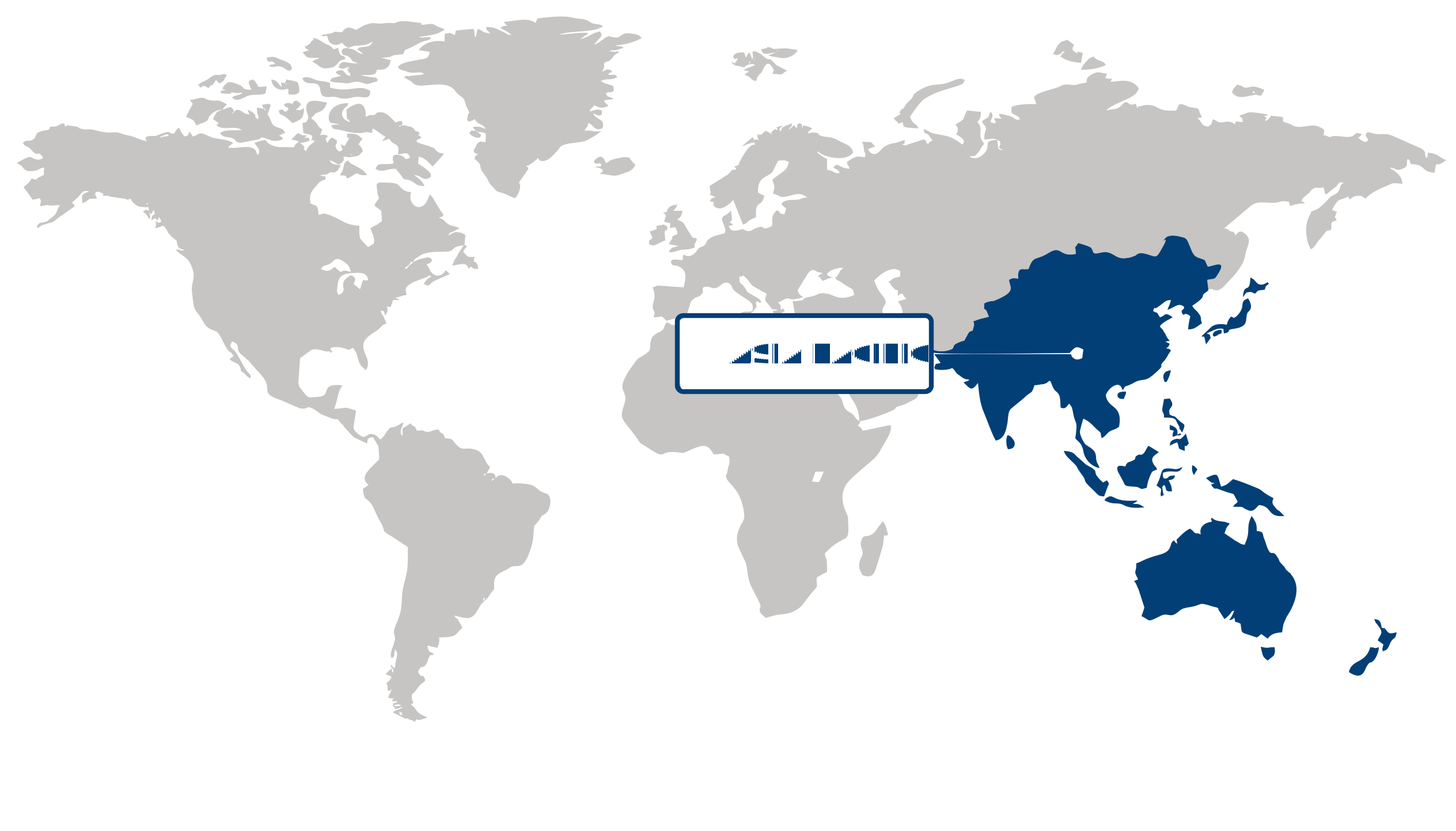
Asia Pacific (Largest Region)
Asia Pacific accounted for the largest share of the forklift market, with a 51.94% share in 2026. The region's leadership is closely linked to its extensive manufacturing base, expanding warehousing capacity, and high demand for efficient material-handling equipment across industrial and commercial operations. Rapid growth in e-commerce and organized logistics is increasing the need for forklifts in distribution centers, while industrial automation and warehouse modernization are encouraging businesses to upgrade material-handling fleets. Construction activity, infrastructure development, and the expansion of manufacturing facilities are also supporting equipment demand. In addition, growing interest in electric and lower-emission forklifts is encouraging fleet modernization as businesses seek greater operating efficiency and alignment with evolving environmental requirements.
North America (Fastest-Growing Region)
North America is the fastest-growing region, supported by warehouse expansion, supply-chain modernization, and increasing investment in automated and efficient material-handling operations. The continued development of distribution facilities and e-commerce fulfillment networks is creating demand for forklifts that can improve productivity and support high-throughput operations. Businesses are also prioritizing equipment with better energy efficiency, operator safety, connectivity, and lower operating costs, encouraging replacement of older fleets with technologically advanced models. Greater integration of electric powertrains and smart warehouse technologies is further strengthening the region's growth prospects, particularly as industrial users focus on improving operational resilience and reducing environmental impact.
| Parameter | North America | Asia Pacific | Europe | Latin America | MEA |
|---|---|---|---|---|---|
| Innovation Hub i Scale Nascent Developing Advanced | |||||
| Cost-Sensitive Region i Scale Low Medium High | |||||
| Regulatory Environment i Scale Restrictive Neutral Supportive | |||||
| Demand Drivers i Scale Weak Moderate Strong | |||||
| Development Stage i Scale Emerging Developing Developed | |||||
| Adoption Rate i Scale Low Medium High | |||||
| New Entrants / Startups i Scale Sparse Moderate Dense | |||||
| Macro Indicators i Scale Weak Stable Strong |
Key Country Insights
Germany 🇩🇪
Industrial Efficiency TransitionGermany prioritizes advanced forklift systems aligned with Industry 4.0 manufacturing and logistics efficiency. Adoption is supported by a shift toward electric models and integrated fleet management solutions designed to optimize material handling in industrial facilities.
France 🇫🇷
Sustainable Fleet ModernizationFrance focuses on transitioning forklift fleets toward electric and low-emission models within logistics and industrial operations. Companies increasingly prioritize energy efficiency, operator safety enhancements, and compliance with environmental workplace standards.
Italy 🇮🇹
Industrial Logistics UpgradesItaly is modernizing forklift fleets across manufacturing and distribution sectors to improve material handling efficiency. Demand is driven by upgrades in mid-sized industrial facilities adopting more reliable and flexible lifting solutions.
Japan 🇯🇵
Compact Logistics OptimizationJapan emphasizes compact, highly maneuverable forklift solutions suited for space-constrained warehouses and precision manufacturing environments. Demand is driven by automation integration and a strong preference for safety-enhanced and energy-efficient material handling equipment.
South Korea 🇰🇷
Smart Warehouse ExpansionSouth Korea is increasingly adopting forklift systems integrated into smart warehouse ecosystems supporting electronics, automotive, and e-commerce logistics. Investment priorities include electrification, telematics-enabled fleet monitoring, and improved operational safety systems.
United States 🇺🇸
Warehouse Automation UpgradeIn the U.S., forklift demand is increasingly tied to warehouse automation and e-commerce logistics expansion. Companies are investing in electric forklifts and connected fleet systems to improve operational efficiency, reduce downtime, and support high-volume distribution environments.
Segment Leadership and Growth Trends
Forklift Market Share (%), by Class, 2026
Go beyond the chart, access full insights & data tables
Request Free Sample ReportClass Segment Analysis: Class 3 (Largest & Fastest-Growing Segment)
Class 3 dominated the forklift market in 2026, accounting for a 48.02% share, while also representing the fastest-growing class. The segment benefits from the widespread need for compact and maneuverable material-handling equipment in warehouses, distribution centers, retail facilities, and other environments where space efficiency is important. Class 3 forklifts are well suited to handling palletized goods and moving materials through constrained operating areas, making them valuable as businesses focus on improving internal logistics and warehouse productivity. The continued expansion of organized warehousing and the emphasis on efficient material flow further support demand for this class.
Power Source Segment Analysis: Electric (Largest & Fastest-Growing Segment)
Electric forklifts held the largest share of the forklift market in 2026 and are also the fastest-growing power-source segment. Their strong position is supported by demand for quieter, cleaner, and increasingly efficient material-handling equipment, particularly in indoor warehouse and distribution environments. Electric models eliminate direct exhaust emissions during operation and can support workplace environments where air quality and noise control are important considerations. Growing emphasis on sustainable operations, energy efficiency, and modernization of material-handling fleets is encouraging businesses to transition toward electric equipment.
| Segment | Sub-Segment | Largest Segment | Fastest Growing |
|---|---|---|---|
| Class | Class 1, Class 2, Class 3, Class 4/5 | Class 3 | Class 3 |
| Power Source | ICE, Electric | Electric | Electric |
| Type | Li-ion, Lead Acid | Li-ion | Li-ion |
| Load Capacity | Below 5 Ton, 5-15 Ton, Above 16 Ton | Below 5 Ton | Below 5 Ton |
| End Use | Industrial, Logistics, Chemical, Food & Beverage, Retail & E-Commerce, Others | Logistics | Retail & E-Commerce |
Competitive Landscape and Market Positioning
Key companies in the forklift market:
1. Toyota Industries Corporation (Japan)
2. KION Group AG (Germany)
3. Jungheinrich AG (Germany)
4. Crown Equipment Corporation (United States)
5. Mitsubishi Logisnext Co. Ltd. (Japan)
6. Hyster-Yale Materials Handling Inc. (United States)
7. Komatsu Ltd. (Japan)
8. Doosan Corporation (South Korea)
9. Hangcha Group Co. Ltd. (China)
10. Anhui Heli Co. Ltd. (China)
The forklift market is undergoing rapid transformation through the adoption of electric-powered systems, warehouse automation technologies, and smart fleet management solutions. Manufacturers are emphasizing energy efficiency, productivity enhancement, and autonomous operational capabilities to meet evolving logistics and industrial requirements. Growing investments in modern warehousing infrastructure are further accelerating innovation and expansion opportunities within the forklift market.
| Company | Market Share | Company Revenue | Revenue CAGR (%) | Product Portfolio | Geographic Presence | Innovation / R&D Focus | Strategic Developments |
|---|---|---|---|---|---|---|---|
| Toyota Industries Corporation (Japan) | |||||||
| KION Group AG (Germany) | |||||||
| Jungheinrich AG (Germany) | |||||||
| Crown Equipment Corporation (United States) | |||||||
| Mitsubishi Logisnext Co. Ltd. (Japan) | |||||||
| Hyster-Yale Materials Handling Inc. (United States) | |||||||
| Komatsu Ltd. (Japan) | |||||||
| Doosan Corporation (South Korea) | |||||||
| Hangcha Group Co. Ltd. (China) | |||||||
| Anhui Heli Co. Ltd. (China). |
Industry Development/News
| Company Name | Date | Key Development |
|---|---|---|
| Metier | May-26 | Metier invested $20 million in Bisedge, an African forklift leasing firm, to support its asset-light leasing model. This strategic capital injection aims to expand access to intralogistics equipment across regional markets, enhancing financing capacity and supporting the modernization of material handling fleets in emerging African industrial sectors. |
| Comau | May-26 | Comau announced the planned acquisition of Brazil-based warehouse automation company Invent. This move is designed to integrate advanced warehouse automation and material handling capabilities into Comau's existing portfolio, strengthening its competitive position in providing comprehensive, integrated logistics systems for global industrial markets. |
| Bobcat | Mar-26 | Bobcat expanded its heavy-duty forklift portfolio with the launch of the DV180S-9 and DV250S-9 diesel models at LogiMAT 2026. These additions increase the company's lifting capacity and product range, targeting high-intensity industrial material handling applications and strengthening its competitive presence in the heavy-duty segment. |
| Symbotic | Feb-26 | Symbotic acquired autonomous forklift developer Fox Robotics to enhance its warehouse logistics automation suite. The integration of proprietary autonomous forklift systems into Symbotic’s end-to-end supply chain platform marks a strategic expansion of its robotics capabilities, aiming to provide more comprehensive, technology-driven solutions for large-scale warehouse operations. |
| Bailey Equipment & Intralogistics | Jan-26 | Bailey Equipment & Intralogistics acquired the Washington state operations of Equipment Depot. This strategic expansion significantly increases the company’s geographic footprint and strengthens its distribution and service infrastructure, enhancing its capacity to provide industrial equipment leasing and comprehensive material handling support services within the region. |
| Clark Material Handling | May-25 | Clark Material Handling relocated its global headquarters to the Dallas–Fort Worth metroplex. This consolidation of corporate operations is intended to centralize strategic coordination, streamline global manufacturing and distribution activities, and provide a more robust foundation for the company’s long-term competitive positioning within the global material handling market. |
| STEF | Apr-25 | STEF launched a hydrogen-powered forklift initiative in France and Spain in partnership with Toyota and Plug Power. By deploying fuel cell-powered material handling equipment in cold chain environments, the project advances sustainable logistics operations and demonstrates a scalable model for reducing carbon emissions in large-scale distribution centers. |
| Raymond Corporation | Jan-25 | The Raymond Corporation is expanding its domestic manufacturing capabilities with a dedicated battery plant for lithium-ion forklift production. This investment directly supports the company’s electrification strategy, increasing production capacity for energy-efficient lift trucks and catering to the growing market shift toward sustainable, electric-powered material handling equipment. |
| Toyota Material Handling | Jan-25 | Toyota Material Handling announced a $100 million investment to construct a new assembly facility in Indiana for battery-powered forklifts. This expansion significantly boosts the company's electric forklift production capacity, aligning its manufacturing footprint with rising industrial demand for low-emission material handling solutions. |
| Amazon | Jan-25 | Amazon successfully deployed an onsite hydrogen generation system utilizing Plug Power electrolyzers to fuel forklift operations at its Colorado fulfillment center. This transition from conventional fuel systems to integrated hydrogen infrastructure represents a significant operational shift toward warehouse decarbonization and long-term energy sustainability. |
Customize Your Report
Explore examples of how this report can be tailored to different research needs, including custom segments, additional topics or chapters, and related reports. Click a section of the wheel or its numbered marker to explore the available options.
Forklift Market — Custom Segments
| Segment | Sub-Segment |
|---|---|
| Automation Level | Manual, Semi-Automated, Automated, Autonomous |
| Ownership Model | Direct Ownership, Rental, Leasing, Equipment-as-a-Service |
| Fleet Size | Single-Unit Fleets, Small Fleets, Medium Fleets, Large Fleets |
Forklift Market — Custom TOC
| Custom Chapter | Custom Details |
|---|---|
| Warehouse Automation Impact Assessment |
|
| Fleet Replacement and Equipment Modernization Outlook |
|
| Battery and Charging Infrastructure Readiness |
|
Need a different cut of the data?
Request Custom ResearchWhat is the current size of the forklift market?
What is the forecasted size of the forklift industry?
How are sustainability mandates influencing forklift fleet investment strategies?
Why are connected forklifts becoming a strategic priority for warehouse operators?
Why does Class 3 lead the forklift market?
Why is Electric the fastest-growing power source in the forklift market?
Why does Asia Pacific dominate the forklift market?
What is driving North America’s fastest growth in the forklift market?
Who are the leading players in the forklift landscape?
Our Clients
"Your insights on workforce structures were spot-on. The analysis on mid-to-senior level roles validated some of our hiring decisions and highlighted gaps."
Ateliers De France
"The report gave us insights on competitors in the market. It helped our team refine our bidding strategy for upcoming contracts."
Clark Construction
"The reports provided a deep dive into market trends, and competitive landscape. The strategic insights and recommendations have been very helpful."
Rudolph and Sletten
Our Research Team & Methodology
Every Fundamental Business Insights report is built by a dedicated vertical research team, validated through a structured primary-and-secondary methodology, and reviewed for accuracy before it reaches you.
Research Team Overview
Prepared by the Construction & Manufacturing Research Team
Delivery
Published
Demand
Available
Support
Trust & Compliance
Research Domains
10 coverage areasResearch Intelligence
| Source | Reference |
|---|---|
| International Organization for Standardization (ISO) | www.iso.org |
| ASTM International | www.astm.org |
| National Institute of Standards and Technology (NIST) | www.nist.gov |
| International Code Council (ICC) | www.iccsafe.org |
| American Concrete Institute (ACI) | www.concrete.org |
| American Institute of Steel Construction (AISC) | www.aisc.org |
| Construction Industry Institute (CII) | www.construction-institute.org |
| Associated General Contractors of America (AGC) | www.agc.org |
| Association of Equipment Manufacturers (AEM) | www.aem.org |
| Building Owners and Managers Association (BOMA) | www.boma.org |
| American Society of Civil Engineers (ASCE) | www.asce.org |
| National Ready Mixed Concrete Association (NRMCA) | www.nrmca.org |
| International Facility Management Association (IFMA) | www.ifma.org |
| World Green Building Council (WorldGBC) | worldgbc.org |
| International Federation of Consulting Engineers (FIDIC) | fidic.org |
| International Labour Organization (ILO) | www.ilo.org |
| American Society of Mechanical Engineers (ASME) | www.asme.org |
| Society of Manufacturing Engineers (SME) | www.sme.org |
| National Association of Home Builders (NAHB) | www.nahb.org |
| European Construction Industry Federation (FIEC) | www.fiec.eu |
Research Workflow & Quality Assurance
Data Collection
Verified information gathered through primary and secondary research.
Data Triangulation
Cross-validation using multiple independent data sources.
Forecast Modelling
Market estimates developed using historical trends and analytical models.
Analyst Validation
Findings reviewed by domain experts for accuracy and consistency.
Editorial & Quality Review
Final editorial, quality, and compliance checks before publication.
Final Publication
Released after successful completion of the internal review process.
Report Coverage
📊 Market Assessment
- Market Size & Forecast
- Market Segmentation
- Regional Analysis
- Growth Drivers & Challenges
- Market Dynamics
🏢 Competitive Intelligence
- Competitive Landscape
- Company Profiles
- Competitive Benchmarking
- Mergers & Acquisitions
- Market Share Analysis or Key Company Strategies
🔍 Strategic Analysis
- Value Chain Analysis
- Porter's Five Forces
- PESTLE Analysis
- Pricing Trends
- Supply-Demand Analysis
🚀 Future Outlook
- Technology Landscape
- Regulatory Landscape
- Investment & Funding Landscape
- Emerging Opportunities
- Future Market Outlook
Have a question about this report or need a custom scope?
Request Customization