Food Antioxidants Market Size & Growth Forecast 2027–2036, By Segments (Type, Form, Application), Regional Demand Trends (North America, Asia Pacific, Europe), Key Country Insights (U.S., Japan, South Korea, Germany, France, Italy), and Competitive Landscape
Market Size and Growth Outlook
Food Antioxidants Market size was worth USD 650.84 million in 2026 and is expected to grow at a 5.8% CAGR between 2027 and 2036, surpassing USD 1.14 billion by 2036. The industry revenue for 2027 is assessed at USD 682.6 million.
Get more details on this report
Request Free Sample ReportFood Antioxidants Market Intelligence Snapshot
Regional Market Dynamics
- Asia Pacific held a 36.04% share in 2026, supported by its large food processing industry and consistent antioxidant use across packaged foods, beverages, edible oils, and preservation applications.
- North America is expected to grow at a 7.01% CAGR, driven by stronger demand for packaged foods, formulation improvements, and wider antioxidant adoption to enhance product stability and shelf life.
Segment Momentum
- Synthetic antioxidants held a 57.75% share in 2026 because they provide cost-effective, consistent oxidation control and reliable shelf-life performance across large-scale food and beverage manufacturing.
- Liquid antioxidants are the fastest-growing form as manufacturers increasingly prefer easier blending and uniform dispersion in oils, beverages, fats, and other liquid-based formulations.
Market Expansion Drivers
- Rising consumption of processed and packaged foods increasing demand for shelf-life extending additives.
- Growing urbanization and convenience food trends accelerating preservative use in ready-to-eat meals.
- Increasing regulatory push for food safety and labeling compliance shaping antioxidant formulation standards.
Leading Market Participants
- Leading companies in the food antioxidants market include BASF SE (Germany), Archer Daniels Midland Company (United States), DuPont de Nemours, Inc. (United States), Kemin Industries, Inc. (United States), Kalsec Inc. (United States), Camlin Fine Sciences Ltd. (India), Eastman Chemical Company (United States), Barentz International BV (Netherlands), Naturex S.A. (France).
Global Market Forecast Snapshot
Market Outlook
- 2026 Market Size: USD 650.84 million
- 2027 Estimated Market Size: USD 682.6 million.
- Projected Market Size: USD 1.14 billion by 2036
- Growth Forecast: 5.8% CAGR (2027-2036)
Regional and Segment Outlook
- Leading Regional Market: Asia Pacific
- High-Growth Regional Hub: North America
- Core Revenue Segment: Synthetic (Type) | Dry (Form) | Meat & Poultry (Application)
- Emerging Opportunity Segment: Natural (Type) | Liquid (Form) | Meat & Poultry (Application)
Market Growth Drivers and Industry Trends
Rising consumption of processed and packaged foods increasing demand for shelf-life extending additives
The growing consumption of processed and packaged foods will drive the food antioxidants market growth as manufacturers seek to protect products from oxidative deterioration during processing, storage, and distribution. Antioxidants help limit oxidation that can affect fats, oils, colors, flavors, and other food components, supporting the stability and acceptable quality of finished products over their intended shelf life. As food producers expand packaged offerings across different categories, maintaining product consistency throughout increasingly complex supply chains becomes more important. The use of antioxidants enables manufacturers to manage oxidation-related quality concerns while developing products that can withstand handling and storage conditions before reaching consumers.
Growing urbanization and convenience food trends accelerating preservative use in ready-to-eat meals
Rapid urbanization and changing consumer lifestyles are supporting demand for convenient meal solutions, which will propel the food antioxidants market as manufacturers formulate ready-to-eat and convenience foods with improved stability. Consumers with limited preparation time increasingly rely on packaged meals and other convenient food formats, requiring manufacturers to preserve sensory characteristics and product quality throughout storage. Antioxidants can be incorporated into formulations to help control oxidative reactions in ingredients susceptible to deterioration, particularly in products containing fats and oils. Their application allows food processors to address formulation and storage requirements while producing convenient products that can be distributed through retail and food-service channels.
Increasing regulatory push for food safety and labeling compliance shaping antioxidant formulation standards
Stronger regulatory attention to food safety and labeling practices is influencing formulation decisions and will boost the food antioxidants market by encouraging manufacturers to adopt controlled and compliant approaches to antioxidant use. Food producers must consider permitted ingredients, application levels, labeling requirements, and product-specific safety expectations when selecting antioxidant solutions for different formulations. Regulatory scrutiny also encourages manufacturers to maintain greater transparency regarding ingredients and processing practices, prompting closer evaluation of antioxidant functionality and compatibility with finished products. As food companies refine formulations to satisfy evolving compliance requirements, antioxidant selection increasingly involves balancing oxidative stability with applicable safety, labeling, and formulation standards.
| Growth Driver | Impact on CAGR | Regulatory Influence | Geographic Relevance | Adoption Rate | Impact Timeline |
|---|---|---|---|---|---|
| Rising consumption of processed and packaged foods increasing demand for shelf-life extending additives | 2.00% | High | Global | High | Near Term |
| Growing urbanization and convenience food trends accelerating preservative use in ready-to-eat meals | 1.70% | Moderate | Asia Pacific, North America | High | Near Term |
| Increasing regulatory push for food safety and labeling compliance shaping antioxidant formulation standards | 1.40% | High | Europe, North America | High | Mid Term |
Unlock insights tailored to your business with our bespoke market research solutions.
Click to get your customized report now.
Regional Demand Dynamics
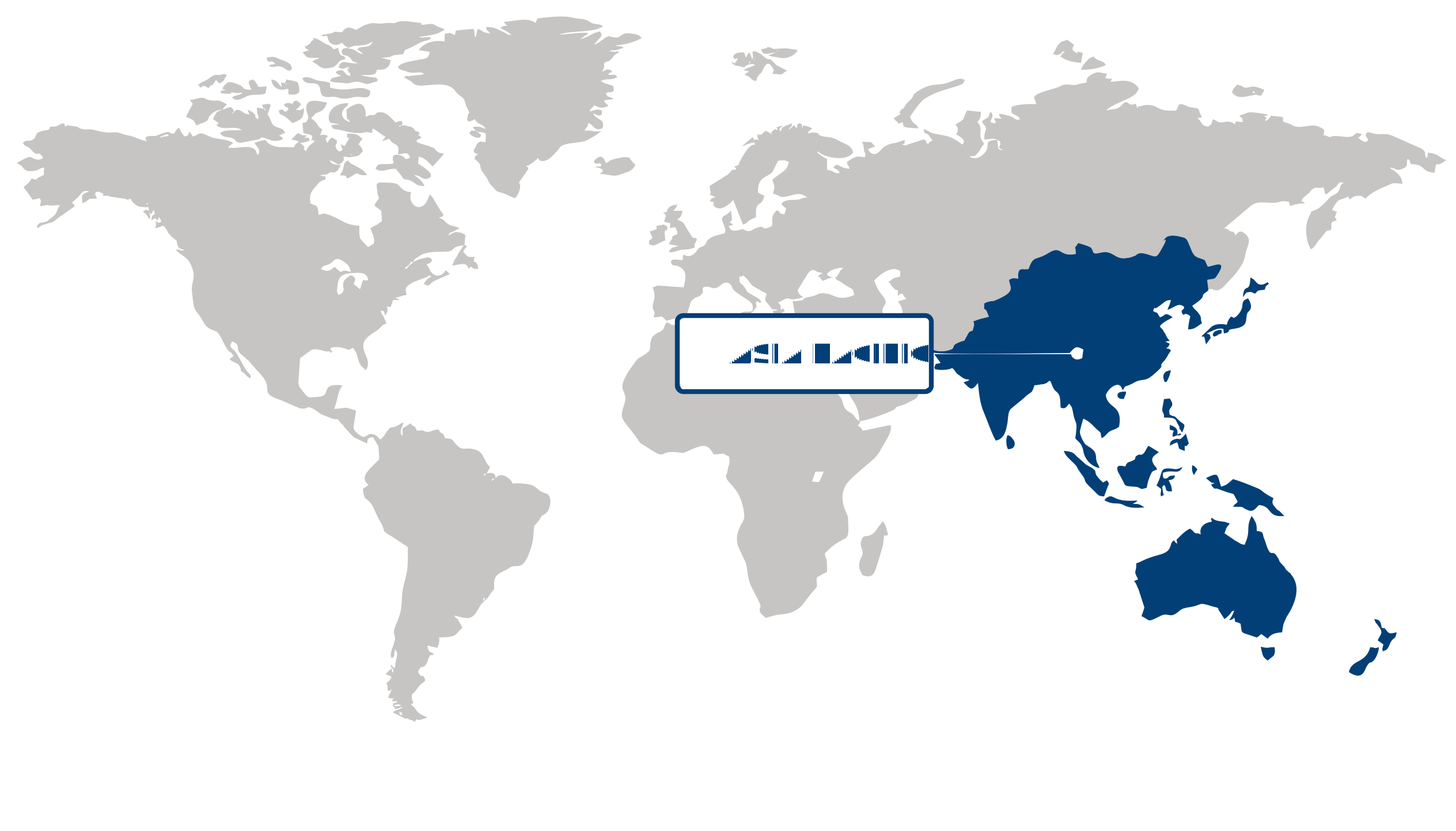
Asia Pacific (Largest Region)
Asia Pacific accounted for a 36.04% share of the food antioxidants market in 2026, making it the largest regional market. The region's strong position is supported by its extensive food processing industry, expanding packaged food sector, and growing demand for products with longer shelf stability. Rapid urbanization and changing dietary habits are increasing consumption of processed and convenience foods, creating greater demand for antioxidants that help preserve flavor, color, freshness, and nutritional quality. At the same time, rising consumer awareness of food quality and clean-label ingredients is encouraging manufacturers to explore antioxidant solutions that align with evolving preferences. A broad agricultural and food manufacturing base further supports the use of antioxidants across beverages, oils, meat products, bakery applications, and other processed foods.
North America (Fastest-Growing Region)
North America represents the fastest-growing regional market, driven by increasing consumer attention to food freshness, nutritional value, and ingredient transparency. Food manufacturers are responding to demand for products with improved shelf stability while also adapting formulations to preferences for recognizable and naturally derived ingredients. Innovation in food processing and preservation is supporting the development of antioxidant applications suited to a wide range of packaged and prepared foods. In addition, stringent food quality and safety expectations encourage manufacturers to maintain product stability throughout processing, storage, and distribution, creating sustained opportunities for antioxidant technologies across the regional food industry.
| Parameter | North America | Asia Pacific | Europe | Latin America | MEA |
|---|---|---|---|---|---|
| Innovation Hub i Scale Nascent Developing Advanced | |||||
| Cost-Sensitive Region i Scale Low Medium High | |||||
| Regulatory Environment i Scale Restrictive Neutral Supportive | |||||
| Demand Drivers i Scale Weak Moderate Strong | |||||
| Development Stage i Scale Emerging Developing Developed | |||||
| Adoption Rate i Scale Low Medium High | |||||
| New Entrants / Startups i Scale Sparse Moderate Dense | |||||
| Macro Indicators i Scale Weak Stable Strong |
Key Country Insights
Germany 🇩🇪
Processing Efficiency SupportGermany focuses on food antioxidants that improve processing efficiency and maintain consistent food quality across packaged products. German manufacturers invest in ingredient solutions compatible with strict quality standards and evolving formulation requirements.
France 🇫🇷
Premium Food PreservationFrance values food antioxidants that protect quality while supporting premium packaged food offerings. French manufacturers increasingly incorporate naturally derived antioxidant ingredients to align preservation performance with consumer preference for recognizable ingredient lists.
Italy 🇮🇹
Traditional Recipe ProtectionItaly applies food antioxidants to preserve quality in packaged foods while maintaining authentic product characteristics. Italian manufacturers seek ingredient solutions that extend shelf life without altering flavor profiles associated with traditional food formulations.
Japan 🇯🇵
Functional Ingredient BalanceJapan integrates food antioxidants into products that combine freshness preservation with functional ingredient positioning. Japanese food manufacturers prioritize antioxidant systems that maintain sensory quality without compromising product formulation objectives.
South Korea 🇰🇷
Convenience Food ApplicationsSouth Korea expands the use of food antioxidants across processed and convenience food categories requiring longer shelf stability. South Korean producers increasingly adopt natural antioxidant ingredients to strengthen product appeal and regulatory compliance.
United States 🇺🇸
Clean Label FormulationThe U.S. food antioxidants market is shaped by demand for clean-label formulations and extended product shelf life. U.S. manufacturers increasingly evaluate natural antioxidant ingredients that support product stability while meeting evolving consumer ingredient expectations.
Segment Leadership and Growth Trends
Food Antioxidants Market Share (%), by Type, 2026
Go beyond the chart, access full insights & data tables
Request Free Sample ReportType Segment Analysis: Synthetic (Largest Segment) vs Natural (Fastest-Growing Segment)
Synthetic antioxidants dominated the food antioxidants market in 2026, accounting for a 57.75% share, supported by their established use in processed foods to delay oxidation, preserve product quality, and extend shelf life. Their consistent performance, formulation flexibility, and broad compatibility with food manufacturing processes make them widely suitable for applications involving fats, oils, processed foods, and other products vulnerable to oxidative deterioration. Established production and formulation practices also support reliable incorporation into large-scale food processing operations. Natural antioxidants are advancing at the fastest pace as food manufacturers respond to rising consumer interest in recognizable ingredients and cleaner-label formulations. Growing preference for naturally derived preservation solutions, together with increased attention to ingredient transparency and perceived health attributes, is encouraging product development around plant-based and naturally sourced antioxidant alternatives.
Form Segment Analysis: Dry (Largest Segment) vs Liquid (Fastest-Growing Segment)
The dry segment held the largest position in the food antioxidants market in 2026, representing a 69.12% share, reflecting its convenient handling, storage stability, and suitability for incorporation into a broad range of dry and processed food formulations. Dry antioxidants can be readily blended into powders, premixes, seasonings, and other food ingredients while offering manufacturers practical advantages during transportation and processing. Their compatibility with established production systems and broad application across food categories continues to support demand. Liquid antioxidants are growing at the fastest rate as food processors increasingly seek formulations that can be incorporated efficiently into liquid, semi-liquid, and high-moisture products. Their ease of dispersion and flexibility in processing applications are supporting wider adoption, particularly as manufacturers prioritize consistent antioxidant distribution and streamlined formulation processes.
| Segment | Sub-Segment | Largest Segment | Fastest Growing |
|---|---|---|---|
| Type | Synthetic, Natural | Synthetic | Natural |
| Form | Dry, Liquid | Dry | Liquid |
| Application | Meat & Poultry, Bakery & Confectionery, Fats & Oil, Fish, Pet Food, Others | Meat & Poultry | Meat & Poultry |
Competitive Landscape and Market Positioning
Major players in the food antioxidants market:
1. BASF SE (Germany)
2. Archer Daniels Midland Company (United States)
3. DuPont de Nemours Inc. (United States)
4. Kemin Industries Inc. (United States)
5. Kalsec Inc. (United States)
6. Camlin Fine Sciences Ltd. (India)
7. Eastman Chemical Company (United States)
8. Barentz International BV (Netherlands)
9. Naturex S.A. (France)
Growing preference for clean-label ingredients is reshaping formulation strategies in the food antioxidants market. Natural extraction techniques and improved stability solutions are gaining traction across applications. The food antioxidants market is expanding steadily as health-conscious consumption patterns intensify.
| Company | Market Share | Company Revenue | Revenue CAGR (%) | Product Portfolio | Geographic Presence | Innovation / R&D Focus | Strategic Developments |
|---|---|---|---|---|---|---|---|
| BASF SE (Germany) | |||||||
| Archer Daniels Midland Company (United States) | |||||||
| DuPont de Nemours Inc. (United States) | |||||||
| Kemin Industries Inc. (United States) | |||||||
| Kalsec Inc. (United States) | |||||||
| Camlin Fine Sciences Ltd. (India) | |||||||
| Eastman Chemical Company (United States) | |||||||
| Barentz International BV (Netherlands) | |||||||
| Naturex S.A. (France). |
Industry Development/News
| Company Name | Date | Key Development |
|---|---|---|
| NYK Group | May-25 | NYK Group launched BioxiGuard, an antioxidant product developed for marine biodiesel fuel applications. The initiative extends antioxidant technology into biofuel stabilization, addressing oxidation control challenges in renewable fuel systems and broadening the company’s functional chemical applications beyond traditional food-related uses into energy-focused markets. |
| Clean Fino-Chem | Dec-24 | Clean Fino-Chem initiated commercial-scale production of Butylated Hydroxy Toluene (BHT), a widely used synthetic antioxidant applied across food, cosmetics, and industrial applications. The development enhances supply availability of key antioxidant compounds, strengthening downstream formulation stability across multiple end-use industries requiring oxidation control. |
| Syensqo | Sep-24 | Syensqo launched “Riza,” a rosemary-derived plant-based antioxidant brand targeting food and flavor applications. The introduction expands its portfolio of natural preservation solutions, supporting growing demand for plant-based functional ingredients used to improve shelf life and oxidative stability in food systems. |
| Kemin Industries | May-24 | Kemin Industries received European Commission approval for its rosemary extract as a feed additive for cat and dog food, enabling commercial use of a natural antioxidant solution in pet nutrition. This regulatory clearance expands its application scope in animal feed preservation, strengthening the company’s positioning in plant-based antioxidant systems used to enhance product stability and shelf life. |
| Kalsec | Aug-22 | Kalsec partnered with Infinome Biosciences to develop naturally sourced ingredient solutions, reinforcing its focus on innovation in clean-label antioxidant systems. The collaboration supports advancement of bio-based ingredient technologies aimed at improving quality and functional performance across food and beverage applications, enhancing competitive positioning in natural preservation solutions. |
| ADM | Jul-22 | ADM acquired Yerbalatina Phytoactives, expanding its portfolio of botanical products and functional nutrition solutions. The acquisition strengthens its capabilities in natural antioxidants, organic extracts, and food colorings, enhancing its position across food, beverage, and health ingredient markets through expanded access to more than 100 plant-based actives. |
| BASF SE | May-22 | BASF SE expanded antioxidant production capacity in Singapore by adding a new production line at its Jurong Island facility. This capacity expansion strengthens its manufacturing footprint in antioxidant chemicals, supporting increased global demand for preservation ingredients across food and industrial applications. |
| International Flavors & Fragrances | Feb-21 | International Flavors & Fragrances merged with DuPont’s Nutrition & Biosciences business, forming a larger global ingredients platform serving food, beverage, and health markets. The combination significantly enhances its scale in functional ingredients, including antioxidant systems, and strengthens its position across consumer-oriented nutrition and wellness applications. |
Customize Your Report
Explore examples of how this report can be tailored to different research needs, including custom segments, additional topics or chapters, and related reports. Click a section of the wheel or its numbered marker to explore the available options.
Food Antioxidants Market — Custom Segments
| Segment | Sub-Segment |
|---|---|
| Antioxidant Function | Oxidation Prevention, Color Retention, Flavor Protection, Shelf-life Extension |
| Clean Label Positioning | Clean Label, Conventional |
| Buyer Type | Food Ingredient Manufacturers, Food & Beverage Processors, Foodservice & Prepared Food Producers |
Food Antioxidants Market — Custom TOC
| Custom Chapter | Custom Details |
|---|---|
| Clean Label Ingredient Adoption Analysis |
|
| Food Preservation Technology Evolution |
|
| Food Manufacturer Formulation Trends |
|
Need a different cut of the data?
Request Custom ResearchWhat is the current revenue of the food antioxidants market?
How much is the food antioxidants industry expected to grow by 2036?
How are clean-label trends influencing ingredient selection in the food antioxidants market?
Why are regulatory requirements becoming more influential in antioxidant procurement decisions?
Why are synthetic antioxidants the largest type in the food antioxidants market?
Which form segment is expanding the fastest in the food antioxidants market?
Why does Asia Pacific lead the food antioxidants market?
What is fueling food antioxidants market growth in North America?
Which companies are driving growth in the food antioxidants landscape?
Our Clients
"The report provided a thorough look at market trends, technological advancements, and the competitive landscape. The depth of insights was really valuable."
ITC Limited
"We would highly recommend Fundamental Business Insights & Consulting to anyone looking for reliable, detailed, and comprehensive market research in the Food industry."
Tyson Foods
"The clarity and presentation of the information were commendable. The report was delivered timely, which made the overall experience smooth and convenient."
Mondelēz International
Our Research Team & Methodology
Every Fundamental Business Insights report is built by a dedicated vertical research team, validated through a structured primary-and-secondary methodology, and reviewed for accuracy before it reaches you.
Research Team Overview
Prepared by the Food & Beverage Research Team
Delivery
Published
Demand
Available
Support
Trust & Compliance
Research Domains
10 coverage areasResearch Intelligence
| Source | Reference |
|---|---|
| Food and Agriculture Organization (FAO) | www.fao.org |
| World Health Organization (WHO) | www.who.int |
| U.S. Food & Drug Administration (FDA) | www.fda.gov |
| European Food Safety Authority (EFSA) | www.efsa.europa.eu |
| U.S. Department of Agriculture (USDA) | www.usda.gov |
| Codex Alimentarius Commission | www.fao.org/fao-who-codexalimentarius |
| International Organization for Standardization (ISO) | www.iso.org |
| AOAC INTERNATIONAL | www.aoac.org |
| Institute of Food Technologists (IFT) | www.ift.org |
| International Dairy Foods Association (IDFA) | www.idfa.org |
| International Sweeteners Association (ISA) | www.sweeteners.org |
| International Probiotics Association (IPA) | internationalprobiotics.org |
| Good Food Institute (GFI) | gfi.org |
| American Feed Industry Association (AFIA) | www.afia.org |
| International Feed Industry Federation (IFIF) | ifif.org |
| Specialty Food Association (SFA) | www.specialtyfood.com |
| Brewers Association | www.brewersassociation.org |
| International Bottled Water Association (IBWA) | bottledwater.org |
| International Alliance for Dietary/Food Supplement Associations (IADSA) | www.iadsa.org |
| OECD Agriculture & Food | www.oecd.org/agriculture |
Research Workflow & Quality Assurance
Data Collection
Verified information gathered through primary and secondary research.
Data Triangulation
Cross-validation using multiple independent data sources.
Forecast Modelling
Market estimates developed using historical trends and analytical models.
Analyst Validation
Findings reviewed by domain experts for accuracy and consistency.
Editorial & Quality Review
Final editorial, quality, and compliance checks before publication.
Final Publication
Released after successful completion of the internal review process.
Report Coverage
📊 Market Assessment
- Market Size & Forecast
- Market Segmentation
- Regional Analysis
- Growth Drivers & Challenges
- Market Dynamics
🏢 Competitive Intelligence
- Competitive Landscape
- Company Profiles
- Competitive Benchmarking
- Mergers & Acquisitions
- Market Share Analysis or Key Company Strategies
🔍 Strategic Analysis
- Value Chain Analysis
- Porter's Five Forces
- PESTLE Analysis
- Pricing Trends
- Supply-Demand Analysis
🚀 Future Outlook
- Technology Landscape
- Regulatory Landscape
- Investment & Funding Landscape
- Emerging Opportunities
- Future Market Outlook
Have a question about this report or need a custom scope?
Request Customization