Flexible OLED Market Size & Forecasts 2026-2035, By Segments (Technology, Panel Size, End-Use Industry, Application), Growth Opportunities, Innovation Landscape, Regulatory Shifts, Strategic Regional Insights (U.S., Japan, China, South Korea, UK, Germany, France), and Competitive Dynamics (Samsung Display, LG Display, BOE Technology, Visionox, EDO)
Market Size and Growth Outlook
Flexible OLED Market size is forecasted to reach USD 263.85 billion by 2035, rising from USD 10.61 billion in 2025, at a CAGR of more than 37.9% between 2026 and 2035. In 2026, revenue is projected at USD 14.31 billion.
Get more details on this report
Request Free Sample ReportFlexible OLED Market Intelligence Snapshot
Regional Market Dynamics
Segment Momentum
Market Expansion Drivers
Leading Market Participants
Global Market Forecast Snapshot
Market Outlook
Regional and Segment Outlook
Market Growth Drivers and Industry Trends
Consumers’ demand for compact multitasking and continuous health monitoring is driving OEMs to adopt new form factors, expanding the flexible OLED market through product launches and ecosystem commitments. Samsung Electronics’ Galaxy Z series and Apple’s iterative expansion of Apple Watch features illustrate device makers prioritizing bendable screens and low-power flexible displays to differentiate portfolios. This trend favors incumbent display manufacturers and materials suppliers able to scale production, while creating openings for startups offering novel hinge mechanisms, thin-film encapsulation, and integration services. Given ongoing product roadmaps and supply-chain contracts announced by Samsung Electronics and Apple, sustained commercialization of foldables and wearables will continue to shape procurements and partnerships across the value chain.
Technological Advancements in Flexible Substrates
Progress in polyimide films, thin glass, and encapsulation chemistries is lowering reliability barriers and enabling higher-volume manufacturing within the flexible OLED market, as evidenced by DuPont’s developments in polyimide substrates and Corning’s work on Willow Glass for flexible form factors. Universal Display Corporation’s material innovations and equipment suppliers’ roll‑to‑roll pilot lines have reduced fragility and improved lifetime, directly influencing OEM design cycles and manufacturing footprints. These material and process gains create strategic opportunities for established suppliers to lock in long-term contracts and for equipment and materials startups to win pilot projects; observed supplier press releases and pilot plant announcements indicate continued maturation of supply capabilities.
Integration into Automotive Displays and Smart Textiles
Automakers and apparel-tech collaborations are broadening addressable applications for flexible panels, bringing new procurement channels and certification demands that will reframe the flexible OLED market. LG Display and Continental have demonstrated automotive-grade flexible OLED prototypes for curved cockpits and center stacks, while Google and Levi’s Project Jacquard illustrates textile integration pathways for interactive fabrics. Tier‑1 suppliers and OEMs can leverage these pilots to co-develop standards and validation processes, and nimble entrants can specialize in automotive-grade encapsulation or textile-compatible interconnects. With multiple OEM demonstrations and brand partnerships publicly reported, expect continued pilots and specification alignment to drive commercial adoption in cabins and wearable garments.
Industry Restraints:
High Manufacturing Costs and Low Yields
High capital intensity and persistently low usable-panel yields constrain flexible OLED commercialization by inflating unit costs and extending payback periods for fabs. Applied Materials has emphasized large capital outlays for vapor deposition and patterning tools, and Universal Display Corporation highlights expensive emitter materials and process sensitivity that drive scrap rates. BOE’s publicized qualification challenges for high-end smartphone panels, reported by Nikkei Asia, underline how yield shortfalls disrupt OEM supply plans. For incumbent suppliers such as Samsung Display and LG Display, high fixed costs necessitate volume-backed contracts and slow margin recovery; for new entrants, the upfront investment and technical risk form a formidable market entry barrier. Expect gradual cost reduction as equipment scaling and material innovations progress, but yields will remain a gating constraint in the near to medium term.
Encapsulation and Durability Constraints for Foldables
Robust barrier technology and mechanical reliability limits product longevity and consumer confidence, directly restraining adoption of flexible OLED devices. Samsung Electronics’ public response to early Galaxy Fold screen failures and subsequent design revisions illustrated how insufficient encapsulation and hinge/display integration can force costly reengineering. Corning’s development efforts on flexible glass and LG Display’s announcements about advanced barrier films indicate industry recognition of the challenge. OEMs demanding stringent lifetime and drop/twist tolerance—notably Apple in supplier qualification processes reported by Nikkei Asia—favor suppliers with proven encapsulation, disadvantaging smaller specialists. Strategically, this drives consolidation around vertically integrated suppliers and co‑development partnerships; incremental improvements in flexible glass and encapsulation will ease constraints, but reliability will continue to shape product roadmaps and buyer selection through the medium term.
| Growth Driver | Impact on CAGR | Regulatory Influence | Geographic Relevance | Adoption Rate | Impact Timeline |
|---|---|---|---|---|---|
| Flexible OLED adoption in foldable and wearable devices | 12.00% | Short term (≤ 2 yrs) | Asia Pacific, North America | Medium | Fast |
| Technological advancements in flexible substrates | 13.00% | Medium term (2–5 yrs) | North America, Europe | Medium | Moderate |
| Integration into automotive displays and smart textiles | 12.90% | Long term (5+ yrs) | Europe, Asia Pacific; Spillover: North America | Low | Slow |
Unlock insights tailored to your business with our bespoke market research solutions.
Click to get your customized report now.
Regional Demand Dynamics
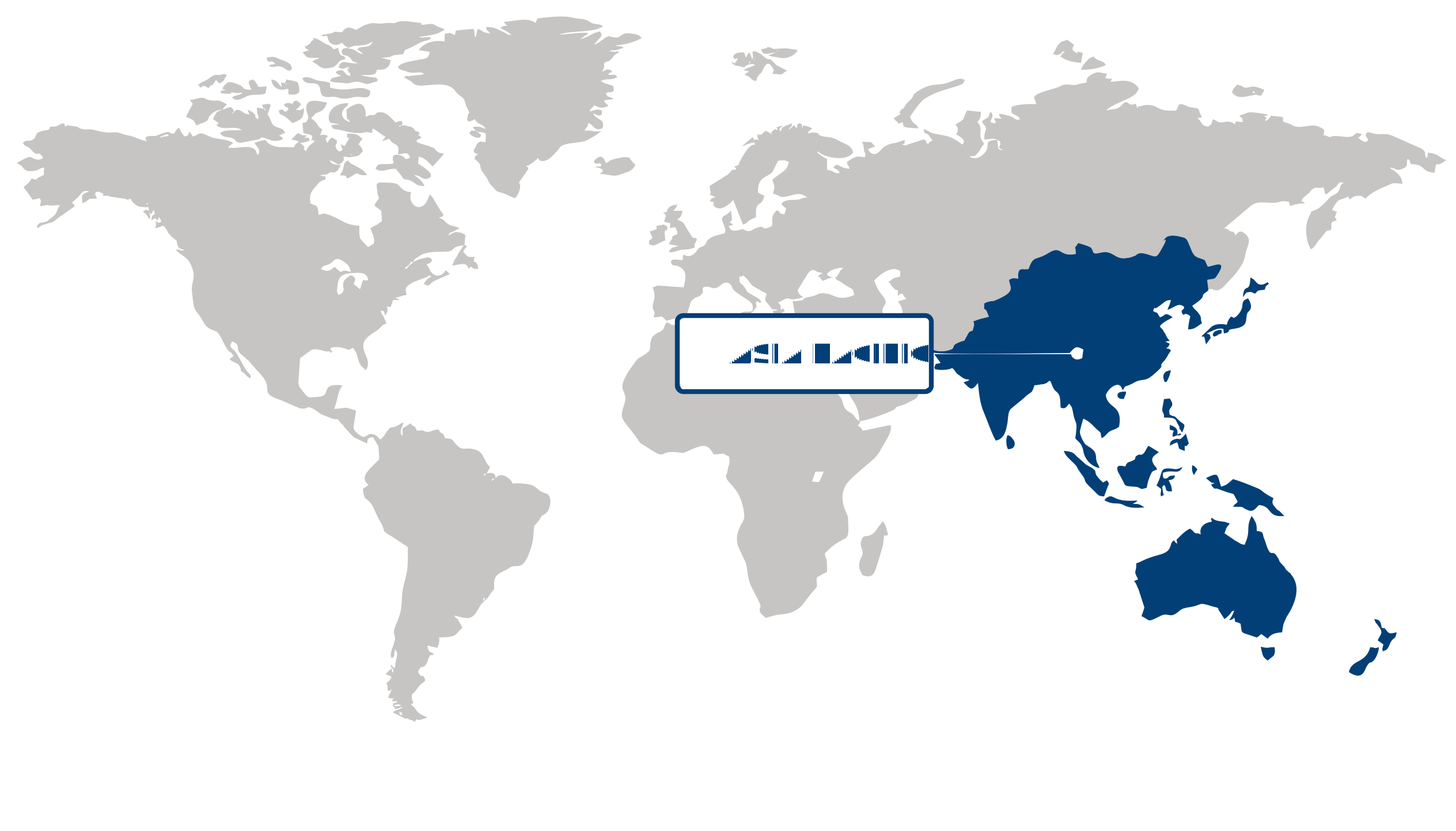
The flexible OLED market in Asia Pacific captured over 41.2% of the global market in 2025 and, with a 45.48% CAGR, is the largest and fastest‑growing region; this leadership stems from the dominance of major display manufacturers and very high smartphone production volumes centered in China and Korea. Evidence includes capacity expansions and product roadmaps from Samsung Display and LG Display and BOE Technology Group’s announcements on flexible AMOLED fabrication, while smartphone OEM demand from Huawei and Xiaomi underscores robust end‑market pull. Deep supplier ecosystems, targeted government industrial policy such as signals from the Ministry of Economy, Trade and Industry (METI) and China’s Ministry of Industry and Information Technology (MIIT), and advances in printed and foldable form factors create a strong runway for innovation and scale across the region.
The flexible OLED market in Japan is positioned as a pivotal hub for materials, equipment and mid‑size panel innovation, where specialist suppliers shape upstream competitiveness. Companies like Sumitomo Chemical and JSR Corporation provide advanced organic materials and ink technologies, and JOLED’s printed OLED initiatives illustrate Japan’s niche strength in quality‑focused production rather than high‑volume smartphone fabs. METI’s industrial initiatives and corporate R&D announcements support this supplier ecosystem, which strategically complements mass fabrication elsewhere in Asia Pacific and strengthens regional supply‑chain resilience and product differentiation.
The flexible OLED market in China anchors regional volume growth through large‑scale panel fabrication and integrated supply‑chain partnerships that drive unit economics. BOE Technology Group and TCL CSOT have publicly signaled capacity ramps for flexible AMOLED panels, while OEMs such as Huawei, Xiaomi and OPPO continue to introduce foldable and flexible‑screen devices, sustaining high production volumes. China’s policy support via MIIT and local incentives, together with rapid downstream adoption by domestic brands, makes the country the primary commercialization engine for the region and a focal point for investors seeking scale and fast time‑to‑market opportunities in flexible OLED technologies.
North America Market Analysis:
North America demonstrated high potential in the flexible OLED market, driven by rising premium-device demand, supply-chain diversification, and targeted manufacturing incentives. Demand for high-quality, energy-efficient displays from brands such as Apple has sustained uptake of flexible panels, while suppliers like Samsung Display continue to channel advanced foldable and flexible panel technology into the region; materials and IP players such as Universal Display Corporation and Corning strengthen the upstream ecosystem. Policy signals from the U.S. Department of Commerce and incentives under recent federal initiatives have encouraged near-shoring and capital investment, and the Consumer Technology Association has documented growing consumer willingness to pay for premium form factors. These dynamics position North America as an attractive battleground for investment in flexible OLED manufacturing, materials, and design partnerships over the coming strategic cycle.
The U.S. acts as the innovation and procurement hub of the flexible OLED market, combining large OEM demand with materials and IP leadership. U.S.-based firms such as Universal Display Corporation drive emitter-material innovation, while Corning and other suppliers support substrate and cover technologies; major device OEMs, notably Apple, concentrate purchasing power and design requirements that pull advanced flexible panels through the supply chain. Federal programs referenced by the U.S. Department of Commerce lower barriers for capital-intensive fabrication, and industry signals reported by the Consumer Technology Association point to continued premium-device adoption. For investors and executives, the U.S. offers concentrated commercial scale and R&D collaboration opportunities that amplify North America’s regional prospects in flexible OLED deployment.
Europe Market Trends:
The flexible OLED market in North America experienced lucrative growth and maintained a notable presence driven by accelerated adoption in premium consumer devices and early industrial deployments. Strong end‑market demand from OEMs, visible in Apple product rollouts, and continued technology advances promoted by Samsung Display signal commercial momentum; parallel interest from the U.S. Department of Energy in display energy efficiency and manufacturing resiliency underscores policy support and sustainability priorities. Supply‑chain realignment and skilled workforce clusters around hubs of electronics manufacturing further reinforce capacity to scale, making North America attractive for investors seeking differentiated, higher‑margin flexible display opportunities.
The flexible OLED market in the United States serves as the regional innovation and demand hub where premium handset penetration, nascent automotive interiors, and AR/VR prototypes converge. Apple’s product announcements and Samsung Display’s technology briefs illustrate strong OEM pull and supplier roadmap alignment, while the U.S. Department of Energy’s programs on advanced manufacturing and efficiency provide R&D and commercialization support. For strategists, the U.S. market’s combination of large addressable demand, procurement scale, and public R&D makes it the primary entry point to capture North American upside.
The flexible OLED market in Canada plays a complementary role focused on materials, prototyping, and sustainable manufacturing pathways that address lifecycle and circularity concerns. National Research Council Canada and Natural Resources Canada initiatives supporting advanced materials and low‑impact fabrication have helped local research and pilot production capabilities; universities and regional technology incubators reinforce this innovation base. Strategically, Canada offers lower‑risk avenues for technology validation and green credentials, strengthening North American supply chains and accelerating commercial adoption across the region.
| Parameter | North America | Asia Pacific | Europe | Latin America | MEA |
|---|---|---|---|---|---|
| Innovation Hub i Scale Nascent Developing Advanced | |||||
| Cost-Sensitive Region i Scale Low Medium High | |||||
| Regulatory Environment i Scale Restrictive Neutral Supportive | |||||
| Demand Drivers i Scale Weak Moderate Strong | |||||
| Development Stage i Scale Emerging Developing Developed | |||||
| Adoption Rate i Scale Low Medium High | |||||
| New Entrants / Startups i Scale Sparse Moderate Dense | |||||
| Macro Indicators i Scale Weak Stable Strong |
Segment Leadership and Growth Trends
Flexible OLED Market Share (%), by Technology, 2026
Go beyond the chart, access full insights & data tables
Request Free Sample ReportAMOLED segment dominated the flexible OLED market in 2025, leading technology share as manufacturers prioritized displays with superior flexibility, contrast, and energy efficiency. Samsung Display and LG Display cite AMOLED advantages in press materials and product briefs, and Apple’s device roadmaps reflect adoption patterns that favor such panels; these endorsements underscore supply-chain investments and R&D focus. Customer preference for slim, high-contrast screens and OEM demands for lower power draw create strategic openings for incumbent panel makers and agile entrants supplying drivers, encapsulation, or yield-improvement services. Continued materials and process refinements at major suppliers suggest AMOLED will remain central in the near to medium term.
Analysis by Panel Size
Up to 7 Inches segment represented largest share of the flexible OLED market in 2025 as smartphone and compact device demand concentrated development on smaller, bendable form factors. Product launches from Apple and Samsung Electronics and OEM sourcing announcements highlight sustained demand for small flexible panels, while supply-chain scaling by BOE and Samsung Display has lowered unit costs. Preferences for portability, repairability concerns, and handset replacement cycles favor this segment, creating opportunities for both established panel suppliers and niche device integrators. Given ongoing smartphone innovation and wearable convergence, the up-to-7-inch segment is expected to retain prominence.
Analysis by End-Use Industry
Consumer Electronics segment held largest share of the flexible OLED market in 2025 driven by extensive integration into smartphones, wearables, and tablets. Apple’s iPhone and Apple Watch disclosures, Samsung Electronics product roadmaps, and Google’s Fitbit device updates illustrate OEM-driven adoption and consumer demand patterns. Sustainability and lifecycle considerations have prompted suppliers to improve recyclability and yield, benefiting established vendors and startups offering assembly or flexible backplane solutions. With persistent consumer appetite for immersive, low-power displays and continual new product introductions, consumer electronics will remain the primary commercial anchor for flexible OLED technology.
| Segment | Sub-Segment | Largest Segment | Fastest Growing |
|---|---|---|---|
| Technology | AMOLED, PMOLED | ||
| Panel Size | Up to 7 Inches, Between 7 and 20 Inches, Between 20 and 51 Inches, More Than 51 Inches | ||
| End-Use Industry | Consumer Electronics, Automotive, Sports & Entertainment, Others | ||
| Application | Smartphones & Tablets, TV, Laptops & Monitors, Wearable, Lighting, Others |
Competitive Landscape and Market Positioning
Competitive dynamics are driven by tighter links between panel makers and device OEMs, moves to secure substrates and encapsulation sources, and staged introductions of foldable and rollable form factors. Leading firms are widening manufacturing footprints, trialing alternative deposition and printing approaches, and broadening material toolkits to raise lifetime and yield. These initiatives sharpen differentiation around integration, speed to design win, and the ability to pair manufacturing scale with proprietary emissive chemistry.
Strategic / Actionable Recommendations for Regional Players
For North America: prioritize closer engagement with specialty materials and pilot fabs, accelerate uptake of advanced emitter chemistries and flexible encapsulation techniques, and focus on premium wearables and automotive cabins where IP and systems integration command higher margins.
For Asia Pacific: exploit scale advantages by aligning upstream suppliers and OEMs, advance low‑cost deposition and roll‑to‑roll trials for high‑volume foldable and large‑format segments, and secure early design collaborations to convert capacity into sustained design wins.
For Europe: target specialty applications such as industrial displays, medical devices and luxury automotive where customization and compliance matter, deepen ties with equipment and materials innovators, and highlight sustainable process and recycling credentials to stand apart from volume‑oriented incumbents.
| Company | Market Share | Company Revenue | Revenue CAGR (%) | Product Portfolio | Geographic Presence | Innovation / R&D Focus | Strategic Developments |
|---|---|---|---|---|---|---|---|
| No companies available. | |||||||
Industry Development/News
| Company Name | Date | Key Development |
|---|
Customize Your Report
Explore examples of how this report can be tailored to different research needs, including custom segments, additional topics or chapters, and related reports. Click a section of the wheel or its numbered marker to explore the available options.
Flexible OLED Market — Custom Segments
| Segment | Sub-Segment |
|---|---|
| No segment data available. | |
Flexible OLED Market — Custom TOC
| Custom Chapter | Custom Details | ||
|---|---|---|---|
| No custom TOC data available. | |||
Need a different cut of the data?
Request Custom ResearchWhat is the current size of the flexible OLED market?
How is the flexible OLED industry size expected to evolve during the forecast period?
Which geographic area exhibits the highest level of flexible OLED market penetration?
What is the fastest growing region in the flexible OLED sector?
Which is the largest sub-segment within the technology segment for flexible OLED industry?
Why does up to 7 inches sub-segment dominate the panel size segment of flexible OLED sector?
How does consumer electronics segment fare in the flexible OLED industry?
What share does smartphones & tablets segment hold in the flexible OLED sector as of 2025?
Who are the leading players in the flexible OLED landscape?
Our Clients
"Working with FBI has been a good experience. The market report provided a holistic view, covering everything from emerging trends to potential risks."
Semtech Corporation
"The experience was highly positive. The team showcased remarkable flexibility in adapting to our specific needs and delivered report that perfectly aligned with all our requirements."
TSMC
"What really stood out to me was how clearly and promptly the Fundamental Business Insights team communicated throughout. It made the collaboration feel effortless."
NXP Semiconductors
Our Research Team & Methodology
Every Fundamental Business Insights report is built by a dedicated vertical research team, validated through a structured primary-and-secondary methodology, and reviewed for accuracy before it reaches you.
Research Team Overview
Prepared by the Electronics & Semiconductors Research Team
Delivery
Published
Demand
Available
Support
Trust & Compliance
Research Domains
10 coverage areasResearch Intelligence
| Source | Reference |
|---|---|
| Semiconductor Industry Association (SIA) | www.semiconductors.org |
| SEMI | www.semi.org |
| JEDEC Solid State Technology Association | www.jedec.org |
| IEEE | www.ieee.org |
| IPC – Association Connecting Electronics Industries | www.ipc.org |
| International Electrotechnical Commission (IEC) | www.iec.ch |
| International Organization for Standardization (ISO) | www.iso.org |
| U.S. Bureau of Industry and Security (BIS) | www.bis.gov |
| U.S. Patent and Trademark Office (USPTO) | www.uspto.gov |
| European Patent Office (EPO) | www.epo.org |
| Taiwan Semiconductor Industry Association (TSIA) | www.tsia.org.tw |
| World Semiconductor Trade Statistics (WSTS) | www.wsts.org |
| International Energy Agency (IEA) | www.iea.org |
| GSMA | www.gsma.com |
| 3GPP | www.3gpp.org |
| ITU (International Telecommunication Union) | www.itu.int |
| Omdia (public insights) | omdia.tech.informa.com |
| Display Supply Chain Consultants (DSCC) | www.displaysupplychain.com |
| U.S. Department of Energy (DOE) | www.energy.gov |
| NIST (National Institute of Standards and Technology) | www.nist.gov |
Research Workflow & Quality Assurance
Data Collection
Verified information gathered through primary and secondary research.
Data Triangulation
Cross-validation using multiple independent data sources.
Forecast Modelling
Market estimates developed using historical trends and analytical models.
Analyst Validation
Findings reviewed by domain experts for accuracy and consistency.
Editorial & Quality Review
Final editorial, quality, and compliance checks before publication.
Final Publication
Released after successful completion of the internal review process.
Report Coverage
📊 Market Assessment
- Market Size & Forecast
- Market Segmentation
- Regional Analysis
- Growth Drivers & Challenges
- Market Dynamics
🏢 Competitive Intelligence
- Competitive Landscape
- Company Profiles
- Competitive Benchmarking
- Mergers & Acquisitions
- Market Share Analysis or Key Company Strategies
🔍 Strategic Analysis
- Value Chain Analysis
- Porter's Five Forces
- PESTLE Analysis
- Pricing Trends
- Supply-Demand Analysis
🚀 Future Outlook
- Technology Landscape
- Regulatory Landscape
- Investment & Funding Landscape
- Emerging Opportunities
- Future Market Outlook
Have a question about this report or need a custom scope?
Request Customization