Flexible Metallic Tubing Market Size & Growth Forecast 2027–2036, By Segments (Trade Size, End Use, Application), Regional Demand Trends (North America, Asia Pacific, Europe), Key Country Insights (U.S., Japan, South Korea, Germany, France, Italy), and Competitive Landscape
Market Size and Growth Outlook
Flexible Metallic Tubing Market size was worth USD 598.98 Million in 2026 and is expected to grow at 8.27% CAGR between 2027 and 2036, reaching USD 1.33 Billion by 2036. The industry revenue for 2027 is estimated at USD 641.03 Million.
Get more details on this report
Request Free Sample ReportFlexible Metallic Tubing Market Intelligence Snapshot
Regional Market Dynamics
- Europe led in 2026 due to its mature industrial base, established safety standards, industrial modernization, and demand across electrical, construction, manufacturing, and infrastructure applications.
- Asia Pacific is the fastest-growing region, supported by industrialization, construction activity, manufacturing investments, electrical infrastructure modernization, and expanding industrial automation.
Segment Momentum
- The 2½ to 3 trade size captured 31% of the market in 2026 by providing an effective balance of cable capacity, mechanical protection, and installation flexibility across industrial, commercial, and infrastructure applications.
- The commercial end-use segment is projected to grow the fastest, supported by increasing construction of offices, retail spaces, healthcare facilities, and other developments requiring reliable, flexible electrical conduit systems.
Market Expansion Drivers
- Expansion of construction and infrastructure projects increasing demand for wiring protection
- Rising adoption of industrial automation requiring durable cable protection systems
- Stricter electrical safety codes driving metallic conduit adoption in critical installations
Leading Market Participants
- Key companies in the flexible metallic tubing market include ABB Ltd. (Switzerland), Atkore Inc. (USA), Anamet Electrical Inc. (USA), Southwire Company, LLC (USA), HellermannTyton Group plc (United Kingdom), Electri-Flex Company (USA), kSARIA Corporation (USA), Bahra Electric (Saudi Arabia), Weyer GmbH (Germany), International Metal Hose Company (USA)
Global Market Forecast Snapshot
Market Outlook
- 2026 Market Size: USD 598.98 Million
- 2027 Estimated Market Size: USD 641.03 Million
- Projected Market Size: USD 1.33 Billion by 2036
- Growth Forecast: 8.27% CAGR (2027-2036)
Regional and Segment Outlook
- Leading Regional Market: Europe
- High-Growth Regional Hub: Asia Pacific
- Core Revenue Segment: 2 ½ to 3 (Trade Size) | Industrial (End Use) | Process Plants (Application)
- Emerging Opportunity Segment: 1 ¼ to 2 (Trade Size) | Commercial (End Use) | Healthcare Facilities (Application)
Market Growth Drivers and Industry Trends
Expansion of construction and infrastructure projects increasing demand for wiring protection
Large-scale residential, commercial, and infrastructure development is increasing the installation of electrical systems that require dependable mechanical protection for wiring. The flexible metallic tubing market is benefiting from this expansion as contractors seek conduit solutions that safeguard cables from physical damage while allowing easier routing through complex building layouts. Flexible tubing is particularly valued in renovation projects and modern construction where adaptability, durability, and installation efficiency are essential for meeting evolving electrical infrastructure requirements.
Rising adoption of industrial automation requiring durable cable protection systems
The growing deployment of automated manufacturing systems, robotics, and industrial control equipment is creating greater demand for reliable cable management solutions capable of operating in challenging environments. As industrial facilities modernize, the flexible metallic tubing market is expanding through increased use of protective tubing that shields electrical wiring from vibration, abrasion, mechanical stress, and exposure to harsh operating conditions. These characteristics help maintain equipment reliability while supporting continuous production processes that depend on uninterrupted electrical connectivity.
Stricter electrical safety codes driving metallic conduit adoption in critical installations
More rigorous electrical safety requirements across industrial, commercial, and critical infrastructure applications are encouraging the use of metallic conduit systems that provide enhanced protection for electrical installations. This regulatory environment will drive the flexible metallic tubing market growth by increasing demand for products that improve fire resistance, mechanical strength, and overall wiring safety in environments where system reliability is essential. Compliance with evolving installation standards also encourages engineers and contractors to specify metallic tubing for projects requiring long-term durability and dependable electrical protection.
| Growth Driver | Impact on CAGR | Regulatory Influence | Geographic Relevance | Adoption Rate | Impact Timeline |
|---|---|---|---|---|---|
| Expansion of construction and infrastructure projects increasing demand for wiring protection | 2.7% | High | Asia Pacific, Middle East | High | Near Term |
| Rising adoption of industrial automation requiring durable cable protection systems | 2.5% | High | North America, Europe | High | Mid Term |
| Stricter electrical safety codes driving metallic conduit adoption in critical installations | 2.3% | High | Global | High | Near Term |
Unlock insights tailored to your business with our bespoke market research solutions.
Click to get your customized report now.
Regional Demand Dynamics
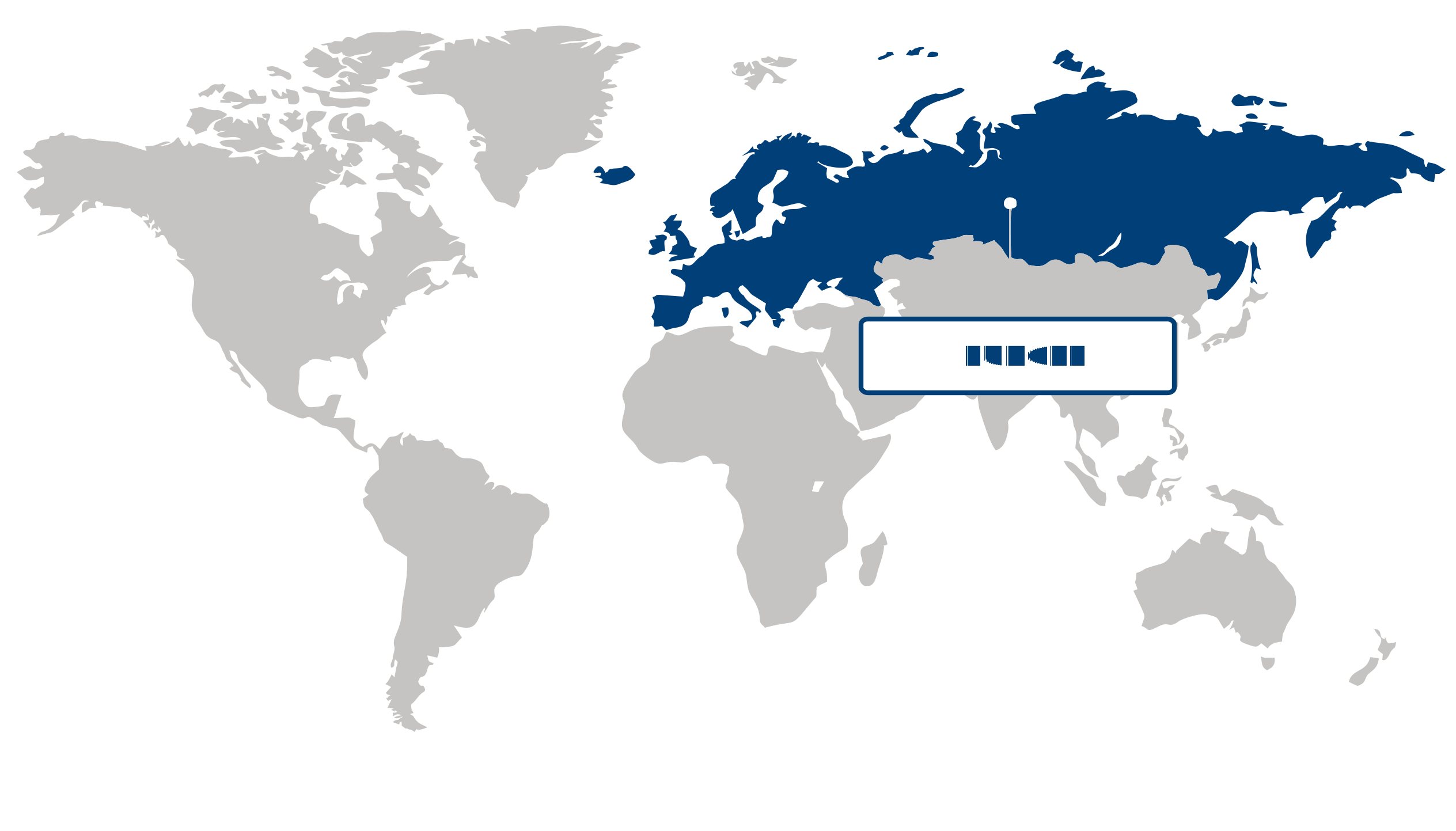
Europe (Largest Region)
The flexible metallic tubing market was led by Europe in 2026, reflecting the region's mature industrial base and strong demand for reliable tubing solutions across electrical, construction, manufacturing, and infrastructure applications. Flexible metallic tubing is valued for its durability, mechanical protection, and ability to accommodate complex installation requirements, supporting adoption in environments where equipment and wiring require enhanced protection. Established industrial standards and a strong emphasis on workplace and infrastructure safety further contribute to regional demand. Ongoing modernization of industrial facilities and investment in resilient building and electrical systems are also supporting the continued use of flexible metallic tubing across diverse applications.
Asia Pacific (Fastest-Growing Region)
Asia Pacific is expected to register the fastest regional growth, propelled by rapid industrialization, infrastructure development, and expanding construction activity. Increasing investment in manufacturing facilities, commercial buildings, transportation infrastructure, and energy systems is creating new applications for flexible metallic tubing where protection and installation flexibility are important. The expansion of industrial automation and electrical equipment is additionally increasing the requirement for durable protective conduits in demanding operating environments. Rising construction activity and modernization of electrical infrastructure across developing economies are expected to broaden the addressable market, while increasing attention to safety and equipment reliability should further support adoption.
| Parameter | North America | Asia Pacific | Europe | Latin America | MEA |
|---|---|---|---|---|---|
| Innovation Hub i Scale Nascent Developing Advanced | |||||
| Cost-Sensitive Region i Scale Low Medium High | |||||
| Regulatory Environment i Scale Restrictive Neutral Supportive | |||||
| Demand Drivers i Scale Weak Moderate Strong | |||||
| Development Stage i Scale Emerging Developing Developed | |||||
| Adoption Rate i Scale Low Medium High | |||||
| New Entrants / Startups i Scale Sparse Moderate Dense | |||||
| Macro Indicators i Scale Weak Stable Strong |
Key Country Insights
United States 🇺🇸
Industrial Infrastructure SupplyThe U.S. flexible metallic tubing market is supported by construction, industrial, and energy projects requiring durable conduit protection. U.S. customers increasingly specify products that simplify installation while meeting demanding electrical and mechanical safety requirements.
Germany 🇩🇪
Precision Manufacturing SupportGermany uses flexible metallic tubing extensively in industrial automation, machinery, and advanced manufacturing facilities. German buyers prioritize corrosion resistance, mechanical durability, and compliance with rigorous industrial performance standards.
Japan 🇯🇵
Compact Engineering ApplicationsJapan incorporates flexible metallic tubing into electronics, factory automation, and precision equipment where installation flexibility is essential. Japanese manufacturers value consistent quality, long service life, and reliable protection for complex cable routing systems.
South Korea 🇰🇷
Electronics Production IntegrationSouth Korea generates demand for flexible metallic tubing through semiconductor, electronics, and advanced manufacturing investments. South Korean industries increasingly seek tubing solutions that support compact equipment layouts and dependable cable protection.
France 🇫🇷
Building Systems ReliabilityFrance emphasizes flexible metallic tubing in commercial construction and industrial installations requiring secure electrical protection. French contractors increasingly select products that improve installation efficiency while meeting modern building and safety specifications.
Italy 🇮🇹
Industrial Retrofit DemandItaly supports flexible metallic tubing adoption through factory upgrades and infrastructure modernization across multiple industries. Italian end users focus on adaptable products that improve maintenance efficiency and withstand demanding operating environments.
Segment Leadership and Growth Trends
Flexible Metallic Tubing Market Share (%), by Trade Size, 2026
Go beyond the chart, access full insights & data tables
Request Free Sample ReportTrade Size Segment Analysis: 2 ½ to 3 (Largest Segment) vs 1 ¼ to 2 (Fastest-Growing Segment)
The 2 ½ to 3 trade size segment dominated the flexible metallic tubing market with a share of 31% in 2026, reflecting its broad suitability for medium-capacity electrical installations across industrial facilities, commercial buildings, and infrastructure projects. This trade size offers an effective balance between cable accommodation, mechanical protection, and installation flexibility, making it well suited for demanding environments where durability and reliable cable management are essential. Its compatibility with a wide range of electrical systems and compliance with stringent safety requirements have further reinforced its widespread adoption.
The 1 ¼ to 2 trade size segment is expected to witness the fastest growth during the forecast period, driven by increasing demand for flexible conduit solutions in modern commercial developments, renovation projects, and compact industrial installations. Growing emphasis on efficient space utilization, simplified installation, and adaptable electrical routing is encouraging greater use of this trade size. Rising investments in smart buildings and advanced electrical infrastructure are also contributing to its expanding adoption across diverse end-use applications.
End Use Segment Analysis: Industrial (Largest Segment) vs Commercial (Fastest-Growing Segment)
The industrial end-use segment held the largest share in 2026, supported by extensive deployment of flexible metallic tubing in manufacturing plants, processing facilities, warehouses, and heavy industrial environments. These installations require durable conduit systems capable of protecting electrical wiring against vibration, moisture, dust, and mechanical stress while ensuring uninterrupted operational reliability. Continued industrial automation and modernization of production facilities have further strengthened demand for robust metallic tubing solutions.
In the flexible metallic tubing market, the commercial end-use segment is projected to experience the fastest growth during the forecast period. Increasing construction of office buildings, retail complexes, healthcare facilities, hospitality establishments, and mixed-use developments is driving demand for flexible electrical conduit systems that enable quick installation and long-term reliability. The growing adoption of energy-efficient building infrastructure and advanced electrical networks is also supporting the expansion of this segment.
Application Segment Analysis: Process Plants (Largest Segment) vs Healthcare Facilities (Fastest-Growing Segment)
The process plants application segment accounted for the largest share in 2026, owing to the extensive use of flexible metallic tubing in industries such as chemicals, oil and gas, food processing, pharmaceuticals, and water treatment. These facilities require highly reliable conduit systems capable of withstanding harsh operating conditions while protecting critical electrical wiring and instrumentation. The need for operational continuity, worker safety, and compliance with industrial standards continues to sustain strong demand within process plant environments.
The healthcare facilities application segment is anticipated to register the fastest growth during the forecast period. Expansion of hospitals, diagnostic centers, laboratories, and specialized medical facilities is increasing the requirement for dependable electrical infrastructure that supports sophisticated medical equipment and uninterrupted power distribution. The growing focus on healthcare infrastructure modernization and stringent safety requirements is accelerating the adoption of flexible metallic tubing across medical environments.
| Segment | Sub-Segment | Largest Segment | Fastest Growing |
|---|---|---|---|
| Trade Size | ½ to 1, 1 ¼ to 2, 2 ½ to 3, 3 to 4, 5 to 6, Others | 2 ½ to 3 | 1 ¼ to 2 |
| End Use | Residential, Commercial, Industrial, Utility | Industrial | Commercial |
| Application | Rail Infrastructure, Military Aerospace, Healthcare Facilities, Process Plants, Energy, Others | Process Plants | Healthcare Facilities |
Competitive Landscape and Market Positioning
Key companies in the flexible metallic tubing market:
- ABB Ltd. (Switzerland)
- Atkore, Inc. (USA)
- Anamet Electrical, Inc. (USA)
- Southwire Company LLC (USA)
- HellermannTyton Group plc (United Kingdom)
- Electri-Flex Company (USA)
- kSARIA Corporation (USA)
- Bahra Electric (Saudi Arabia)
- Weyer GmbH (Germany)
- International Metal Hose Company (USA)
Demand for dependable performance in complex industrial environments is reshaping competitive priorities within the flexible metallic tubing market. Manufacturers are investing in advanced material processing, precision manufacturing, and enhanced corrosion resistance to meet increasingly stringent requirements across construction, energy, manufacturing, and infrastructure applications. At the same time, buyers are placing greater value on application-specific engineering support and customized product configurations, encouraging suppliers to expand technical capabilities rather than compete primarily on standardized offerings. Compliance with evolving safety and installation standards further elevates the importance of certified performance, manufacturing consistency, and long-term durability as defining competitive attributes.
| Company | Market Share | Company Revenue | Revenue CAGR (%) | Product Portfolio | Geographic Presence | Innovation / R&D Focus | Strategic Developments |
|---|---|---|---|---|---|---|---|
| ABB Ltd. (Switzerland) | |||||||
| Atkore Inc. (USA) | |||||||
| Anamet Electrical Inc. (USA) | |||||||
| Southwire Company LLC (USA) | |||||||
| HellermannTyton Group plc (United Kingdom) | |||||||
| Electri-Flex Company (USA) | |||||||
| kSARIA Corporation (USA) | |||||||
| Bahra Electric (Saudi Arabia) | |||||||
| Weyer GmbH (Germany) | |||||||
| International Metal Hose Company (USA) |
Industry Development/News
| Company Name | Date | Key Development |
|---|---|---|
| Atkore | Sep-25 | Atkore refined its strategic focus toward core electrical infrastructure markets by planning to divest noncore telecom conduit assets and reduce manufacturing capacity. This enables the redirection of capital and operating resources toward PVC and metallic electrical conduit systems utilized for cabling protection in substations, solar projects, and grid modernization initiatives, thereby serving utilities and EPCs requiring high-volume infrastructure construction solutions. |
| ABB | Jul-25 | ABB expanded its Adaptaflex flexible electrical conduit portfolio to address rising demand from utility-scale power, renewable energy, and grid control installations. The rugged, standards-compliant conduit systems target harsh outdoor environments, vibration-prone equipment, and critical power controls in substations and wind and solar facilities, strengthening the company's electrification and automation offerings for resilient electrical infrastructure. |
Customize Your Report
Explore examples of how this report can be tailored to different research needs, including custom segments, additional topics or chapters, and related reports. Click a section of the wheel or its numbered marker to explore the available options.
Flexible Metallic Tubing Market — Custom Segments
| Segment | Sub-Segment |
|---|---|
| Material | Galvanized Steel, Stainless Steel, Aluminum, Other Metals |
| Construction | Interlocked, Corrugated, Braided |
| Performance Rating | Standard Duty, Heavy Duty, Extra-Heavy Duty |
Flexible Metallic Tubing Market — Custom TOC
| Custom Chapter | Custom Details |
|---|---|
| Application-Specific Demand Mapping |
|
| Material Substitution Risk Assessment |
|
| Infrastructure Retrofit Opportunity Assessment |
|
Need a different cut of the data?
Request Custom ResearchHow much revenue does the flexible metallic tubing market generate?
What are the growth projections for the flexible metallic tubing industry?
How are construction and industrial modernization driving demand for flexible metallic tubing?
Why are stricter electrical safety requirements supporting the flexible metallic tubing market?
Why is the 2½ to 3 trade size the largest segment in the flexible metallic tubing market?
Which end-use segment is expanding fastest in the flexible metallic tubing market?
Why does Europe lead the flexible metallic tubing market?
How is Asia Pacific supporting future growth in flexible metallic tubing?
What are the prominent companies operating in the flexible metallic tubing landscape?
Our Clients
"Your insights on workforce structures were spot-on. The analysis on mid-to-senior level roles validated some of our hiring decisions and highlighted gaps."
Ateliers De France
"The report gave us insights on competitors in the market. It helped our team refine our bidding strategy for upcoming contracts."
Clark Construction
"The reports provided a deep dive into market trends, and competitive landscape. The strategic insights and recommendations have been very helpful."
Rudolph and Sletten
Our Research Team & Methodology
Every Fundamental Business Insights report is built by a dedicated vertical research team, validated through a structured primary-and-secondary methodology, and reviewed for accuracy before it reaches you.
Research Team Overview
Prepared by the Construction & Manufacturing Research Team
Delivery
Published
Demand
Available
Support
Trust & Compliance
Research Domains
10 coverage areasResearch Intelligence
| Source | Reference |
|---|---|
| International Organization for Standardization (ISO) | www.iso.org |
| ASTM International | www.astm.org |
| National Institute of Standards and Technology (NIST) | www.nist.gov |
| International Code Council (ICC) | www.iccsafe.org |
| American Concrete Institute (ACI) | www.concrete.org |
| American Institute of Steel Construction (AISC) | www.aisc.org |
| Construction Industry Institute (CII) | www.construction-institute.org |
| Associated General Contractors of America (AGC) | www.agc.org |
| Association of Equipment Manufacturers (AEM) | www.aem.org |
| Building Owners and Managers Association (BOMA) | www.boma.org |
| American Society of Civil Engineers (ASCE) | www.asce.org |
| National Ready Mixed Concrete Association (NRMCA) | www.nrmca.org |
| International Facility Management Association (IFMA) | www.ifma.org |
| World Green Building Council (WorldGBC) | worldgbc.org |
| International Federation of Consulting Engineers (FIDIC) | fidic.org |
| International Labour Organization (ILO) | www.ilo.org |
| American Society of Mechanical Engineers (ASME) | www.asme.org |
| Society of Manufacturing Engineers (SME) | www.sme.org |
| National Association of Home Builders (NAHB) | www.nahb.org |
| European Construction Industry Federation (FIEC) | www.fiec.eu |
Research Workflow & Quality Assurance
Data Collection
Verified information gathered through primary and secondary research.
Data Triangulation
Cross-validation using multiple independent data sources.
Forecast Modelling
Market estimates developed using historical trends and analytical models.
Analyst Validation
Findings reviewed by domain experts for accuracy and consistency.
Editorial & Quality Review
Final editorial, quality, and compliance checks before publication.
Final Publication
Released after successful completion of the internal review process.
Report Coverage
📊 Market Assessment
- Market Size & Forecast
- Market Segmentation
- Regional Analysis
- Growth Drivers & Challenges
- Market Dynamics
🏢 Competitive Intelligence
- Competitive Landscape
- Company Profiles
- Competitive Benchmarking
- Mergers & Acquisitions
- Market Share Analysis or Key Company Strategies
🔍 Strategic Analysis
- Value Chain Analysis
- Porter's Five Forces
- PESTLE Analysis
- Pricing Trends
- Supply-Demand Analysis
🚀 Future Outlook
- Technology Landscape
- Regulatory Landscape
- Investment & Funding Landscape
- Emerging Opportunities
- Future Market Outlook
Have a question about this report or need a custom scope?
Request Customization