Flame Retardant Polymeric Materials Market Size & Growth Forecast 2027–2036, By Segments (Type, End Use Industry), Regional Demand Trends (North America, Asia Pacific, Europe), Key Country Insights (U.S., Japan, South Korea, Germany, France, Italy), and Competitive Landscape
Market Size and Growth Outlook
Flame Retardant Polymeric Materials Market size was valued at USD 7.08 Billion in 2026 and is anticipated to grow at 6.36% CAGR from 2027 to 2036, reaching USD 13.12 Billion by 2036. The industry revenue for 2027 is estimated at USD 7.46 Billion.
Get more details on this report
Request Free Sample ReportFlame Retardant Polymeric Materials Market Intelligence Snapshot
Regional Market Dynamics
- Europe leads due to stringent safety requirements, strong fire-safety focus, environmental compliance, and demand across construction, transportation, and electrical applications.
- Asia Pacific is the fastest-growing region, driven by industrialization, infrastructure development, expanding manufacturing, and greater adoption of fire-safe lightweight materials.
Segment Momentum
- Metal hydroxide accounted for 35.42% of the market in 2026, supported by its smoke suppression, thermal stability, halogen-free performance, and compatibility with a wide range of polymer applications.
- P-N-based intumescent flame retardants are the fastest-growing type because they provide improved fire resistance, enhanced char formation, reduced smoke generation, and lower environmental impact for advanced polymer applications.
Market Expansion Drivers
- Increasing fire safety regulations driving flame retardant material adoption
- Expanding construction and electronics industries boosting fire-safe polymer demand
- Rising automotive safety standards increasing engineered polymer usage
Leading Market Participants
- Leading companies in the flame retardant polymeric materials market include Albemarle Corporation (United States), Clariant AG (Switzerland), LANXESS AG (Germany), BASF SE (Germany), FRX Innovations Inc. (United States), Dow Inc. (United States), Celanese Corporation (United States), Italmatch Chemicals S.p.A. (Italy), SABIC (Saudi Arabia), Thor Group (United Kingdom)
Global Market Forecast Snapshot
Market Outlook
- 2026 Market Size: USD 7.08 Billion
- 2027 Estimated Market Size: USD 7.46 Billion
- Projected Market Size: USD 13.12 Billion by 2036
- Growth Forecast: 6.36% CAGR (2027-2036)
Regional and Segment Outlook
- Leading Regional Market: Europe
- High-Growth Regional Hub: Asia Pacific
- Core Revenue Segment: Metal Hydroxide (Type) | Construction (End Use Industry)
- Emerging Opportunity Segment: P-N-based IFR (Type) | Electronics (End Use Industry)
Market Growth Drivers and Industry Trends
Increasing fire safety regulations driving flame retardant material adoption
Stronger regulatory requirements for fire prevention and building safety are creating sustained demand for advanced protective materials that will drive the flame retardant polymeric materials market growth. Manufacturers across multiple industries are incorporating flame-retardant polymers to comply with evolving safety standards governing construction materials, electrical components, industrial equipment, and consumer products. These materials help reduce fire propagation and improve overall product safety while enabling manufacturers to meet certification and compliance requirements in highly regulated applications.
Expanding construction and electronics industries boosting fire-safe polymer demand
Rapid growth in construction activity and increasing production of electronic equipment are expanding the use of specialized polymers, creating favorable opportunities for the flame retardant polymeric materials market. Buildings, electrical systems, consumer electronics, and industrial devices require materials capable of providing insulation, durability, and enhanced fire resistance under demanding operating conditions. This broadening application base encourages material innovation while supporting the development of high-performance polymer formulations designed to satisfy both functional and safety requirements.
Rising automotive safety standards increasing engineered polymer usage
Automotive manufacturers are integrating advanced materials that improve passenger protection and component reliability, a trend that will propel the flame retardant polymeric materials market growth. Engineered flame-retardant polymers are increasingly used in vehicle interiors, electrical systems, battery-related components, and under-the-hood applications where resistance to heat and fire is essential. The growing incorporation of electronic systems and lightweight materials within modern vehicles further increases the importance of polymer solutions that combine mechanical performance with enhanced fire safety characteristics.
| Growth Driver | Impact on CAGR | Regulatory Influence | Geographic Relevance | Adoption Rate | Impact Timeline |
|---|---|---|---|---|---|
| Increasing fire safety regulations driving flame retardant material adoption | 2.2% | High | North America, Europe | High | Near Term |
| Expanding construction and electronics industries boosting fire-safe polymer demand | 2.1% | High | Asia Pacific, North America | High | Mid Term |
| Rising automotive safety standards increasing engineered polymer usage | 2% | High | Europe, Asia Pacific | High | Mid Term |
Unlock insights tailored to your business with our bespoke market research solutions.
Click to get your customized report now.
Regional Demand Dynamics
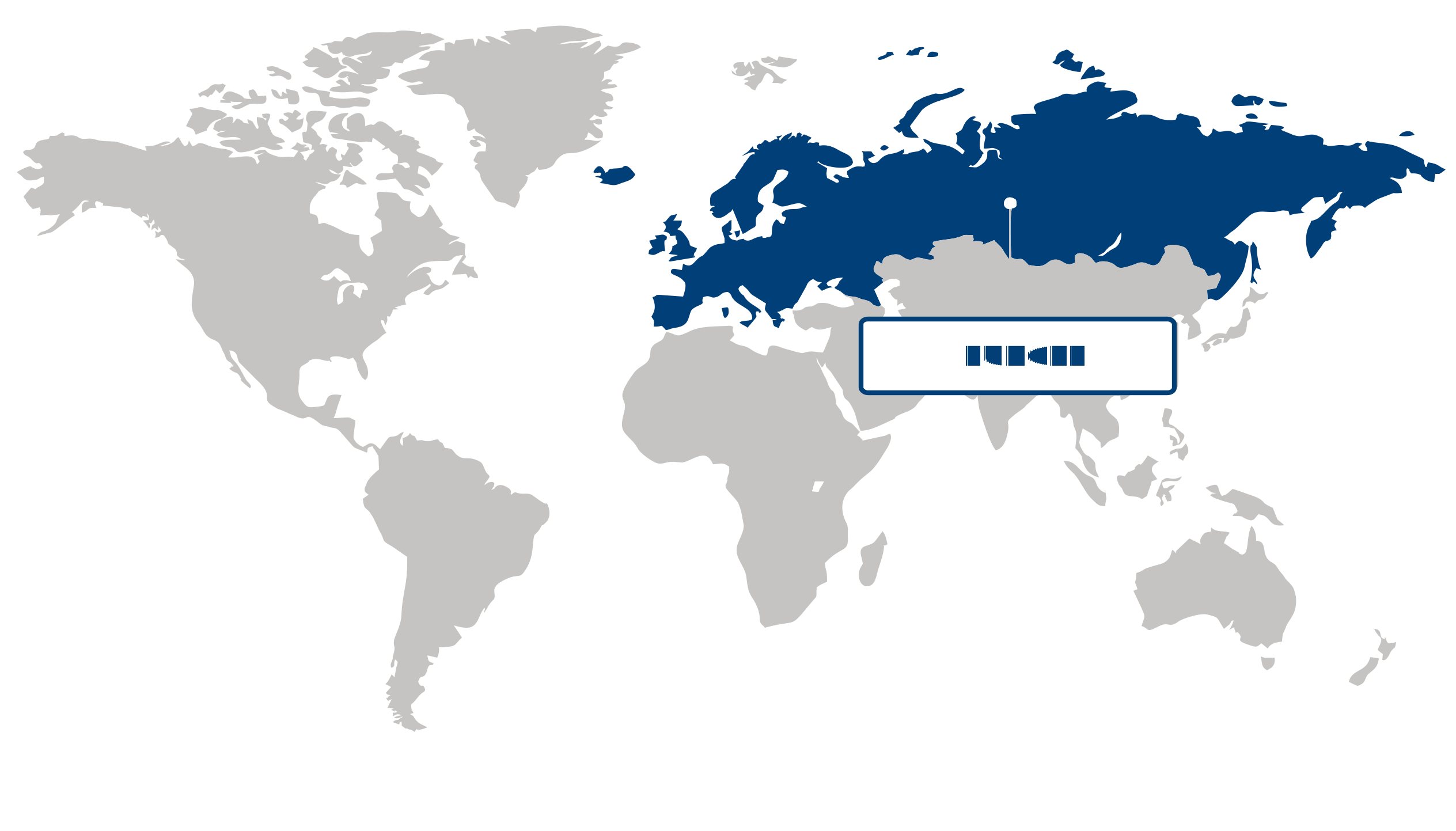
Europe (Largest Region)
Europe maintained the largest position in the flame retardant polymeric materials market in 2026, underpinned by stringent safety requirements across construction, transportation, electrical and electronics, and industrial applications. The region’s strong focus on fire safety, environmental compliance, and material performance encourages manufacturers and end users to adopt polymeric materials with enhanced flame resistance. Ongoing renovation and modernization of buildings and infrastructure, together with demand for safer lightweight materials in transportation and electrical equipment, continues to support regional consumption.
Asia Pacific (Fastest-Growing Region)
Asia Pacific is expected to be the fastest-growing regional market as rapid industrialization and infrastructure development expand the use of polymeric materials across electrical, electronics, automotive, construction, and consumer-product applications. Growing manufacturing activity is increasing the need for materials that provide both lightweight performance and improved fire safety. In parallel, rising regulatory attention to product safety and the expansion of modern infrastructure are encouraging manufacturers to incorporate flame-retardant materials into increasingly diverse applications, supporting sustained regional demand.
| Parameter | North America | Asia Pacific | Europe | Latin America | MEA |
|---|---|---|---|---|---|
| Innovation Hub i Scale Nascent Developing Advanced | |||||
| Cost-Sensitive Region i Scale Low Medium High | |||||
| Regulatory Environment i Scale Restrictive Neutral Supportive | |||||
| Demand Drivers i Scale Weak Moderate Strong | |||||
| Development Stage i Scale Emerging Developing Developed | |||||
| Adoption Rate i Scale Low Medium High | |||||
| New Entrants / Startups i Scale Sparse Moderate Dense | |||||
| Macro Indicators i Scale Weak Stable Strong |
Key Country Insights
United States 🇺🇸
Advanced Materials DevelopmentThe U.S. flame retardant polymeric materials market supports electronics, construction, transportation, and industrial manufacturing applications. Companies in the U.S. prioritize halogen-free formulations, regulatory compliance, and material performance for demanding end-use environments.
Germany 🇩🇪
Engineering Polymer FocusGermany integrates flame retardant polymeric materials into automotive, electrical, and industrial manufacturing sectors requiring high-performance plastics. Suppliers in Germany invest in advanced compounding technologies and sustainable material solutions that meet evolving safety standards.
Japan 🇯🇵
High-Performance Resin ApplicationsJapan focuses on flame retardant polymeric materials for precision electronics, automotive components, and advanced industrial equipment. Manufacturers in Japan emphasize material reliability, compact component design, and compliance with stringent product safety requirements.
South Korea 🇰🇷
Electronics Manufacturing SupportSouth Korea relies on flame retardant polymeric materials across semiconductor, electronics, and battery manufacturing industries. Material suppliers in South Korea prioritize thermal stability, lightweight formulations, and compatibility with high-volume production processes.
France 🇫🇷
Sustainable Material ComplianceFrance encourages flame retardant polymeric materials that satisfy environmental regulations while maintaining fire protection performance. Companies in France develop recyclable and low-emission formulations suitable for construction, transportation, and industrial applications.
Italy 🇮🇹
Industrial Processing SolutionsItaly applies flame retardant polymeric materials across machinery, electrical equipment, and building products manufacturing. Producers in Italy focus on processing efficiency, product consistency, and customized formulations tailored to industrial customer requirements.
Segment Leadership and Growth Trends
Flame Retardant Polymeric Materials Market Share (%), by Type, 2026
Go beyond the chart, access full insights & data tables
Request Free Sample ReportType Segment Analysis: Metal Hydroxide (Largest Segment) vs P-N-based IFR (Fastest-Growing Segment)
Holding the largest share of the flame retardant polymeric materials market, the metal hydroxide segment accounted for 35.42% in 2026. Its leading position is supported by widespread adoption across polymer applications that require effective flame resistance while maintaining compliance with increasingly stringent fire safety and environmental standards. Metal hydroxide-based flame retardants are valued for their smoke-suppressing characteristics, thermal stability, and compatibility with a broad range of polymer formulations, making them a preferred choice in industries seeking reliable, halogen-free flame protection. Their established commercial availability and cost-effective performance further reinforce their dominant role across multiple end-use applications.
The P-N-based intumescent flame retardant (IFR) segment is expected to witness the fastest growth during the forecast period. Rising demand for advanced flame-retardant systems with improved mechanical performance and lower environmental impact is accelerating the adoption of phosphorus-nitrogen-based technologies. These formulations offer enhanced char formation, efficient fire resistance, and reduced smoke generation, making them increasingly attractive for high-performance engineering plastics and specialty applications. Continued innovation in polymer formulations and growing emphasis on sustainable fire protection solutions are expected to strengthen the expansion of this segment.
End Use Industry Segment Analysis: Construction (Largest Segment) vs Electronics (Fastest-Growing Segment)
The construction segment held the largest share of the market in 2026. Extensive use of flame-retardant polymeric materials in insulation products, cables, pipes, panels, coatings, and other building components continues to support its leadership. Tightening building safety regulations, increased emphasis on fire-resistant infrastructure, and the growing adoption of advanced construction materials have encouraged consistent demand for high-performance flame-retardant polymers. Ongoing urban development and infrastructure modernization projects further sustain the segment's strong market position.
In the flame retardant polymeric materials market, the electronics segment is projected to register the fastest growth during the forecast period. Expanding production of consumer electronics, electrical equipment, and advanced electronic components is increasing the need for materials capable of meeting stringent fire safety requirements without compromising performance. The growing trend toward miniaturized devices, higher operating temperatures, and improved electrical reliability is encouraging manufacturers to incorporate advanced flame-retardant polymeric materials, supporting rapid growth across the electronics industry.
| Segment | Sub-Segment | Largest Segment | Fastest Growing |
|---|---|---|---|
| Type | Metal Hydroxide, Organic/ Inorganic Phosphorus, P-N-based IFR, Inorganic/ Organic Silicon, Nanomaterials, Others | Metal Hydroxide | P-N-based IFR |
| End Use Industry | Construction, Automotive, Electronics, Aerospace & Defense, Textile, Others | Construction | Electronics |
Competitive Landscape and Market Positioning
Key companies in the flame retardant polymeric materials market:
- Albemarle Corporation (United States)
- Clariant AG (Switzerland)
- LANXESS AG (Germany)
- BASF SE (Germany)
- FRX Innovations, Inc. (United States)
- Dow, Inc. (United States)
- Celanese Corporation (United States)
- Italmatch Chemicals S.p.A. (Italy)
- SABIC (Saudi Arabia)
- Thor Group (United Kingdom)
Advances in material science are reshaping competition in the flame retardant polymeric materials market as suppliers strive to deliver solutions that satisfy evolving fire safety standards without compromising mechanical performance or processing efficiency. Development efforts increasingly emphasize formulations compatible with stricter environmental expectations and a broader range of end-use applications, encouraging sustained investment in specialty chemistries and application engineering. As customers demand materials tailored to complex manufacturing requirements, technical support, regulatory expertise, and long-term innovation pipelines are becoming as important as production capacity in determining competitive strength.
| Company | Market Share | Company Revenue | Revenue CAGR (%) | Product Portfolio | Geographic Presence | Innovation / R&D Focus | Strategic Developments |
|---|---|---|---|---|---|---|---|
| Albemarle Corporation (United States) | |||||||
| Clariant AG (Switzerland) | |||||||
| LANXESS AG (Germany) | |||||||
| BASF SE (Germany) | |||||||
| FRX Innovations Inc. (United States) | |||||||
| Dow Inc. (United States) | |||||||
| Celanese Corporation (United States) | |||||||
| Italmatch Chemicals S.p.A. (Italy) | |||||||
| SABIC (Saudi Arabia) | |||||||
| Thor Group (United Kingdom) |
Industry Development/News
| Company Name | Date | Key Development |
|---|---|---|
| Clariant | Oct-23 | Clariant inaugurated a CHF 60 million halogen-free Exolit OP flame retardant manufacturing facility in Daya Bay, Huizhou, China. The plant expands production capacity for organophosphorus additives to serve regional original equipment manufacturers across e-mobility, electronics, and infrastructure sectors. |
| LANXESS | Oct-22 | LANXESS introduced a non-halogenated phosphorus flame retardant designed for glass fiber-reinforced polyamides used in electrical and electronic components. The additive maintains thermal stability and mechanical performance in high-temperature applications such as connectors and switches. |
| BASF | Jul-22 | BASF collaborated with THOR GmbH to combine BASF's Flamestab and THOR's AFLAMMIT technologies, developing non-halogenated flame retardant additive solutions to enhance fire safety in polymeric materials across transportation and construction applications. |
Customize Your Report
Explore examples of how this report can be tailored to different research needs, including custom segments, additional topics or chapters, and related reports. Click a section of the wheel or its numbered marker to explore the available options.
Flame Retardant Polymeric Materials Market — Custom Segments
| Segment | Sub-Segment |
|---|---|
| Polymer Matrix | Polyolefins, Engineering Thermoplastics, PVC & Other Vinyl Polymers, Thermoset Resins, Elastomers |
| Processing Method | Injection Molding, Extrusion, Blow Molding, Compression Molding, Other Processing Methods |
| Product Form | Flame-Retardant Compounds, Masterbatches, Flame-Retardant Additives, Pre-Formulated Resins |
Flame Retardant Polymeric Materials Market — Custom TOC
| Custom Chapter | Custom Details |
|---|---|
| Halogen-Free Material Transition |
|
| OEM Qualification & Specification Adoption |
|
| Application-Specific Material Selection |
|
Need a different cut of the data?
Request Custom ResearchWhat is the market size of flame retardant polymeric materials?
What is the anticipated CAGR of the flame retardant polymeric materials industry?
How are evolving fire safety regulations influencing demand for flame retardant polymeric materials?
Why are automotive and electronics industries increasing the use of flame retardant polymers?
Why is the metal hydroxide segment the largest in the flame retardant polymeric materials market?
What is fueling the growth of P-N-based intumescent flame retardants?
Why does Europe lead the flame retardant polymeric materials market?
What is accelerating flame retardant polymeric materials growth in Asia Pacific?
Which organizations are considered leaders in the flame retardant polymeric materials landscape?
Our Clients
"The report helped us understand emerging consumer trends in our product category. It clarified where to focus innovation for the next product launch."
LyondellBasell
"The regional forecast section was incredibly useful. We were able to identify two new potential partners in Europe thanks to the vendor mapping you included."
SABIC
"We appreciated how actionable the recommendations were. It guided us to improve supply chain resilience."
Olin Corporation
Our Research Team & Methodology
Every Fundamental Business Insights report is built by a dedicated vertical research team, validated through a structured primary-and-secondary methodology, and reviewed for accuracy before it reaches you.
Research Team Overview
Prepared by the Chemicals & Materials Research Team
Delivery
Published
Demand
Available
Support
Trust & Compliance
Research Domains
10 coverage areasResearch Intelligence
| Source | Reference |
|---|---|
| American Chemistry Council (ACC) | www.americanchemistry.com |
| European Chemical Industry Council (Cefic) | cefic.org |
| International Council of Chemical Associations (ICCA) | icca-chem.org |
| European Chemicals Agency (ECHA) | echa.europa.eu |
| U.S. Environmental Protection Agency (EPA) | www.epa.gov |
| ASTM International | www.astm.org |
| International Organization for Standardization (ISO) | www.iso.org |
| National Institute of Standards and Technology (NIST) | www.nist.gov |
| Plastics Industry Association (PLASTICS) | www.plasticsindustry.org |
| European Biplastics | www.european-bioplastics.org |
| The Adhesive and Sealant Council (ASC) | www.ascouncil.org |
| National Association of Corrosion Engineers (AMPP) | www.ampp.org |
| Society of Plastics Engineers (SPE) | www.4spe.org |
| International Fertilizer Association (IFA) | www.fertilizer.org |
| CropLife International | croplife.org |
| Packaging Europe | packagingeurope.com |
| Flexible Packaging Association (FPA) | www.flexpack.org |
| Battery Council International (BCI) | batterycouncil.org |
| International Copper Association (ICA) | internationalcopper.org |
| World Steel Association | worldsteel.org |
Research Workflow & Quality Assurance
Data Collection
Verified information gathered through primary and secondary research.
Data Triangulation
Cross-validation using multiple independent data sources.
Forecast Modelling
Market estimates developed using historical trends and analytical models.
Analyst Validation
Findings reviewed by domain experts for accuracy and consistency.
Editorial & Quality Review
Final editorial, quality, and compliance checks before publication.
Final Publication
Released after successful completion of the internal review process.
Report Coverage
📊 Market Assessment
- Market Size & Forecast
- Market Segmentation
- Regional Analysis
- Growth Drivers & Challenges
- Market Dynamics
🏢 Competitive Intelligence
- Competitive Landscape
- Company Profiles
- Competitive Benchmarking
- Mergers & Acquisitions
- Market Share Analysis or Key Company Strategies
🔍 Strategic Analysis
- Value Chain Analysis
- Porter's Five Forces
- PESTLE Analysis
- Pricing Trends
- Supply-Demand Analysis
🚀 Future Outlook
- Technology Landscape
- Regulatory Landscape
- Investment & Funding Landscape
- Emerging Opportunities
- Future Market Outlook
Have a question about this report or need a custom scope?
Request Customization