Fire Fighting Foam Market Size & Growth Forecast 2027–2036, By Segments (Fire Type, End-use, Foam Type), Regional Demand Trends (North America, Asia Pacific, Europe), Key Country Insights (U.S., Japan, South Korea, Germany, France, Italy), and Competitive Landscape
Market Size and Growth Outlook
Fire Fighting Foam Market size was worth USD 5.7 billion in 2026 and is poised to grow at a 3.42% CAGR between 2027 and 2036, reaching USD 7.98 billion by 2036. The industry revenue for 2027 is assessed at USD 5.86 billion.
Get more details on this report
Request Free Sample ReportFire Fighting Foam Market Intelligence Snapshot
Regional Market Dynamics
- Asia Pacific leads due to its broad industrial base and extensive demand from manufacturing, oil and gas, aviation, ports, and storage infrastructure requiring routine foam procurement and replacement.
- North America is projected to grow at a 4.22% CAGR, supported by investments in fire safety upgrades, suppression system modernization, and ongoing procurement for maintenance and compliance.
Segment Momentum
- Class A leads with a 43.3% share due to its effectiveness in ordinary combustible fire scenarios. Its routine use in municipal and industrial safety systems ensures steady demand.
- Class B is the fastest-growing segment as demand rises for flammable liquid fire protection. It is increasingly used in high-risk industrial and transport environments requiring rapid suppression.
Market Expansion Drivers
- Increasing wildfire and industrial fire incidents driving demand for high-performance fire suppression foams.
- Expanding oil and gas, aviation, and marine safety operations increasing firefighting foam utilization.
- Development of fluorine-free and environmentally safer foam formulations supporting regulatory-compliant fire safety solutions.
Leading Market Participants
- Major companies in the fire fighting foam market include Perimeter Solutions, Inc. (United States), Johnson Controls International plc (Ireland), Angus Fire Limited (United Kingdom), National Foam, Inc. (United States), DIC Corporation (Japan), Dafo Fomtec AB (Sweden), BIO-EX S.A.S. (France), Chemguard, Inc. (United States), SFFECO Global (Saudi Arabia), Dr. Richard Sthamer GmbH & Co. KG (Germany).
Global Market Forecast Snapshot
Market Outlook
- 2026 Market Size: USD 5.7 billion
- 2027 Estimated Market Size: USD 5.86 billion.
- Projected Market Size: USD 7.98 billion by 2036
- Growth Forecast: 3.42% CAGR (2027-2036)
Regional and Segment Outlook
- Leading Regional Market: Asia Pacific
- High-Growth Regional Hub: North America
- Core Revenue Segment: Class a (Fire Type) | Oil & Gas (End-use) | Aqueous Film Forming Foam (AFFF) (Foam Type)
- Emerging Opportunity Segment: Class B (Fire Type) | Aviation (End-use) | Synthetic Detergent Foam (Foam Type)
Market Growth Drivers and Industry Trends
Increasing wildfire and industrial fire incidents driving demand for high-performance fire suppression foams
Growing exposure to wildfires and industrial fire hazards is increasing the need for effective suppression technologies capable of controlling fires rapidly under challenging conditions. The fire fighting foam market will gain from this demand as high-performance foams are used in applications where rapid fire knockdown, fuel coverage, and resistance to re-ignition are critical. Industrial facilities handling flammable materials require suppression solutions that can respond effectively to different fire scenarios, while wildfire-prone regions are strengthening preparedness and emergency response capabilities. Increasing attention to fire safety across industrial sites, storage facilities, and other high-risk locations is encouraging investment in firefighting equipment and compatible foam systems. Requirements for dependable suppression performance are also influencing procurement decisions for emergency response and fixed fire protection installations.
Expanding oil and gas, aviation, and marine safety operations increasing firefighting foam utilization
Expansion of operations involving flammable fuels and other high-risk materials is creating additional requirements for specialized fire suppression systems. In the fire fighting foam market, oil and gas facilities rely on foam-based systems for protecting fuel storage, processing areas, loading infrastructure, and other locations where hydrocarbon fires can occur. Aviation facilities similarly require robust emergency response capabilities around aircraft and fuel-handling areas, while marine operations face fire risks associated with onboard fuels, machinery, and cargo. As these sectors expand their infrastructure and strengthen safety procedures, demand for compatible foam concentrates, dispensing equipment, and fixed suppression systems increases. The operational complexity of these environments also places greater emphasis on foam solutions that can be deployed effectively across large and difficult-to-access fire-risk areas.
Development of fluorine-free and environmentally safer foam formulations supporting regulatory-compliant fire safety solutions
Environmental concerns surrounding certain conventional firefighting foam chemistries are encouraging the development and adoption of alternatives with reduced environmental persistence. Development of fluorine-free formulations will support the fire fighting foam market by providing end users with options designed to meet evolving environmental and safety requirements while maintaining effective fire suppression performance. Foam manufacturers are focusing on formulations that can provide suitable fire control characteristics without relying on fluorinated substances associated with regulatory scrutiny. This transition is influencing procurement decisions among industrial facilities, airports, marine operators, and other users seeking to modernize existing suppression systems. Compatibility with existing application equipment, storage requirements, training procedures, and operational fire safety standards is also becoming an important consideration as users evaluate alternative foam technologies.
| Growth Driver | Impact on CAGR | Regulatory Influence | Geographic Relevance | Adoption Rate | Impact Timeline |
|---|---|---|---|---|---|
| Increasing wildfire and industrial fire incidents driving demand for high-performance fire suppression foams | 2.00% | High | North America, Asia Pacific | High | Near Term |
| Expanding oil and gas, aviation, and marine safety operations increasing firefighting foam utilization | 1.70% | Moderate | Middle East, Asia Pacific | High | Mid Term |
| Development of fluorine-free and environmentally safer foam formulations supporting regulatory-compliant fire safety solutions | 1.40% | High | Europe, North America | Emerging | Long Term |
Unlock insights tailored to your business with our bespoke market research solutions.
Click to get your customized report now.
Regional Demand Dynamics
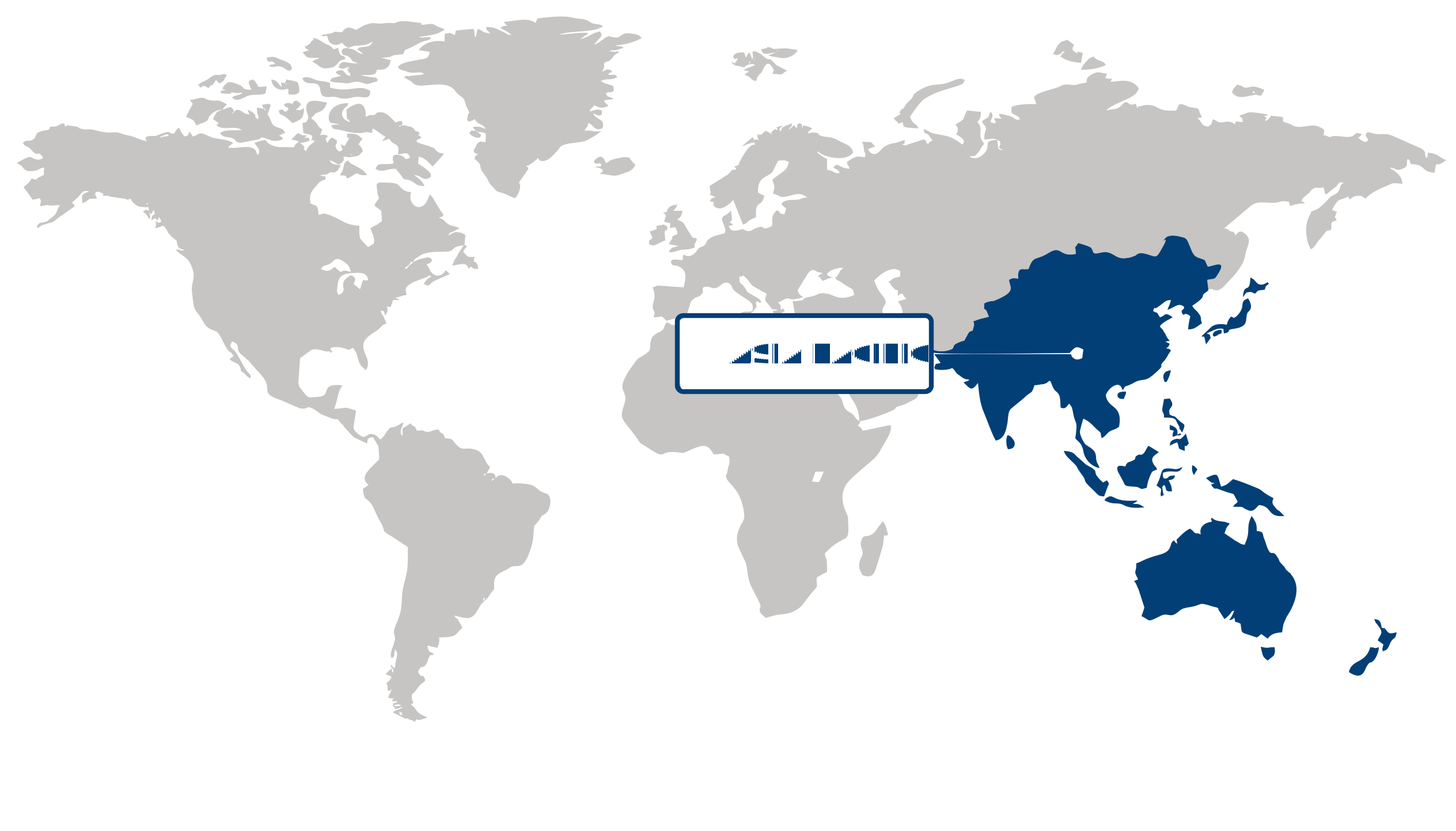
Asia Pacific (Largest Region)
The Asia Pacific region accounted for the largest share of the fire fighting foam market in 2026, underpinned by expanding industrial activity, urban development, and the need for enhanced fire protection across manufacturing, energy, transportation, and commercial infrastructure. Rapid development of industrial facilities and increasingly complex built environments is strengthening demand for specialized firefighting systems capable of addressing liquid-fuel and industrial fire hazards. Regulatory attention to workplace and infrastructure safety, together with investment in emergency-response capabilities, is further supporting adoption. The region's diverse industrial base also creates demand for different foam technologies suited to varying fire risks, while ongoing modernization of fire-protection infrastructure is encouraging the replacement and upgrading of existing systems.
North America (Fastest-Growing Region)
North America is the fastest-growing regional market, supported by continued modernization of fire-safety infrastructure and heightened attention to performance, environmental compliance, and operational reliability. Demand is being reinforced by fire-protection requirements across industrial facilities, transportation assets, energy infrastructure, and commercial properties. Regulatory evolution surrounding foam composition and environmental impact is also prompting users to transition toward newer formulations and update existing firefighting systems. This shift is creating opportunities for advanced foam technologies that balance fire suppression effectiveness with increasingly stringent environmental considerations, while investments in resilient emergency-response infrastructure continue to support regional market growth.
| Parameter | North America | Asia Pacific | Europe | Latin America | MEA |
|---|---|---|---|---|---|
| Innovation Hub i Scale Nascent Developing Advanced | |||||
| Cost-Sensitive Region i Scale Low Medium High | |||||
| Regulatory Environment i Scale Restrictive Neutral Supportive | |||||
| Demand Drivers i Scale Weak Moderate Strong | |||||
| Development Stage i Scale Emerging Developing Developed | |||||
| Adoption Rate i Scale Low Medium High | |||||
| New Entrants / Startups i Scale Sparse Moderate Dense | |||||
| Macro Indicators i Scale Weak Stable Strong |
Key Country Insights
Germany 🇩🇪
Industrial Fire ProtectionGermany is prioritizing advanced fire fighting foam solutions for industrial facilities, logistics sites, and chemical operations. Buyers are emphasizing environmentally responsible formulations that maintain effective suppression performance under demanding operating conditions.
France 🇫🇷
Sustainable Foam AdoptionFrance is encouraging adoption of fire fighting foam formulations with lower environmental impact across municipal and industrial applications. Procurement decisions increasingly consider disposal requirements, regulatory alignment, and operational effectiveness.
Italy 🇮🇹
Emergency Response ModernizationItaly is modernizing fire fighting foam inventories to support industrial fire services and public emergency response capabilities. Organizations are prioritizing compliant formulations that simplify deployment while maintaining dependable fire suppression performance.
Japan 🇯🇵
High-Risk Facility ReadinessJapan is strengthening fire fighting foam deployment across airports, manufacturing facilities, and energy infrastructure. Organizations are selecting products that balance rapid fire suppression with evolving environmental and operational standards.
South Korea 🇰🇷
Petrochemical Safety SolutionsSouth Korea is increasing focus on fire fighting foam for petrochemical complexes and industrial installations requiring specialized fire protection. Foam suppliers are supporting users with products designed for efficient application and updated safety practices.
United States 🇺🇸
Fluorine-Free TransitionThe U.S. fire fighting foam market is shifting toward fluorine-free formulations as industrial users and emergency responders adapt to evolving environmental requirements. End users are evaluating foam performance alongside regulatory compliance and replacement planning for existing inventories.
Segment Leadership and Growth Trends
Fire Fighting Foam Market Share (%), by Fire Type, 2026
Go beyond the chart, access full insights & data tables
Request Free Sample ReportFire Type Segment Analysis: Class a (Largest Segment) vs Class B (Fastest-Growing Segment)
The class a segment dominated the fire fighting foam market, accounting for a 43.3% share in 2026. Its leading position is supported by the broad requirement for firefighting solutions across applications involving ordinary combustible materials, where effective suppression and rapid control of fires are critical. Continued emphasis on fire prevention, emergency preparedness, and reliable suppression performance across commercial, industrial, and infrastructure environments supports sustained demand for class a firefighting foam.
Class B is the fastest-growing segment, supported by increasing attention to fire risks involving flammable and combustible liquids. The segment benefits from the need for specialized suppression capabilities in environments where liquid-fuel fires can escalate rapidly and require effective firefighting responses. Growing focus on operational safety, emergency response readiness, and protection of high-risk facilities is strengthening the adoption of class B firefighting foam.
End-use Segment Analysis: Oil & Gas (Largest Segment) vs Aviation (Fastest-Growing Segment)
Holding the largest share of the fire fighting foam market, the oil & gas segment accounted for 22.52% in 2026. Its position reflects the inherently high fire risk associated with facilities handling flammable fuels and hydrocarbons, creating a strong need for dependable fire suppression systems. The emphasis on protecting processing, storage, transportation, and other fuel-related operations further supports demand for firefighting foam solutions capable of addressing severe industrial fire hazards.
The aviation segment is expected to be the fastest-growing, driven by the stringent need for effective fire protection across airports, aircraft operations, fuel-handling areas, and related infrastructure. Aviation environments require rapid and dependable emergency response because fuel-related incidents can pose significant operational and safety risks. Greater emphasis on preparedness, passenger and infrastructure protection, and specialized firefighting capabilities is supporting the expanding use of firefighting foam in aviation applications.
| Segment | Sub-Segment | Largest Segment | Fastest Growing |
|---|---|---|---|
| Fire Type | Class A, Class B, Class C | Class a | Class B |
| End-use | Oil & Gas, Automotive, Chemical, Aviation, Marine, Mining, Others | Oil & Gas | Aviation |
| Foam Type | Aqueous Film Forming Foam (AFFF), Alcohol Resistant Aqueous Film Forming Foam (AR-AFFF), Protein Foam, Synthetic Detergent Foam | Aqueous Film Forming Foam (AFFF) | Synthetic Detergent Foam |
Competitive Landscape and Market Positioning
Top players in the fire fighting foam market:
1. Perimeter Solutions Inc. (United States)
2. Johnson Controls International plc (Ireland)
3. Angus Fire Limited (United Kingdom)
4. National Foam Inc. (United States)
5. DIC Corporation (Japan)
6. Dafo Fomtec AB (Sweden)
7. BIO-EX S.A.S. (France)
8. Chemguard Inc. (United States)
9. SFFECO Global (Saudi Arabia)
10. Dr. Richard Sthamer GmbH & Co. KG (Germany)
Environmental compliance is driving reformulation of fire suppression agents. Eco-friendly alternatives are gaining strong adoption across industries. In the fire fighting foam market, innovation is strongly guided by safety and environmental standards.
| Company | Market Share | Company Revenue | Revenue CAGR (%) | Product Portfolio | Geographic Presence | Innovation / R&D Focus | Strategic Developments |
|---|---|---|---|---|---|---|---|
| Perimeter Solutions Inc. (United States) | |||||||
| Johnson Controls International plc (Ireland) | |||||||
| Angus Fire Limited (United Kingdom) | |||||||
| National Foam Inc. (United States) | |||||||
| DIC Corporation (Japan) | |||||||
| Dafo Fomtec AB (Sweden) | |||||||
| BIO-EX S.A.S. (France) | |||||||
| Chemguard Inc. (United States) | |||||||
| SFFECO Global (Saudi Arabia) | |||||||
| Dr. Richard Sthamer GmbH & Co. KG (Germany). |
Industry Development/News
| Company Name | Date | Key Development |
|---|---|---|
| 3M | May-26 | Australia has initiated a USD 1.4 billion legal action against 3M over PFAS-based firefighting foam contamination across 28 military sites. The case intensifies regulatory and litigation pressure on legacy AFFF manufacturers and reinforces escalating global liability exposure associated with PFAS “forever chemicals” used in firefighting foam formulations. |
| Perimeter Solutions | Apr-25 | Perimeter Solutions launched SOLBERG SPARTAN at FDIC 2025, a fluorine-free foam concentrate formulated at 1% concentration for multi-scenario fire suppression including structure, wildland, vehicle, gasoline, and waste fires. The development reflects accelerating industry transition toward fluorine-free alternatives in response to PFAS-related regulatory and environmental pressures. |
| Oxyle | Feb-25 | Oxyle secured USD 16 million in seed funding to scale its PFAS destruction technology focused on wastewater treatment applications. The capital is intended to accelerate commercial deployment and team expansion, supporting industrial efforts to eliminate persistent PFAS contaminants linked to firefighting foam environmental remediation challenges. |
| Perimeter Solutions | Feb-25 | Perimeter Solutions reported a 93.42% increase in fire safety sales reaching USD 436.27 million in 2024, indicating strong market expansion in fire suppression products. The performance highlights growing demand for firefighting foam solutions and reinforces competitive momentum in fluorine-free and advanced fire suppression product categories. |
| Perimeter Solutions | Jun-21 | Perimeter Solutions transitioned into a publicly traded entity through acquisition by EverArc Holdings, strengthening its financial position to support expansion in firefighting foam and fire suppression solutions. The transaction enhanced capital access for scaling product development and global deployment of advanced foam technologies. |
| Johnson Controls | Apr-21 | Johnson Controls introduced Chemguard 3×3, a non-fluorinated foam concentrate designed for Class B hydrocarbon and polar solvent fuel fires. The product represents an early shift toward fluorine-free firefighting foam formulations aimed at addressing environmental and regulatory concerns linked to PFAS-based legacy foam technologies. |
Customize Your Report
Explore examples of how this report can be tailored to different research needs, including custom segments, additional topics or chapters, and related reports. Click a section of the wheel or its numbered marker to explore the available options.
Fire Fighting Foam Market — Custom Segments
| Segment | Sub-Segment |
|---|---|
| Application Method | Fixed Fire Suppression Systems, Portable Fire Extinguishers, Mobile Firefighting Equipment, Foam-Water Sprinkler Systems |
| Storage Format | Bulk Liquid Foam Concentrates, Pre-Mixed Foam Solutions, Foam Pods or Capsules |
| Distribution Channel | Direct Sales, Fire Protection Distributors, Specialty Chemical Distributors, Online Channels |
Fire Fighting Foam Market — Custom TOC
| Custom Chapter | Custom Details |
|---|---|
| PFAS Transition Readiness Assessment |
|
| Fire Protection System Retrofit Market Analysis |
|
| Sustainable Foam Alternatives Assessment |
|
Need a different cut of the data?
Request Custom ResearchHow much revenue does the fire fighting foam market generate?
What are the growth projections for the fire fighting foam industry?
How are environmental regulations reshaping procurement strategies in the fire fighting foam market?
Which operational factors are driving sustained demand for fire fighting foam solutions?
Why does Class A foam dominate the fire fighting foam market?
How is Class B foam driving growth in the fire fighting foam market?
Why is Asia Pacific the leading regional market for fire fighting foam?
What is driving fire fighting foam market growth in North America?
What are the prominent companies operating in the fire fighting foam landscape?
Our Clients
"The report helped us understand emerging consumer trends in our product category. It clarified where to focus innovation for the next product launch."
LyondellBasell
"The regional forecast section was incredibly useful. We were able to identify two new potential partners in Europe thanks to the vendor mapping you included."
SABIC
"We appreciated how actionable the recommendations were. It guided us to improve supply chain resilience."
Olin Corporation
Our Research Team & Methodology
Every Fundamental Business Insights report is built by a dedicated vertical research team, validated through a structured primary-and-secondary methodology, and reviewed for accuracy before it reaches you.
Research Team Overview
Prepared by the Chemicals & Materials Research Team
Delivery
Published
Demand
Available
Support
Trust & Compliance
Research Domains
10 coverage areasResearch Intelligence
| Source | Reference |
|---|---|
| American Chemistry Council (ACC) | www.americanchemistry.com |
| European Chemical Industry Council (Cefic) | cefic.org |
| International Council of Chemical Associations (ICCA) | icca-chem.org |
| European Chemicals Agency (ECHA) | echa.europa.eu |
| U.S. Environmental Protection Agency (EPA) | www.epa.gov |
| ASTM International | www.astm.org |
| International Organization for Standardization (ISO) | www.iso.org |
| National Institute of Standards and Technology (NIST) | www.nist.gov |
| Plastics Industry Association (PLASTICS) | www.plasticsindustry.org |
| European Biplastics | www.european-bioplastics.org |
| The Adhesive and Sealant Council (ASC) | www.ascouncil.org |
| National Association of Corrosion Engineers (AMPP) | www.ampp.org |
| Society of Plastics Engineers (SPE) | www.4spe.org |
| International Fertilizer Association (IFA) | www.fertilizer.org |
| CropLife International | croplife.org |
| Packaging Europe | packagingeurope.com |
| Flexible Packaging Association (FPA) | www.flexpack.org |
| Battery Council International (BCI) | batterycouncil.org |
| International Copper Association (ICA) | internationalcopper.org |
| World Steel Association | worldsteel.org |
Research Workflow & Quality Assurance
Data Collection
Verified information gathered through primary and secondary research.
Data Triangulation
Cross-validation using multiple independent data sources.
Forecast Modelling
Market estimates developed using historical trends and analytical models.
Analyst Validation
Findings reviewed by domain experts for accuracy and consistency.
Editorial & Quality Review
Final editorial, quality, and compliance checks before publication.
Final Publication
Released after successful completion of the internal review process.
Report Coverage
📊 Market Assessment
- Market Size & Forecast
- Market Segmentation
- Regional Analysis
- Growth Drivers & Challenges
- Market Dynamics
🏢 Competitive Intelligence
- Competitive Landscape
- Company Profiles
- Competitive Benchmarking
- Mergers & Acquisitions
- Market Share Analysis or Key Company Strategies
🔍 Strategic Analysis
- Value Chain Analysis
- Porter's Five Forces
- PESTLE Analysis
- Pricing Trends
- Supply-Demand Analysis
🚀 Future Outlook
- Technology Landscape
- Regulatory Landscape
- Investment & Funding Landscape
- Emerging Opportunities
- Future Market Outlook
Have a question about this report or need a custom scope?
Request Customization