Fertilizer Spreaders Market Size & Forecasts 2026-2035, By Segments (Type, Application), Growth Opportunities, Innovation Landscape, Regulatory Shifts, Strategic Regional Insights (U.S., Japan, China, South Korea, UK, Germany, France), and Competitive Dynamics (Amazone, Kuhn, Great Plains, Vicon, Hardi)
Market Size and Growth Outlook
Fertilizer Spreaders Market size is expected to advance from USD 28.81 billion in 2025 to USD 124.92 billion by 2035, registering a CAGR of more than 15.8% across 2026-2035. By 2026, the industry is anticipated to generate USD 32.85 billion in revenue.
Get more details on this report
Request Free Sample ReportFertilizer Spreaders Market Intelligence Snapshot
Regional Market Dynamics
Segment Momentum
Market Expansion Drivers
Leading Market Participants
Global Market Forecast Snapshot
Market Outlook
Regional and Segment Outlook
Market Growth Drivers and Industry Trends
The increasing emphasis on precision agriculture is transforming the fertilizer spreaders market by driving demand for equipment that maximizes input efficiency and crop yields. Farmers and agribusinesses are prioritizing precise nutrient application to reduce waste and environmental impact, aligning with sustainability goals. Notably, Deere & Company has highlighted precision nutrient management as a key element in its recent product developments. This shift encourages manufacturers to integrate advanced application technologies and data-driven controls into spreaders, benefiting both incumbents with R&D capabilities and startups specializing in ag tech innovation. As precision agriculture becomes integral to large-scale farming operations worldwide, market participants who develop adaptive and scalable fertilizer spreader solutions will be well-positioned to meet evolving customer requirements and regulatory landscapes.
Technological Innovation in Fertilizer Spreader Equipment
Technological advancements, including the integration of automation, sensors, and IoT connectivity, are reshaping the fertilizer spreaders market by enabling real-time application adjustments and improving operational efficiency. Companies like CNH Industrial have introduced smart spreader models capable of variable-rate technology, enhancing accuracy and reducing input costs. This trend reflects broader digital transformation imperatives within agriculture and creates a competitive edge for players investing in advanced product lines. Both established manufacturers and agile new entrants stand to gain by offering innovative solutions that streamline fertilizer application and ensure compliance with increasingly stringent environmental standards. Continued innovation will be essential as growers demand smarter, more versatile equipment to navigate complex agronomic scenarios.
Expansion of Mechanized Farming in Emerging Markets
The fertilizer spreaders market is benefiting from expanding mechanization across emerging economies, driven by rising labor costs and the pursuit of higher productivity in countries such as India and Brazil. According to the Food and Agriculture Organization of the United Nations (FAO), mechanized farming adoption is accelerating to support growing food demands and improve soil management practices. This uptake provides a fertile opportunity for manufacturers to penetrate underserved regions with tailored, cost-effective spreader solutions adapted to local agronomic conditions. New market entrants with flexible manufacturing and distribution strategies can capitalize on this expansion, while incumbents may strengthen their positions through localized partnerships and after-sales support networks. The sustained mechanization trend will likely continue to bolster fertilizer spreader demand aligned with modernization efforts in these key markets.
Industry Restraints:
Environmental Regulation Compliance Challenges
Stringent environmental regulations aimed at reducing nutrient runoff and limiting greenhouse gas emissions significantly curtail fertilizer spreaders' market growth. Compliance with frameworks such as the U.S. EPA’s Nutrient Management Strategy and the European Union’s Nitrates Directive demands advanced equipment equipped with precision technology, which increases manufacturing complexity and cost. According to the International Fertilizer Industry Association (IFA), many small and mid-sized producers struggle to retrofit or innovate under these policy constraints, leading to slower product rollouts and restrained demand from cost-sensitive farmers. For market players, adapting to evolving regulatory standards means higher R&D investments and delayed time-to-market, creating barriers that favor well-capitalized incumbents and limit agility for startups. Moving forward, ongoing tightening of environmental policies will sustain this restraint, underscoring the necessity for continuous innovation in sustainable fertilizer spreading solutions.
High Capital Intensity and Operational Complexity
The fertilizer spreaders market faces significant hurdles due to the high capital costs and operational intricacies inherent in advanced equipment design and manufacturing. As detailed in a recent Deere & Company investor briefing, the integration of GPS-guided application systems and durability enhancements elevates production expenses, reducing accessibility for smaller manufacturers and farmers with limited budgets. This dynamic restricts broad adoption, as operational training requirements and maintenance challenges further deter stakeholders from upgrading legacy systems. For established manufacturers, there is pressure to balance cost control and technological advancement, while new entrants confront steep barriers to entry. Industry insights from the Association of Equipment Manufacturers indicate these factors will remain salient, compelling market participants to innovate cost-effective, user-friendly solutions to expand adoption and sustain growth.
| Growth Driver | Impact on CAGR | Regulatory Influence | Geographic Relevance | Adoption Rate | Impact Timeline |
|---|---|---|---|---|---|
| Rising demand in precision agriculture & large-scale farming | 6.00% | Short term (≤ 2 yrs) | North America, Europe | Medium | Fast |
| Technological innovation in fertilizer spreader equipment | 5.00% | Medium term (2–5 yrs) | Europe, Asia Pacific | Low | Moderate |
| Expansion of mechanized farming in emerging markets | 4.80% | Long term (5+ yrs) | Asia Pacific; Spillover: Latin America | Low | Moderate |
Unlock insights tailored to your business with our bespoke market research solutions.
Click to get your customized report now.
Regional Demand Dynamics
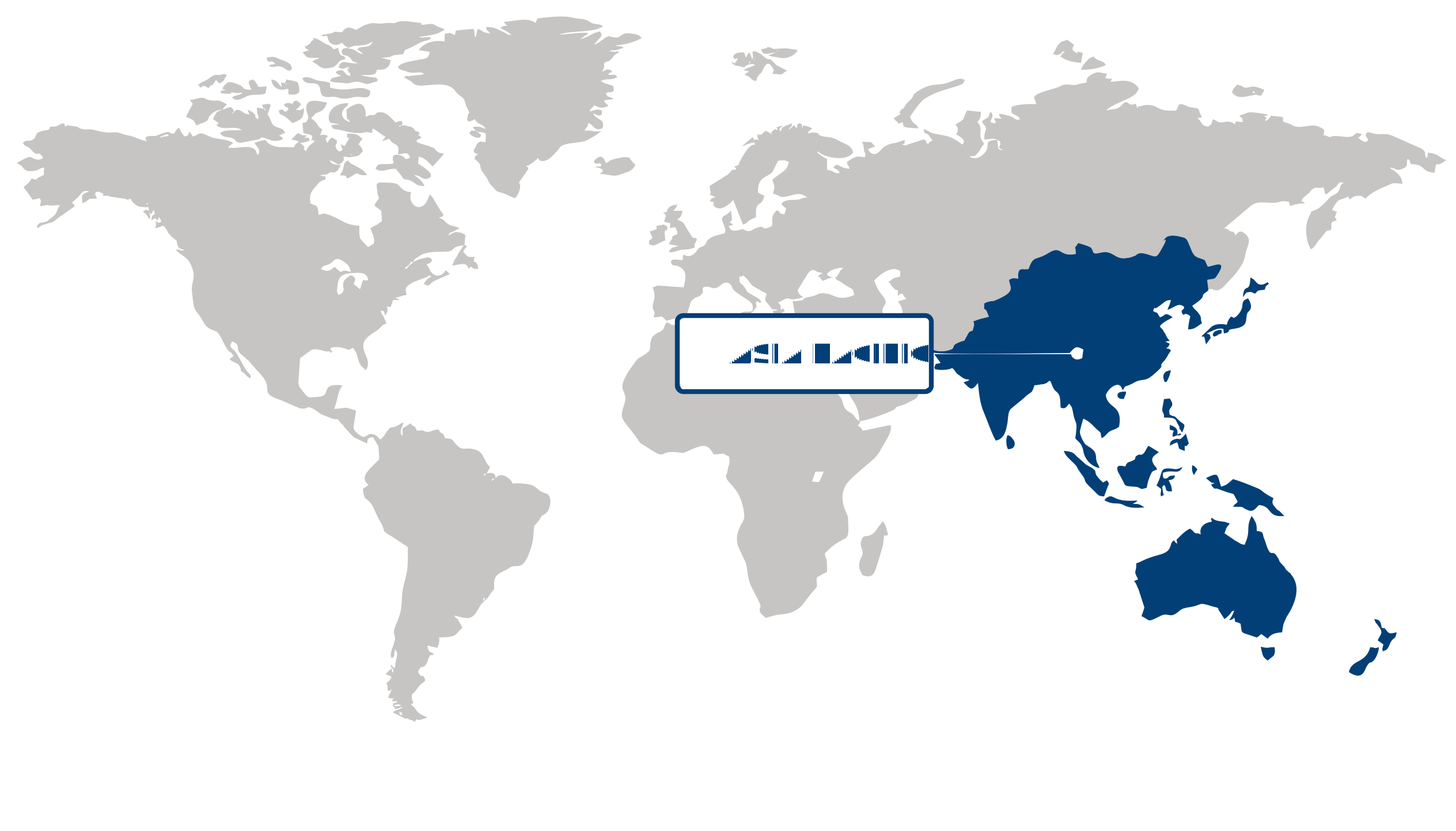
Asia Pacific dominated the fertilizer spreaders market in 2025, representing more than 39.45% of the global share and registering the fastest growth with a CAGR of 18.96%. This leadership stems primarily from the expanding acreage under agricultural cultivation in key developing economies within the region, which fuels robust demand for mechanized fertilization solutions. For instance, India’s Ministry of Agriculture highlights continuous farmland expansion alongside efforts to improve crop yields, reinforcing the need for advanced fertilizer spreading technology. Furthermore, increasing government incentives for precision farming and sustainability-driven reforms in countries like Australia and Indonesia accelerate adoption. Combined with improvements in supply chain infrastructure and innovations from local manufacturers such as Kubota Corporation, the region’s market is set to benefit from intensified investments in food security and digital agriculture, positioning Asia Pacific as the most lucrative arena for fertilizer spreader advancements.
Japan serves as a pivotal hub in the Asia Pacific fertilizer spreaders market, characterized by its emphasis on technological sophistication and sustainable farming practices, which commands premium demand for advanced spreader models. The Ministry of Agriculture, Forestry and Fisheries in Japan actively promotes smart agriculture initiatives integrating IoT and automation, enhancing precision in fertilizer application to reduce environmental impact. This positions Japan as a leader in adopting high-efficiency spreaders, influencing regional innovation standards. Meanwhile, China anchors the region’s expansion through extensive agricultural land development and aggressive mechanization driven by national policies like the Ministry of Agriculture and Rural Affairs’ commitment to modernization. Chinese companies such as Weifang Rollong Machinery emphasize scalable, cost-effective spreader solutions suited for large-scale farms, reflecting localized consumer and operational dynamics. Together, Japan’s technology-driven model and China’s volume-centric growth reinforce Asia Pacific’s dominant and fast-growing presence in the fertilizer spreaders market.
Europe Market Analysis:
Europe maintained a notable market presence in the fertilizer spreaders market, holding a significant share driven by the region’s advanced agricultural infrastructure and strong regulatory emphasis on sustainable farming practices. The demand for precision agriculture has accelerated adoption of technologically sophisticated spreaders that optimize nutrient delivery while minimizing environmental impact. Policies such as the European Green Deal and CAP (Common Agricultural Policy) reforms encourage efficient fertilizer use, further propelling market activity. Leading agricultural machinery manufacturers headquartered in Europe, including companies like Amazone and Kverneland Group, continuously innovate product portfolios to meet stringent emissions and efficiency standards. Additionally, Europe's well-developed logistics network supports efficient distribution channels, enhancing market competitiveness. Given these dynamics, Europe is poised to remain a key player in the fertilizer spreaders market, with ample room for growth as digital farming solutions and sustainability priorities remain central to agricultural modernization efforts.
Germany plays a pivotal role in Europe’s fertilizer spreaders market, anchored by its status as one of the continent’s largest agricultural machinery producers and exporters. German farmers’ increasing shift toward precision fertilization techniques aligns with national policies promoting resource efficiency and environmental stewardship, supported by incentives from the Federal Ministry of Food and Agriculture. Key players like Rauch and Horsch leverage Germany’s strong R&D capabilities to introduce smart spreaders integrating GPS and IoT technologies, enhancing product appeal among tech-savvy users. Furthermore, Germany’s export-oriented industry benefits from established supply chains within the EU, enabling rapid response to regional demand fluctuations. This robust innovation ecosystem and regulatory alignment underscore Germany’s instrumental role in sustaining and expanding Europe’s leadership in the fertilizer spreaders market.
France also holds substantial influence in the European fertilizer spreaders market, reflecting the country’s large arable land area and extensive focus on sustainable agriculture. The French government’s commitment to agroecology encourages farmers to adopt precision spreaders that reduce fertilizer runoff and promote soil health. Domestic manufacturers like Sulky-Burel actively invest in eco-friendly product lines and digital integration to address evolving farmer preferences and regulatory requirements. Additionally, cooperative structures prevalent in France facilitate knowledge transfer and collective purchasing, enhancing market penetration of advanced fertilizer spreaders. Supported by initiatives from FranceAgriMer and other agricultural bodies, France’s proactive approach to sustainable fertilization positions it as a strategic market within Europe, contributing to the region’s overall competitiveness and innovation in fertilizer spreaders.
North America Market Trends:
North America maintained notable presence in the fertilizer spreaders market, supported by evolving agricultural practices and increasing emphasis on precision farming techniques. The region's significance is underpinned by steady investment in sustainable agriculture, as reflected in initiatives led by the U.S. Department of Agriculture promoting efficient nutrient management. Consumer preferences are shifting towards technologically advanced equipment that improves yield while minimizing environmental impact, driving manufacturers to innovate in spreader design and automation. Additionally, robust supply chains and the presence of major agricultural equipment producers like Deere & Company facilitate market growth despite cyclical economic pressures. Regulatory frameworks encouraging reduced chemical runoff and fertilizer over-application further catalyze adoption of advanced spreaders. Going forward, North America’s ability to integrate digital transformation into farm operations positions the region as a key driver of moderate growth, offering investors strategic opportunities aligned with sustainability and operational efficiency.
The U.S. plays a pivotal role in the fertilizer spreaders market, fueled by its expansive agricultural base and technological adoption rates. Increasing governmental support through programs such as the USDA’s Conservation Stewardship Program incentivizes farmers to adopt precision nutrient dissemination technologies, boosting demand. Leading manufacturers, including AGCO Corporation and CNH Industrial, continually launch innovative spreaders tailored to diverse crop requirements and varying farm sizes, highlighted in their recent product announcements. Additionally, the U.S. farm sector's resilience amid global supply chain disruptions underscores the market's stability. This dynamic landscape fosters competitive innovation and integration of advanced digital tools, such as GPS-guided spreaders, enhancing efficiency and environmental compliance. Consequently, the U.S. stands as a cornerstone of North America’s fertilizer spreaders market, anchoring regional moderate growth through technology-driven agricultural modernization.
| Parameter | North America | Asia Pacific | Europe | Latin America | MEA |
|---|---|---|---|---|---|
| Innovation Hub i Scale Nascent Developing Advanced | |||||
| Cost-Sensitive Region i Scale Low Medium High | |||||
| Regulatory Environment i Scale Restrictive Neutral Supportive | |||||
| Demand Drivers i Scale Weak Moderate Strong | |||||
| Development Stage i Scale Emerging Developing Developed | |||||
| Adoption Rate i Scale Low Medium High | |||||
| New Entrants / Startups i Scale Sparse Moderate Dense | |||||
| Macro Indicators i Scale Weak Stable Strong |
Segment Leadership and Growth Trends
Fertilizer Spreaders Market Share (%), by Type, 2026
Go beyond the chart, access full insights & data tables
Request Free Sample ReportBroadcast spreader dominated the fertilizer spreaders market in 2025, capturing the largest share due to its unparalleled efficiency in covering large agricultural areas. This leadership is primarily driven by the growing demand for efficient large-area fertilizer application in commercial farming, enabling timely nutrient distribution and optimizing input costs. Customer preferences increasingly lean towards equipment that balances operational scale with precision, supported by advancements in spreader design enhancing coverage uniformity. The Food and Agriculture Organization (FAO) has highlighted mechanized fertilizer application as critical to sustainable intensification, reinforcing broadcast spreaders' role. For industry players, this segment offers strategic advantages through product innovation and integration with precision agriculture technologies. Given ongoing investments in large-scale farming and sustainability mandates, broadcast spreaders are expected to maintain prominence as essential tools for scalable, eco-conscious nutrient management.
Analysis by Application
Farms represented the largest share in the fertilizer spreaders market in 2025, reflecting the significant uptake of mechanized solutions to boost crop yields and operational efficiency. This segment’s leadership stems from widespread mechanization initiatives that align with the need to improve productivity amid global food security concerns. Demand is further shaped by farmers’ adoption of technologies endorsed by agricultural extension services and government subsidy programs, such as those promoted by the U.S. Department of Agriculture, favoring mechanized fertilizer spreaders. The trend towards precision farming and digital agriculture also strengthens the growth of farm-based usage by optimizing input application tailored to soil variability. For incumbents and new entrants, the farm segment offers ample opportunity to develop specialized equipment and service models. With the persistent drive to enhance productivity while reducing environmental footprints, farms will remain the pivotal application focus in the fertilizer spreaders market.
| Segment | Sub-Segment | Largest Segment | Fastest Growing |
|---|---|---|---|
| Type | Broadcast Spreader, Hand-Held Spreader, Drop Spreader | ||
| Application | Public Gardens, Farms, Others |
Competitive Landscape and Market Positioning
The competitive landscape is characterized by ongoing efforts to enhance product performance and operational efficiency. Leading companies are intensifying investments in advanced spreading technologies and eco-friendly solutions, reflecting an evolving focus on sustainability and precision agriculture. Several players are enhancing their market reach through partnerships that integrate digital connectivity and data analytics into spreading equipment, driving operational insights for end-users. The introduction of smart spreaders with automated calibration and real-time monitoring capabilities is increasingly common, elevating the technological standard across the market. Moreover, consolidation activities and strategic alliances have refined portfolio breadth, enabling companies to offer comprehensive solutions catering to diverse customer needs while challenging competitors to elevate innovation and service excellence.
Strategic / Actionable Recommendations for Regional Players
North American entities should explore synergies with technology innovators specializing in IoT and AI to embed advanced digital functionalities into spreader systems, matching the increased demand for precision farming solutions. Strengthening collaborations with agricultural machinery manufacturers can enhance product integration and attract a broader customer base seeking fully automated nutrient management.
In Asia Pacific, capitalizing on the rapid mechanization of agriculture and rising adoption of sustainable farming practices can be pivotal. Aligning with local agricultural cooperatives and technology providers to customize spreaders for regional crop and soil conditions will drive market relevance. Investing in scalable, cost-effective models tailored for small to mid-sized farms could unlock significant growth opportunities.
European manufacturers should prioritize the development of environmentally optimized equipment compliant with stringent regulatory frameworks. Focusing on partnerships that support research in organic and mixed fertilizer applications can position firms as preferred suppliers amidst increasing eco-consciousness. Additionally, expanding digital services that offer integrated field management solutions will reinforce customer loyalty and differentiate offerings in a mature market.
| Company | Market Share | Company Revenue | Revenue CAGR (%) | Product Portfolio | Geographic Presence | Innovation / R&D Focus | Strategic Developments |
|---|---|---|---|---|---|---|---|
| No companies available. | |||||||
Industry Development/News
| Company Name | Date | Key Development |
|---|
Customize Your Report
Explore examples of how this report can be tailored to different research needs, including custom segments, additional topics or chapters, and related reports. Click a section of the wheel or its numbered marker to explore the available options.
Fertilizer Spreaders Market — Custom Segments
| Segment | Sub-Segment |
|---|---|
| No segment data available. | |
Fertilizer Spreaders Market — Custom TOC
| Custom Chapter | Custom Details | ||
|---|---|---|---|
| No custom TOC data available. | |||
Need a different cut of the data?
Request Custom ResearchWhat is the current size of the fertilizer spreaders market?
What is the projected value of the fertilizer spreaders industry by 2035?
Which territory dominates the fertilizer spreaders market share rankings?
What is the fastest growing region in the fertilizer spreaders sector?
What factors give broadcast spreader segment a competitive edge in the fertilizer spreaders sector?
Which is the largest sub-segment within the application segment for fertilizer spreaders industry?
Who are the leading players in the fertilizer spreaders landscape?
Our Clients
"The team at Fundamental Business Insights & Consulting demonstrated a commitment to excellence, not only in the quality of the report but also in their client-centric approach."
FANUC
"The level of detail in the market segmentation provided were particularly noteworthy. The detailed country-level insights were also very helpful."
B&R Industrial Automation GmbH
"The consultant took the time to understand our specific business objectives, ensuring that the reports were tailored to address our unique challenges and opportunities."
KUKA SE & Co. KGaA
Our Research Team & Methodology
Every Fundamental Business Insights report is built by a dedicated vertical research team, validated through a structured primary-and-secondary methodology, and reviewed for accuracy before it reaches you.
Research Team Overview
Prepared by the Industrial Automation & Equipment Research Team
Delivery
Published
Demand
Available
Support
Trust & Compliance
Research Domains
10 coverage areasResearch Intelligence
| Source | Reference |
|---|---|
| International Society of Automation (ISA) | www.isa.org |
| International Organization for Standardization (ISO) | www.iso.org |
| National Institute of Standards and Technology (NIST) | www.nist.gov |
| IEEE | www.ieee.org |
| VDMA (German Mechanical Engineering Industry Association) | www.vdma.org |
| Association for Advancing Automation (A3) | www.automate.org |
| International Federation of Robotics (IFR) | ifr.org |
| ASME (American Society of Mechanical Engineers) | www.asme.org |
| ASHRAE | www.ashrae.org |
| American Society of Heating, Refrigerating and Air-Conditioning Engineers (ASHRAE) | www.ashrae.org |
| Material Handling Industry (MHI) | www.mhi.org |
| OSHA (Occupational Safety and Health Administration) | www.osha.gov |
| National Fire Protection Association (NFPA) | www.nfpa.org |
| ASTM International | www.astm.org |
| International Electrotechnical Commission (IEC) | www.iec.ch |
| Open Process Automation Forum (The Open Group) | www.opengroup.org/open-process-automation-forum |
| AGMA (American Gear Manufacturers Association) | www.agma.org |
| Association of Equipment Manufacturers (AEM) | www.aem.org |
| Food and Agriculture Organization (FAO) | www.fao.org |
| International Labour Organization (ILO) | www.ilo.org |
Research Workflow & Quality Assurance
Data Collection
Verified information gathered through primary and secondary research.
Data Triangulation
Cross-validation using multiple independent data sources.
Forecast Modelling
Market estimates developed using historical trends and analytical models.
Analyst Validation
Findings reviewed by domain experts for accuracy and consistency.
Editorial & Quality Review
Final editorial, quality, and compliance checks before publication.
Final Publication
Released after successful completion of the internal review process.
Report Coverage
📊 Market Assessment
- Market Size & Forecast
- Market Segmentation
- Regional Analysis
- Growth Drivers & Challenges
- Market Dynamics
🏢 Competitive Intelligence
- Competitive Landscape
- Company Profiles
- Competitive Benchmarking
- Mergers & Acquisitions
- Market Share Analysis or Key Company Strategies
🔍 Strategic Analysis
- Value Chain Analysis
- Porter's Five Forces
- PESTLE Analysis
- Pricing Trends
- Supply-Demand Analysis
🚀 Future Outlook
- Technology Landscape
- Regulatory Landscape
- Investment & Funding Landscape
- Emerging Opportunities
- Future Market Outlook
Have a question about this report or need a custom scope?
Request Customization