Ferrochrome Market Size & Growth Forecast 2027–2036, By Segments (Application, Product), Regional Demand Trends (North America, Asia Pacific, Europe), Key Country Insights (U.S., Japan, South Korea, Germany, France, Italy), and Competitive Landscape
Market Size and Growth Outlook
Ferrochrome Market size was valued at USD 22.2 billion in 2026 and is projected to grow at a 5.8% CAGR from 2027 to 2036, exceeding USD 39.01 billion by 2036. The industry revenue for 2027 is estimated at USD 23.28 billion.
Get more details on this report
Request Free Sample ReportFerrochrome Market Intelligence Snapshot
Regional Market Dynamics
- Asia Pacific captured 59.95% of the market in 2026, supported by its large stainless steel production base, established processing infrastructure, and strong procurement relationships between steelmakers and ferrochrome suppliers.
- Europe is projected to grow at a 7.46% CAGR, supported by demand for high-value stainless steel applications, dependable alloy sourcing, and ongoing industrial replacement activity across advanced manufacturing sectors.
Segment Momentum
- High Carbon Ferrochrome held an 87.97% market share in 2026 due to its widespread use in stainless steel production and bulk metallurgical processes, where manufacturers prioritize high-volume, established production routes.
- Low Carbon Ferrochrome is growing fastest because producers increasingly require tighter carbon control for applications demanding precise alloy composition and higher finished steel quality, strengthening its role in specialized production environments.
Market Expansion Drivers
- Strong stainless steel demand from construction and automotive industries driving ferrochrome consumption.
- Supply chain disruptions and production constraints tightening global ferrochrome availability.
- Transition toward low-carbon ferrochrome production improving competitiveness of sustainable suppliers.
Leading Market Participants
- Leading players in the ferrochrome market include Glencore plc (Switzerland), Samancor Chrome Holdings Proprietary Limited (South Africa), YILDIRIM Group (Turkey), Eurasian Resources Group S.à r.l. (Luxembourg), Outokumpu Oyj (Finland), IMFA - Indian Metals & Ferro Alloys Limited (India), Balasore Alloys Limited (India), Ferro Alloys Corporation Limited (India), ALBChrome Holding sh.a. (Albania), Vargön Alloys AB (Sweden).
Global Market Forecast Snapshot
Market Outlook
- 2026 Market Size: USD 22.2 billion
- 2027 Estimated Market Size: USD 23.28 billion.
- Projected Market Size: USD 39.01 billion by 2036
- Growth Forecast: 5.8% CAGR (2027-2036)
Regional and Segment Outlook
- Leading Regional Market: Asia Pacific
- High-Growth Regional Hub: Europe
- Core Revenue Segment: Stainless Steel (Application) | High Carbon Ferrochrome (Product)
- Emerging Opportunity Segment: Stainless Steel (Application) | Low Carbon Ferrochrome (Product)
Market Growth Drivers and Industry Trends
Strong stainless steel demand from construction and automotive industries driving ferrochrome consumption
The ferrochrome market will be strongly supported by sustained stainless steel consumption in construction and automotive manufacturing, where chromium is essential for providing corrosion resistance, durability, and surface performance. Growing use of stainless steel in building structures, architectural elements, infrastructure equipment, vehicle components, and exhaust systems directly increases the requirement for ferrochrome as a key alloying input. Construction activity also generates demand for stainless steel in applications exposed to moisture and demanding operating environments, while automotive producers use corrosion-resistant grades in components requiring strength and long service life. As stainless steel remains important across these end-use industries, ferrochrome consumption is closely linked to their production requirements and material specifications.
Supply chain disruptions and production constraints tightening global ferrochrome availability
Supply-side volatility can influence the ferrochrome market by reducing the availability of material and creating greater pressure across international procurement networks. Disruptions affecting mining operations, electricity availability, transportation, processing capacity, or cross-border logistics can constrain ferrochrome production and shipments, while operational limitations at production facilities can further restrict supply. Producers and stainless steel manufacturers may respond by strengthening inventory management and securing alternative sources to protect production continuity. Such conditions can increase the strategic importance of reliable ferrochrome supply, particularly for stainless steel producers that require consistent access to alloying materials for maintaining specified chromium content and production schedules.
Transition toward low-carbon ferrochrome production improving competitiveness of sustainable suppliers
The shift toward lower-carbon production methods is reshaping competitive dynamics within the ferrochrome market as stainless steel producers and industrial buyers increasingly consider the environmental profile of upstream materials. Ferrochrome production can involve substantial energy consumption, making energy-efficient furnaces, renewable electricity, process optimization, and improved resource utilization important areas for technological development. Producers that can reduce emissions while maintaining product quality and reliable output may gain greater acceptance among customers seeking to lower the embedded carbon intensity of stainless steel production. This transition is also encouraging investment in cleaner production technologies and operational improvements that can strengthen the position of suppliers capable of meeting increasingly demanding sustainability requirements.
| Growth Driver | Impact on CAGR | Regulatory Influence | Geographic Relevance | Adoption Rate | Impact Timeline |
|---|---|---|---|---|---|
| Strong stainless steel demand from construction and automotive industries driving ferrochrome consumption | 2.60% | High | Asia Pacific | High | Near Term |
| Supply chain disruptions and production constraints tightening global ferrochrome availability | 2.10% | Moderate | Africa, Asia Pacific | Medium | Near Term |
| Transition toward low-carbon ferrochrome production improving competitiveness of sustainable suppliers | 1.80% | High | Europe, Asia Pacific | Medium | Mid Term |
Unlock insights tailored to your business with our bespoke market research solutions.
Click to get your customized report now.
Regional Demand Dynamics
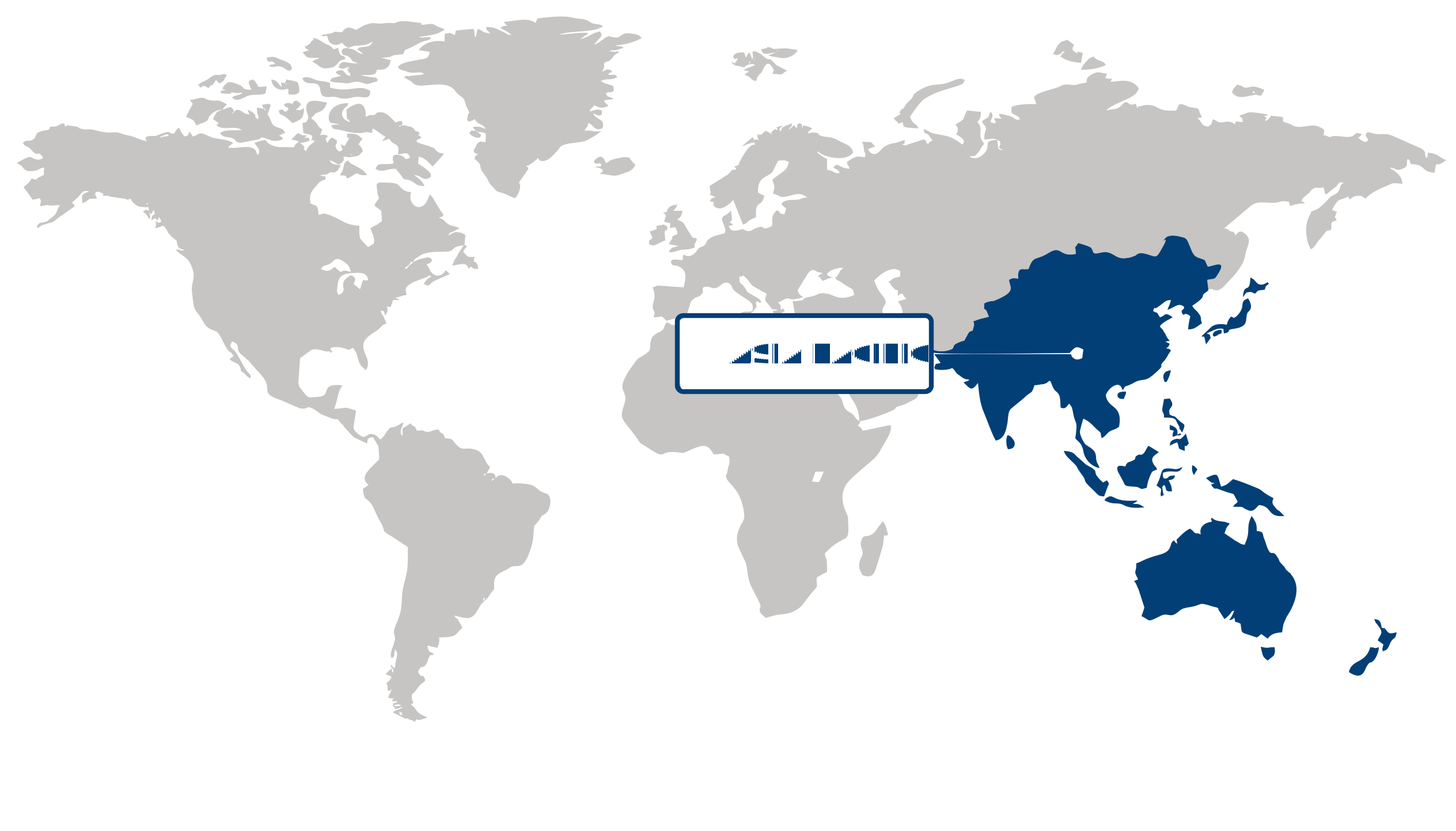
Asia Pacific (Largest Region)
Asia Pacific accounted for the largest share of the ferrochrome market at 59.95% in 2026, supported by strong stainless steel production, extensive industrial manufacturing, and sustained demand for chromium-containing alloys. The region's large metallurgical and steel-processing base creates significant consumption opportunities for ferrochrome, while expanding manufacturing activity continues to reinforce demand for corrosion-resistant and durable steel products. Established raw-material processing capabilities and industrial infrastructure further strengthen the region's market position.
Europe (Fastest-Growing Region)
Europe is the fastest-growing regional market, driven by increasing demand for high-performance stainless steel and greater emphasis on efficient industrial production. The region's established metalworking and engineering industries support ferrochrome consumption across applications requiring strength, corrosion resistance, and durability. Ongoing industrial modernization and a focus on advanced materials are creating additional opportunities for ferrochrome suppliers as manufacturers seek reliable inputs for specialized steel production.
| Parameter | North America | Asia Pacific | Europe | Latin America | MEA |
|---|---|---|---|---|---|
| Innovation Hub i Scale Nascent Developing Advanced | |||||
| Cost-Sensitive Region i Scale Low Medium High | |||||
| Regulatory Environment i Scale Restrictive Neutral Supportive | |||||
| Demand Drivers i Scale Weak Moderate Strong | |||||
| Development Stage i Scale Emerging Developing Developed | |||||
| Adoption Rate i Scale Low Medium High | |||||
| New Entrants / Startups i Scale Sparse Moderate Dense | |||||
| Macro Indicators i Scale Weak Stable Strong |
Key Country Insights
Germany 🇩🇪
Precision Steel IntegrationGermany emphasizes consistent ferrochrome supply for premium stainless steel and engineering-grade alloys used across automotive and industrial equipment manufacturing. Procurement increasingly focuses on quality consistency, environmental compliance, and long-term supplier relationships.
France 🇫🇷
Sustainable Alloy SupplyFrance integrates ferrochrome procurement with industrial decarbonization initiatives and specialty steel applications. Purchasing decisions increasingly consider responsible sourcing practices alongside material quality to support manufacturing and infrastructure projects.
Italy 🇮🇹
Industrial Processing BaseItaly uses ferrochrome extensively in stainless steel manufacturing for machinery, consumer goods, and construction products. Italian manufacturers emphasize cost-efficient sourcing, dependable imports, and material consistency to maintain production competitiveness.
Japan 🇯🇵
Advanced Metallurgy FocusJapan relies on high-quality ferrochrome for specialty steel production supporting automotive, electronics, and precision manufacturing. Producers and end users prioritize stable material specifications and efficient import logistics to maintain manufacturing performance.
South Korea 🇰🇷
Export Manufacturing SupportSouth Korea aligns ferrochrome procurement with stainless steel production serving shipbuilding, construction, and export-oriented manufacturing. Market participants seek reliable international suppliers capable of supporting flexible production schedules and evolving product requirements.
United States 🇺🇸
Specialty Alloy DemandThe U.S. ferrochrome market is shaped by stainless steel production, aerospace alloys, and industrial manufacturing requiring dependable chromium inputs. Buyers are prioritizing diversified sourcing strategies and domestic processing partnerships to strengthen supply continuity for critical metallurgical applications.
Segment Leadership and Growth Trends
Ferrochrome Market Share (%), by Application, 2026
Go beyond the chart, access full insights & data tables
Request Free Sample ReportApplication Segment Analysis: Stainless Steel (Largest & Fastest-Growing Segment)
Stainless steel was the dominant application in the ferrochrome market, holding a 79.61% share in 2026 while also registering the fastest growth among applications. Ferrochrome is an essential source of chromium in stainless steel production, where chromium provides corrosion resistance, durability, and surface performance. Expanding demand for stainless steel across construction, automotive, industrial equipment, consumer products, and processing industries continues to sustain ferrochrome consumption. The need for materials capable of withstanding harsh operating environments further reinforces the importance of ferrochrome in stainless steel manufacturing.
Product Segment Analysis: High Carbon Ferrochrome (Largest Segment) vs Low Carbon Ferrochrome (Fastest-Growing Segment)
High carbon ferrochrome maintained a commanding position in the ferrochrome market, accounting for an 87.97% share in 2026. Its extensive use in stainless steel production is supported by its efficient chromium contribution and suitability for large-scale alloy manufacturing. The continued expansion of stainless steel applications across industrial and infrastructure-related sectors provides a stable demand base for high carbon ferrochrome, while its established role in conventional alloy production reinforces its leading position.
Low carbon ferrochrome is advancing more rapidly as manufacturers place greater emphasis on controlling carbon content in specialized alloy and stainless steel production. Its use enables tighter compositional control where material specifications and performance requirements demand lower carbon levels. Increasing demand for higher-quality specialty steels and applications requiring precise alloy characteristics is creating greater opportunities for low carbon ferrochrome, supporting its faster growth within the product segment.
| Segment | Sub-Segment | Largest Segment | Fastest Growing |
|---|---|---|---|
| Application | Stainless Steel, Others | Stainless Steel | Stainless Steel |
| Product | High Carbon Ferrochrome, Medium Carbon Ferrochrome, Low Carbon Ferrochrome | High Carbon Ferrochrome | Low Carbon Ferrochrome |
Competitive Landscape and Market Positioning
Key companies in the ferrochrome market:
1. Glencore plc (Switzerland)
2. Samancor Chrome Holdings Proprietary Limited (South Africa)
3. YILDIRIM Group (Turkey)
4. Eurasian Resources Group S.Ã r.l. (Luxembourg)
5. Outokumpu Oyj (Finland)
6. IMFA - Indian Metals & Ferro Alloys Limited (India)
7. Balasore Alloys Limited (India)
8. Ferro Alloys Corporation Limited (India)
9. ALBChrome Holding sh.a. (Albania)
10. Vargön Alloys AB (Sweden)
The ferrochrome market is being shaped by fluctuating industrial demand patterns and evolving production standards. Efficiency improvements in metallurgical processes are gaining importance amid cost and sustainability pressures. The sector continues to adapt to changing requirements from downstream applications.
| Company | Market Share | Company Revenue | Revenue CAGR (%) | Product Portfolio | Geographic Presence | Innovation / R&D Focus | Strategic Developments |
|---|---|---|---|---|---|---|---|
| Glencore plc (Switzerland) | |||||||
| Samancor Chrome Holdings Proprietary Limited (South Africa) | |||||||
| YILDIRIM Group (Turkey) | |||||||
| Eurasian Resources Group S.à r.l. (Luxembourg) | |||||||
| Outokumpu Oyj (Finland) | |||||||
| IMFA - Indian Metals & Ferro Alloys Limited (India) | |||||||
| Balasore Alloys Limited (India) | |||||||
| Ferro Alloys Corporation Limited (India) | |||||||
| ALBChrome Holding sh.a. (Albania) | |||||||
| Vargön Alloys AB (Sweden). |
Industry Development/News
| Company Name | Date | Key Development |
|---|---|---|
| IMFA | May-26 | IMFA acquired Tata Steel’s ferrochrome plant in Kalinganagar for ₹707 crore, adding four furnaces with 100,000 tpa capacity. The company plans to expand this to 150,000 tpa, solidifying its position as India’s largest ferrochrome producer and significantly increasing its integrated production scale in the domestic and export markets. |
| IMFA | May-26 | IMFA announced a ₹6.1 billion investment plan in Odisha to expand ferrochrome production capacity, with output growth targeted from FY27. This initiative supports the company’s broader strategy to enhance its competitive positioning and strengthen the domestic supply chain for India's stainless steel and industrial metals sectors. |
| Vedanta | May-26 | Vedanta committed over ₹12,500 crore to expand production capacity across its metallurgical portfolio, including ferrochrome. This strategic investment aims to bolster the supply of critical metals for the electric vehicle ecosystem, reinforcing the company's downstream integration and expanding its operational footprint in strategic industrial minerals markets. |
| Oman Chromite | Apr-26 | Oman Chromite increased its equity stake in Gulf Alloys and Metals, operator of a low-carbon ferrochrome smelter in SOHAR Freezone. This investment aligns with regional objectives to expand lower-emission metallurgical capacity and strengthens the company’s role in the production of sustainable ferrochrome for international markets. |
| Glencore-Merafe Venture | Apr-26 | The Glencore-Merafe venture reached financial close on a 100MW solar PV project in partnership with Pele Green Energy. The integration of solar power is designed to decarbonize energy-intensive smelting operations in South Africa, reducing grid reliance and improving the long-term operational sustainability and emission profiles of the joint venture’s production facilities. |
| Glencore | Feb-26 | Glencore initiated advanced negotiations with South African authorities to restructure ferrochrome smelting operations in response to rising electricity costs and operational pressures. These discussions are focused on securing sustainable power tariffs to maintain the viability of key smelters and address structural challenges within the global ferrochrome supply chain. |
| ALBCHROME | Jan-26 | ALBCHROME commenced an expansion and modernization project for its Albanian smelting facilities. By upgrading technology to improve energy efficiency and increase output, the company aims to enhance its production capabilities to meet the growing demand from European stainless steel manufacturers for environmentally compliant and high-quality ferrochrome. |
Customize Your Report
Explore examples of how this report can be tailored to different research needs, including custom segments, additional topics or chapters, and related reports. Click a section of the wheel or its numbered marker to explore the available options.
Ferrochrome Market — Custom Segments
| Segment | Sub-Segment |
|---|---|
| Ore Source | Domestic Chromite Ore, Imported Chromite Ore |
| Supplier Type | Integrated Ferrochrome Producers, Independent Ferrochrome Producers, Captive Producers |
| Product Form | Lump Ferrochrome, Granular Ferrochrome, Briquetted Ferrochrome |
Ferrochrome Market — Custom TOC
| Custom Chapter | Custom Details |
|---|---|
| Chrome Ore Supply Security Assessment |
|
| Smelter Cost Competitiveness Benchmarking |
|
| Decarbonization Pathways for Ferrochrome Production |
|
Need a different cut of the data?
Request Custom ResearchWhat is the market size of ferrochrome?
How will the ferrochrome industry grow in terms of size and CAGR by 2036?
How is stainless steel production shaping long-term ferrochrome procurement strategies across industrial buyers?
Why is the shift toward low-carbon ferrochrome influencing supplier selection in stainless steel value chains?
Why is High Carbon Ferrochrome the largest product segment in the ferrochrome market?
Why is Low Carbon Ferrochrome the fastest-growing product segment in the ferrochrome market?
Why does Asia Pacific hold the largest share of the ferrochrome market?
What is driving ferrochrome market growth in Europe?
Which organizations are considered leaders in the ferrochrome landscape?
Our Clients
"The report helped us understand emerging consumer trends in our product category. It clarified where to focus innovation for the next product launch."
LyondellBasell
"The regional forecast section was incredibly useful. We were able to identify two new potential partners in Europe thanks to the vendor mapping you included."
SABIC
"We appreciated how actionable the recommendations were. It guided us to improve supply chain resilience."
Olin Corporation
Our Research Team & Methodology
Every Fundamental Business Insights report is built by a dedicated vertical research team, validated through a structured primary-and-secondary methodology, and reviewed for accuracy before it reaches you.
Research Team Overview
Prepared by the Chemicals & Materials Research Team
Delivery
Published
Demand
Available
Support
Trust & Compliance
Research Domains
10 coverage areasResearch Intelligence
| Source | Reference |
|---|---|
| American Chemistry Council (ACC) | www.americanchemistry.com |
| European Chemical Industry Council (Cefic) | cefic.org |
| International Council of Chemical Associations (ICCA) | icca-chem.org |
| European Chemicals Agency (ECHA) | echa.europa.eu |
| U.S. Environmental Protection Agency (EPA) | www.epa.gov |
| ASTM International | www.astm.org |
| International Organization for Standardization (ISO) | www.iso.org |
| National Institute of Standards and Technology (NIST) | www.nist.gov |
| Plastics Industry Association (PLASTICS) | www.plasticsindustry.org |
| European Biplastics | www.european-bioplastics.org |
| The Adhesive and Sealant Council (ASC) | www.ascouncil.org |
| National Association of Corrosion Engineers (AMPP) | www.ampp.org |
| Society of Plastics Engineers (SPE) | www.4spe.org |
| International Fertilizer Association (IFA) | www.fertilizer.org |
| CropLife International | croplife.org |
| Packaging Europe | packagingeurope.com |
| Flexible Packaging Association (FPA) | www.flexpack.org |
| Battery Council International (BCI) | batterycouncil.org |
| International Copper Association (ICA) | internationalcopper.org |
| World Steel Association | worldsteel.org |
Research Workflow & Quality Assurance
Data Collection
Verified information gathered through primary and secondary research.
Data Triangulation
Cross-validation using multiple independent data sources.
Forecast Modelling
Market estimates developed using historical trends and analytical models.
Analyst Validation
Findings reviewed by domain experts for accuracy and consistency.
Editorial & Quality Review
Final editorial, quality, and compliance checks before publication.
Final Publication
Released after successful completion of the internal review process.
Report Coverage
📊 Market Assessment
- Market Size & Forecast
- Market Segmentation
- Regional Analysis
- Growth Drivers & Challenges
- Market Dynamics
🏢 Competitive Intelligence
- Competitive Landscape
- Company Profiles
- Competitive Benchmarking
- Mergers & Acquisitions
- Market Share Analysis or Key Company Strategies
🔍 Strategic Analysis
- Value Chain Analysis
- Porter's Five Forces
- PESTLE Analysis
- Pricing Trends
- Supply-Demand Analysis
🚀 Future Outlook
- Technology Landscape
- Regulatory Landscape
- Investment & Funding Landscape
- Emerging Opportunities
- Future Market Outlook
Have a question about this report or need a custom scope?
Request Customization