Feed Binders Market Size & Growth Forecast 2027–2036, By Segments (Source, Type, Livestock), Regional Demand Trends (North America, Asia Pacific, Europe), Key Country Insights (U.S., Japan, South Korea, Germany, France, Italy), and Competitive Landscape
Market Size and Growth Outlook
Feed Binders Market size was over USD 4.79 Billion in 2026 and is likely to grow at 5.62% CAGR between 2027 and 2036, crossing USD 8.28 Billion by 2036. The industry revenue for 2027 is assessed at USD 5.02 Billion.
Get more details on this report
Request Free Sample ReportFeed Binders Market Intelligence Snapshot
Regional Market Dynamics
- Asia Pacific held the largest share in 2026, supported by extensive livestock and aquaculture production, expanding commercial farming, and modernization of feed manufacturing infrastructure.
- North America is growing fastest through advanced livestock practices, technologically enhanced feed formulations, and increasing focus on feed safety, efficiency, sustainability, and pellet quality.
Segment Momentum
- Poultry was the largest livestock segment in 2026, driven by high global poultry production and strong demand for compound feed that requires binders to maintain pellet quality and consistency.
- Aquaculture is the fastest-growing livestock segment as fish and shrimp farming increasingly relies on feed binders to improve pellet water stability, reduce nutrient loss, and support high-quality aquatic feed production.
Market Expansion Drivers
- Rising demand for high-performance animal nutrition boosting feed pellet stability solutions
- Expansion of commercial livestock farming increasing adoption of advanced feed formulations
- Growth in sustainable livestock production practices driving natural feed binding solutions adoption
Leading Market Participants
- Leading companies in the feed binders market include Adisseo (France), Archer Daniels Midland Company (USA), Cargill Incorporated (USA), BASF SE (Germany), DSM-Firmenich AG (Netherlands), DuPont de Nemours, Inc. (USA), Alltech Inc. (USA), Kemin Industries, Inc. (USA), Borregaard ASA (Norway), Novus International, Inc. (USA)
Global Market Forecast Snapshot
Market Outlook
- 2026 Market Size: USD 4.79 Billion
- 2027 Estimated Market Size: USD 5.02 Billion
- Projected Market Size: USD 8.28 Billion by 2036
- Growth Forecast: 5.62% CAGR (2027-2036)
Regional and Segment Outlook
- Leading Regional Market: Asia Pacific
- High-Growth Regional Hub: North America
- Core Revenue Segment: Natural (Source) | Plant Gums & Starches (Type) | Poultry (Livestock)
- Emerging Opportunity Segment: Synthetic (Source) | Lignosulfonates (Type) | Aquaculture (Livestock)
Market Growth Drivers and Industry Trends
Rising demand for high-performance animal nutrition boosting feed pellet stability solutions
Increasing emphasis on animal productivity and feed efficiency is driving demand for feed ingredients that improve pellet quality and maintain nutritional consistency during handling and storage. The feed binders market growth is supported by livestock producers seeking binding solutions that enhance pellet durability, reduce feed wastage, and improve overall feed performance. Strong pellet integrity also contributes to more uniform feed intake, allowing producers to maintain consistent nutrition across poultry, swine, ruminant, and aquaculture production systems.
Expansion of commercial livestock farming increasing adoption of advanced feed formulations
The expansion of commercial livestock operations is encouraging the use of scientifically formulated feeds designed to support higher productivity and efficient farm management. The feed binders market benefits from increasing incorporation of advanced binding agents that improve manufacturing efficiency while maintaining feed quality throughout transportation and storage. Feed manufacturers are also optimizing formulations to produce durable pellets capable of withstanding large-scale production and distribution processes without compromising physical characteristics.
Growth in sustainable livestock production practices driving natural feed binding solutions adoption
The growing focus on sustainable livestock production is encouraging feed manufacturers to incorporate natural and environmentally responsible ingredients into animal nutrition products. Rising adoption of sustainable farming practices will propel the feed binders market growth as producers seek naturally derived binding solutions that align with clean-label feed formulations and responsible sourcing objectives. These binders also support efficient feed processing while helping manufacturers address evolving sustainability expectations across modern livestock production systems.
| Growth Driver | Impact on CAGR | Regulatory Influence | Geographic Relevance | Adoption Rate | Impact Timeline |
|---|---|---|---|---|---|
| Rising demand for high-performance animal nutrition boosting feed pellet stability solutions | 2% | Moderate | Asia Pacific, North America | High | Near Term |
| Expansion of commercial livestock farming increasing adoption of advanced feed formulations | 1.7% | Moderate | Asia Pacific, Latin America | High | Mid Term |
| Growth in sustainable livestock production practices driving natural feed binding solutions adoption | 1.4% | Moderate | Europe, North America | Emerging | Mid Term |
Unlock insights tailored to your business with our bespoke market research solutions.
Click to get your customized report now.
Regional Demand Dynamics
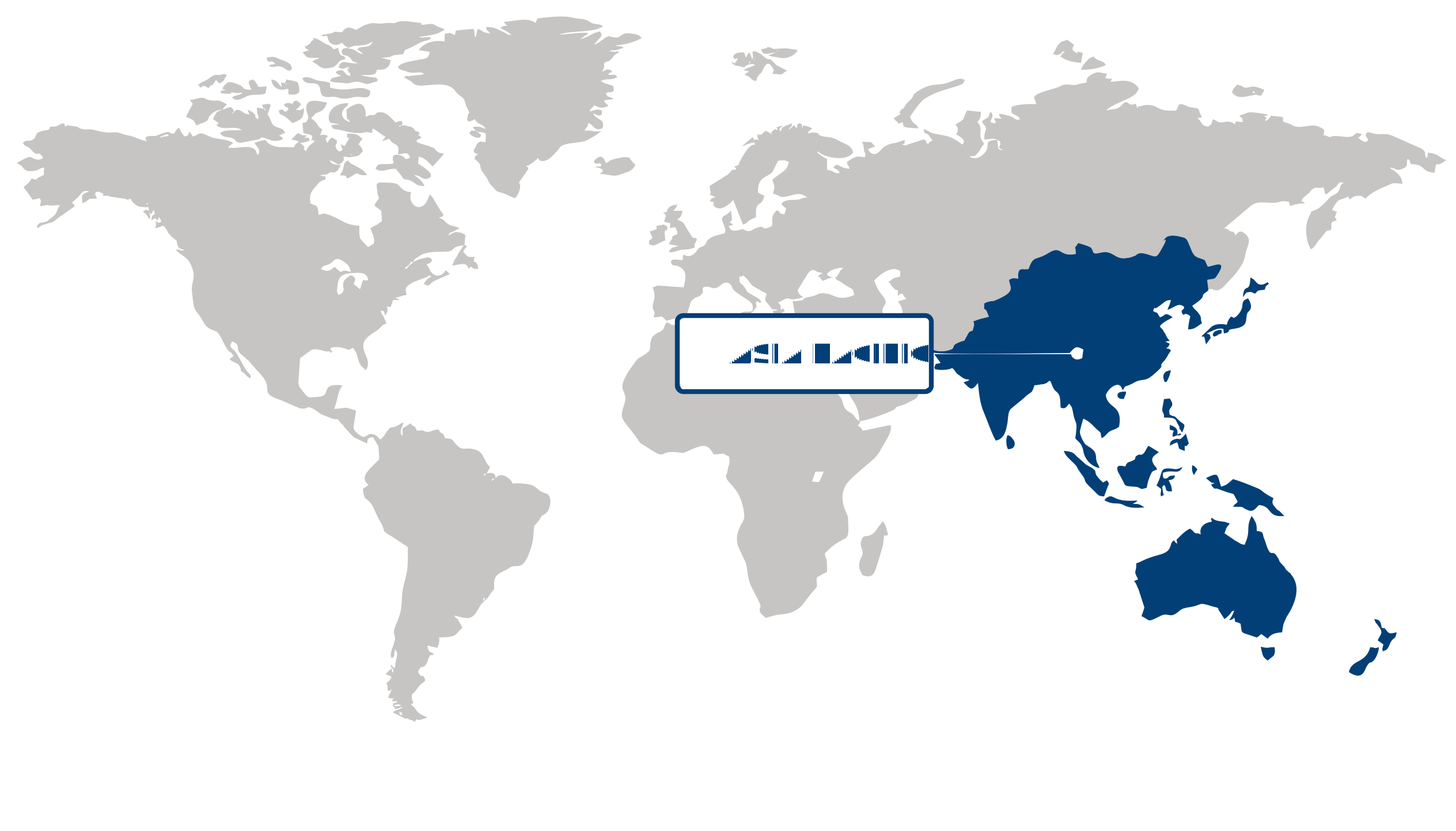
Asia Pacific (Largest Region)
The feed binders market was led by Asia Pacific, which held the largest share in 2026. The region’s strong position is supported by its extensive livestock and aquaculture production base, rising demand for efficient animal nutrition, and increasing emphasis on feed quality and animal health. Expanding commercial farming operations and the modernization of feed manufacturing infrastructure are encouraging greater adoption of binders to improve feed durability, reduce wastage, and support consistent nutritional delivery. Growing awareness of feed efficiency and the need for cost-effective production are further strengthening regional demand.
North America (Fastest-Growing Region)
North America is positioned as the fastest-growing region, supported by advanced livestock farming practices, greater adoption of technologically enhanced feed formulations, and continued investment in animal nutrition. The region’s mature commercial feed industry and strong focus on improving feed performance are creating favorable conditions for binder adoption. Increasing attention to feed safety, production efficiency, and sustainable livestock management is also encouraging producers to incorporate functional feed additives that can enhance pellet quality and operational performance.
| Parameter | North America | Asia Pacific | Europe | Latin America | MEA |
|---|---|---|---|---|---|
| Innovation Hub i Scale Nascent Developing Advanced | |||||
| Cost-Sensitive Region i Scale Low Medium High | |||||
| Regulatory Environment i Scale Restrictive Neutral Supportive | |||||
| Demand Drivers i Scale Weak Moderate Strong | |||||
| Development Stage i Scale Emerging Developing Developed | |||||
| Adoption Rate i Scale Low Medium High | |||||
| New Entrants / Startups i Scale Sparse Moderate Dense | |||||
| Macro Indicators i Scale Weak Stable Strong |
Key Country Insights
United States 🇺🇸
Feed efficiency optimizationIn the U.S., feed binders are widely used in large-scale livestock production to improve pellet quality, reduce feed wastage, and enhance nutrient retention. The market is driven by commercial feed mill integration and a strong focus on optimizing feed conversion efficiency in intensive farming systems.
Germany 🇩🇪
Regulated additive usageIn Germany, feed binders are adopted under strict regulatory frameworks emphasizing safety and traceability in animal nutrition. The market prioritizes certified formulations that support feed stability while aligning with environmental and livestock welfare standards.
Japan 🇯🇵
Quality livestock nutritionIn Japan, feed binders are integrated into high-quality livestock diets where consistency and digestibility are key priorities. The market reflects strong demand for precision-formulated feed products supporting premium meat and dairy production systems.
South Korea 🇰🇷
Compound feed adoptionIn South Korea, feed binders are increasingly used in compound feed manufacturing to improve pellet durability and reduce nutrient loss during handling. Adoption is closely linked to intensification of livestock operations and standardized feed production practices.
France 🇫🇷
Aromatic feed formulationsIn France, feed binders are incorporated into specialized feed formulations that balance texture stability with palatability for livestock. The market emphasizes controlled formulation practices aligned with diverse cattle and poultry production systems.
Italy 🇮🇹
Specialty livestock dietsIn Italy, feed binders are used in niche livestock diets where feed structure and quality consistency support regional animal husbandry practices. Demand is shaped by small-to-medium producers focusing on differentiated feed performance outcomes.
Segment Leadership and Growth Trends
Feed Binders Market Share (%), by Source, 2026
Go beyond the chart, access full insights & data tables
Request Free Sample ReportSource Segment Analysis: Natural (Largest Segment) vs Synthetic (Fastest-Growing Segment)
The natural source segment led the feed binders market with a 62.4% share in 2026. Its dominance is primarily attributed to the growing preference for naturally derived feed ingredients that align with evolving livestock nutrition and feed quality requirements. Natural binders are widely utilized because they improve pellet durability and feed stability while supporting consumer and industry demand for ingredients perceived as safer and more sustainable. Their broad acceptance across multiple livestock categories has reinforced the segment’s leading position.
The synthetic source segment is experiencing the fastest growth due to increasing demand for binders that offer consistent performance and enhanced feed manufacturing efficiency. Synthetic solutions can provide improved binding characteristics under specific processing conditions, making them attractive for large-scale feed production. As feed manufacturers focus on optimizing production processes and feed quality, adoption of synthetic binders is gaining momentum.
Type Segment Analysis: Plant Gums & Starches (Largest Segment) vs Lignosulfonates (Fastest-Growing Segment)
The plant gums and starches segment dominated the feed binders market and accounted for 27% of the market share in 2026. This segment benefits from the widespread availability of plant-based raw materials and their effectiveness in improving feed pellet integrity. Feed manufacturers frequently utilize these binders because they support pellet formation while fitting well within the growing preference for naturally sourced feed ingredients. Their versatility across various feed formulations has further strengthened their market position.
The lignosulfonates segment is emerging as the fastest-growing category due to its strong binding performance and suitability for high-volume feed production. These binders are increasingly adopted in commercial feed manufacturing because they help improve pellet strength and reduce feed wastage during transportation and handling. Rising emphasis on production efficiency and feed quality is contributing to the expansion of the lignosulfonates segment.
Livestock Segment Analysis: Poultry (Largest Segment) vs Aquaculture (Fastest-Growing Segment)
The poultry segment held the largest share of the feed binders market in 2026. Its leading position is supported by the substantial global demand for poultry products and the large-scale production systems used within the industry. Feed binders play an important role in maintaining feed quality and consistency, which are critical for supporting efficient poultry production. The high consumption of compound feed within the poultry sector continues to drive demand for binder solutions.
The aquaculture segment is witnessing the fastest growth as fish and shrimp farming operations increasingly require specialized feed formulations with enhanced water stability. Feed binders are essential in aquaculture because they help maintain pellet integrity and reduce nutrient loss in aquatic environments. The ongoing expansion of aquaculture production and rising demand for high-quality aquatic feed are supporting strong growth in this segment.
| Segment | Sub-Segment | Largest Segment | Fastest Growing |
|---|---|---|---|
| Source | Natural, Synthetic | Natural | Synthetic |
| Type | Lignosulfonates, Plant Gums & Starches, Gelatin, Molasses, Clays, Others | Plant Gums & Starches | Lignosulfonates |
| Livestock | Poultry, Aquaculture, Swine, Pet, Others | Poultry | Aquaculture |
Competitive Landscape and Market Positioning
Prominent players in the feed binders market:
- Adisseo (France)
- Archer Daniels Midland Company (USA)
- Cargill Incorporated (USA)
- BASF SE (Germany)
- DSM-Firmenich AG (Netherlands)
- DuPont de Nemours, Inc. (USA)
- Alltech, Inc. (USA)
- Kemin Industries, Inc. (USA)
- Borregaard ASA (Norway)
- Novus International, Inc. (USA)
The feed binders market is evolving as suppliers compete around formulation performance, animal nutrition outcomes, and compatibility with changing livestock production practices. Producers are moving beyond basic binding functionality by developing solutions that support feed quality, processing efficiency, and broader nutritional objectives. Established participants are leveraging formulation expertise and distribution capabilities, while specialized providers are creating differentiation through targeted solutions for specific feed applications. Competitive positioning is increasingly determined by the ability to support producers seeking consistent feed performance, operational efficiency, and improved livestock management outcomes.
| Company | Market Share | Company Revenue | Revenue CAGR (%) | Product Portfolio | Geographic Presence | Innovation / R&D Focus | Strategic Developments |
|---|---|---|---|---|---|---|---|
| Adisseo (France) | |||||||
| Archer Daniels Midland Company (USA) | |||||||
| Cargill Incorporated (USA) | |||||||
| BASF SE (Germany) | |||||||
| DSM-Firmenich AG (Netherlands) | |||||||
| DuPont de Nemours Inc. (USA) | |||||||
| Alltech Inc. (USA) | |||||||
| Kemin Industries Inc. (USA) | |||||||
| Borregaard ASA (Norway) | |||||||
| Novus International Inc. (USA) |
Industry Development/News
| Company Name | Date | Key Development |
|---|---|---|
| DSM-Firmenich | Sep-24 | The European Union approved DSM-Firmenich's next-generation phytase, HiPhorius, featuring state-of-the-art formulation technology designed to protect enzyme activity during high-temperature feed processing such as pelleting up to 95°C. This specialized granulate binder formulation is integral to achieving enhanced thermal stability in animal nutrition applications. |
| Kemin Industries | May-22 | Kemin Industries expanded its operational footprint by opening new offices and a distribution center in Mexico dedicated to Kemin Animal Nutrition. This strategic expansion aims to enhance regional service delivery and provide customized solutions tailored to the local animal nutrition market. |
| Cargill | Apr-22 | Cargill executed a major facility expansion at its Global Animal Nutrition Center in the United States backed by a USD 50 million investment. The capital allocation funded the construction of a new dairy innovation unit and an advanced research and development center to bolster animal nutrition capabilities. |
| Darling Ingredients Inc. | Jan-20 | Darling Ingredients Inc. acquired the remaining 50% joint venture stake in EnviroFlight, LLC from Intrexon Corporation, successfully bringing its total ownership interest to 100%. This consolidation strengthens the company's positioning within the alternative nutrition and feed ingredients sector. |
| ADM | Apr-19 | ADM significantly expanded its manufacturing capacity by opening a new high-tech livestock feed facility in Quincy, Illinois, United States. The operational investment strengthens the company's animal nutrition capabilities to better serve customers across aquaculture and broader livestock industries. |
| Ingredion Incorporated | Mar-19 | Ingredion Incorporated acquired Washington State-based potato starch producer Western Polymer to scale up its specialty starch manufacturing footprint. The strategic transaction expands the company's regional processing capabilities and strengthens its ingredient production portfolio. |
Customize Your Report
Explore examples of how this report can be tailored to different research needs, including custom segments, additional topics or chapters, and related reports. Click a section of the wheel or its numbered marker to explore the available options.
Feed Binders Market — Custom Segments
| Segment | Sub-Segment |
|---|---|
| Animal Growth Stage | Starter, Grower, Finisher, Adult/Maintenance |
| Buyer Type | Feed Manufacturers, Livestock Producers, Feed Mills & Cooperatives, Feed Additive Distributors |
| Feed Format | Pelleted Feed, Mash Feed, Crumbled Feed, Liquid Feed |
Feed Binders Market — Custom TOC
| Custom Chapter | Custom Details |
|---|---|
| Sustainable Feed Ingredient Integration Outlook |
|
| Feed Mill Procurement & Purchasing Strategy |
|
| Specialty Feed Additive Positioning Analysis |
|
Need a different cut of the data?
Request Custom ResearchHow much revenue does the feed binders market generate?
How much is the feed binders industry expected to grow by 2036?
How is the focus on feed efficiency driving the feed binders market?
Why are sustainable livestock practices increasing demand for natural feed binders?
Which livestock segment generates the highest demand for feed binders?
What is fueling the rapid growth of aquaculture in the feed binders market?
Why does Asia Pacific lead the feed binders market?
How is North America driving faster feed binders market growth?
What are the prominent companies operating in the feed binders landscape?
Our Clients
"The report provided a thorough look at market trends, technological advancements, and the competitive landscape. The depth of insights was really valuable."
ITC Limited
"We would highly recommend Fundamental Business Insights & Consulting to anyone looking for reliable, detailed, and comprehensive market research in the Food industry."
Tyson Foods
"The clarity and presentation of the information were commendable. The report was delivered timely, which made the overall experience smooth and convenient."
Mondelēz International
Our Research Team & Methodology
Every Fundamental Business Insights report is built by a dedicated vertical research team, validated through a structured primary-and-secondary methodology, and reviewed for accuracy before it reaches you.
Research Team Overview
Prepared by the Food & Beverage Research Team
Delivery
Published
Demand
Available
Support
Trust & Compliance
Research Domains
10 coverage areasResearch Intelligence
| Source | Reference |
|---|---|
| Food and Agriculture Organization (FAO) | www.fao.org |
| World Health Organization (WHO) | www.who.int |
| U.S. Food & Drug Administration (FDA) | www.fda.gov |
| European Food Safety Authority (EFSA) | www.efsa.europa.eu |
| U.S. Department of Agriculture (USDA) | www.usda.gov |
| Codex Alimentarius Commission | www.fao.org/fao-who-codexalimentarius |
| International Organization for Standardization (ISO) | www.iso.org |
| AOAC INTERNATIONAL | www.aoac.org |
| Institute of Food Technologists (IFT) | www.ift.org |
| International Dairy Foods Association (IDFA) | www.idfa.org |
| International Sweeteners Association (ISA) | www.sweeteners.org |
| International Probiotics Association (IPA) | internationalprobiotics.org |
| Good Food Institute (GFI) | gfi.org |
| American Feed Industry Association (AFIA) | www.afia.org |
| International Feed Industry Federation (IFIF) | ifif.org |
| Specialty Food Association (SFA) | www.specialtyfood.com |
| Brewers Association | www.brewersassociation.org |
| International Bottled Water Association (IBWA) | bottledwater.org |
| International Alliance for Dietary/Food Supplement Associations (IADSA) | www.iadsa.org |
| OECD Agriculture & Food | www.oecd.org/agriculture |
Research Workflow & Quality Assurance
Data Collection
Verified information gathered through primary and secondary research.
Data Triangulation
Cross-validation using multiple independent data sources.
Forecast Modelling
Market estimates developed using historical trends and analytical models.
Analyst Validation
Findings reviewed by domain experts for accuracy and consistency.
Editorial & Quality Review
Final editorial, quality, and compliance checks before publication.
Final Publication
Released after successful completion of the internal review process.
Report Coverage
📊 Market Assessment
- Market Size & Forecast
- Market Segmentation
- Regional Analysis
- Growth Drivers & Challenges
- Market Dynamics
🏢 Competitive Intelligence
- Competitive Landscape
- Company Profiles
- Competitive Benchmarking
- Mergers & Acquisitions
- Market Share Analysis or Key Company Strategies
🔍 Strategic Analysis
- Value Chain Analysis
- Porter's Five Forces
- PESTLE Analysis
- Pricing Trends
- Supply-Demand Analysis
🚀 Future Outlook
- Technology Landscape
- Regulatory Landscape
- Investment & Funding Landscape
- Emerging Opportunities
- Future Market Outlook
Have a question about this report or need a custom scope?
Request Customization