Energy-Efficient Materials Market Size & Growth Forecast 2027–2036, By Segments (End-use, Product Type, Distribution Channel), Regional Demand Trends (North America, Asia Pacific, Europe), Key Country Insights (U.S., Japan, South Korea, Germany, France, Italy), and Competitive Landscape
Market Size and Growth Outlook
Energy-Efficient Materials Market size was over USD 18.29 Billion in 2026 and is likely to grow at 9.12% CAGR between 2027 and 2036, crossing USD 43.78 Billion by 2036. The industry revenue for 2027 is calculated at USD 19.71 Billion.
Get more details on this report
Request Free Sample ReportEnergy-Efficient Materials Market Intelligence Snapshot
Regional Market Dynamics
- Europe held the largest share in 2026, supported by stringent environmental policies, energy-efficiency standards, decarbonization initiatives, and sustainable infrastructure modernization.
- Asia Pacific is the fastest-growing region, driven by rapid urbanization, industrial expansion, construction investment, and rising demand for energy-saving infrastructure.
Segment Momentum
- Building & construction held a 42.12% market share in 2026 as energy-efficient materials improve insulation, reduce heat transfer, and lower heating and cooling energy requirements across residential, commercial, and industrial buildings.
- Automotive & transportation is the fastest-growing end-use segment as manufacturers increasingly adopt energy-efficient materials for lightweight construction, improved thermal management, and enhanced vehicle energy performance.
Market Expansion Drivers
- Rising energy and utility costs accelerating adoption of high-performance energy-efficient building materials
- Stringent green building regulations and incentives driving sustainable construction material integration
- Advancements in thermal insulation and smart material technologies improving building energy optimization
Leading Market Participants
- Key players in the energy-efficient materials market include Saint-Gobain S.A. (France), Owens Corning (USA), PPG Industries Inc. (USA), Rockwool A/S (Denmark), Knauf Insulation (Germany), Johns Manville (USA), Nippon Sheet Glass Co., Ltd. (Japan), AGC Inc. (Japan), 3B-the fibreglass company (Belgium)
Global Market Forecast Snapshot
Market Outlook
- 2026 Market Size: USD 18.29 Billion
- 2027 Estimated Market Size: USD 19.71 Billion
- Projected Market Size: USD 43.78 Billion by 2036
- Growth Forecast: 9.12% CAGR (2027-2036)
Regional and Segment Outlook
- Leading Regional Market: Europe
- High-Growth Regional Hub: Asia Pacific
- Core Revenue Segment: Building & Construction (End-use) | Spray Foam (Product Type) | Offline (Distribution Channel)
- Emerging Opportunity Segment: Automotive & Transportation (End-use) | Spray Foam (Product Type) | Online (Distribution Channel)
Market Growth Drivers and Industry Trends
Rising energy and utility costs accelerating adoption of high-performance energy-efficient building materials
Escalating energy and utility expenses are encouraging property owners, developers, and facility managers to prioritize materials that improve building efficiency and reduce long-term operating costs. The energy-efficient materials market growth is driven by increasing demand for advanced construction materials that minimize heat transfer, improve thermal performance, and reduce dependence on heating and cooling systems. Residential, commercial, and industrial construction projects are placing greater emphasis on lifecycle cost optimization, leading to wider adoption of high-performance insulation, energy-efficient glazing, reflective roofing products, and other materials designed to enhance building performance while lowering ongoing energy consumption.
Stringent green building regulations and incentives driving sustainable construction material integration
Governments and regulatory bodies are strengthening sustainability standards by introducing building codes, certification frameworks, and financial incentives that encourage environmentally responsible construction practices. These regulatory developments will propel the energy-efficient materials market growth as builders increasingly incorporate materials that support improved energy performance, reduced environmental impact, and compliance with evolving efficiency requirements. The growing adoption of green building certifications has also prompted architects and project developers to select construction materials that contribute to resource conservation, improved indoor environmental quality, and long-term operational efficiency across both new developments and renovation projects.
Advancements in thermal insulation and smart material technologies improving building energy optimization
Continuous innovation in material science is enabling the development of insulation products and intelligent building materials with enhanced thermal management capabilities. Within the energy-efficient materials market, these technological advancements improve building energy optimization by enabling more effective temperature regulation, reducing thermal losses, and adapting to changing environmental conditions. Smart materials capable of responding to heat, light, or moisture variations are also expanding design flexibility for modern buildings, allowing construction professionals to integrate energy-saving functionality without compromising structural performance or architectural requirements.
| Growth Driver | Impact on CAGR | Regulatory Influence | Geographic Relevance | Adoption Rate | Impact Timeline |
|---|---|---|---|---|---|
| Rising energy and utility costs accelerating adoption of high-performance energy-efficient building materials | 2.4% | High | Europe, North America | High | Near Term |
| Stringent green building regulations and incentives driving sustainable construction material integration | 2.2% | High | Europe, Asia Pacific | High | Mid Term |
| Advancements in thermal insulation and smart material technologies improving building energy optimization | 2% | High | North America, Asia Pacific | Medium | Mid Term |
Unlock insights tailored to your business with our bespoke market research solutions.
Click to get your customized report now.
Regional Demand Dynamics
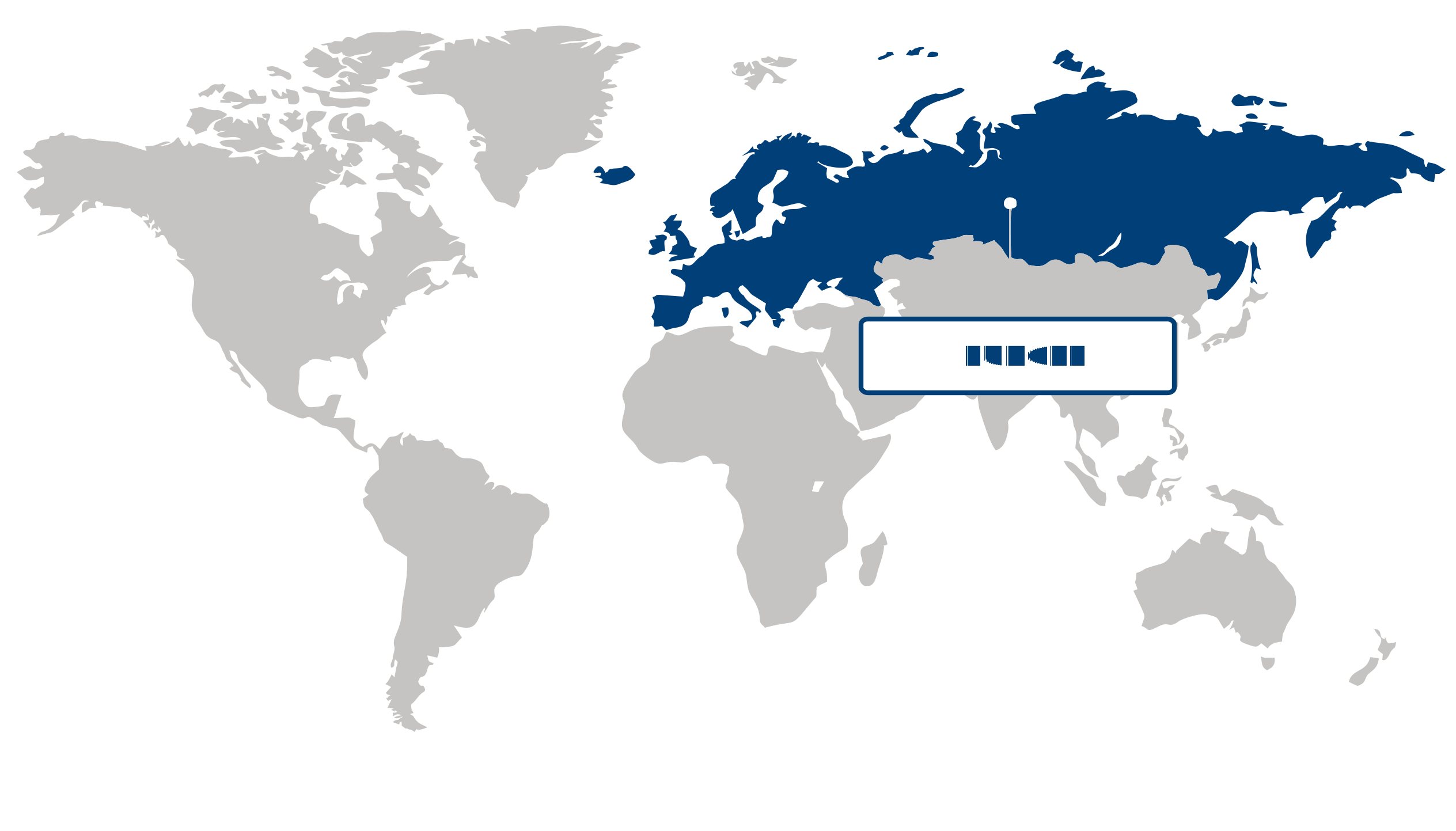
Europe (Largest Region)
Europe held the largest share of the energy-efficient materials market in 2026, underpinned by stringent environmental policies, strong energy-efficiency standards, and growing efforts to reduce energy consumption across buildings and industrial operations. Demand for high-performance insulation, energy-saving construction materials, and efficient material solutions is being reinforced by decarbonization initiatives and the modernization of aging infrastructure. The region’s emphasis on sustainable construction and lower-carbon industrial processes is encouraging businesses and infrastructure developers to incorporate energy-efficient materials into new projects as well as renovation activities.
Asia Pacific (Fastest-Growing Region)
Asia Pacific represents the fastest-growing regional market as rapid urbanization, industrial expansion, and rising construction activity increase the need for materials that can improve energy performance. Growing investment in residential, commercial, and industrial infrastructure is creating broader applications for advanced insulation, reflective materials, and other energy-saving solutions. In addition, increasing awareness of energy conservation and the need to manage rising cooling and heating requirements are encouraging governments, developers, and industries across the region to adopt materials that support more efficient and sustainable infrastructure.
| Parameter | North America | Asia Pacific | Europe | Latin America | MEA |
|---|---|---|---|---|---|
| Innovation Hub i Scale Nascent Developing Advanced | |||||
| Cost-Sensitive Region i Scale Low Medium High | |||||
| Regulatory Environment i Scale Restrictive Neutral Supportive | |||||
| Demand Drivers i Scale Weak Moderate Strong | |||||
| Development Stage i Scale Emerging Developing Developed | |||||
| Adoption Rate i Scale Low Medium High | |||||
| New Entrants / Startups i Scale Sparse Moderate Dense | |||||
| Macro Indicators i Scale Weak Stable Strong |
Key Country Insights
United States 🇺🇸
Advanced Building InnovationThe U.S. is accelerating adoption of energy-efficient materials across commercial construction, industrial facilities, and residential retrofits. Manufacturers are prioritizing high-performance insulation, low-carbon materials, and products that align with evolving energy efficiency standards and sustainability targets.
Germany 🇩🇪
Industrial Efficiency FocusGermany emphasizes energy-efficient materials that improve manufacturing efficiency and building performance while supporting decarbonization initiatives. Demand is centered on durable solutions compatible with stringent engineering specifications and circular economy practices.
Japan 🇯🇵
Space-Optimized SolutionsJapan prioritizes energy-efficient materials that maximize thermal performance within compact residential and commercial spaces. Suppliers are developing lightweight, high-performance materials that complement renovation projects and advanced construction technologies.
South Korea 🇰🇷
Smart Infrastructure IntegrationSouth Korea is incorporating energy-efficient materials into smart buildings and infrastructure developments to improve operational efficiency. Local demand favors innovative materials that integrate with digital construction methods and sustainable urban development strategies.
France 🇫🇷
Sustainable Renovation DemandFrance is strengthening demand for energy-efficient materials through building renovation programs and environmental construction requirements. Suppliers are expanding product portfolios that enhance thermal efficiency while meeting increasingly stringent sustainability expectations.
Italy 🇮🇹
Heritage Retrofit ApplicationsItaly focuses on energy-efficient materials suitable for modernizing existing buildings while preserving architectural integrity. Manufacturers are offering adaptable insulation and façade solutions that balance efficiency improvements with renovation requirements.
Segment Leadership and Growth Trends
Energy-Efficient Materials Market Share (%), by End-use, 2026
Go beyond the chart, access full insights & data tables
Request Free Sample ReportEnd-use Segment Analysis: Building & Construction (Largest Segment) vs Automotive & Transportation (Fastest-Growing Segment)
The building & construction segment accounted for the largest share of the energy-efficient materials market in 2026, representing 42.12%. Its leading position is supported by the widespread need to reduce energy consumption in residential, commercial, and industrial buildings through improved insulation and thermal performance. Energy-efficient materials can help minimize heat transfer, improve indoor comfort, and reduce the energy required for heating and cooling systems. Growing attention to sustainable building practices, energy conservation, and the development of more efficient structures is encouraging the adoption of advanced materials across the construction sector, reinforcing its central role in the market.
Automotive & transportation is expected to be the fastest-growing end-use segment, driven by the industry's increasing focus on improving energy efficiency and reducing vehicle weight and environmental impact. Advanced energy-efficient materials can contribute to improved thermal management, lightweight vehicle construction, and enhanced overall performance, supporting their adoption across evolving transportation technologies. The transition toward electrified mobility is further strengthening demand for materials that improve battery efficiency, thermal control, and vehicle energy consumption. These trends are creating favorable conditions for accelerated adoption across automotive and transportation applications.
Product Type Segment Analysis: Spray Foam (Largest & Fastest-Growing Segment)
The spray foam segment led the energy-efficient materials market in 2026, holding a 34.34% share, and is also the fastest-growing product type. Its strong position is attributed to its ability to provide effective thermal insulation while filling gaps, cracks, and irregular spaces that can otherwise contribute to energy loss. Spray foam can create continuous insulation layers that improve building envelope performance and help reduce heating and cooling requirements. Its versatility across new construction and retrofit applications, combined with increasing demand for energy-efficient buildings and improved indoor comfort, continues to drive adoption. Growing awareness of energy conservation and the need to improve building efficiency further support the segment's sustained market momentum.
Distribution Channel Segment Analysis: Offline (Largest Segment) vs Online (Fastest-Growing Segment)
Offline channels held the largest share of the energy-efficient materials market in 2026, reflecting the importance of physical distribution networks for products that often require technical evaluation, professional guidance, and project-specific selection. Contractors, builders, installers, and other buyers frequently rely on established suppliers and distributors to assess material suitability, availability, installation requirements, and performance characteristics. The established relationships between manufacturers, distributors, and construction professionals continue to support offline purchasing, particularly for large-scale building and infrastructure projects.
The online segment is anticipated to be the fastest-growing distribution channel, supported by increasing digitalization across procurement and construction supply chains. Online platforms provide buyers with convenient access to product information, technical specifications, comparisons, and purchasing options, simplifying the process of evaluating energy-efficient materials. Digital channels also broaden product accessibility beyond traditional geographic markets and support more efficient sourcing for contractors, businesses, and individual consumers. As buyers become increasingly comfortable with online research and purchasing, digital distribution is gaining importance in the energy-efficient materials industry.
| Segment | Sub-Segment | Largest Segment | Fastest Growing |
|---|---|---|---|
| End-use | Building & Construction, Automotive & Transportation, Energy & Utilities, Consumer Electronics, Others | Building & Construction | Automotive & Transportation |
| Product Type | Fiberglass, Mineral Wool, Cellulose, Spray Foam, Expanded Polystyrene (EPS), Extruded Polystyrene (XPS), Others | Spray Foam | Spray Foam |
| Distribution Channel | Online, Offline | Offline | Online |
Competitive Landscape and Market Positioning
Prominent players in the energy-efficient materials market:
- Saint-Gobain S.A. (France)
- Owens Corning (USA)
- PPG Industries, Inc. (USA)
- Rockwool A/S (Denmark)
- Knauf Insulation (Germany)
- Johns Manville (USA)
- Nippon Sheet Glass Co., Ltd. (Japan)
- AGC, Inc. (Japan)
- 3B-the fibreglass company (Belgium)
Market rivalry is increasingly influenced by how effectively suppliers combine material performance with sustainability objectives and regulatory compliance across diverse end-use industries. Demand from construction, transportation, industrial manufacturing, and energy applications is encouraging manufacturers to broaden product portfolios that improve thermal efficiency, reduce resource consumption, and integrate into existing production systems without significant design changes. Differentiation is also emerging through lifecycle performance, certification capabilities, and technical support, as customers place greater emphasis on long-term operational value rather than evaluating materials solely on initial procurement considerations.
| Company | Market Share | Company Revenue | Revenue CAGR (%) | Product Portfolio | Geographic Presence | Innovation / R&D Focus | Strategic Developments |
|---|---|---|---|---|---|---|---|
| Saint-Gobain S.A. (France) | |||||||
| Owens Corning (USA) | |||||||
| PPG Industries Inc. (USA) | |||||||
| Rockwool A/S (Denmark) | |||||||
| Knauf Insulation (Germany) | |||||||
| Johns Manville (USA) | |||||||
| Nippon Sheet Glass Co. Ltd. (Japan) | |||||||
| AGC Inc. (Japan) | |||||||
| 3B-the fibreglass company (Belgium) |
Industry Development/News
| Company Name | Date | Key Development |
|---|---|---|
| Knauf Insulation | Apr-25 | Knauf Insulation expanded its "Performance+" portfolio to include specialized pipe and tank fiberglass insulation. As the only formaldehyde-free, asthma- and allergy-friendly certified solution for industrial piping, this launch addresses critical energy-efficiency needs in industrial temperature control and infrastructure protection. |
| Standard Bank | Mar-25 | Standard Bank secured USD 250 million in funding from the International Finance Corporation to catalyze green housing projects across South Africa. The investment provides critical capital for developers to overcome financial barriers in constructing energy-efficient, sustainable residential units, significantly expanding market access for high-performance building materials. |
| Knauf Insulation | Dec-24 | Knauf Insulation expanded its "Performance+" portfolio to the residential market, introducing thermal and acoustical fiberglass insulation. Unveiled at the ICAA Convention, this product line is certified asthma- and allergy-friendly, further driving the adoption of healthier, sustainable materials in residential building envelopes. |
| Onx Homes | Jul-24 | Onx Homes expanded its portfolio of energy-efficient residential developments in Central Florida with a 200-home community project. By integrating high-efficiency appliances and sustainable residential designs as standard features, the company demonstrates the commercial scalability of energy-efficient building practices in the mass-market residential sector. |
| Atlas Copco Vacuum | May-24 | Atlas Copco Vacuum implemented a high-efficiency vacuum system at Isola’s Norwegian manufacturing facility. The installation optimizes the production process for insulation, roofing membranes, and sealing products, directly enhancing the operational energy efficiency of the manufacturing line for materials critical to energy-efficient construction. |
| Knauf Insulation | May-24 | Knauf Insulation launched its "Performance+" HVAC fiberglass insulation line, the first formaldehyde-free and asthma- and allergy-friendly certified product of its kind. The product innovation establishes a new technical standard for indoor air quality and sustainable material composition in HVAC infrastructure. |
| Owens Corning | Aug-21 | Owens Corning launched its "PINK Next Gen" Fiberglas insulation, utilizing advanced fiber technology to improve handling and installation speed by approximately 23%. The innovation represents a material advancement in manufacturing and application efficiency for thermal insulation products within the construction sector. |
Customize Your Report
Explore examples of how this report can be tailored to different research needs, including custom segments, additional topics or chapters, and related reports. Click a section of the wheel or its numbered marker to explore the available options.
Energy-Efficient Materials Market — Custom Segments
| Segment | Sub-Segment |
|---|---|
| Building Energy Performance Level | Standard Efficiency, High Efficiency, Near-Zero Energy, Net-Zero Energy |
| Project Lifecycle Stage | New Construction, Major Renovation, Retrofit/Upgrade, Maintenance & Replacement |
| Installation Method | Site-Built Installation, Prefabricated/Modular Installation, Spray-Applied Installation, Loose-Fill/Blown Installation |
Energy-Efficient Materials Market — Custom TOC
| Custom Chapter | Custom Details |
|---|---|
| Embodied Carbon Reduction Strategies |
|
| Green Building Material Adoption Pathways |
|
| Retrofit Demand for Energy-Efficient Materials |
|
Need a different cut of the data?
Request Custom ResearchWhat is the market valuation of energy-efficient materials?
What are the growth projections for the energy-efficient materials industry?
How are rising energy costs changing material selection in construction projects?
Why are regulations and smart material innovations accelerating energy-efficient material adoption?
Why does the building & construction segment dominate the energy-efficient materials market?
Why is the automotive & transportation segment growing the fastest?
Why does Europe lead the energy-efficient materials market?
How is Asia Pacific driving growth in energy-efficient materials?
Which companies dominate the energy-efficient materials landscape?
Our Clients
"Your insights on workforce structures were spot-on. The analysis on mid-to-senior level roles validated some of our hiring decisions and highlighted gaps."
Ateliers De France
"The report gave us insights on competitors in the market. It helped our team refine our bidding strategy for upcoming contracts."
Clark Construction
"The reports provided a deep dive into market trends, and competitive landscape. The strategic insights and recommendations have been very helpful."
Rudolph and Sletten
Our Research Team & Methodology
Every Fundamental Business Insights report is built by a dedicated vertical research team, validated through a structured primary-and-secondary methodology, and reviewed for accuracy before it reaches you.
Research Team Overview
Prepared by the Construction & Manufacturing Research Team
Delivery
Published
Demand
Available
Support
Trust & Compliance
Research Domains
10 coverage areasResearch Intelligence
| Source | Reference |
|---|---|
| International Organization for Standardization (ISO) | www.iso.org |
| ASTM International | www.astm.org |
| National Institute of Standards and Technology (NIST) | www.nist.gov |
| International Code Council (ICC) | www.iccsafe.org |
| American Concrete Institute (ACI) | www.concrete.org |
| American Institute of Steel Construction (AISC) | www.aisc.org |
| Construction Industry Institute (CII) | www.construction-institute.org |
| Associated General Contractors of America (AGC) | www.agc.org |
| Association of Equipment Manufacturers (AEM) | www.aem.org |
| Building Owners and Managers Association (BOMA) | www.boma.org |
| American Society of Civil Engineers (ASCE) | www.asce.org |
| National Ready Mixed Concrete Association (NRMCA) | www.nrmca.org |
| International Facility Management Association (IFMA) | www.ifma.org |
| World Green Building Council (WorldGBC) | worldgbc.org |
| International Federation of Consulting Engineers (FIDIC) | fidic.org |
| International Labour Organization (ILO) | www.ilo.org |
| American Society of Mechanical Engineers (ASME) | www.asme.org |
| Society of Manufacturing Engineers (SME) | www.sme.org |
| National Association of Home Builders (NAHB) | www.nahb.org |
| European Construction Industry Federation (FIEC) | www.fiec.eu |
Research Workflow & Quality Assurance
Data Collection
Verified information gathered through primary and secondary research.
Data Triangulation
Cross-validation using multiple independent data sources.
Forecast Modelling
Market estimates developed using historical trends and analytical models.
Analyst Validation
Findings reviewed by domain experts for accuracy and consistency.
Editorial & Quality Review
Final editorial, quality, and compliance checks before publication.
Final Publication
Released after successful completion of the internal review process.
Report Coverage
📊 Market Assessment
- Market Size & Forecast
- Market Segmentation
- Regional Analysis
- Growth Drivers & Challenges
- Market Dynamics
🏢 Competitive Intelligence
- Competitive Landscape
- Company Profiles
- Competitive Benchmarking
- Mergers & Acquisitions
- Market Share Analysis or Key Company Strategies
🔍 Strategic Analysis
- Value Chain Analysis
- Porter's Five Forces
- PESTLE Analysis
- Pricing Trends
- Supply-Demand Analysis
🚀 Future Outlook
- Technology Landscape
- Regulatory Landscape
- Investment & Funding Landscape
- Emerging Opportunities
- Future Market Outlook
Have a question about this report or need a custom scope?
Request Customization