Electronic Thermal Management Materials Market Size & Forecasts 2026-2035, By Segments (Product, End-Use Industry), Growth Opportunities, Innovation Landscape, Regulatory Shifts, Strategic Regional Insights (U.S., Japan, China, South Korea, UK, Germany, France), and Competitive Dynamics (3M, DuPont, Henkel, Laird, Parker Hannifin)
Market Size and Growth Outlook
Electronic Thermal Management Materials Market size is forecasted to reach USD 18.57 billion by 2035, rising from USD 7.7 billion in 2025, at a CAGR of more than 9.2% between 2026 and 2035. In 2026, revenue is projected at USD 8.32 billion.
Get more details on this report
Request Free Sample ReportElectronic Thermal Management Materials Market Intelligence Snapshot
Regional Market Dynamics
Segment Momentum
Market Expansion Drivers
Leading Market Participants
Global Market Forecast Snapshot
Market Outlook
Regional and Segment Outlook
Market Growth Drivers and Industry Trends
This rising demand has intensified performance requirements across the electronic thermal management materials market, as thinner smartphones and denser server racks force tighter thermal budgets. Apple product disclosures and Google’s public documentation on data center cooling highlight real-world pressure to improve thermal conductivity and thin-form-factor TIMs, while Tesla’s battery thermal management updates illustrate automotive needs. This trend favors incumbents like 3M and Henkel with established supply chains and formulation expertise, and creates entry points for specialty startups offering rapid prototyping and niche chemistries. Expect procurement-driven consolidation and closer OEM-supplier partnerships as companies prioritize validated, scalable solutions over experimental chemistries.
Technological advancements in phase-change and PCM materials
Advances in phase-change and PCM materials are expanding design options in the electronic thermal management materials market by enabling passive, reversible heat buffering in confined spaces. Oak Ridge National Laboratory research and BASF’s commercial formulations demonstrate movement from lab prototypes to industrial-grade PCM assemblies for battery modules and consumer devices. These improvements reduce integration risk for OEMs and create licensing, toll-manufacturing, and co-development opportunities for material suppliers and startups focused on encapsulation and cycling stability. Firms that invest in supply-chain qualification and accelerated, application-specific testing will capture early share as PCM performance metrics standardize.
Adoption in EVs, data centers, and consumer electronics
Growing adoption across EVs, hyperscale data centers, and consumer electronics is creating predictable demand corridors that shape the electronic thermal management materials market; Tesla’s thermal systems work, Amazon Web Services’ data center cooling initiatives, and Apple’s device thermal strategies exemplify this pull. Policy drivers such as European Commission electrification targets and investments by Microsoft and NVIDIA in high-performance compute are tightening specifications and increasing procurement scale. Incumbents can scale through OEM programs and integrated supply agreements, while new entrants can differentiate via application-specific solutions for batteries, server cold plates, or foldables—validated through partner pilots and joint qualification pathways.
Industry Restraints:
Regulatory Compliance Burdens: Tightening chemical, safety and materials standards imposed by regulators such as the European Chemicals Agency (ECHA) under REACH, the European Commission’s RoHS directives, and heightened scrutiny by the U.S. Environmental Protection Agency (EPA) increase development complexity for thermal management materials. Mandatory testing, documentation and restricted substance substitutions raise formulation and certification costs and extend time-to-market, while Underwriters Laboratories (UL) flammability and performance standards add further validation steps. Larger incumbents can absorb these compliance investments, but smaller suppliers and startups face a higher barrier to entry and slower commercialization. Given active rulemaking at ECHA and the EPA and evolving UL requirements, compliance costs and material substitution cycles will remain a primary constraint in the near to medium term.
Supply Chain Vulnerabilities: Dependency on concentrated suppliers and geopolitically sensitive upstream inputs—highlighted by analyses from the World Economic Forum on global supply-chain fragility and export controls enforced by the Bureau of Industry and Security (U.S. Department of Commerce)—constrains availability and lead times for key thermal interface and phase-change materials supplied by firms such as 3M. Disruptions force higher inventory, dual-sourcing or qualification of alternate chemistries, increasing working capital and qualification timelines. Incumbent OEMs can mitigate risk through scale and long-term contracts; new entrants confront longer qualification cycles and customer distrust. With WEF warnings and ongoing export control regimes, manufacturers will continue pursuing regionalization and resilient sourcing strategies through the medium term.
| Growth Driver | Impact on CAGR | Regulatory Influence | Geographic Relevance | Adoption Rate | Impact Timeline |
|---|---|---|---|---|---|
| Rising demand for thermal interface and heat dissipation materials | 3.50% | Short term (≤ 2 yrs) | North America, Asia Pacific | Medium | Fast |
| Technological advancements in phase-change and PCM materials | 3.00% | Medium term (2–5 yrs) | Europe, North America | Medium | Moderate |
| Adoption in EVs, data centers, and consumer electronics | 2.70% | Long term (5+ yrs) | Asia Pacific, Europe; Spillover: North America | Low | Slow |
Unlock insights tailored to your business with our bespoke market research solutions.
Click to get your customized report now.
Regional Demand Dynamics
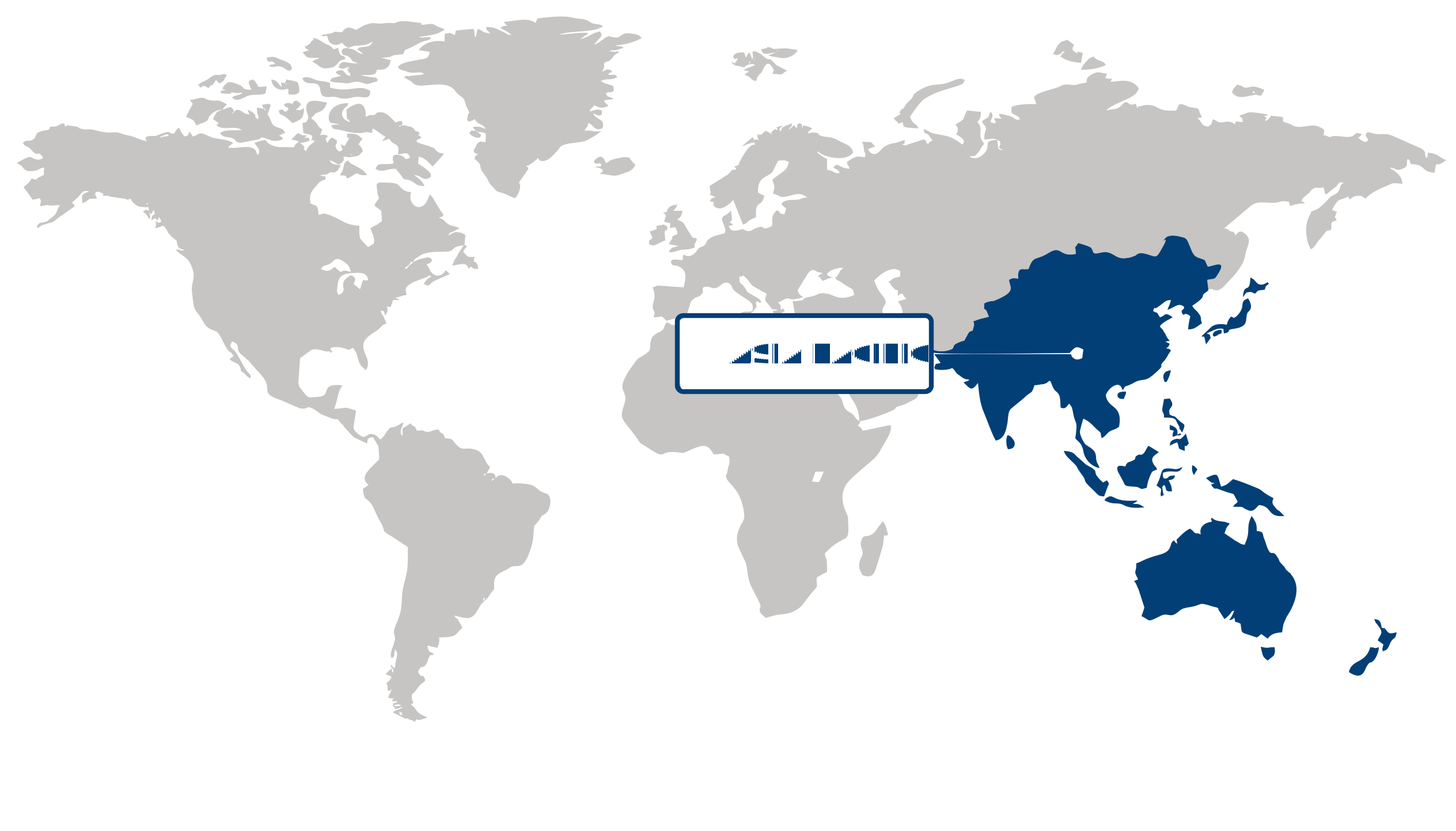
Captured approximately 49.38% of the global market in 2025 and, at a 10.5% CAGR, Asia Pacific is the largest and fastest-growing region for the electronic thermal management materials market. This leadership is driven by dense electronics clusters (TSMC, Foxconn Technology Group) and an EV production ramp-up (BYD, CATL) that together create concentrated demand for advanced thermal interface materials, phase change materials and heat spreaders; policy signals from the Ministry of Industry and Information Technology (China) and the Ministry of Economy, Trade and Industry (Japan) further accelerate investment. Sources such as the International Energy Agency and corporate releases from BYD and TSMC illustrate both scale and technology intensity, making the region fertile for premium material suppliers and integrated solutions providers.
Japan is positioned as a pivotal hub in Asia Pacific for the electronic thermal management materials market, leveraging high-precision semiconductor packaging and automotive-tier expertise. Domestic players like DENSO and supply-chain commitments from Toyota Motor Corporation drive demand for high-reliability thermal solutions tailored to automotive electronics and power modules, while METI initiatives support advanced materials R&D. Corporate press releases from DENSO and Toyota highlight product-level innovation and supplier partnerships, implying that Japan will continue setting quality and specification benchmarks that regional suppliers must meet to capture premium segments.
China anchors Asia Pacific's expansion in the electronic thermal management materials market, supplying volume and fast time-to-market for EVs and consumer electronics. Large manufacturers such as BYD, NIO and Foxconn Technology Group, combined with policy backing from the Ministry of Industry and Information Technology and demand statistics from the China Association of Automobile Manufacturers, are accelerating adoption of cost-effective thermal materials across battery packs and power electronics. For investors and suppliers, China offers scale-oriented opportunities to optimize unit economics while co-developing product platforms for export across Asia Pacific.
North America Market Analysis:
North America held a commanding share in the electronic thermal management materials market, driven by concentrated demand from advanced semiconductor fabs, EV supply chains, and hyperscale data centers. Strong policy support such as the CHIPS and Science Act (U.S. Department of Commerce) and corporate investment by firms like Intel and Google have accelerated onshore capacity, raising demand for high-performance TIMs, gap fillers, and phase-change materials; 3M and Parker Hannifin press releases document expanded product lines to serve these needs. Regulatory emphasis on energy efficiency (U.S. Department of Energy) and automakers’ electrification roadmaps (Tesla corporate disclosures) further bias procurement toward higher-reliability, lower-emissions solutions. These dynamics, coupled with established supply-chain hubs and R&D ecosystems, make North America a durable center for premium thermal-material adoption and innovation.
United States remains the principal national market in the electronic thermal management materials market, reflecting concentration of semiconductor fabs, EV manufacturing, and cloud infrastructure. Federal incentives under the CHIPS and Science Act (U.S. Department of Commerce) and DOE grants for energy-efficient data centers (U.S. Department of Energy) are stimulating procurement of advanced thermal interfaces; Intel and Google public statements highlight packaging and cooling upgrades tied to these programs. Automotive electrification and OEM sourcing strategies—illustrated in Tesla product and supply disclosures—drive demand for battery thermal management materials and adhesives. For investors and strategists, the U.S. market’s policy-backed capital spending and lead-customer base create near-term commercialization pathways that reinforce broader North American leadership.
Europe Market Trends:
Experienced moderate growth, North America’s electronic thermal management materials market has sustained a notable presence driven by expanding EV fleets, hyperscale data centers, and electrification across industrial segments. Demand has been reinforced by efficiency and sustainability priorities cited in U.S. Department of Energy (DOE) programs and National Renewable Energy Laboratory (NREL) research on thermal control for power electronics, while product launches from 3M and Henkel highlight supplier innovation in thermal interface materials. Logistical resilience around nearshoring and supply-chain diversification has been visible in corporate disclosures, and regulatory nudges from the U.S. Environmental Protection Agency (EPA) toward energy efficiency are reshaping procurement. These dynamics position the region for measured expansion as OEMs and data-center operators adopt higher-performance, lower-emissions thermal solutions.
As the innovation leader, the United States’ electronic thermal management materials market benefits from concentrated R&D and early adopter demand, especially in data centers and EV powertrains. U.S. Department of Energy (DOE) funding streams and National Institute of Standards and Technology (NIST) engagements have accelerated qualification pathways, while product roadmaps from NVIDIA and Intel underscore rising cooling intensity in high-performance computing. Corporate press releases from large OEMs demonstrate procurement shifts toward advanced TIMs and phase-change materials. Strategic implication: U.S. demand for validated, scalable materials creates an addressable market for suppliers that can pair performance with certification and supply reliability, amplifying North American opportunity.
A specialized manufacturing hub, Canada’s electronic thermal management materials market is shaped by clean-technology investments and automotive supply-chain depth. The Government of Canada’s funding programs for EV and battery ecosystems, combined with commercialization activities from Ballard Power Systems and Magna International, are increasing demand for thermal materials tailored to battery packs and fuel-cell systems. Industry announcements reveal collaboration between materials suppliers and OEMs on lightweight, thermally conductive solutions. Strategic implication: Canada’s policy-backed manufacturing expansion offers suppliers a gateway to regional volume contracts and co-development partnerships that strengthen North American market penetration.
| Parameter | North America | Asia Pacific | Europe | Latin America | MEA |
|---|---|---|---|---|---|
| Innovation Hub i Scale Nascent Developing Advanced | |||||
| Cost-Sensitive Region i Scale Low Medium High | |||||
| Regulatory Environment i Scale Restrictive Neutral Supportive | |||||
| Demand Drivers i Scale Weak Moderate Strong | |||||
| Development Stage i Scale Emerging Developing Developed | |||||
| Adoption Rate i Scale Low Medium High | |||||
| New Entrants / Startups i Scale Sparse Moderate Dense | |||||
| Macro Indicators i Scale Weak Stable Strong |
Segment Leadership and Growth Trends
Electronic Thermal Management Materials Market Share (%), by Product, 2026
Go beyond the chart, access full insights & data tables
Request Free Sample ReportGap Fillers represented largest share of the electronic thermal management materials market in 2025 within the Product segment, driven by rising demand for efficient thermal management in compact, high-performance electronic devices. Among segments, gap fillers lead because they provide conformal contact in tight tolerances and high‑conductivity paths favored in 3M and Henkel product literature and Intel engineering guidance; OEM priorities for miniaturization at Apple and Samsung and supply‑chain emphasis on qualified, low‑void materials further reinforce leadership. This creates advantages for established suppliers with scale and certifications and for innovators offering tailored chemistries, and continued device densification and rising chip power densities imply gap fillers will remain strategically important in the near to medium term.
Analysis by End-Use Industry
Consumer Electronics held largest share of the electronic thermal management materials market in 2025 in the End-Use Industry segment, propelled by increasing adoption of smartphones, laptops and wearables that demand robust thermal solutions. Among segments, consumer OEMs such as Apple and Samsung and chipset vendors like Qualcomm highlight thermal constraints in technical briefs and product announcements, and market signals from GSMA on device proliferation and European Commission energy efficiency rules shape supplier priorities. Customer preferences for thinner, longer‑lasting devices and rapid design cycles favor suppliers offering system integration or sustainable materials; incumbents can lock in OEM partnerships while agile entrants can win niche design‑ins, and continued proliferation of portable electronics supports ongoing relevance over the near to medium term.
| Segment | Sub-Segment | Largest Segment | Fastest Growing |
|---|---|---|---|
| Product | Conductive Pastes, Conductive Tapes, Phase Change Materials, Gap Fillers, Thermal Greases | ||
| End-Use Industry | Consumer Electronics, Automotive, Aerospace, Healthcare, Telecommunication |
Competitive Landscape and Market Positioning
The competitive environment shows the Top 10 broadening capabilities through selective portfolio expansion, deeper technical collaborations, and focused product roadmaps supported by sustained R&D and localized supply moves. These activities are driving differentiation around thermal performance, integration ease, and qualification speed, raising commercial thresholds for new entrants and pushing mid-tier suppliers toward specialization or cooperative models to remain relevant.
Strategic / Actionable Recommendations for Regional Players
North America: Prioritize co-development with hyperscalers, EV system integrators, and semiconductor OEMs to accelerate design-in of high-performance interface materials; pair this with pilot-scale production near customer clusters and targeted investments in advanced polymer and phase-change chemistries to convert technical wins into secured supply agreements.
Asia Pacific: Leverage proximity to EMS and chip fabrication hubs by offering accelerated qualification cycles, joint testing capabilities, and supply continuity; concentrate on scalable compound formulations and tighter engineering links with substrate and packaging suppliers to capture upstream design opportunities.
Europe: Focus on compliance-driven differentiated materials for automotive and industrial electronics, deepen collaboration with tier-one automotive suppliers and thermal module assemblers, and advance low-environmental-impact, recyclable thermal solutions to meet procurement and regulatory expectations.
| Company | Market Share | Company Revenue | Revenue CAGR (%) | Product Portfolio | Geographic Presence | Innovation / R&D Focus | Strategic Developments |
|---|---|---|---|---|---|---|---|
| No companies available. | |||||||
Industry Development/News
| Company Name | Date | Key Development |
|---|
Customize Your Report
Explore examples of how this report can be tailored to different research needs, including custom segments, additional topics or chapters, and related reports. Click a section of the wheel or its numbered marker to explore the available options.
Electronic Thermal Management Materials Market — Custom Segments
| Segment | Sub-Segment |
|---|---|
| No segment data available. | |
Electronic Thermal Management Materials Market — Custom TOC
| Custom Chapter | Custom Details | ||
|---|---|---|---|
| No custom TOC data available. | |||
Need a different cut of the data?
Request Custom ResearchWhat is the current revenue of the electronic thermal management materials market?
How is the electronic thermal management materials industry size expected to evolve during the forecast period?
Which part of the world represents the largest segment of the electronic thermal management materials market?
Which area is showing the greatest surge in electronic thermal management materials sector?
Why does gap fillers sub-segment dominate the product segment of electronic thermal management materials sector?
How does consumer electronics segment fare in the electronic thermal management materials industry?
Which companies are driving growth in the electronic thermal management materials landscape?
Our Clients
"Working with FBI has been a good experience. The market report provided a holistic view, covering everything from emerging trends to potential risks."
Semtech Corporation
"The experience was highly positive. The team showcased remarkable flexibility in adapting to our specific needs and delivered report that perfectly aligned with all our requirements."
TSMC
"What really stood out to me was how clearly and promptly the Fundamental Business Insights team communicated throughout. It made the collaboration feel effortless."
NXP Semiconductors
Our Research Team & Methodology
Every Fundamental Business Insights report is built by a dedicated vertical research team, validated through a structured primary-and-secondary methodology, and reviewed for accuracy before it reaches you.
Research Team Overview
Prepared by the Electronics & Semiconductors Research Team
Delivery
Published
Demand
Available
Support
Trust & Compliance
Research Domains
10 coverage areasResearch Intelligence
| Source | Reference |
|---|---|
| Semiconductor Industry Association (SIA) | www.semiconductors.org |
| SEMI | www.semi.org |
| JEDEC Solid State Technology Association | www.jedec.org |
| IEEE | www.ieee.org |
| IPC – Association Connecting Electronics Industries | www.ipc.org |
| International Electrotechnical Commission (IEC) | www.iec.ch |
| International Organization for Standardization (ISO) | www.iso.org |
| U.S. Bureau of Industry and Security (BIS) | www.bis.gov |
| U.S. Patent and Trademark Office (USPTO) | www.uspto.gov |
| European Patent Office (EPO) | www.epo.org |
| Taiwan Semiconductor Industry Association (TSIA) | www.tsia.org.tw |
| World Semiconductor Trade Statistics (WSTS) | www.wsts.org |
| International Energy Agency (IEA) | www.iea.org |
| GSMA | www.gsma.com |
| 3GPP | www.3gpp.org |
| ITU (International Telecommunication Union) | www.itu.int |
| Omdia (public insights) | omdia.tech.informa.com |
| Display Supply Chain Consultants (DSCC) | www.displaysupplychain.com |
| U.S. Department of Energy (DOE) | www.energy.gov |
| NIST (National Institute of Standards and Technology) | www.nist.gov |
Research Workflow & Quality Assurance
Data Collection
Verified information gathered through primary and secondary research.
Data Triangulation
Cross-validation using multiple independent data sources.
Forecast Modelling
Market estimates developed using historical trends and analytical models.
Analyst Validation
Findings reviewed by domain experts for accuracy and consistency.
Editorial & Quality Review
Final editorial, quality, and compliance checks before publication.
Final Publication
Released after successful completion of the internal review process.
Report Coverage
📊 Market Assessment
- Market Size & Forecast
- Market Segmentation
- Regional Analysis
- Growth Drivers & Challenges
- Market Dynamics
🏢 Competitive Intelligence
- Competitive Landscape
- Company Profiles
- Competitive Benchmarking
- Mergers & Acquisitions
- Market Share Analysis or Key Company Strategies
🔍 Strategic Analysis
- Value Chain Analysis
- Porter's Five Forces
- PESTLE Analysis
- Pricing Trends
- Supply-Demand Analysis
🚀 Future Outlook
- Technology Landscape
- Regulatory Landscape
- Investment & Funding Landscape
- Emerging Opportunities
- Future Market Outlook
Have a question about this report or need a custom scope?
Request Customization