Electric Vehicle Battery Testing Market Size & Growth Forecast 2027–2036, By Segments (Sourcing, Testing, Vehicle, Propulsion, End Use), Regional Demand Trends (North America, Asia Pacific, Europe), Key Country Insights (U.S., Japan, South Korea, Germany, France, Italy), and Competitive Landscape
Market Size and Growth Outlook
Electric Vehicle Battery Testing Market size was valued at USD 1.46 Billion in 2026 and is projected to grow at 15.81% CAGR from 2027 to 2036, attaining USD 6.34 Billion by 2036. The industry revenue for 2027 is estimated at USD 1.66 Billion.
Get more details on this report
Request Free Sample ReportElectric Vehicle Battery Testing Market Intelligence Snapshot
Regional Market Dynamics
- Asia Pacific led in 2026, supported by strong EV manufacturing, expanding battery production, and rising requirements for safety, durability, performance validation, and quality assurance.
- Growing EV infrastructure and investments in battery technologies are increasing demand for comprehensive testing across battery development and manufacturing processes.
Segment Momentum
- Performance testing accounted for 41.04% of the market in 2026 and is also the fastest-growing segment, driven by the need to evaluate battery efficiency, driving range, charging capability, reliability, and overall product quality.
- Commercial vehicles are the fastest-growing segment as fleet electrification increases demand for rigorous battery testing to support larger battery packs, demanding operating conditions, and extended utilization cycles.
Market Expansion Drivers
- Expanding EV production globally increasing demand for high-volume battery validation systems
- Stringent safety and regulatory standards driving advanced battery compliance and certification testing
- Increasing battery energy density and complexity requiring advanced diagnostic and stress testing solutions
Leading Market Participants
- Top companies in the electric vehicle battery testing market include SGS S.A. (Switzerland), Bureau Veritas S.A. (France), DEKRA SE (Germany), TÜV SÜD AG (Germany), Intertek Group plc (United Kingdom), UL Solutions Inc. (United States), Applus+ (Spain), DNV AS (Norway), Element Materials Technology (United Kingdom), AVL List GmbH (Austria)
Global Market Forecast Snapshot
Market Outlook
- 2026 Market Size: USD 1.46 Billion
- 2027 Estimated Market Size: USD 1.66 Billion
- Projected Market Size: USD 6.34 Billion by 2036
- Growth Forecast: 15.81% CAGR (2027-2036)
Regional and Segment Outlook
- Leading Regional Market: Asia Pacific
- High-Growth Regional Hub: Asia Pacific
- Core Revenue Segment: In-house (Sourcing) | Performance Testing (Testing) | Passenger Vehicles (Vehicle) | Battery Electric Vehicles (BEV) (Propulsion) | Automotive OEMs (End Use)
- Emerging Opportunity Segment: Outsourcing (Sourcing) | Performance Testing (Testing) | Commercial Vehicles (Vehicle) | Battery Electric Vehicles (BEV) (Propulsion) | Third-party Testing Service Providers (End Use)
Market Growth Drivers and Industry Trends
Expanding EV production globally increasing demand for high-volume battery validation systems
The expansion of electric vehicle manufacturing is expected to drive the electric vehicle battery testing market growth as battery producers and automotive manufacturers increase investments in scalable validation infrastructure. Higher production volumes require efficient testing systems capable of evaluating battery cells, modules, and packs throughout development and manufacturing stages without creating operational bottlenecks. Automated validation platforms help maintain consistent product quality by identifying performance deviations before batteries are integrated into vehicles. The growing diversity of battery chemistries and vehicle platforms further increases the need for flexible testing solutions that can support multiple production programs under standardized quality procedures.
Stringent safety and regulatory standards driving advanced battery compliance and certification testing
Evolving regulatory frameworks and safety requirements are accelerating the electric vehicle battery testing market by increasing the importance of comprehensive compliance and certification processes. Battery systems must undergo extensive evaluation for electrical performance, thermal behavior, mechanical durability, and operational reliability before commercial deployment. Advanced testing laboratories support manufacturers by verifying that products satisfy industry standards while reducing the risk of safety-related failures during real-world operation. Regulatory compliance also encourages continuous improvements in testing methodologies, prompting greater adoption of sophisticated equipment capable of reproducing demanding environmental and operational conditions.
Increasing battery energy density and complexity requiring advanced diagnostic and stress testing solutions
Rising battery performance expectations will boost the electric vehicle battery testing market demand as higher energy density designs require increasingly sophisticated diagnostic capabilities. Modern battery systems incorporate advanced materials, complex electronic controls, and integrated battery management technologies that must be evaluated under a broad range of operating scenarios. Stress testing, lifecycle analysis, thermal diagnostics, and failure detection techniques enable manufacturers to understand battery behavior under demanding conditions while supporting product optimization and quality assurance. These advanced testing approaches provide deeper insights into long-term performance characteristics and interactions among multiple battery system components.
| Growth Driver | Impact on CAGR | Regulatory Influence | Geographic Relevance | Adoption Rate | Impact Timeline |
|---|---|---|---|---|---|
| Expanding EV production globally increasing demand for high-volume battery validation systems | 2% | High | Asia Pacific, North America, Europe | High | Near Term |
| Stringent safety and regulatory standards driving advanced battery compliance and certification testing | 1.9% | High | Europe, North America, Asia Pacific | High | Near Term |
| Increasing battery energy density and complexity requiring advanced diagnostic and stress testing solutions | 1.7% | Moderate | Asia Pacific, Europe | High | Mid Term |
Unlock insights tailored to your business with our bespoke market research solutions.
Click to get your customized report now.
Regional Demand Dynamics
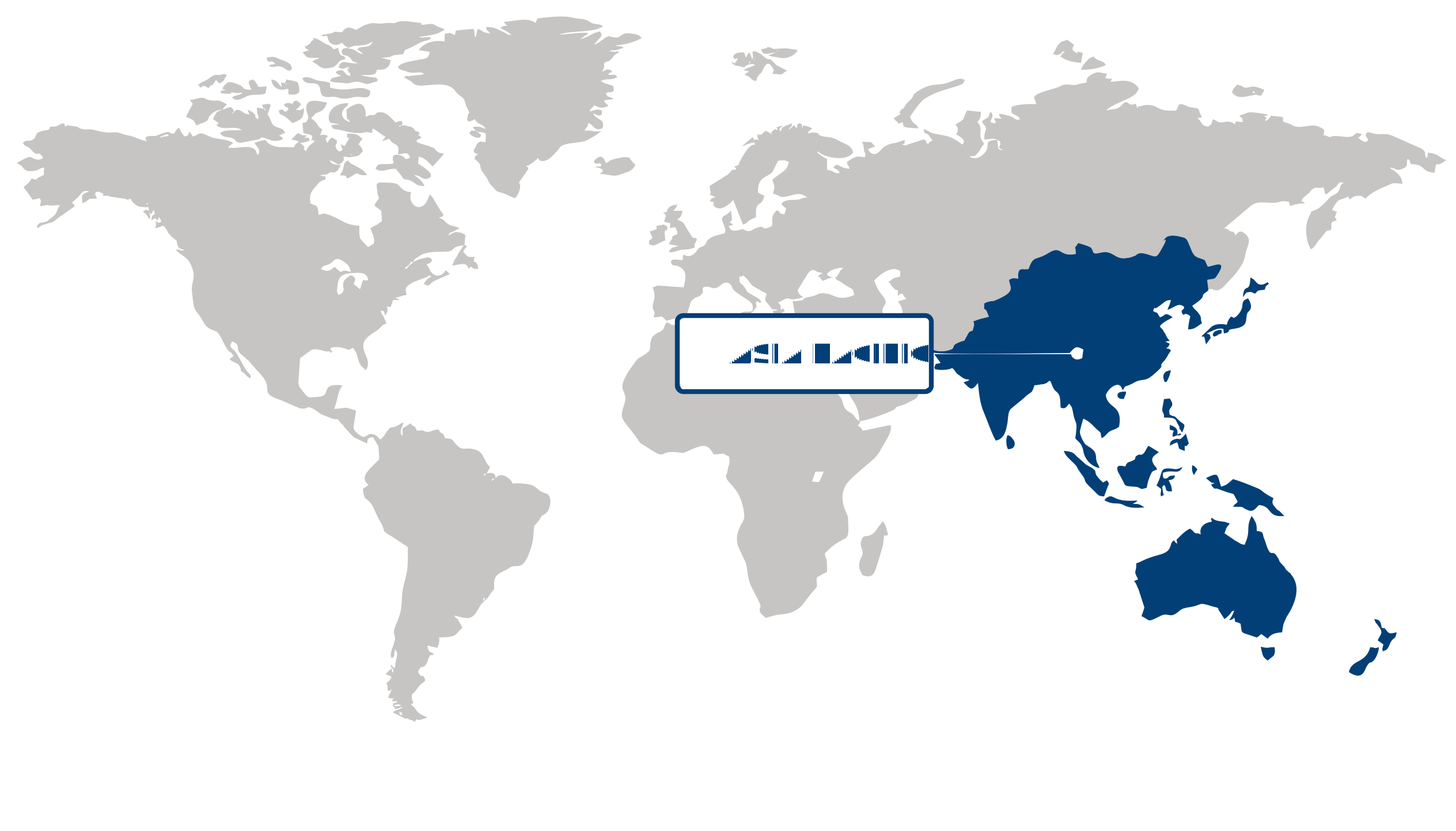
Asia Pacific (Largest & Fastest-Growing Region)
The electric vehicle battery testing market was led by Asia Pacific, which held the largest share in 2026 and is also expected to register the fastest growth. The region benefits from a strong electric vehicle manufacturing ecosystem and increasing emphasis on battery safety, reliability, durability, and performance validation. Expanding battery production and continued development of advanced energy storage technologies are driving greater requirements for testing across development and manufacturing processes. In addition, growing investments in electric mobility infrastructure and battery technology are supporting demand for comprehensive testing capabilities, positioning Asia Pacific as a key regional market for battery validation and quality assurance.
| Parameter | North America | Asia Pacific | Europe | Latin America | MEA |
|---|---|---|---|---|---|
| Innovation Hub i Scale Nascent Developing Advanced | |||||
| Cost-Sensitive Region i Scale Low Medium High | |||||
| Regulatory Environment i Scale Restrictive Neutral Supportive | |||||
| Demand Drivers i Scale Weak Moderate Strong | |||||
| Development Stage i Scale Emerging Developing Developed | |||||
| Adoption Rate i Scale Low Medium High | |||||
| New Entrants / Startups i Scale Sparse Moderate Dense | |||||
| Macro Indicators i Scale Weak Stable Strong |
Key Country Insights
United States 🇺🇸
Advanced Validation ProgramsThe U.S. electric vehicle battery testing market is expanding through investments in battery safety validation and performance certification. Manufacturers are increasing laboratory capabilities to evaluate durability, thermal performance, and compliance with evolving industry requirements.
Germany 🇩🇪
Manufacturing Quality AssuranceGermany prioritizes battery testing solutions that support automotive manufacturing quality and product reliability. Companies are strengthening validation processes for battery cells, modules, and packs to improve production consistency and regulatory compliance.
Japan 🇯🇵
Battery Reliability AssessmentJapan focuses on comprehensive battery testing that supports long-term reliability and product safety. Manufacturers are investing in advanced testing methods to optimize battery lifespan, charging performance, and consistent operation across demanding applications.
South Korea 🇰🇷
High-Volume Testing CapabilitySouth Korea continues expanding electric vehicle battery testing capacity alongside domestic battery manufacturing. Companies are emphasizing automated testing systems that accelerate validation while maintaining consistent quality across large-scale production programs.
France 🇫🇷
Certification and ComplianceFrance is reinforcing electric vehicle battery testing activities to support certification and evolving regulatory expectations. Testing organizations are enhancing capabilities for safety verification, lifecycle assessment, and battery performance evaluation across electric mobility applications.
Italy 🇮🇹
Battery Performance VerificationItaly is increasing adoption of battery testing technologies that support electric vehicle manufacturing and component development. Companies are prioritizing accurate performance verification and durability assessment to strengthen product quality and supply chain confidence.
Segment Leadership and Growth Trends
Electric Vehicle Battery Testing Market Share (%), by Sourcing, 2026
Go beyond the chart, access full insights & data tables
Request Free Sample ReportSourcing Segment Analysis: In-house (Largest Segment) vs Outsourcing (Fastest-Growing Segment)
Holding the largest share of the electric vehicle battery testing market, the in-house sourcing segment accounted for 61.48% in 2026. Automotive manufacturers and battery developers continue to prioritize internal testing capabilities to maintain tighter control over product quality, intellectual property, and compliance with evolving safety standards. In-house facilities also enable faster validation during battery development cycles, improve coordination between engineering teams, and support rapid product optimization before commercial deployment.
Outsourcing is emerging as the fastest-growing sourcing segment as manufacturers increasingly collaborate with specialized testing laboratories to access advanced equipment and technical expertise without significant capital investment. Rising battery innovation, expanding testing requirements across multiple chemistries, and the need for independent certification are encouraging companies to rely on external service providers for specialized validation and regulatory assessments.
Testing Segment Analysis: Performance Testing (Largest & Fastest-Growing Segment)
Performance testing dominated the electric vehicle battery testing market with a 41.04% share in 2026 and also represents the fastest-growing testing segment. The increasing emphasis on battery efficiency, driving range, charging capability, and long-term reliability has made performance evaluation a critical step throughout battery development and production. As manufacturers continue introducing higher-capacity batteries and advanced cell technologies, demand for comprehensive performance testing is accelerating to ensure consistent quality, optimize energy output, and strengthen consumer confidence in electric vehicles.
Vehicle Segment Analysis: Passenger Vehicles (Largest Segment) vs Commercial Vehicles (Fastest-Growing Segment)
Passenger vehicles held the largest share of the segment in 2026. Strong consumer adoption of electric passenger cars, expanding model portfolios, and continuous improvements in battery technology have significantly increased testing requirements for safety, durability, and operational performance. Manufacturers are also investing heavily in validation processes to meet evolving regulatory standards while enhancing vehicle reliability and driving experience.
Commercial vehicles represent the fastest-growing segment as fleet electrification gains momentum across logistics, public transportation, and industrial operations. Larger battery packs, demanding operating conditions, and extended utilization cycles require more rigorous testing protocols, driving greater demand for advanced battery testing solutions tailored to commercial vehicle applications.
| Segment | Sub-Segment | Largest Segment | Fastest Growing |
|---|---|---|---|
| Sourcing | In-house, Outsourcing | In-house | Outsourcing |
| Testing | Performance Testing, Safety Testing, Lifecycle Testing, Others | Performance Testing | Performance Testing |
| Vehicle | Passenger Vehicles, Commercial Vehicles | Passenger Vehicles | Commercial Vehicles |
| Propulsion | Battery Electric Vehicles (BEV), Plug-in Hybrid Electric Vehicles (PHEV), Hybrid Electric Vehicles (HEV) | Battery Electric Vehicles (BEV) | Battery Electric Vehicles (BEV) |
| End Use | Automotive OEMs, Battery Manufacturers, Research and Development Institutes, Third-party Testing Service Providers | Automotive OEMs | Third-party Testing Service Providers |
Competitive Landscape and Market Positioning
Major players in the electric vehicle battery testing market:
- SGS S.A. (Switzerland)
- Bureau Veritas S.A. (France)
- DEKRA SE (Germany)
- TÜV SÜD AG (Germany)
- Intertek Group plc (United Kingdom)
- UL Solutions, Inc. (United States)
- Applus+ (Spain)
- DNV AS (Norway)
- Element Materials Technology (United Kingdom)
- AVL List GmbH (Austria)
Rapid advances in battery chemistry and pack architecture are shifting competitive emphasis toward testing platforms capable of adapting to evolving validation requirements without extensive infrastructure changes. Service providers and equipment developers are expanding capabilities in performance characterization, durability assessment, and safety validation to support increasingly complex battery technologies across development and production stages. Greater reliance on digital data acquisition, automated testing workflows, and predictive analytics is also redefining customer expectations, with laboratories and manufacturers seeking faster insight while maintaining rigorous testing consistency. This environment favors organizations that combine technical flexibility with deep application knowledge across diverse battery technologies.
| Company | Market Share | Company Revenue | Revenue CAGR (%) | Product Portfolio | Geographic Presence | Innovation / R&D Focus | Strategic Developments |
|---|---|---|---|---|---|---|---|
| SGS S.A. (Switzerland) | |||||||
| Bureau Veritas S.A. (France) | |||||||
| DEKRA SE (Germany) | |||||||
| TÜV SÜD AG (Germany) | |||||||
| Intertek Group plc (United Kingdom) | |||||||
| UL Solutions Inc. (United States) | |||||||
| Applus+ (Spain) | |||||||
| DNV AS (Norway) | |||||||
| Element Materials Technology (United Kingdom) | |||||||
| AVL List GmbH (Austria) |
Industry Development/News
| Company Name | Date | Key Development |
|---|---|---|
| Battery OK Technologies | Sep-25 | Battery OK Technologies launched "EV DOCTOR AIR," a subscription-based, AI-powered diagnostic solution for electric vehicle batteries. The platform provides a scalable and cost-effective method for assessing battery health, offering universal compatibility for rapid diagnostics outside of traditional laboratory testing environments. |
| GÖPEL electronic | Jun-25 | GÖPEL electronic introduced a modular high-voltage battery test bench designed for functional evaluation and safety assurance of EV battery packs. Optimized for both automotive R&D and high-volume production environments, the system enhances the efficiency of quality assurance processes for battery cells and modules. |
| UL Solutions | May-25 | UL Solutions opened its Europe Advanced Battery Testing Laboratory in Aachen, Germany, to support the growing testing demand for electric vehicle batteries and large-scale energy storage systems. This facility significantly expands the company’s capacity to deliver testing and certification services within the European market. |
| SGS | Dec-24 | SGS expanded its battery testing infrastructure in suburban Detroit, Michigan, with a 60,000-square-foot facility. The $45 million investment integrates advanced extreme-temperature environmental chambers and mechanical abuse testing systems capable of simultaneously validating up to 500 battery packs in compliance with UN Regulation 100.03 standards. |
| Bureau Veritas | Nov-24 | Bureau Veritas established a five-year strategic partnership with a leading European automotive OEM to provide end-to-end battery testing services. The agreement features a dedicated on-site laboratory and embedded engineering teams, marking a transition toward long-term, integrated service models that prioritize deep technical collaboration over traditional transactional testing approaches. |
| UL Solutions | Oct-24 | UL Solutions launched an advanced cybersecurity testing protocol specifically designed for battery management systems (BMS). The methodology assesses vulnerabilities related to firmware tampering, communication exploits, and denial-of-service attacks, ensuring that connected battery architectures meet evolving regulatory requirements and industry standards such as UN Regulation 155. |
| TÜV SÜD | Sep-24 | TÜV SÜD inaugurated a $30 million battery testing center in Suzhou, China, capable of supporting 1,000 simultaneous test channels. The facility incorporates AI-enabled analytics to accelerate lifecycle and durability validation, strengthening the organization's regional footprint in a key global hub for battery manufacturing and compliance. |
| Intertek | Jul-24 | Intertek launched a digital twin-based battery testing platform that integrates physical testing with computational modeling. By leveraging machine learning validated against real-world test data, the solution enables the virtual simulation of extreme and unsafe battery scenarios, effectively reducing product validation timelines by 30–40 percent. |
Customize Your Report
Explore examples of how this report can be tailored to different research needs, including custom segments, additional topics or chapters, and related reports. Click a section of the wheel or its numbered marker to explore the available options.
Electric Vehicle Battery Testing Market — Custom Segments
| Segment | Sub-Segment |
|---|---|
| Battery Testing Stage | Cell Testing, Module Testing, Pack Testing, Vehicle-Level Testing |
| Battery Component Tested | Cells, Modules, Battery Packs, Battery Management Systems |
| Testing Environment | Laboratory Testing, Environmental and Climatic Testing, Vehicle and Road Testing, Simulation and Virtual Testing |
Electric Vehicle Battery Testing Market — Custom TOC
| Custom Chapter | Custom Details |
|---|---|
| EV Battery Testing Demand Roadmap |
|
| Testing Capacity Expansion Opportunities |
|
| Battery Certification Pathways |
|
Need a different cut of the data?
Request Custom ResearchWhat is the market size of electric vehicle battery testing?
What is the expected industry size of electric vehicle battery testing by 2036?
How is expanding EV production influencing investment in battery testing infrastructure?
Why is increasing battery complexity driving demand for advanced diagnostic testing?
Why is performance testing the leading testing segment in the electric vehicle battery testing market?
Which vehicle segment is expected to grow the fastest in the electric vehicle battery testing market?
Why is Asia Pacific leading the electric vehicle battery testing market?
What is driving battery testing growth in Asia Pacific?
Which organizations are considered leaders in the electric vehicle battery testing landscape?
Our Clients
"The team surpassed our expectations with the report depth. The actionable insights provided proved crucial in navigating market challenges."
Tata Motors
"We found the report to be very informative. The expertise and attention to market nuances significantly influenced our business direction."
DENSO Corporation
"The consumer survey findings were quite good. We now have a clearer picture of the customer churning and retention strategy."
HL Mando
Our Research Team & Methodology
Every Fundamental Business Insights report is built by a dedicated vertical research team, validated through a structured primary-and-secondary methodology, and reviewed for accuracy before it reaches you.
Research Team Overview
Prepared by the Automotive & Transportation Research Team
Delivery
Published
Demand
Available
Support
Trust & Compliance
Research Domains
10 coverage areasResearch Intelligence
| Source | Reference |
|---|---|
| International Organization of Motor Vehicle Manufacturers (OICA) | www.oica.net |
| SAE International | www.sae.org |
| International Energy Agency (IEA) | www.iea.org |
| International Transport Forum (ITF) | www.itf-oecd.org |
| International Road Federation (IRF) | www.irf.global |
| International Organization for Standardization (ISO) | www.iso.org |
| United Nations Economic Commission for Europe (UNECE) | unece.org |
| National Highway Traffic Safety Administration (NHTSA) | www.nhtsa.gov |
| U.S. Department of Transportation (USDOT) | www.transportation.gov |
| European Automobile Manufacturers' Association (ACEA) | www.acea.auto |
| Society of Indian Automobile Manufacturers (SIAM) | www.siam.in |
| International Air Transport Association (IATA) | www.iata.org |
| International Civil Aviation Organization (ICAO) | www.icao.int |
| International Maritime Organization (IMO) | www.imo.org |
| International Union of Railways (UIC) | uic.org |
| American Public Transportation Association (APTA) | www.apta.com |
| International Federation of Robotics (IFR) | ifr.org |
| CharIN | www.charin.global |
| World Shipping Council | www.worldshipping.org |
| International Federation of Freight Forwarders Associations (FIATA) | fiata.org |
Research Workflow & Quality Assurance
Data Collection
Verified information gathered through primary and secondary research.
Data Triangulation
Cross-validation using multiple independent data sources.
Forecast Modelling
Market estimates developed using historical trends and analytical models.
Analyst Validation
Findings reviewed by domain experts for accuracy and consistency.
Editorial & Quality Review
Final editorial, quality, and compliance checks before publication.
Final Publication
Released after successful completion of the internal review process.
Report Coverage
📊 Market Assessment
- Market Size & Forecast
- Market Segmentation
- Regional Analysis
- Growth Drivers & Challenges
- Market Dynamics
🏢 Competitive Intelligence
- Competitive Landscape
- Company Profiles
- Competitive Benchmarking
- Mergers & Acquisitions
- Market Share Analysis or Key Company Strategies
🔍 Strategic Analysis
- Value Chain Analysis
- Porter's Five Forces
- PESTLE Analysis
- Pricing Trends
- Supply-Demand Analysis
🚀 Future Outlook
- Technology Landscape
- Regulatory Landscape
- Investment & Funding Landscape
- Emerging Opportunities
- Future Market Outlook
Have a question about this report or need a custom scope?
Request Customization