Electric Tractor Market Size & Growth Forecast 2027–2036, By Segments (Battery, Power, Application, Drivetrain), Regional Demand Trends (North America, Asia Pacific, Europe), Key Country Insights (U.S., Japan, South Korea, Germany, France, Italy), and Competitive Landscape
Market Size and Growth Outlook
Electric Tractor Market size was estimated at USD 300.7 Million in 2026 and is projected to grow at 23.15% CAGR from 2027 to 2036, attaining USD 2.41 Billion by 2036. The industry revenue for 2027 is assessed at USD 362.13 Million.
Get more details on this report
Request Free Sample ReportElectric Tractor Market Intelligence Snapshot
Regional Market Dynamics
- Europe held the largest share in 2026, supported by environmental policies, sustainable agriculture initiatives, cleaner farming technologies, and established agricultural machinery infrastructure.
- Asia Pacific is the fastest-growing region, driven by agricultural modernization, mechanization, sustainable farming initiatives, smart farming adoption, and improving charging and energy infrastructure.
Segment Momentum
- The low power segment held a 50.88% share in 2026, driven by strong demand from small and medium-sized farms for cost-effective tractors used in routine agricultural operations.
- The industrial segment is growing fastest as organizations adopt electric tractors for material handling, logistics support, and utility operations to reduce costs and improve sustainability.
Market Expansion Drivers
- Environmental regulations accelerating electrification of agricultural tractor fleets globally
- Battery cost reductions and efficiency improvements enhancing electric farm equipment adoption
- Precision agriculture integration driving autonomous electric tractor deployment across farms
Leading Market Participants
- Prominent players in the electric tractor market include John Deere (Deere & Company) (USA), Kubota Corporation (Japan), CNH Industrial N.V. (United Kingdom), AGCO Corporation (USA), Yanmar Holdings Co., Ltd. (Japan), Mahindra & Mahindra Limited (India), CLAAS KGaA mbH (Germany), Solectrac Inc. (USA), Monarch Tractor Inc. (USA), Escorts Kubota Limited (India)
Global Market Forecast Snapshot
Market Outlook
- 2026 Market Size: USD 300.7 Million
- 2027 Estimated Market Size: USD 362.13 Million
- Projected Market Size: USD 2.41 Billion by 2036
- Growth Forecast: 23.15% CAGR (2027-2036)
Regional and Segment Outlook
- Leading Regional Market: Europe
- High-Growth Regional Hub: Asia Pacific
- Core Revenue Segment: Lithium-ion (Battery) | Low Power (Power) | Agriculture (Application) | Battery Electric (Drivetrain)
- Emerging Opportunity Segment: Lithium-ion (Battery) | High Power (Power) | Industrial (Application) | Battery Electric (Drivetrain)
Market Growth Drivers and Industry Trends
Environmental regulations accelerating electrification of agricultural tractor fleets globally
Stronger environmental policies aimed at reducing emissions from agricultural machinery are creating significant opportunities for the electric tractor market as farmers and equipment operators transition toward cleaner alternatives. Regulatory initiatives encouraging lower-emission farming practices are prompting manufacturers to expand electric equipment portfolios while supporting the adoption of technologies that reduce dependence on conventional fuel-powered machinery. These policy developments also encourage investments in charging infrastructure and sustainable farm operations, reinforcing the shift toward electrified agricultural equipment.
Battery cost reductions and efficiency improvements enhancing electric farm equipment adoption
Advancements in battery technology are making electric agricultural machinery increasingly practical, and the electric tractor market is benefiting from improved operating efficiency, longer working durations, and lower ownership costs. More efficient battery systems enhance equipment productivity while reducing maintenance requirements associated with conventional powertrains. As energy storage technologies continue to improve, farmers gain greater confidence in adopting electric tractors for a wider range of agricultural applications that demand reliable daily performance.
Precision agriculture integration driving autonomous electric tractor deployment across farms
The increasing adoption of data-driven farming practices is expanding opportunities for the electric tractor market by supporting the deployment of autonomous and connected agricultural equipment. Precision agriculture systems rely on sensors, positioning technologies, and digital farm management platforms to optimize field operations, enabling electric tractors to perform repetitive tasks with greater accuracy and consistency. Integrating autonomous capabilities with electric propulsion also allows farmers to improve resource utilization, enhance operational planning, and coordinate machinery more effectively within modern precision farming ecosystems.
| Growth Driver | Impact on CAGR | Regulatory Influence | Geographic Relevance | Adoption Rate | Impact Timeline |
|---|---|---|---|---|---|
| Environmental regulations accelerating electrification of agricultural tractor fleets globally | 2% | High | Europe, North America | High | Near Term |
| Battery cost reductions and efficiency improvements enhancing electric farm equipment adoption | 1.7% | High | Asia Pacific, North America | High | Mid Term |
| Precision agriculture integration driving autonomous electric tractor deployment across farms | 1.5% | Moderate | North America, Europe | Medium | Mid Term |
Unlock insights tailored to your business with our bespoke market research solutions.
Click to get your customized report now.
Regional Demand Dynamics
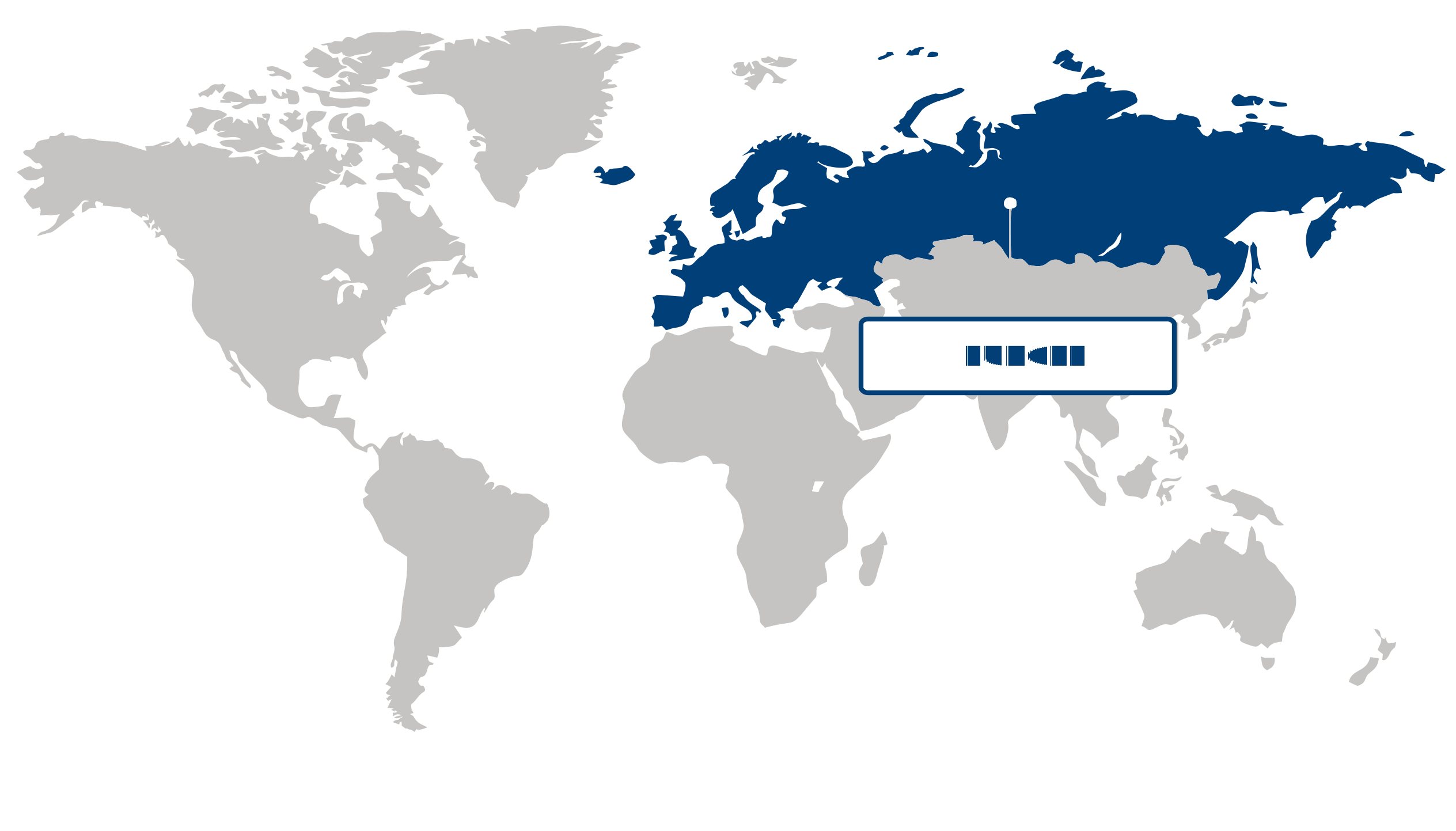
Europe (Largest Region)
Europe held the largest share of the electric tractor market in 2026, supported by strong environmental policies, growing emphasis on sustainable agriculture, and increasing efforts to reduce emissions from farming operations. Agricultural producers are showing greater interest in electrified machinery as improvements in battery technology and electric powertrains make these vehicles increasingly suitable for selected farming applications. The region's focus on precision agriculture and efficient farm management is also encouraging the adoption of technologically advanced equipment that can support lower operating emissions and more sustainable production practices. In addition, government initiatives promoting cleaner agricultural technologies, combined with established agricultural machinery infrastructure and environmental awareness among farmers, are creating favorable conditions for electric tractor adoption.
Asia Pacific (Fastest-Growing Region)
Asia Pacific is expected to be the fastest-growing region, driven by agricultural modernization, expanding mechanization, and increasing interest in low-emission farming equipment. The need to improve farm productivity while managing fuel and operating costs is encouraging producers to consider electric alternatives, particularly as agricultural technologies become more accessible. Government efforts toward sustainable farming and rural infrastructure development are also supporting the transition toward cleaner machinery. Furthermore, the expansion of smart farming practices and improving availability of charging and energy infrastructure are creating opportunities for electric tractors across developing agricultural markets. Growing awareness of environmental sustainability and continued modernization of farming operations are expected to strengthen regional demand.
| Parameter | North America | Asia Pacific | Europe | Latin America | MEA |
|---|---|---|---|---|---|
| Innovation Hub i Scale Nascent Developing Advanced | |||||
| Cost-Sensitive Region i Scale Low Medium High | |||||
| Regulatory Environment i Scale Restrictive Neutral Supportive | |||||
| Demand Drivers i Scale Weak Moderate Strong | |||||
| Development Stage i Scale Emerging Developing Developed | |||||
| Adoption Rate i Scale Low Medium High | |||||
| New Entrants / Startups i Scale Sparse Moderate Dense | |||||
| Macro Indicators i Scale Weak Stable Strong |
Key Country Insights
United States 🇺🇸
Precision Farming AdoptionThe U.S. electric tractor market is shaped by precision agriculture and lower operating cost objectives for specialty farming operations. Equipment developers in the U.S. focus on battery performance, autonomous capabilities, and compatibility with digital farm management systems.
Germany 🇩🇪
Sustainable Equipment TransitionGermany advances electric tractor adoption through sustainable agricultural practices and farm equipment innovation. German manufacturers prioritize efficient electric drivetrains and compatibility with modern farming operations seeking lower emissions and quieter machinery.
Japan 🇯🇵
Compact Farm SolutionsJapan emphasizes compact electric tractors suited to smaller agricultural holdings and labor-efficient farming. Japanese equipment producers integrate automation features and energy-efficient designs that address operational challenges in intensive cultivation environments.
South Korea 🇰🇷
Smart Agriculture IntegrationSouth Korea connects electric tractor development with smart farming technologies and digital agricultural infrastructure. Domestic manufacturers increasingly combine electrification with connected equipment features to improve operational efficiency for commercial farms.
France 🇫🇷
Low-Emission FarmingFrance promotes electric tractors for vineyards, orchards, and specialty agriculture where reduced noise and emissions provide operational advantages. French agricultural stakeholders increasingly evaluate electric equipment as part of sustainable farm modernization strategies.
Italy 🇮🇹
Specialty Crop MechanizationItaly's electric tractor market benefits from demand in vineyards, orchards, and horticultural farming requiring compact and maneuverable equipment. Italian manufacturers tailor electric tractor designs to specialized cultivation practices and diverse terrain conditions.
Segment Leadership and Growth Trends
Electric Tractor Market Share (%), by Battery, 2026
Go beyond the chart, access full insights & data tables
Request Free Sample ReportBattery Segment Analysis: Lithium-ion (Largest & Fastest-Growing Segment)
The lithium-ion segment led the electric tractor market with a 58.3% share in 2026 and also represents the fastest-growing battery type. Lithium-ion batteries are increasingly preferred due to their high energy density, longer operational life, faster charging capability, and lower maintenance requirements compared with conventional battery technologies. These advantages enable electric tractors to deliver improved operating efficiency, extended working hours, and enhanced overall performance in agricultural and utility applications. Continuous advancements in battery technology and growing investment in agricultural electrification continue to reinforce the segment's leadership.
Power Segment Analysis: Low Power (Largest Segment) vs High Power (Fastest-Growing Segment)
The low power segment accounted for a 50.88% share of the electric tractor market in 2026. Its dominance is driven by strong demand from small and medium-sized farms where compact tractors are widely used for routine cultivation, mowing, spraying, and material handling activities. Low power electric tractors offer cost-effective operation, reduced emissions, and simplified maintenance, making them well suited for day-to-day agricultural tasks. Increasing adoption of sustainable farming practices continues to support the segment's leading position.
The high power segment is anticipated to witness the fastest growth as larger farming operations increasingly require electric tractors capable of handling heavy-duty applications with greater efficiency. Advances in battery capacity, electric drivetrains, and power management systems are enabling high power models to perform demanding agricultural and industrial operations while reducing dependence on conventional fuel-powered equipment. Growing mechanization and the transition toward low-emission farming equipment are accelerating demand for this segment.
Application Segment Analysis: Agriculture (Largest Segment) vs Industrial (Fastest-Growing Segment)
The agriculture segment dominated the electric tractor market in 2026, reflecting the growing adoption of electric machinery for field preparation, planting, crop maintenance, and other farming activities. Farmers are increasingly investing in electric tractors to reduce fuel expenses, lower emissions, and improve operational efficiency while complying with evolving environmental regulations. Continued modernization of agricultural practices and increasing focus on sustainable farming technologies support the segment's market leadership.
The industrial segment is expected to experience the fastest growth as electric tractors gain wider acceptance for material handling, logistics support, landscaping, and utility operations across industrial facilities. Organizations are increasingly adopting electric equipment to reduce operating costs, improve workplace sustainability, and comply with stricter environmental standards. Expanding industrial electrification initiatives and continuous improvements in electric vehicle performance continue to drive rapid growth in this application segment.
| Segment | Sub-Segment | Largest Segment | Fastest Growing |
|---|---|---|---|
| Battery | Lithium-ion, Lead-acid, Others | Lithium-ion | Lithium-ion |
| Power | Low Power, Medium Power, High Power | Low Power | High Power |
| Application | Agriculture, Utility, Industrial | Agriculture | Industrial |
| Drivetrain | Battery Electric, Hybrid Electric, Plug-in Electric | Battery Electric | Battery Electric |
Competitive Landscape and Market Positioning
Prominent players in the electric tractor market:
- John Deere (Deere & Company) (USA)
- Kubota Corporation (Japan)
- CNH Industrial N.V. (United Kingdom)
- AGCO Corporation (USA)
- Yanmar Holdings Co., Ltd. (Japan)
- Mahindra & Mahindra Limited (India)
- CLAAS KGaA mbH (Germany)
- Solectrac, Inc. (USA)
- Monarch Tractor, Inc. (USA)
- Escorts Kubota Limited (India)
The Electric Tractor Market is entering a more dynamic competitive phase as manufacturers compete to redefine agricultural equipment through electrification, automation, and improved operational efficiency. Traditional equipment providers are expanding their capabilities while newer participants are focusing on purpose-built electric platforms designed around changing farming needs. Differentiation is increasingly centered on battery integration, machine reliability, charging practicality, and compatibility with modern precision agriculture systems. As farmers evaluate alternatives to conventional equipment, companies that can combine performance, affordability, and ecosystem support are gaining stronger market relevance.
| Company | Market Share | Company Revenue | Revenue CAGR (%) | Product Portfolio | Geographic Presence | Innovation / R&D Focus | Strategic Developments |
|---|---|---|---|---|---|---|---|
| John Deere (Deere & Company) (USA) | |||||||
| Kubota Corporation (Japan) | |||||||
| CNH Industrial N.V. (United Kingdom) | |||||||
| AGCO Corporation (USA) | |||||||
| Yanmar Holdings Co. Ltd. (Japan) | |||||||
| Mahindra & Mahindra Limited (India) | |||||||
| CLAAS KGaA mbH (Germany) | |||||||
| Solectrac Inc. (USA) | |||||||
| Monarch Tractor Inc. (USA) | |||||||
| Escorts Kubota Limited (India) |
Industry Development/News
| Company Name | Date | Key Development |
|---|---|---|
| Diess E-Agrartechnik AG | May-26 | Diess E-Agrartechnik AG unveiled plans to introduce a mid-range electric tractor in 2027 featuring a swappable battery system designed to maximize operating time. The product roadmap marks the startup's formal entry into the electric agricultural machinery segment. |
| Caterpillar | Apr-26 | Caterpillar acquired Monarch Tractor's autonomous electric tractor technology following the startup's closure. This transaction directly strengthens the industrial conglomerate's technical capabilities in autonomous systems and electrified agricultural equipment, positioning it to compete in the smart farming segment. |
| FarmX | Feb-26 | FarmX acquired Amos Power alongside securing new funding to accelerate the deployment of its AI-powered autonomous farming platform. The transaction expands the company's agricultural automation capabilities, integrating intelligent software into electrified tractor machinery architectures. |
| Moonrider | Dec-25 | Moonrider secured USD 6 million in Series A funding led by pi Ventures with participation from Singularity AMC and existing investors. The capital injection will be used to accelerate the development and engineering of the company's proprietary electric tractor technology. |
| Montra Electric | Nov-25 | Montra Electric launched the E-27, marking India's first ARAI-certified electric tractor. The company expanded its distribution reach into northern Indian regional markets with 2WD and 4WD variants aimed at advancing sustainable agricultural mechanization. |
| Volkswagen Group Africa | Nov-24 | Volkswagen Group Africa launched a multifunctional facility in Rwanda featuring electric tractors. This operational expansion establishes a regional logistics footprint aimed at improving local agricultural mechanization and supporting sustainable commercial farming operations. |
| SuperPanther | Sep-24 | SuperPanther partnered with Steyr Automotive to unveil the eTopas 600 electric tractor unit for the European market at IAA Transportation. The commercial partnership broadens the company's heavy-duty commercial electric vehicle portfolio for regional logistics and agriculture. |
| Monarch Tractor | Jul-24 | Monarch Tractor raised USD 133 million in a capital funding round to support its international expansion initiatives. The company will utilize the investment to strategically grow its commercial presence and distribution network within the European electric tractor market. |
| AutoNxt Automation | Apr-24 | AutoNxt Automation secured Pre-Series A investment funding led by Saama. The capital infusion is dedicated to supporting the commercial launch and scale-up of its electric tractor platform, which incorporates planned self-driving and autonomous capabilities. |
| EOX | — | EOX announced the commercial launch of its autonomous electric tractors in Western Australia. This geographic expansion positions the company within the Australian agricultural equipment market to address localized demand for sustainable farming equipment and energy sovereignty. |
Customize Your Report
Explore examples of how this report can be tailored to different research needs, including custom segments, additional topics or chapters, and related reports. Click a section of the wheel or its numbered marker to explore the available options.
Electric Tractor Market — Custom Segments
| Segment | Sub-Segment |
|---|---|
| Tractor Class | Compact/Utility Tractors, Row-Crop Tractors, Orchard/Vineyard Tractors, Specialty Tractors |
| Charging Method | AC Charging, DC Fast Charging, Battery Swapping |
| Ownership Model | Direct Ownership, Leasing, Equipment-as-a-Service |
Electric Tractor Market — Custom TOC
| Custom Chapter | Custom Details |
|---|---|
| Farm Electrification Adoption Assessment |
|
| Charging Infrastructure Readiness Analysis |
|
| Total Cost of Ownership Benchmarking |
|
Need a different cut of the data?
Request Custom ResearchHow much is the electric tractor market worth?
How is the electric tractor industry projected to perform over the next decade?
How are environmental regulations accelerating adoption of electric tractors?
Why is precision agriculture driving demand for electric tractors?
Why is the low power segment leading the electric tractor market?
How is the industrial segment creating new growth opportunities in the electric tractor market?
What makes Europe the leading electric tractor market?
How is Asia Pacific driving growth in the electric tractor market?
What are the key competitors in the electric tractor landscape?
Our Clients
"The team surpassed our expectations with the report depth. The actionable insights provided proved crucial in navigating market challenges."
Tata Motors
"We found the report to be very informative. The expertise and attention to market nuances significantly influenced our business direction."
DENSO Corporation
"The consumer survey findings were quite good. We now have a clearer picture of the customer churning and retention strategy."
HL Mando
Our Research Team & Methodology
Every Fundamental Business Insights report is built by a dedicated vertical research team, validated through a structured primary-and-secondary methodology, and reviewed for accuracy before it reaches you.
Research Team Overview
Prepared by the Automotive & Transportation Research Team
Delivery
Published
Demand
Available
Support
Trust & Compliance
Research Domains
10 coverage areasResearch Intelligence
| Source | Reference |
|---|---|
| International Organization of Motor Vehicle Manufacturers (OICA) | www.oica.net |
| SAE International | www.sae.org |
| International Energy Agency (IEA) | www.iea.org |
| International Transport Forum (ITF) | www.itf-oecd.org |
| International Road Federation (IRF) | www.irf.global |
| International Organization for Standardization (ISO) | www.iso.org |
| United Nations Economic Commission for Europe (UNECE) | unece.org |
| National Highway Traffic Safety Administration (NHTSA) | www.nhtsa.gov |
| U.S. Department of Transportation (USDOT) | www.transportation.gov |
| European Automobile Manufacturers' Association (ACEA) | www.acea.auto |
| Society of Indian Automobile Manufacturers (SIAM) | www.siam.in |
| International Air Transport Association (IATA) | www.iata.org |
| International Civil Aviation Organization (ICAO) | www.icao.int |
| International Maritime Organization (IMO) | www.imo.org |
| International Union of Railways (UIC) | uic.org |
| American Public Transportation Association (APTA) | www.apta.com |
| International Federation of Robotics (IFR) | ifr.org |
| CharIN | www.charin.global |
| World Shipping Council | www.worldshipping.org |
| International Federation of Freight Forwarders Associations (FIATA) | fiata.org |
Research Workflow & Quality Assurance
Data Collection
Verified information gathered through primary and secondary research.
Data Triangulation
Cross-validation using multiple independent data sources.
Forecast Modelling
Market estimates developed using historical trends and analytical models.
Analyst Validation
Findings reviewed by domain experts for accuracy and consistency.
Editorial & Quality Review
Final editorial, quality, and compliance checks before publication.
Final Publication
Released after successful completion of the internal review process.
Report Coverage
📊 Market Assessment
- Market Size & Forecast
- Market Segmentation
- Regional Analysis
- Growth Drivers & Challenges
- Market Dynamics
🏢 Competitive Intelligence
- Competitive Landscape
- Company Profiles
- Competitive Benchmarking
- Mergers & Acquisitions
- Market Share Analysis or Key Company Strategies
🔍 Strategic Analysis
- Value Chain Analysis
- Porter's Five Forces
- PESTLE Analysis
- Pricing Trends
- Supply-Demand Analysis
🚀 Future Outlook
- Technology Landscape
- Regulatory Landscape
- Investment & Funding Landscape
- Emerging Opportunities
- Future Market Outlook
Have a question about this report or need a custom scope?
Request Customization