Electric Three Wheeler Market Size & Growth Forecast 2027–2036, By Segments (Battery Type, Power, End-Use), Regional Demand Trends (North America, Asia Pacific, Europe), Key Country Insights (U.S., Japan, South Korea, Germany, France, Italy), and Competitive Landscape
Market Size and Growth Outlook
Electric Three Wheeler Market size was over USD 1.7 billion in 2026 and is likely to grow at a 7.51% CAGR between 2027 and 2036, exceeding USD 3.51 billion by 2036. The industry revenue for 2027 is estimated at USD 1.81 billion.
Get more details on this report
Request Free Sample ReportElectric Three Wheeler Market Intelligence Snapshot
Regional Market Dynamics
- Asia Pacific held a 62.69% market share in 2026, driven by widespread passenger and last-mile freight usage, high vehicle utilization, and strong demand for electric mobility in dense urban areas.
- Asia Pacific is projected to grow at an 8.59% CAGR as electrification aligns with predictable transport routes, expanding replacement demand, and income-generating passenger and cargo operations.
Segment Momentum
- Lithium-ion leads with 45.93% share due to its balanced range, charging efficiency, and lightweight design, improving uptime and usability for passenger and cargo operations despite higher upfront cost.
- Above 1500 W grows fastest as users demand higher acceleration and load-handling capability, with stronger performance supporting commercial use cases that require improved route flexibility and reliable output under demanding operating conditions.
Market Expansion Drivers
- Government subsidies and emission regulations accelerating transition from ICE to electric vehicles.
- Rising last-mile logistics and e-commerce demand boosting commercial electric fleet adoption.
- Improved battery-as-a-service and financing models reducing upfront ownership barriers for operators.
Leading Market Participants
- Key companies in the electric three wheeler market include Mahindra Electric Mobility Limited (India), Bajaj Auto Limited (India), Piaggio Vehicles Pvt. Ltd. (India), Atul Auto Limited (India), Euler Motors Pvt. Ltd. (India), Omega Seiki Mobility Pvt. Ltd. (India), Terra Motors Corporation (Japan), Gayam Motor Works Pvt. Ltd. (India), Jiangsu Jinpeng Group Co., Ltd. (China), E-Tuk Factory Limited (Thailand).
Global Market Forecast Snapshot
Market Outlook
- 2026 Market Size: USD 1.7 billion
- 2027 Estimated Market Size: USD 1.81 billion.
- Projected Market Size: USD 3.51 billion by 2036
- Growth Forecast: 7.51% CAGR (2027-2036)
Regional and Segment Outlook
- Leading Regional Market: Asia Pacific
- High-Growth Regional Hub: Asia Pacific
- Core Revenue Segment: Lithium-ion (Battery Type) | 1000 W - 1500 W (Power) | Passenger Carrier (End-Use)
- Emerging Opportunity Segment: Lead Acid (Battery Type) | Above 1500 W (Power) | Goods Carrier (End-Use)
Market Growth Drivers and Industry Trends
Government subsidies and emission regulations accelerating transition from ICE to electric vehicles
Government incentives and increasingly stringent emissions requirements will drive the electric three wheeler market growth by improving the economic and regulatory attractiveness of electric mobility compared with internal combustion engine alternatives. Subsidies, purchase incentives, tax benefits, and other policy measures can reduce the effective acquisition cost of electric three wheelers, making them more accessible to individual operators and commercial fleet owners. At the same time, emissions regulations are encouraging transport operators to consider cleaner vehicle technologies, particularly in urban areas where air-quality objectives are becoming more important. The combination of policy support and environmental requirements is encouraging manufacturers and fleet operators to shift toward electric powertrains for passenger and cargo transportation.
Rising last-mile logistics and e-commerce demand boosting commercial electric fleet adoption
Rapid growth in e-commerce and last-mile delivery activity will propel the electric three wheeler market as logistics operators require cost-efficient vehicles suited to frequent short-distance transportation. Electric three wheelers are well suited to urban delivery operations because of their compact dimensions, maneuverability in congested areas, and compatibility with repeated delivery routes. The expansion of online retail is increasing the need for localized distribution and flexible delivery fleets, while businesses are also placing greater emphasis on operating efficiency and cleaner transportation solutions. These characteristics are encouraging commercial users to incorporate electric three wheelers into delivery networks serving residential areas, retail outlets, and local distribution points.
Improved battery-as-a-service and financing models reducing upfront ownership barriers for operators
The development of battery-as-a-service arrangements and alternative financing models will boost the electric three wheeler market by addressing some of the initial cost and battery ownership challenges faced by vehicle operators. Battery-as-a-service models can separate battery-related expenses from vehicle acquisition, allowing users to access energy storage through subscription, leasing, or usage-based arrangements. Financing options can similarly distribute vehicle costs over time, making electric three wheelers more accessible to operators with limited capital availability. Such models can also provide greater flexibility in battery management and replacement, reducing concerns related to battery investment and enabling commercial users to adopt electric vehicles within operating budgets that may otherwise constrain fleet electrification.
| Growth Driver | Impact on CAGR | Regulatory Influence | Geographic Relevance | Adoption Rate | Impact Timeline |
|---|---|---|---|---|---|
| Government subsidies and emission regulations accelerating transition from ICE to electric vehicles | 2.50% | High | Asia Pacific, Africa | High | Near Term |
| Rising last-mile logistics and e-commerce demand boosting commercial electric fleet adoption | 2.20% | Moderate | Asia Pacific, Latin America | High | Mid Term |
| Improved battery-as-a-service and financing models reducing upfront ownership barriers for operators | 1.90% | Moderate | Asia Pacific, Africa | High | Mid Term |
Unlock insights tailored to your business with our bespoke market research solutions.
Click to get your customized report now.
Regional Demand Dynamics
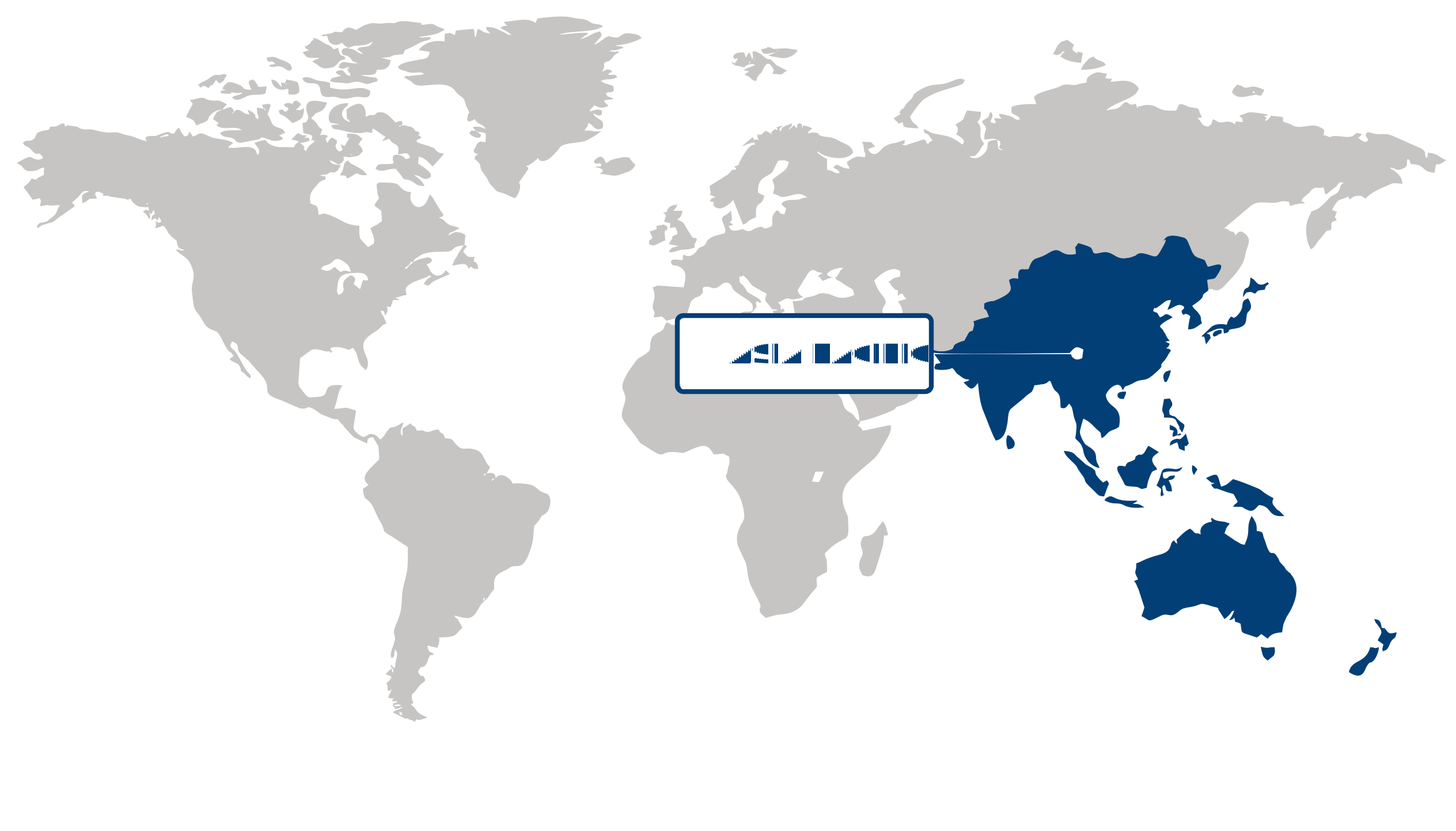
Asia Pacific (Largest & Fastest-Growing Region)
The electric three wheeler market in Asia Pacific accounted for the largest share of 62.69% in 2026 while also representing the fastest-growing regional market, reflecting strong demand for affordable, efficient, and low-emission urban transportation. High population density, expanding urban areas, and the widespread use of three wheelers for passenger mobility and last-mile deliveries create a strong foundation for electric vehicle adoption. Government support for vehicle electrification, improvements in charging infrastructure, and efforts to reduce urban air pollution are further encouraging the transition from conventional powertrains to electric alternatives. In addition, the relatively lower operating and maintenance requirements of electric three wheelers are supporting their adoption among commercial and small-scale transport operators, particularly where cost efficiency is a key purchasing consideration.
| Parameter | North America | Asia Pacific | Europe | Latin America | MEA |
|---|---|---|---|---|---|
| Innovation Hub i Scale Nascent Developing Advanced | |||||
| Cost-Sensitive Region i Scale Low Medium High | |||||
| Regulatory Environment i Scale Restrictive Neutral Supportive | |||||
| Demand Drivers i Scale Weak Moderate Strong | |||||
| Development Stage i Scale Emerging Developing Developed | |||||
| Adoption Rate i Scale Low Medium High | |||||
| New Entrants / Startups i Scale Sparse Moderate Dense | |||||
| Macro Indicators i Scale Weak Stable Strong |
Key Country Insights
Germany 🇩🇪
Micromobility IntegrationGermany is exploring electric three wheelers as part of broader urban mobility and emission reduction initiatives. Fleet operators in Germany are increasingly assessing these vehicles for commercial deliveries and municipal services where compact, low-emission transport solutions are advantageous.
France 🇫🇷
Sustainable City LogisticsFrance is adopting electric three wheelers to support low-emission zones and environmentally focused transport policies. Logistics providers in France are evaluating these vehicles for city-center deliveries where restrictions on conventional vehicles create opportunities for compact electric alternatives.
Italy 🇮🇹
Small Business MobilityItaly's electric three wheeler market benefits from demand among local merchants and service providers requiring economical urban transport solutions. Businesses in Italy are increasingly considering electric three wheelers for goods movement and specialized commercial applications in historic city centers.
Japan 🇯🇵
Compact Urban TransportJapan's electric three wheeler market is supported by demand for space-efficient vehicles suited to congested cities and aging communities. Manufacturers in Japan are focusing on lightweight designs and practical utility applications, including neighborhood logistics and short-distance transportation services.
South Korea 🇰🇷
Smart Delivery MobilitySouth Korea is incorporating electric three wheelers into digitally connected delivery networks and urban logistics services. Businesses in South Korea are emphasizing battery efficiency and fleet management technologies to improve operational flexibility in rapidly growing e-commerce distribution systems.
United States 🇺🇸
Urban Fleet PilotsThe U.S. electric three wheeler market is gaining traction through pilot programs in urban logistics and last-mile delivery applications. Companies in the U.S. are evaluating compact electric cargo vehicles to reduce operating costs and meet sustainability targets in dense metropolitan areas.
Segment Leadership and Growth Trends
Electric Three Wheeler Market Share (%), by Battery Type, 2026
Go beyond the chart, access full insights & data tables
Request Free Sample ReportBattery Type Segment Analysis: Lithium-ion (Largest Segment) vs Lead Acid (Fastest-Growing Segment)
Lithium-ion batteries held the largest share of the electric three wheeler market, accounting for 45.93% in 2026. Their position is supported by advantages such as high energy density, lower weight, efficient power delivery, and suitability for repeated charging cycles. These characteristics are particularly valuable in electric three-wheelers, where battery performance directly affects vehicle usability, operating efficiency, and range. Continued electrification of urban mobility and growing demand for efficient commercial and passenger three-wheelers further support the adoption of lithium-ion battery systems.
Lead acid batteries are expected to experience the fastest growth as their relatively established technology, accessibility, and cost advantages support adoption among users seeking economical electric mobility solutions. Their familiarity within the automotive and mobility ecosystem can simplify maintenance and replacement requirements, particularly in cost-sensitive applications. As electric three-wheelers expand across commercial transportation and last-mile mobility, demand for battery options that balance affordability, availability, and functional requirements is creating additional opportunities for lead acid systems.
Power Segment Analysis: 1000 W - 1500 W (Largest Segment) vs Above 1500 W (Fastest-Growing Segment)
The 1000 W - 1500 W power segment represented the largest share of the electric three wheeler market, reaching 45.21% in 2026. This power range provides a practical balance between propulsion capability, energy consumption, and suitability for common three-wheeler applications. It can support routine passenger and goods transportation while meeting the performance requirements of urban and short-distance mobility. Growing adoption of electric three-wheelers for practical commercial and transportation uses continues to reinforce demand for power systems that provide dependable performance without unnecessarily increasing energy requirements.
Above 1500 W power systems are gaining momentum as users increasingly seek stronger performance for applications requiring higher load-carrying capability, improved acceleration, and operation across more demanding routes. Higher-powered electric three-wheelers can provide greater flexibility for commercial transportation and goods movement where operating conditions place greater demands on the vehicle. As electric mobility expands beyond basic urban travel toward more demanding use cases, the need for enhanced propulsion performance is supporting increasing interest in higher-power configurations.
| Segment | Sub-Segment | Largest Segment | Fastest Growing |
|---|---|---|---|
| Battery Type | Lithium-ion, Lead Acid, Others | Lithium-ion | Lead Acid |
| Power | Up to 1000W, 1000 W - 1500 W, Above 1500 W | 1000 W - 1500 W | Above 1500 W |
| End-Use | Passenger Carrier, Goods Carrier | Passenger Carrier | Goods Carrier |
Competitive Landscape and Market Positioning
Key companies in the electric three wheeler market:
1. Mahindra Electric Mobility Limited (India)
2. Bajaj Auto Limited (India)
3. Piaggio Vehicles Pvt. Ltd. (India)
4. Atul Auto Limited (India)
5. Euler Motors Pvt. Ltd. (India)
6. Omega Seiki Mobility Pvt. Ltd. (India)
7. Terra Motors Corporation (Japan)
8. Gayam Motor Works Pvt. Ltd. (India)
9. Jiangsu Jinpeng Group Co. Ltd. (China)
10. E-Tuk Factory Limited (Thailand)
The electric three wheeler market is experiencing strong growth due to rising demand for sustainable urban mobility solutions. Battery efficiency improvements are enhancing vehicle range and reliability. The electric three wheeler market continues to expand as electrification adoption accelerates across transport segments.
| Company | Market Share | Company Revenue | Revenue CAGR (%) | Product Portfolio | Geographic Presence | Innovation / R&D Focus | Strategic Developments |
|---|---|---|---|---|---|---|---|
| Mahindra Electric Mobility Limited (India) | |||||||
| Bajaj Auto Limited (India) | |||||||
| Piaggio Vehicles Pvt. Ltd. (India) | |||||||
| Atul Auto Limited (India) | |||||||
| Euler Motors Pvt. Ltd. (India) | |||||||
| Omega Seiki Mobility Pvt. Ltd. (India) | |||||||
| Terra Motors Corporation (Japan) | |||||||
| Gayam Motor Works Pvt. Ltd. (India) | |||||||
| Jiangsu Jinpeng Group Co. Ltd. (China) | |||||||
| E-Tuk Factory Limited (Thailand). |
Industry Development/News
| Company Name | Date | Key Development |
|---|---|---|
| Omega Seiki Mobility | Jun-26 | Omega Seiki Mobility integrated Honda’s e:Swap battery-swapping ecosystem into its Rage+ electric cargo three-wheeler. This strategic partnership enhances operational efficiency for last-mile logistics by significantly reducing charging downtime and improving overall vehicle uptime through broader access to Honda’s established swap network infrastructure. |
| Zelio E-Mobility | May-26 | Zelio E-Mobility reported strong financial performance for FY26, with revenue reaching ₹313.68 crore and a 75.4% increase in net profit. Concurrently, the company expanded its dealership network across India, reflecting robust market demand for electric mobility and a significant strengthening of its commercial footprint in the electric three-wheeler sector. |
| Hyundai Motor Company and TVS Motor Company | Apr-26 | Hyundai Motor Company and TVS Motor Company entered a joint development agreement to design and commercialize electric three-wheelers for India and global markets. By leveraging Hyundai’s human-centric design expertise and TVS’s platform capabilities, the collaboration aims to produce last-mile mobility solutions specifically engineered for high-demand urban transport environments. |
| Stellantis | May-25 | Stellantis launched the FIAT TRIS electric three-wheeler, marking the brand’s strategic entry into the three-wheeled EV segment. Designed for B2B last-mile delivery applications, this expansion is part of the company’s broader global micromobility strategy, aimed at providing efficient, sustainable logistics solutions in dense urban environments. |
| Hero MotoCorp | Mar-25 | Hero MotoCorp invested ₹525 crore in Euler Motors to facilitate the development and scaling of electric three-wheeler solutions for commercial applications. This strategic investment enables the company to enter the electric three-wheeler segment and strengthens its competitive positioning within the rapidly expanding last-mile mobility market. |
Customize Your Report
Explore examples of how this report can be tailored to different research needs, including custom segments, additional topics or chapters, and related reports. Click a section of the wheel or its numbered marker to explore the available options.
Electric Three Wheeler Market — Custom Segments
| Segment | Sub-Segment |
|---|---|
| Vehicle Configuration | Passenger Rickshaws, Cargo Three Wheelers, Loader Three Wheelers |
| Charging Infrastructure Type | Plug-in Charging, Battery Swapping, Depot/Fleet Charging |
| Ownership Model | Individual Ownership, Fleet Ownership, Shared Mobility Ownership |
Electric Three Wheeler Market — Custom TOC
| Custom Chapter | Custom Details |
|---|---|
| Fleet Electrification Opportunity Analysis |
|
| Charging Infrastructure Expansion Strategies |
|
| Electric Three Wheeler Financing Models |
|
Need a different cut of the data?
Request Custom ResearchWhat is the current size of the electric three wheeler market?
What is the forecasted size of the electric three wheeler industry?
How are new ownership models accelerating electric three wheeler adoption?
How is the growth of e-commerce influencing procurement in the electric three wheeler market?
What makes Lithium-ion the largest battery type in the Electric Three Wheeler Market?
Why is the Above 1500 W power segment the fastest-growing in the Electric Three Wheeler Market?
Why does Asia Pacific lead the electric three wheeler market?
What is driving the rapid growth of the electric three wheeler market in Asia Pacific?
Who are the leading players in the electric three wheeler landscape?
Our Clients
"The team surpassed our expectations with the report depth. The actionable insights provided proved crucial in navigating market challenges."
Tata Motors
"We found the report to be very informative. The expertise and attention to market nuances significantly influenced our business direction."
DENSO Corporation
"The consumer survey findings were quite good. We now have a clearer picture of the customer churning and retention strategy."
HL Mando
Our Research Team & Methodology
Every Fundamental Business Insights report is built by a dedicated vertical research team, validated through a structured primary-and-secondary methodology, and reviewed for accuracy before it reaches you.
Research Team Overview
Prepared by the Automotive & Transportation Research Team
Delivery
Published
Demand
Available
Support
Trust & Compliance
Research Domains
10 coverage areasResearch Intelligence
| Source | Reference |
|---|---|
| International Organization of Motor Vehicle Manufacturers (OICA) | www.oica.net |
| SAE International | www.sae.org |
| International Energy Agency (IEA) | www.iea.org |
| International Transport Forum (ITF) | www.itf-oecd.org |
| International Road Federation (IRF) | www.irf.global |
| International Organization for Standardization (ISO) | www.iso.org |
| United Nations Economic Commission for Europe (UNECE) | unece.org |
| National Highway Traffic Safety Administration (NHTSA) | www.nhtsa.gov |
| U.S. Department of Transportation (USDOT) | www.transportation.gov |
| European Automobile Manufacturers' Association (ACEA) | www.acea.auto |
| Society of Indian Automobile Manufacturers (SIAM) | www.siam.in |
| International Air Transport Association (IATA) | www.iata.org |
| International Civil Aviation Organization (ICAO) | www.icao.int |
| International Maritime Organization (IMO) | www.imo.org |
| International Union of Railways (UIC) | uic.org |
| American Public Transportation Association (APTA) | www.apta.com |
| International Federation of Robotics (IFR) | ifr.org |
| CharIN | www.charin.global |
| World Shipping Council | www.worldshipping.org |
| International Federation of Freight Forwarders Associations (FIATA) | fiata.org |
Research Workflow & Quality Assurance
Data Collection
Verified information gathered through primary and secondary research.
Data Triangulation
Cross-validation using multiple independent data sources.
Forecast Modelling
Market estimates developed using historical trends and analytical models.
Analyst Validation
Findings reviewed by domain experts for accuracy and consistency.
Editorial & Quality Review
Final editorial, quality, and compliance checks before publication.
Final Publication
Released after successful completion of the internal review process.
Report Coverage
📊 Market Assessment
- Market Size & Forecast
- Market Segmentation
- Regional Analysis
- Growth Drivers & Challenges
- Market Dynamics
🏢 Competitive Intelligence
- Competitive Landscape
- Company Profiles
- Competitive Benchmarking
- Mergers & Acquisitions
- Market Share Analysis or Key Company Strategies
🔍 Strategic Analysis
- Value Chain Analysis
- Porter's Five Forces
- PESTLE Analysis
- Pricing Trends
- Supply-Demand Analysis
🚀 Future Outlook
- Technology Landscape
- Regulatory Landscape
- Investment & Funding Landscape
- Emerging Opportunities
- Future Market Outlook
Have a question about this report or need a custom scope?
Request Customization