Dry Type Distribution Transformer Market Size & Growth Forecast 2027–2036, By Segments (Core, Winding, Application, Rating, Product), Regional Demand Trends (North America, Asia Pacific, Europe), Key Country Insights (U.S., Japan, South Korea, Germany, France, Italy), and Competitive Landscape
Market Size and Growth Outlook
Dry Type Distribution Transformer Market size was estimated at USD 12.3 Billion in 2026 and is projected to grow at 10.28% CAGR from 2027 to 2036, reaching USD 32.72 Billion by 2036. The industry revenue for 2027 is calculated at USD 13.37 Billion.
Get more details on this report
Request Free Sample ReportDry Type Distribution Transformer Market Intelligence Snapshot
Regional Market Dynamics
- Asia Pacific led in 2026, driven by rapid industrialization, urban expansion, and substantial investment in electricity transmission and distribution infrastructure.
- Rising power consumption, expanding manufacturing and commercial developments, and demand for safe, low-maintenance, flexible distribution equipment are supporting continued adoption.
Segment Momentum
- The commercial & industrial segment led the market in 2026 due to rising electricity demand across manufacturing facilities and commercial buildings. Reliable, low-maintenance, and safe power distribution solutions continue to support strong adoption.
- The auto transformer segment is projected to grow the fastest because it offers compact construction, lower losses, and efficient voltage regulation. Increasing demand for cost-effective and space-efficient power infrastructure is accelerating adoption.
Market Expansion Drivers
- Grid refurbishment programs accelerating replacement of aging oil-based transformer systems
- Renewable energy expansion increasing demand for safe indoor transformer installations
- Rising urban infrastructure development driving compact and fire-safe transformer adoption
Leading Market Participants
- Major players in the dry type distribution transformer market include ABB Ltd. (Switzerland), Siemens Energy AG (Germany), Schneider Electric SE (France), Eaton Corporation plc (Ireland), Hitachi Energy Ltd. (Switzerland), General Electric Company (United States), Bharat Heavy Electricals Limited (India), CG Power and Industrial Solutions Limited (India), Fuji Electric Co., Ltd. (Japan), WEG S.A. (Brazil)
Global Market Forecast Snapshot
Market Outlook
- 2026 Market Size: USD 12.3 Billion
- 2027 Estimated Market Size: USD 13.37 Billion
- Projected Market Size: USD 32.72 Billion by 2036
- Growth Forecast: 10.28% CAGR (2027-2036)
Regional and Segment Outlook
- Leading Regional Market: Asia Pacific
- High-Growth Regional Hub: Asia Pacific
- Core Revenue Segment: Shell (Core) | Two Winding (Winding) | Commercial & Industrial (Application) | > 1 MVA (Rating) | Cast Resin (Product)
- Emerging Opportunity Segment: Closed (Core) | Auto Transformer (Winding) | Residential (Application) | ≤ 250 kVA (Rating) | Vacuum Pressure Impregnated (Product)
Market Growth Drivers and Industry Trends
Grid refurbishment programs accelerating replacement of aging oil-based transformer systems
Extensive modernization of aging electricity infrastructure is creating sustained replacement demand that will drive the dry type distribution transformer market growth. Utilities and grid operators are progressively replacing conventional oil-filled transformers with dry-type alternatives to improve operational safety, reduce maintenance requirements, and comply with evolving environmental and fire protection standards. Modern distribution networks also require equipment capable of supporting higher reliability and efficient power delivery across commercial, industrial, and institutional facilities. These refurbishment initiatives frequently prioritize transformers with lower operational risks in densely populated environments where leak prevention and simplified maintenance are important operational considerations.
Renewable energy expansion increasing demand for safe indoor transformer installations
The rapid deployment of renewable power generation across commercial buildings, industrial facilities, and distributed energy systems is increasing the need for reliable electrical infrastructure, boosting the dry type distribution transformer market. Dry-type transformers are particularly well suited for indoor installations because they eliminate the use of insulating oil, reducing fire hazards while supporting safer operation in confined or occupied spaces. Renewable energy projects integrated with rooftop solar systems, energy storage installations, and microgrids increasingly require compact and dependable transformers capable of maintaining efficient power distribution under varying load conditions. Their compatibility with environmentally sensitive locations and enclosed electrical rooms makes them a preferred choice across diverse clean energy applications.
Rising urban infrastructure development driving compact and fire-safe transformer adoption
Rapid urbanization and expanding investments in commercial complexes, transportation facilities, hospitals, educational institutions, and residential developments are reinforcing demand for space-efficient electrical equipment, which will propel the dry type distribution transformer market growth. Dense urban environments often require transformers that can be installed within buildings while meeting stringent fire safety and environmental regulations. Dry-type designs offer flexibility for installation in limited spaces and reduce concerns associated with oil leakage or contamination, making them suitable for modern infrastructure projects. The growing emphasis on resilient urban power distribution systems also encourages adoption of transformer technologies designed to operate reliably under demanding indoor operating conditions.
| Growth Driver | Impact on CAGR | Regulatory Influence | Geographic Relevance | Adoption Rate | Impact Timeline |
|---|---|---|---|---|---|
| Grid refurbishment programs accelerating replacement of aging oil-based transformer systems | 2% | High | North America, Europe | High | Near Term |
| Renewable energy expansion increasing demand for safe indoor transformer installations | 1.5% | High | Europe, Asia Pacific | High | Mid Term |
| Rising urban infrastructure development driving compact and fire-safe transformer adoption | 1% | Moderate | Middle East, Asia Pacific | High | Mid Term |
Unlock insights tailored to your business with our bespoke market research solutions.
Click to get your customized report now.
Regional Demand Dynamics
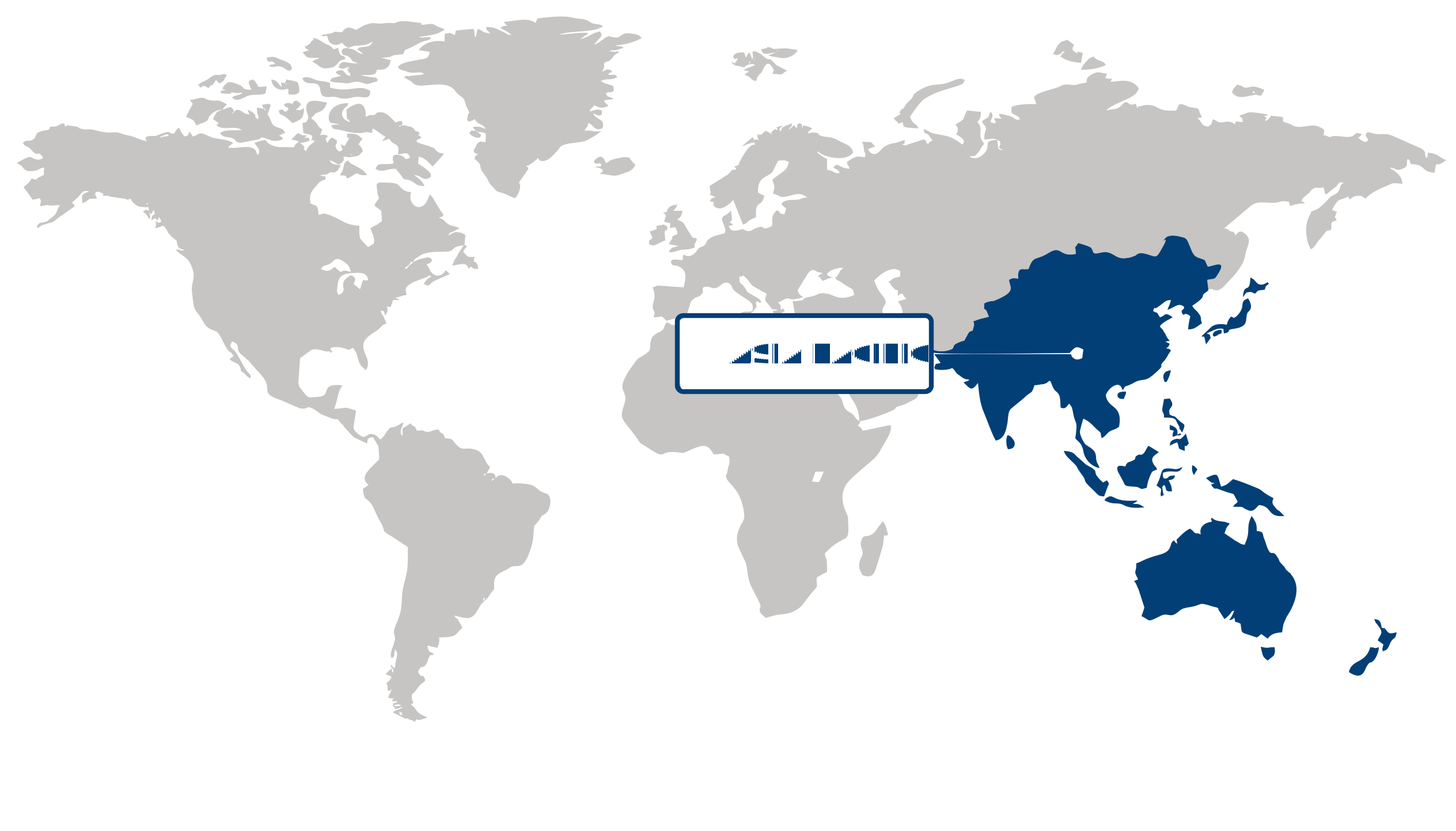
Asia Pacific (Largest & Fastest-Growing Region)
Asia Pacific dominated the dry type distribution transformer market in 2026 and is expected to maintain the fastest growth over the forecast period. The region's market position is supported by rapid industrialization, urban expansion, and substantial investment in electricity transmission and distribution infrastructure. Growing power consumption from manufacturing facilities, commercial developments, and expanding urban centers is increasing the need for efficient and reliable distribution equipment. Dry type transformers are also gaining relevance where safety, reduced maintenance requirements, and installation flexibility are important considerations, supporting their adoption across modern infrastructure projects.
| Parameter | North America | Asia Pacific | Europe | Latin America | MEA |
|---|---|---|---|---|---|
| Innovation Hub i Scale Nascent Developing Advanced | |||||
| Cost-Sensitive Region i Scale Low Medium High | |||||
| Regulatory Environment i Scale Restrictive Neutral Supportive | |||||
| Demand Drivers i Scale Weak Moderate Strong | |||||
| Development Stage i Scale Emerging Developing Developed | |||||
| Adoption Rate i Scale Low Medium High | |||||
| New Entrants / Startups i Scale Sparse Moderate Dense | |||||
| Macro Indicators i Scale Weak Stable Strong |
Key Country Insights
United States 🇺🇸
Grid Modernization SupportThe U.S. dry type distribution transformer market benefits from investments in commercial facilities, renewable energy integration, and power distribution upgrades. Utilities and industrial operators across the U.S. increasingly adopt dry type transformers for improved operational safety and reduced maintenance requirements.
Germany 🇩🇪
Industrial Energy EfficiencyGermany prioritizes dry type distribution transformers that improve energy efficiency and support advanced manufacturing environments. German industrial facilities increasingly deploy compact transformer solutions aligned with stringent electrical safety and sustainability objectives.
Japan 🇯🇵
Space-Conscious Electrical SystemsJapan emphasizes compact dry type distribution transformers suitable for dense commercial buildings, transportation infrastructure, and manufacturing sites. Suppliers in Japan focus on reliable thermal performance and efficient installation within space-constrained electrical networks.
South Korea 🇰🇷
Digital Infrastructure ExpansionSouth Korea continues expanding dry type distribution transformer deployment across data centers, advanced manufacturing facilities, and smart infrastructure projects. Local demand favors equipment with improved monitoring capabilities and dependable performance under variable electrical loads.
France 🇫🇷
Sustainable Building IntegrationFrance is increasing adoption of dry type distribution transformers for commercial buildings and public infrastructure requiring enhanced fire safety and environmental performance. The French market values energy-efficient transformer technologies that support modern building electrification strategies.
Italy 🇮🇹
Commercial Facility ReliabilityItaly focuses on dry type distribution transformers that deliver dependable electrical distribution across industrial plants, healthcare facilities, and commercial developments. Italian buyers increasingly seek low-maintenance solutions that simplify installation while supporting long-term operational reliability.
Segment Leadership and Growth Trends
Dry Type Distribution Transformer Market Share (%), by Core, 2026
Go beyond the chart, access full insights & data tables
Request Free Sample ReportCore Segment Analysis: Shell (Largest Segment) vs Closed (Fastest-Growing Segment)
Holding the largest share of the dry type distribution transformer market, the shell segment accounted for 38.56% in 2026, supported by its structural advantages and suitability for applications requiring enhanced mechanical strength and reliable performance. Shell-type designs provide improved protection for windings and better resistance to operational stresses, making them suitable for power distribution systems where durability and stability are critical. The increasing focus on efficient electricity distribution infrastructure and the need for transformers capable of operating reliably in diverse environments have contributed to the continued adoption of shell core configurations.
The closed segment is projected to witness strong growth due to rising demand for compact and efficient transformer designs. Closed core structures offer benefits such as reduced magnetic losses, improved energy efficiency, and optimized performance, making them increasingly suitable for modern power networks. The growing emphasis on energy conservation and the expansion of decentralized power distribution systems are supporting the adoption of closed core dry type distribution transformers.
Winding Segment Analysis: Two Winding (Largest Segment) vs Auto Transformer (Fastest-Growing Segment)
In the dry type distribution transformer market, the two winding segment maintained a leading position in 2026 due to its widespread use across conventional power distribution applications. Two winding transformers provide effective voltage transformation, electrical isolation, and operational reliability, making them a preferred choice for industrial, commercial, and utility installations. Their established design and compatibility with various distribution systems continue to support their strong market presence.
The auto transformer segment is gaining momentum as industries and power operators increasingly seek solutions that offer improved efficiency and reduced material requirements. Auto transformers provide advantages such as compact construction, lower losses, and cost-effective operation, which make them suitable for applications where voltage regulation and space optimization are important. The growing need for efficient power infrastructure is contributing to increased adoption of auto transformer configurations.
Application Segment Analysis: Commercial & Industrial (Largest Segment) vs Residential (Fastest-Growing Segment)
The commercial & industrial segment dominated the dry type distribution transformer market in 2026, driven by increasing electricity demand across manufacturing facilities, commercial buildings, and industrial establishments. These applications require reliable and safe power distribution solutions with minimal maintenance requirements, making dry type transformers highly suitable due to their operational safety and environmental advantages. The expansion of industrial infrastructure and modernization of commercial power systems continue to strengthen demand for transformers in this segment.
The residential segment is expected to experience significant growth due to increasing urban development and rising electricity consumption in housing projects. The adoption of dry type distribution transformers in residential applications is supported by their compact design, fire safety benefits, and suitability for indoor installations. Growing investments in reliable residential power distribution networks are further encouraging the integration of these transformer systems.
| Segment | Sub-Segment | Largest Segment | Fastest Growing |
|---|---|---|---|
| Core | Closed, Shell, Berry | Shell | Closed |
| Winding | Two Winding, Auto Transformer | Two Winding | Auto Transformer |
| Application | Residential, Commercial & Industrial, Utility | Commercial & Industrial | Residential |
| Rating | ≤ 250 kVA, > 250 kVA to ≤ 1 MVA, > 1 MVA | > 1 MVA | ≤ 250 kVA |
| Product | Open Wound, Cast Resin, Vacuum Pressure Impregnated, Vacuum Pressure Encapsulated | Cast Resin | Vacuum Pressure Impregnated |
Competitive Landscape and Market Positioning
Prominent players in the dry type distribution transformer market:
- ABB Ltd. (Switzerland)
- Siemens Energy AG (Germany)
- Schneider Electric SE (France)
- Eaton Corporation plc (Ireland)
- Hitachi Energy Ltd. (Switzerland)
- General Electric Company (United States)
- Bharat Heavy Electricals Limited (India)
- CG Power and Industrial Solutions Limited (India)
- Fuji Electric Co., Ltd. (Japan)
- WEG S.A. (Brazil)
Shifting preferences toward safer and lower-maintenance electrical infrastructure are encouraging manufacturers to compete through engineering capabilities rather than manufacturing scale alone. Suppliers are investing in transformer designs that improve thermal management, energy efficiency, and installation flexibility for commercial buildings, industrial facilities, and distributed power networks with demanding operating conditions. Competition increasingly extends beyond the equipment itself, with buyers placing greater emphasis on customization, shorter project lead times, and lifecycle support tailored to complex electrical systems. As grid modernization progresses across multiple end-use sectors, technical expertise in meeting diverse application requirements has become a defining competitive advantage.
| Company | Market Share | Company Revenue | Revenue CAGR (%) | Product Portfolio | Geographic Presence | Innovation / R&D Focus | Strategic Developments |
|---|---|---|---|---|---|---|---|
| ABB Ltd. (Switzerland) | |||||||
| Siemens Energy AG (Germany) | |||||||
| Schneider Electric SE (France) | |||||||
| Eaton Corporation plc (Ireland) | |||||||
| Hitachi Energy Ltd. (Switzerland) | |||||||
| General Electric Company (United States) | |||||||
| Bharat Heavy Electricals Limited (India) | |||||||
| CG Power and Industrial Solutions Limited (India) | |||||||
| Fuji Electric Co. Ltd. (Japan) | |||||||
| WEG S.A. (Brazil) |
Industry Development/News
| Company Name | Date | Key Development |
|---|---|---|
| WEG | Jul-25 | WEG supplied Toyota with dry-type transformers exceeding 45 MVA of power as part of a major manufacturing facility expansion in Sorocaba, Brazil, supporting the consolidation of hybrid flex-fuel vehicle production. |
| Hitachi Energy | Apr-25 | Hitachi Energy announced a USD 22.5 million investment to expand and modernize its dry-type transformer manufacturing footprint in Southwest Virginia, which includes opening a 75,000-square-foot facility in Atkins and upgrading operations in Bland. |
| Eaton | Aug-23 | Eaton committed over USD 500 million to expand its North American manufacturing capacity, focusing specifically on transformers and essential electrical technologies to enhance operational resilience and meet rising commercial, utility, and industrial demand. |
| Eaton | Apr-23 | Eaton acquired a 49% stake in Jiangsu Ryan Electrical Co. Ltd., a manufacturer specializing in power distribution and dry-type transformers, to enhance its ability to serve global customers and strengthen its market positioning. |
Customize Your Report
Explore examples of how this report can be tailored to different research needs, including custom segments, additional topics or chapters, and related reports. Click a section of the wheel or its numbered marker to explore the available options.
Dry Type Distribution Transformer Market — Custom Segments
| Segment | Sub-Segment |
|---|---|
| Insulation Class | Class F, Class H, Class C |
| Cooling Method | Air Natural, Air Forced, Air Blast |
| Installation Type | Indoor, Outdoor, Enclosed/Substation |
Dry Type Distribution Transformer Market — Custom TOC
| Custom Chapter | Custom Details |
|---|---|
| Grid Modernization Deployment Priorities |
|
| Data Center Transformer Demand Assessment |
|
| Transformer Replacement & Retrofit Potential |
|
Need a different cut of the data?
Request Custom ResearchWhat is the market size of dry type distribution transformer?
How will the dry type distribution transformer industry grow in terms of size and CAGR by 2036?
How are grid modernization programs reshaping demand in the dry type distribution transformer market?
Why is renewable energy deployment increasing adoption of dry type distribution transformers?
Why is the commercial & industrial segment the largest application in the dry type distribution transformer market?
Which winding segment is expected to grow the fastest in the dry type distribution transformer market?
What supports Asia Pacific’s leadership in dry type distribution transformers?
Why is Asia Pacific expected to remain the fastest-growing region?
Which organizations are considered leaders in the dry type distribution transformer landscape?
Our Clients
"The information presented in the report was genuinely insightful. The data was clear and easy to understand, which made it much easier to interpret the findings."
Amara Raja Group
"The responsiveness and professionalism exhibited by the team were exemplary. They were readily available to address queries, provide clarifications, and offer additional insights."
ONGC
"The reports offered a comprehensive analysis of various segments within the market. The detailed insights into market trends, and regulatory landscapes were excellent."
TotalEnergies
Our Research Team & Methodology
Every Fundamental Business Insights report is built by a dedicated vertical research team, validated through a structured primary-and-secondary methodology, and reviewed for accuracy before it reaches you.
Research Team Overview
Prepared by the Energy & Power Research Team
Delivery
Published
Demand
Available
Support
Trust & Compliance
Research Domains
10 coverage areasResearch Intelligence
| Source | Reference |
|---|---|
| International Energy Agency (IEA) | www.iea.org |
| U.S. Energy Information Administration (EIA) | www.eia.gov |
| International Renewable Energy Agency (IRENA) | www.irena.org |
| International Electrotechnical Commission (IEC) | www.iec.ch |
| International Organization for Standardization (ISO) | www.iso.org |
| IEEE | www.ieee.org |
| CIGRE (International Council on Large Electric Systems) | www.cigre.org |
| World Energy Council (WEC) | www.worldenergy.org |
| U.S. Department of Energy (DOE) | www.energy.gov |
| International Atomic Energy Agency (IAEA) | www.iaea.org |
| American Petroleum Institute (API) | www.api.org |
| Society of Petroleum Engineers (SPE) | www.spe.org |
| Hydrogen Council | hydrogencouncil.com |
| Battery Council International (BCI) | batterycouncil.org |
| Global Wind Energy Council (GWEC) | gwec.net |
| SolarPower Europe | www.solarpowereurope.org |
| World Bioenergy Association (WBA) | worldbioenergy.org |
| International Hydropower Association (IHA) | www.hydropower.org |
| Edison Electric Institute (EEI) | www.eei.org |
| National Renewable Energy Laboratory (NREL) | www.nrel.gov |
Research Workflow & Quality Assurance
Data Collection
Verified information gathered through primary and secondary research.
Data Triangulation
Cross-validation using multiple independent data sources.
Forecast Modelling
Market estimates developed using historical trends and analytical models.
Analyst Validation
Findings reviewed by domain experts for accuracy and consistency.
Editorial & Quality Review
Final editorial, quality, and compliance checks before publication.
Final Publication
Released after successful completion of the internal review process.
Report Coverage
📊 Market Assessment
- Market Size & Forecast
- Market Segmentation
- Regional Analysis
- Growth Drivers & Challenges
- Market Dynamics
🏢 Competitive Intelligence
- Competitive Landscape
- Company Profiles
- Competitive Benchmarking
- Mergers & Acquisitions
- Market Share Analysis or Key Company Strategies
🔍 Strategic Analysis
- Value Chain Analysis
- Porter's Five Forces
- PESTLE Analysis
- Pricing Trends
- Supply-Demand Analysis
🚀 Future Outlook
- Technology Landscape
- Regulatory Landscape
- Investment & Funding Landscape
- Emerging Opportunities
- Future Market Outlook
Have a question about this report or need a custom scope?
Request Customization