Drilling Polymers Market Size & Growth Forecast 2027–2036, By Segments (Type, Technique, End-Use), Regional Demand Trends (North America, Asia Pacific, Europe), Key Country Insights (U.S., Japan, South Korea, Germany, France, Italy), and Competitive Landscape
Market Size and Growth Outlook
Drilling Polymers Market size was assessed at USD 2.3 billion in 2026 and is poised to grow at a 3.33% CAGR between 2027 and 2036, surpassing USD 3.19 billion by 2036. The industry revenue for 2027 is estimated at USD 2.36 billion.
Get more details on this report
Request Free Sample ReportDrilling Polymers Market Intelligence Snapshot
Regional Market Dynamics
- Asia Pacific held a 41.34% market share in 2026, supported by extensive upstream oil and gas activity and steady demand for drilling polymers across onshore and offshore operations.
- Asia Pacific is projected to grow at a 4.1% CAGR as ongoing exploration, field development, and demand for high-performance drilling fluids continue to strengthen polymer consumption.
Segment Momentum
- Polyacrylamide accounted for 66.93% of the market in 2026 because it reliably improves drilling fluid performance, borehole stability, cuttings transport, and filtration control across diverse drilling conditions.
- Reverse Circulation Drilling is the fastest-growing technique as operators increasingly prioritize faster drilling cycles and efficient sample recovery, driving demand for specialized drilling polymer formulations.
Market Expansion Drivers
- Water-based drilling mud performance enhancement improving lubrication and operational efficiency in drilling operations.
- Expanding onshore oil & gas and mining exploration activities increasing drilling fluid consumption.
- Rising horizontal and directional drilling complexity increasing advanced polymer utilization in borehole stability.
Leading Market Participants
- Leading companies in the drilling polymers market include Halliburton Company (United States), Baker Hughes Company (United States), SLB (United States), Chevron Phillips Chemical Company LLC (United States), Di-Corp Holding Ltd. (Canada), Baroid Industrial Drilling Products (United States), Global Drilling Fluids and Chemicals Limited (India), SINO MUD Group (China), Newpark Resources, Inc. (United States), CETCO Energy Services Company LLC (United States).
Global Market Forecast Snapshot
Market Outlook
- 2026 Market Size: USD 2.3 billion
- 2027 Estimated Market Size: USD 2.36 billion.
- Projected Market Size: USD 3.19 billion by 2036
- Growth Forecast: 3.33% CAGR (2027-2036)
Regional and Segment Outlook
- Leading Regional Market: Asia Pacific
- High-Growth Regional Hub: Asia Pacific
- Core Revenue Segment: Polyacrylamide (Type) | Diamond Drilling (Technique) | Oil & Gas (End-Use)
- Emerging Opportunity Segment: Polyacrylamide (Type) | Reverse Circulation Drilling (Technique) | Mining (End-Use)
Market Growth Drivers and Industry Trends
Water-based drilling mud performance enhancement improving lubrication and operational efficiency in drilling operations
The drilling polymers market is gaining momentum as water-based drilling fluids require additives capable of improving lubrication, fluid stability, and overall operational performance. Drilling polymers can modify fluid properties by supporting viscosity control, filtration management, shale inhibition, and suspension of solid particles, helping drilling fluids function effectively under demanding borehole conditions. As operators increasingly use water-based mud systems because of operational and environmental considerations, the need for polymeric additives that maintain fluid performance becomes more important. Improved lubrication can also help reduce friction between drilling equipment and formation surfaces, supporting smoother drilling operations and better management of fluid behavior throughout the well.
Expanding onshore oil & gas and mining exploration activities increasing drilling fluid consumption
Expansion of onshore oil and gas exploration, together with increased mining exploration activity, will drive the drilling polymers market growth by generating additional requirements for drilling fluids and their performance-enhancing additives. Exploration and production operations rely on drilling muds to transport cuttings, stabilize boreholes, control fluid loss, and maintain suitable pressure conditions during drilling. Polymer additives play a key role in tailoring these properties to different geological formations and operating requirements. Mining exploration similarly depends on drilling systems capable of maintaining borehole integrity and efficient cuttings removal, creating demand for specialized fluid formulations as exploration activity extends across varied geological environments.
Rising horizontal and directional drilling complexity increasing advanced polymer utilization in borehole stability
Increasing technical complexity in horizontal and directional drilling is creating stronger requirements for advanced drilling fluid systems, supporting growth of the drilling polymers market. These drilling methods involve extended well paths, changing formation conditions, and greater sensitivity to friction, fluid loss, and borehole instability compared with simpler vertical drilling operations. Polymer additives help engineers control rheological properties, improve cuttings transport, reduce filtration, and support formation stability throughout complex well sections. As operators pursue access to difficult-to-reach reservoirs and optimize well placement, drilling fluid formulations increasingly require polymers with controlled performance characteristics suited to demanding trajectories and formation conditions.
| Growth Driver | Impact on CAGR | Regulatory Influence | Geographic Relevance | Adoption Rate | Impact Timeline |
|---|---|---|---|---|---|
| Rising drilling activities globally | 1.20% | Short term (≤ 2 yrs) | North America, Middle East | Medium | Fast |
| Technological improvements in drilling polymers | 1.20% | Medium term (2–5 yrs) | North America, Asia Pacific | Low | Moderate |
| Expansion of oil & gas operations in emerging markets | 1.20% | Long term (5+ yrs) | Asia Pacific, Latin America | Low | Slow |
| Water-based drilling mud performance enhancement improving lubrication and operational efficiency in drilling operations | 2.20% | Moderate | North America | High | Near Term |
| Expanding onshore oil & gas and mining exploration activities increasing drilling fluid consumption | 1.80% | Moderate | North America, Asia Pacific | High | Near Term |
| Rising horizontal and directional drilling complexity increasing advanced polymer utilization in borehole stability | 1.50% | Moderate | North America, Middle East & Africa | Medium | Mid Term |
Unlock insights tailored to your business with our bespoke market research solutions.
Click to get your customized report now.
Regional Demand Dynamics
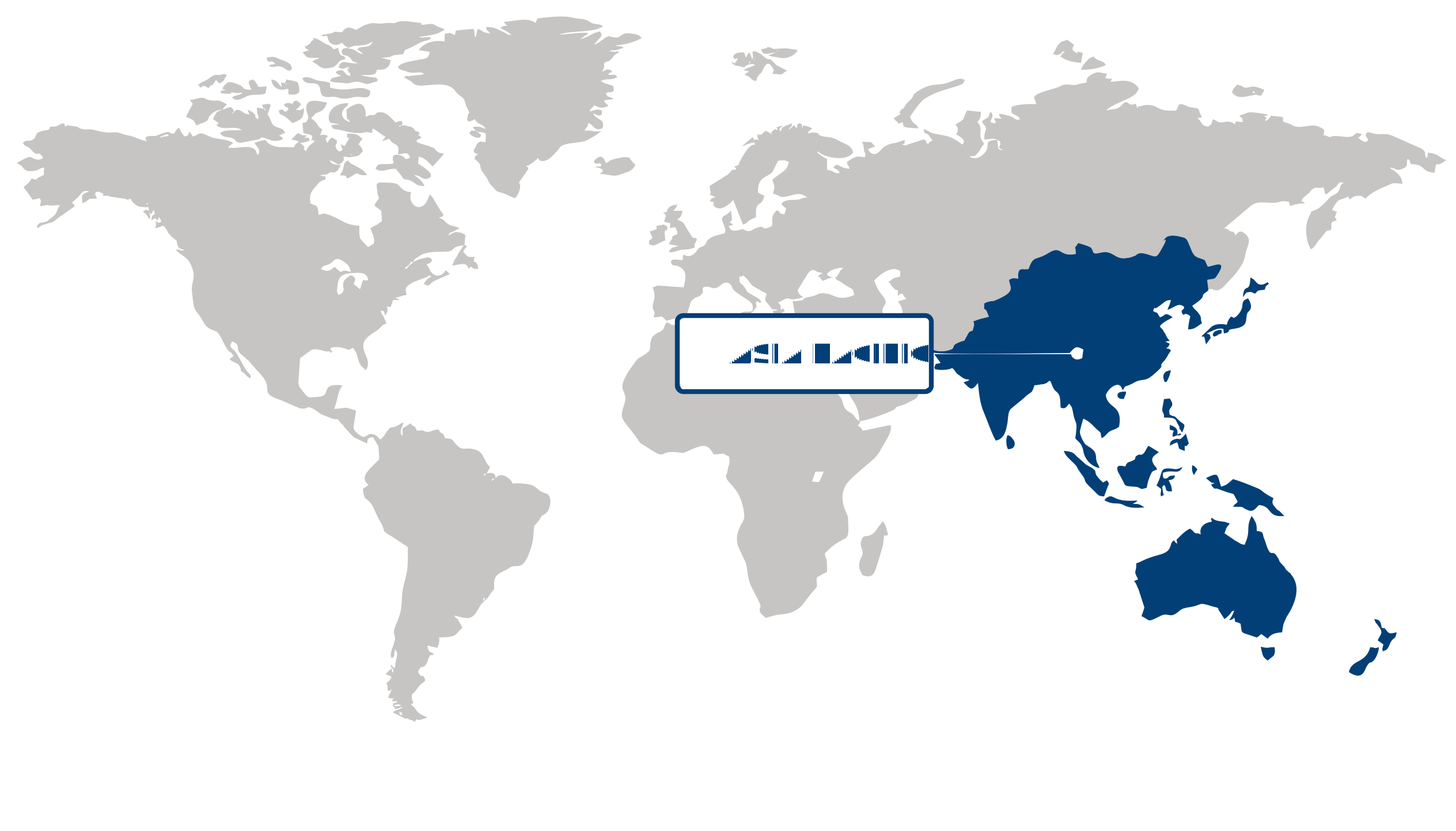
Asia Pacific (Largest & Fastest-Growing Region)
The Asia Pacific drilling polymers market accounted for the largest share of 41.34% in 2026 and is also the fastest-growing regional market, supported by expanding oil and gas exploration, drilling activity, and industrial infrastructure development. Drilling polymers are increasingly used to improve fluid performance, stabilize formations, control filtration, and enhance drilling efficiency under challenging operating conditions. The region's growing energy requirements are encouraging investment in exploration and production activities, creating sustained demand for specialized drilling fluid additives. Expanding unconventional and technically demanding drilling operations are also increasing the need for polymer systems that can provide effective rheological control and wellbore stability. In addition, the development of regional oilfield services and chemical manufacturing capabilities is strengthening supply availability and supporting broader adoption of drilling polymers.
| Parameter | North America | Asia Pacific | Europe | Latin America | MEA |
|---|---|---|---|---|---|
| Innovation Hub i Scale Nascent Developing Advanced | |||||
| Cost-Sensitive Region i Scale Low Medium High | |||||
| Regulatory Environment i Scale Restrictive Neutral Supportive | |||||
| Demand Drivers i Scale Weak Moderate Strong | |||||
| Development Stage i Scale Emerging Developing Developed | |||||
| Adoption Rate i Scale Low Medium High | |||||
| New Entrants / Startups i Scale Sparse Moderate Dense | |||||
| Macro Indicators i Scale Weak Stable Strong |
Key Country Insights
Germany 🇩🇪
Specialty Polymer DevelopmentGermany focuses on advanced drilling polymer formulations that deliver reliable rheological performance while meeting stringent environmental requirements. German suppliers continue refining specialty chemistries to support energy and geothermal drilling applications.
France 🇫🇷
Sustainable Drilling SolutionsFrance promotes drilling polymers that balance operational effectiveness with environmental considerations across energy exploration activities. French suppliers increasingly develop formulations that support responsible drilling practices without compromising fluid performance.
Italy 🇮🇹
Geothermal Application FocusItaly utilizes drilling polymers across geothermal and energy drilling projects requiring dependable wellbore stability. Italian service providers increasingly adopt advanced polymer systems that improve drilling efficiency while supporting diverse geological conditions.
Japan 🇯🇵
Precision Fluid EngineeringJapan applies drilling polymers in technically demanding drilling projects where fluid stability and operational consistency are critical. Japanese manufacturers emphasize high-quality polymer formulations compatible with increasingly sophisticated drilling technologies.
South Korea 🇰🇷
Offshore Supply SupportSouth Korea strengthens the drilling polymers market through its offshore engineering capabilities and specialized chemical manufacturing. Companies in South Korea focus on supplying durable polymer solutions that support efficient drilling fluid performance across energy projects.
United States 🇺🇸
Advanced Well PerformanceThe U.S. drilling polymers market emphasizes high-performance fluid systems for complex onshore and offshore drilling operations. Operators in the U.S. prioritize polymers that improve borehole stability, reduce fluid loss, and enhance drilling efficiency under demanding geological conditions.
Segment Leadership and Growth Trends
Drilling Polymers Market Share (%), by Type, 2026
Go beyond the chart, access full insights & data tables
Request Free Sample ReportType Segment Analysis: Polyacrylamide (Largest & Fastest-Growing Segment)
Polyacrylamide represented the largest and fastest-growing type segment in the drilling polymers market, accounting for 66.93% share in 2026. Its strong position is supported by its ability to modify drilling fluid properties and improve performance under demanding drilling conditions. Polyacrylamide-based polymers can contribute to fluid stability, shale inhibition, filtration control, and borehole stabilization, helping drilling operators manage formation-related challenges and maintain efficient operations. Their broad functionality makes them valuable across drilling environments where fluid performance directly influences operational reliability. Continued emphasis on improving drilling efficiency, maintaining wellbore stability, and controlling fluid behavior is therefore supporting sustained demand for polyacrylamide-based drilling polymers.
Technique Segment Analysis: Diamond Drilling (Largest Segment) vs Reverse Circulation Drilling (Fastest-Growing Segment)
Diamond drilling led the drilling polymers market by technique, accounting for 24.41% share in 2026, owing to its ability to deliver precise and high-quality core samples in exploration and drilling activities. The technique is particularly valuable where detailed geological information is required to evaluate subsurface formations and support resource assessment. Drilling polymers can enhance fluid performance during such operations by contributing to borehole stability, controlling fluid loss, and protecting core quality. Continued exploration activity and the need for reliable subsurface information are supporting the use of diamond drilling, while demand for improved drilling performance reinforces the role of polymer-based fluid additives.
Reverse circulation drilling is the fastest-growing technique segment as drilling operators increasingly seek efficient approaches for exploration and resource evaluation. The technique can provide rapid sample recovery and support drilling operations in challenging environments, making it attractive where productivity and timely geological information are important. Greater emphasis on efficient exploration workflows and improved access to subsurface data is encouraging adoption of reverse circulation methods. As drilling activities increasingly prioritize operational efficiency, sample quality, and faster evaluation of geological formations, demand for drilling polymers that support fluid stability and borehole performance is creating additional momentum for this technique.
| Segment | Sub-Segment | Largest Segment | Fastest Growing |
|---|---|---|---|
| Type | Polyacrylamide, Others | Polyacrylamide | Polyacrylamide |
| Technique | Down The Hole Drills (DTH)/Rotary Air Blast Drilling (RAB), Diamond Drilling, Top Hammer Drilling, Reverse Circulation Drilling, Others | Diamond Drilling | Reverse Circulation Drilling |
| End-Use | Mining, Oil & Gas, Construction, Others | Oil & Gas | Mining |
Competitive Landscape and Market Positioning
Major players in the drilling polymers market:
1. Halliburton Company (United States)
2. Baker Hughes Company (United States)
3. SLB (United States)
4. Chevron Phillips Chemical Company LLC (United States)
5. Di-Corp Holding Ltd. (Canada)
6. Baroid Industrial Drilling Products (United States)
7. Global Drilling Fluids and Chemicals Limited (India)
8. SINO MUD Group (China)
9. Newpark Resources Inc. (United States)
10. CETCO Energy Services Company LLC (United States)
The drilling polymers market is evolving with increasing demand for high-performance drilling fluid additives. Innovation is focused on improving well stability and operational efficiency. The drilling polymers market continues to expand as exploration activities become more technically demanding.
| Company | Market Share | Company Revenue | Revenue CAGR (%) | Product Portfolio | Geographic Presence | Innovation / R&D Focus | Strategic Developments |
|---|---|---|---|---|---|---|---|
| Halliburton Company (United States) | |||||||
| Baker Hughes Company (United States) | |||||||
| SLB (United States) | |||||||
| Chevron Phillips Chemical Company LLC (United States) | |||||||
| Di-Corp Holding Ltd. (Canada) | |||||||
| Baroid Industrial Drilling Products (United States) | |||||||
| Global Drilling Fluids and Chemicals Limited (India) | |||||||
| SINO MUD Group (China) | |||||||
| Newpark Resources Inc. (United States) | |||||||
| CETCO Energy Services Company LLC (United States). |
Industry Development/News
| Company Name | Date | Key Development |
|---|
Customize Your Report
Explore examples of how this report can be tailored to different research needs, including custom segments, additional topics or chapters, and related reports. Click a section of the wheel or its numbered marker to explore the available options.
Drilling Polymers Market — Custom Segments
| Segment | Sub-Segment |
|---|---|
| Drilling Fluid System | Water-Based Fluids, Oil-Based Fluids, Synthetic-Based Fluids |
| Well Type | Onshore Wells, Offshore Wells, Geothermal Wells, Mining & Exploration Wells |
| Procurement Model | Direct Procurement, Distributor-Based Procurement, Drilling Contractor Procurement |
Drilling Polymers Market — Custom TOC
| Custom Chapter | Custom Details |
|---|---|
| Unconventional Drilling Opportunity Assessment |
|
| Sustainable Drilling Fluid Strategy |
|
| Mud System Technology Adoption Analysis |
|
Need a different cut of the data?
Request Custom ResearchHow big is the drilling polymers market?
What is the expected industry size of drilling polymers by 2036?
Which operational trends are driving demand for advanced drilling polymer formulations?
How is the expansion of onshore exploration influencing procurement in the drilling polymers market?
Why is Polyacrylamide the leading type in the drilling polymers market?
Which drilling technique is growing fastest in the drilling polymers market?
Why does Asia Pacific lead the drilling polymers market?
What supports Asia Pacific's continued growth in the drilling polymers market?
Who are the major participants shaping the drilling polymers landscape?
Our Clients
"The report helped us understand emerging consumer trends in our product category. It clarified where to focus innovation for the next product launch."
LyondellBasell
"The regional forecast section was incredibly useful. We were able to identify two new potential partners in Europe thanks to the vendor mapping you included."
SABIC
"We appreciated how actionable the recommendations were. It guided us to improve supply chain resilience."
Olin Corporation
Our Research Team & Methodology
Every Fundamental Business Insights report is built by a dedicated vertical research team, validated through a structured primary-and-secondary methodology, and reviewed for accuracy before it reaches you.
Research Team Overview
Prepared by the Chemicals & Materials Research Team
Delivery
Published
Demand
Available
Support
Trust & Compliance
Research Domains
10 coverage areasResearch Intelligence
| Source | Reference |
|---|---|
| American Chemistry Council (ACC) | www.americanchemistry.com |
| European Chemical Industry Council (Cefic) | cefic.org |
| International Council of Chemical Associations (ICCA) | icca-chem.org |
| European Chemicals Agency (ECHA) | echa.europa.eu |
| U.S. Environmental Protection Agency (EPA) | www.epa.gov |
| ASTM International | www.astm.org |
| International Organization for Standardization (ISO) | www.iso.org |
| National Institute of Standards and Technology (NIST) | www.nist.gov |
| Plastics Industry Association (PLASTICS) | www.plasticsindustry.org |
| European Biplastics | www.european-bioplastics.org |
| The Adhesive and Sealant Council (ASC) | www.ascouncil.org |
| National Association of Corrosion Engineers (AMPP) | www.ampp.org |
| Society of Plastics Engineers (SPE) | www.4spe.org |
| International Fertilizer Association (IFA) | www.fertilizer.org |
| CropLife International | croplife.org |
| Packaging Europe | packagingeurope.com |
| Flexible Packaging Association (FPA) | www.flexpack.org |
| Battery Council International (BCI) | batterycouncil.org |
| International Copper Association (ICA) | internationalcopper.org |
| World Steel Association | worldsteel.org |
Research Workflow & Quality Assurance
Data Collection
Verified information gathered through primary and secondary research.
Data Triangulation
Cross-validation using multiple independent data sources.
Forecast Modelling
Market estimates developed using historical trends and analytical models.
Analyst Validation
Findings reviewed by domain experts for accuracy and consistency.
Editorial & Quality Review
Final editorial, quality, and compliance checks before publication.
Final Publication
Released after successful completion of the internal review process.
Report Coverage
📊 Market Assessment
- Market Size & Forecast
- Market Segmentation
- Regional Analysis
- Growth Drivers & Challenges
- Market Dynamics
🏢 Competitive Intelligence
- Competitive Landscape
- Company Profiles
- Competitive Benchmarking
- Mergers & Acquisitions
- Market Share Analysis or Key Company Strategies
🔍 Strategic Analysis
- Value Chain Analysis
- Porter's Five Forces
- PESTLE Analysis
- Pricing Trends
- Supply-Demand Analysis
🚀 Future Outlook
- Technology Landscape
- Regulatory Landscape
- Investment & Funding Landscape
- Emerging Opportunities
- Future Market Outlook
Have a question about this report or need a custom scope?
Request Customization