Disposable Plates Market Size & Growth Forecast 2027–2036, By Segments (Design, End Use, Product Type, Distribution Channel, Price), Regional Demand Trends (North America, Asia Pacific, Europe), Key Country Insights (U.S., Japan, South Korea, Germany, France, Italy), and Competitive Landscape
Market Size and Growth Outlook
Disposable Plates Market size was around USD 6.4 Billion in 2026 and is slated to grow at 5.41% CAGR from 2027 to 2036, crossing USD 10.84 Billion by 2036. The industry revenue for 2027 is assessed at USD 6.69 Billion.
Get more details on this report
Request Free Sample ReportDisposable Plates Market Intelligence Snapshot
Regional Market Dynamics
- Asia Pacific leads as foodservice, takeaway, delivery, catering, and organized retail expand, supported by urbanization, changing lifestyles, and stronger distribution networks.
- Rising incomes, evolving consumption habits, and growing demand for recyclable and biodegradable materials are supporting product adoption and market development across the region.
Segment Momentum
- Plain disposable plates held 65.28% of the market in 2026 because of their versatility, cost-effectiveness, manufacturing simplicity, and widespread use across households, foodservice businesses, catering, and takeaway applications.
- Paper plates are expected to witness the fastest growth as sustainability initiatives and environmental awareness encourage consumers and foodservice providers to adopt eco-friendly, biodegradable disposable serving solutions.
Market Expansion Drivers
- Increasing environmental awareness driving shift toward biodegradable and compostable disposable tableware
- Rising consumer preference for eco-friendly dining solutions boosting sustainable disposable plate demand
- Growth in food delivery and quick-service restaurants increasing demand for convenient disposable packaging solutions
Leading Market Participants
- Top companies in the disposable plates market include Huhtamäki Oyj (Finland), Dart Container Corporation (United States), Pactiv Evergreen Inc. (United States), International Paper Company (United States), Georgia-Pacific LLC (United States), Genpak LLC (United States), Duni Group AB (Sweden), Hotpack Packaging Industries LLC (United Arab Emirates), Vegware Ltd. (United Kingdom)
Global Market Forecast Snapshot
Market Outlook
- 2026 Market Size: USD 6.4 Billion
- 2027 Estimated Market Size: USD 6.69 Billion
- Projected Market Size: USD 10.84 Billion by 2036
- Growth Forecast: 5.41% CAGR (2027-2036)
Regional and Segment Outlook
- Leading Regional Market: Asia Pacific
- High-Growth Regional Hub: Asia Pacific
- Core Revenue Segment: Plain (Design) | Commercial (End Use) | Plastic Plates (Product Type) | Offline (Distribution Channel) | Low (Price)
- Emerging Opportunity Segment: Compartmental (Design) | Commercial (End Use) | Paper Plates (Product Type) | Online (Distribution Channel) | Medium (Price)
Market Growth Drivers and Industry Trends
Increasing environmental awareness driving shift toward biodegradable and compostable disposable tableware
Growing concerns regarding plastic waste and environmental sustainability are encouraging consumers and businesses to adopt biodegradable alternatives, which will drive the disposable plates market growth. Restaurants, event organizers, and households are increasingly seeking tableware solutions made from environmentally responsible materials that reduce ecological impact compared with conventional plastic products. This shift toward compostable and sustainable options is influencing manufacturers to develop disposable plates that align with changing consumer expectations and environmental preferences.
Rising consumer preference for eco-friendly dining solutions boosting sustainable disposable plate demand
The disposable plates market growth is supported by changing consumer behavior, as environmentally conscious buyers increasingly prefer dining products that combine convenience with sustainability. Consumers are becoming more selective about single-use products and are favoring options that minimize waste while maintaining functionality for everyday meals, gatherings, and outdoor activities. This preference is encouraging suppliers to expand sustainable disposable tableware offerings across retail and foodservice channels.
Growth in food delivery and quick-service restaurants increasing demand for convenient disposable packaging solutions
Expansion of food delivery services and quick-service restaurant networks will boost the disposable plates market demand by increasing the need for practical and hygienic serving solutions. Foodservice operators rely on disposable tableware to improve operational efficiency, simplify handling, and support takeaway consumption patterns. The growing popularity of ready-to-eat meals and convenient dining formats is increasing the requirement for lightweight, durable, and easily disposable plate options across foodservice applications.
| Growth Driver | Impact on CAGR | Regulatory Influence | Geographic Relevance | Adoption Rate | Impact Timeline |
|---|---|---|---|---|---|
| Increasing environmental awareness driving shift toward biodegradable and compostable disposable tableware | 1.8% | High | North America, Europe, Asia Pacific | High | Near Term |
| Rising consumer preference for eco-friendly dining solutions boosting sustainable disposable plate demand | 1.6% | Moderate | Europe, North America | High | Near Term |
| Growth in food delivery and quick-service restaurants increasing demand for convenient disposable packaging solutions | 1.4% | Low | Asia Pacific, North America | High | Mid Term |
Unlock insights tailored to your business with our bespoke market research solutions.
Click to get your customized report now.
Regional Demand Dynamics
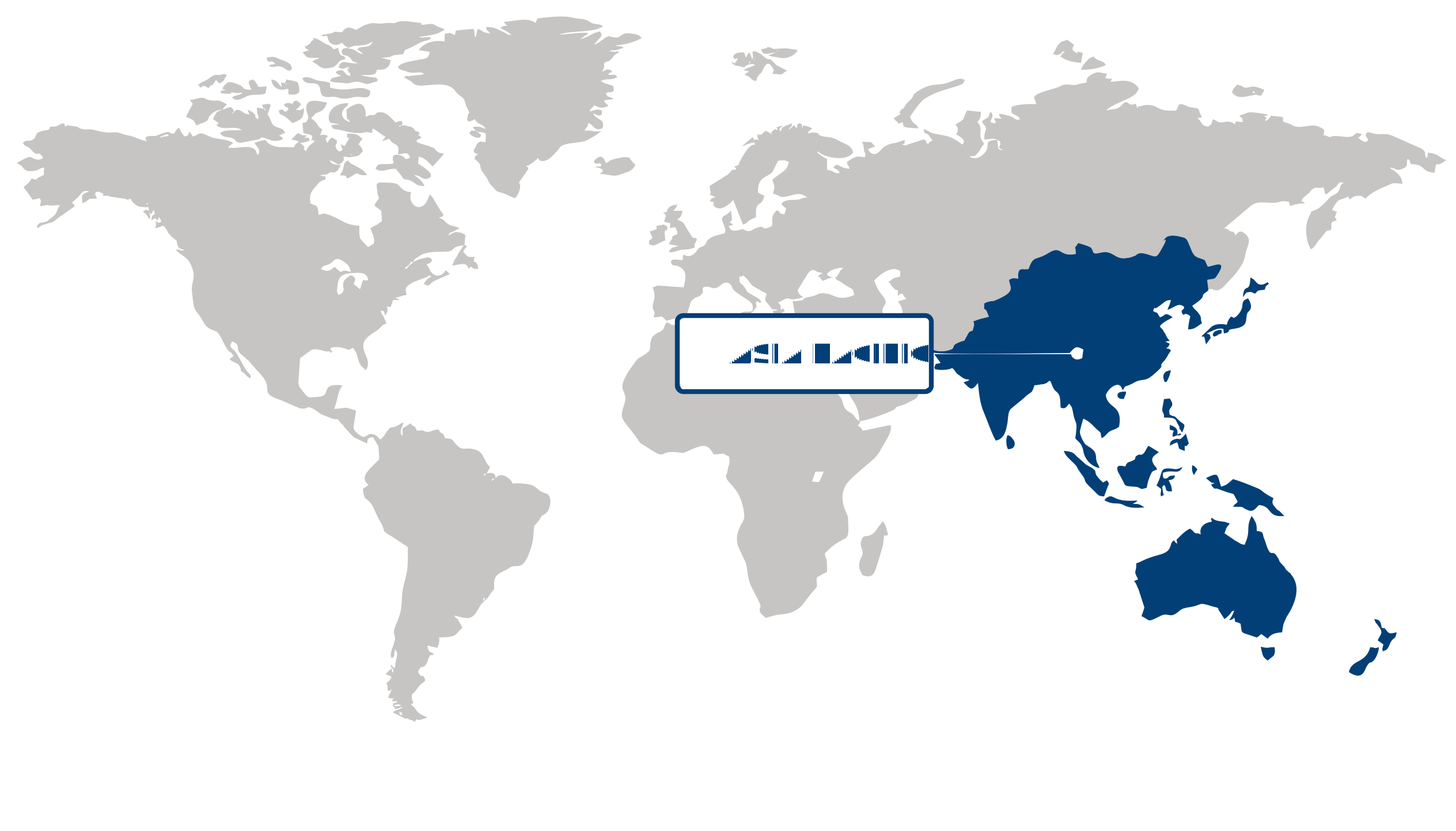
Asia Pacific (Largest & Fastest-Growing Region)
The disposable plates market was led by Asia Pacific in 2026, with the region also representing the fastest-growing market. Expanding foodservice activity, urbanization, and changing consumer lifestyles are supporting greater demand for convenient serving and dining solutions. The growing prevalence of takeaway meals, food delivery, catering, and organized retail is broadening the use of disposable plates across residential and commercial settings. Rising disposable incomes and evolving consumption habits are further encouraging demand, while improvements in manufacturing capacity and distribution networks are strengthening product availability throughout the region. Increasing attention to recyclable and biodegradable materials is also influencing product development as consumers and regulators place greater emphasis on waste management and environmental sustainability.
| Parameter | North America | Asia Pacific | Europe | Latin America | MEA |
|---|---|---|---|---|---|
| Innovation Hub i Scale Nascent Developing Advanced | |||||
| Cost-Sensitive Region i Scale Low Medium High | |||||
| Regulatory Environment i Scale Restrictive Neutral Supportive | |||||
| Demand Drivers i Scale Weak Moderate Strong | |||||
| Development Stage i Scale Emerging Developing Developed | |||||
| Adoption Rate i Scale Low Medium High | |||||
| New Entrants / Startups i Scale Sparse Moderate Dense | |||||
| Macro Indicators i Scale Weak Stable Strong |
Key Country Insights
United States 🇺🇸
Convenience ConsumptionThe U.S. disposable plates market is influenced by food delivery, outdoor gatherings, and institutional foodservice demand. Buyers increasingly prefer products combining convenience with improved material sustainability and compliance with changing environmental expectations.
Germany 🇩🇪
Sustainable Material ShiftGermany places strong emphasis on disposable plates made from recyclable, compostable, and fiber-based materials. Manufacturers respond by expanding environmentally responsible product portfolios that align with stricter packaging and waste management practices.
Japan 🇯🇵
Premium Disposable SolutionsJapan values disposable plates offering high product quality, attractive presentation, and reliable performance for convenience retail and catering applications. Product development focuses on lightweight construction, hygiene, and efficient storage characteristics.
South Korea 🇰🇷
Foodservice Packaging DemandSouth Korea supports disposable plates through expanding takeaway dining, cafés, and delivery services. Suppliers prioritize durable, aesthetically appealing products that accommodate diverse food formats while addressing growing interest in environmentally preferable materials.
France 🇫🇷
Eco-Friendly Catering FocusFrance encourages disposable plates that reduce environmental impact while meeting hospitality and event industry requirements. Companies continue introducing bio-based and recyclable alternatives that balance functionality with evolving regulatory expectations.
Italy 🇮🇹
Hospitality Event SupplyItaly maintains consistent disposable plates demand across catering, tourism, and seasonal events. Businesses seek practical products offering attractive design, dependable strength, and improved sustainability to serve professional foodservice applications effectively.
Segment Leadership and Growth Trends
Disposable Plates Market Share (%), by Design, 2026
Go beyond the chart, access full insights & data tables
Request Free Sample ReportDesign Segment Analysis: Plain (Largest Segment) vs Compartmental (Fastest-Growing Segment)
In the disposable plates market, the plain design segment captured 65.28% of the market share in 2026. Its dominance is driven by broad consumer acceptance, manufacturing simplicity, and versatility across household, foodservice, and catering applications. Plain disposable plates are suitable for serving a wide variety of food items, making them a preferred choice for restaurants, events, and takeaway services. Their cost-effectiveness and ease of large-scale production further contribute to their widespread adoption.
The compartmental design segment is anticipated to record the fastest growth as demand rises for convenient meal presentation and portion separation. Increasing consumption of packaged meals, institutional food services, and takeaway offerings is encouraging the use of compartmental plates that help maintain food quality by preventing mixing of different items. Growing preference for organized food packaging solutions is expected to support continued expansion of this segment.
End Use Segment Analysis: Commercial (Largest & Fastest-Growing Segment)
The commercial end-use segment dominated the disposable plates market, accounting for 93.1% in 2026, while also emerging as the fastest-growing segment. Strong demand from restaurants, catering companies, quick-service outlets, food delivery providers, and large-scale event organizers continues to drive consumption. The increasing need for hygienic, convenient, and efficient serving solutions, combined with the expansion of organized foodservice operations and takeaway culture, reinforces the segment’s market leadership and sustained growth potential.
Product Type Segment Analysis: Plastic Plates (Largest Segment) vs Paper Plates (Fastest-Growing Segment)
The plastic plates segment held the largest market share of 58.72% in 2026 due to its durability, lightweight nature, and suitability for handling a wide range of food types. These plates are widely utilized across commercial foodservice operations and social gatherings where strength, convenience, and affordability are important considerations. Established manufacturing capabilities and extensive product availability have further strengthened the segment’s leading position.
Within the disposable plates market, the paper plates segment is expected to grow at the fastest pace as environmental awareness and sustainability initiatives encourage greater adoption of eco-friendly alternatives. Consumers and foodservice providers are increasingly seeking disposable products with lower environmental impact, prompting a shift toward paper-based options. Continued innovation in biodegradable materials and improvements in product performance are expected to accelerate demand for this segment.
| Segment | Sub-Segment | Largest Segment | Fastest Growing |
|---|---|---|---|
| Design | Compartmental, Plain | Plain | Compartmental |
| End Use | Residential, Commercial | Commercial | Commercial |
| Product Type | Plastic Plates, Aluminum Plates, Paper Plates, Others | Plastic Plates | Paper Plates |
| Distribution Channel | Online, Offline | Offline | Online |
| Price | Low, Medium, High | Low | Medium |
Competitive Landscape and Market Positioning
Prominent players in the disposable plates market:
- Huhtamäki Oyj (Finland)
- Dart Container Corporation (United States)
- Pactiv Evergreen, Inc. (United States)
- International Paper Company (United States)
- Georgia-Pacific LLC (United States)
- Genpak LLC (United States)
- Duni Group AB (Sweden)
- Hotpack Packaging Industries LLC (United Arab Emirates)
- Vegware Ltd. (United Kingdom)
Competitive dynamics are increasingly shaped by the transition from conventional single-use products toward materials and manufacturing approaches that better align with changing environmental expectations and purchasing preferences. Producers are expanding beyond basic cost competition by developing disposable plates with improved strength, heat resistance, and suitability for a wider range of food service applications, allowing greater differentiation in a traditionally standardized product category. Material innovation is becoming a central strategic focus as suppliers balance functionality with sustainability objectives while responding to evolving regulatory requirements and institutional procurement standards. Distribution efficiency and the ability to consistently supply diverse end-use channels further reinforce competitive positioning in a market where product availability remains a critical purchasing consideration.
| Company | Market Share | Company Revenue | Revenue CAGR (%) | Product Portfolio | Geographic Presence | Innovation / R&D Focus | Strategic Developments |
|---|---|---|---|---|---|---|---|
| Huhtamäki Oyj (Finland) | |||||||
| Dart Container Corporation (United States) | |||||||
| Pactiv Evergreen Inc. (United States) | |||||||
| International Paper Company (United States) | |||||||
| Georgia-Pacific LLC (United States) | |||||||
| Genpak LLC (United States) | |||||||
| Duni Group AB (Sweden) | |||||||
| Hotpack Packaging Industries LLC (United Arab Emirates) | |||||||
| Vegware Ltd. (United Kingdom) |
Industry Development/News
| Company Name | Date | Key Development |
|---|---|---|
| Pactiv Evergreen | May-25 | Pactiv Evergreen launched a next-generation bagasse plate production line across three of its domestic manufacturing facilities. The capacity expansion adds an annual volume of 200 million units and secures full ASTM D6400 compostability certification to target industrial accounts. |
| GreenBox | Mar-25 | GreenBox introduced a sustainable alternative packaging solution that transforms standard pizza boxes into functional plates and storage containers, targeting circular economy waste reduction and driving new product design formats within the commercial food service market. |
| Huhtamaki Oyj | Mar-25 | Huhtamaki Oyj consolidated its European fiber-based foodservice packaging operations by merging four separate manufacturing sites across Finland, Germany, and Poland. The structural reorganization unites operations under a single development platform to streamline supply chain efficiency and accelerate product innovation. |
| Dart Container Corporation | Oct-24 | Dart Container Corporation entered into a strategic production partnership with a domestic biopolymer manufacturer to commercialize EcoLock PRO. The newly developed PHA-enhanced compostable plate line specifically targets expansion into premium catering and institutional food service distribution channels. |
| Reynolds Consumer Products | Jun-24 | Reynolds Consumer Products scaled up its sustainable product footprint by expanding the distribution of its Hefty ECOSAVE compostable plate portfolio. The expansion introduces three new product sizes and a multi-compartment tray format through major national retail accounts including Walmart, Target, and Amazon. |
| Biopac India Corporation | Mar-24 | Biopac India Corporation commissioned a dedicated bagasse plate manufacturing plant in Pune, India. The greenfield facility adds 1.5 billion units of annual capacity, significantly boosting production capabilities to serve regional Quick Service Restaurants alongside dedicated export programs to Europe and the Middle East. |
Customize Your Report
Explore examples of how this report can be tailored to different research needs, including custom segments, additional topics or chapters, and related reports. Click a section of the wheel or its numbered marker to explore the available options.
Disposable Plates Market — Custom Segments
| Segment | Sub-Segment |
|---|---|
| Sustainability Positioning | Conventional Plates, Recyclable Plates, Compostable Plates, Biodegradable Plates |
| Foodservice Application | Restaurants & Cafes, Catering & Events, Institutional Foodservice, Takeaway & Delivery |
| Purchase Volume | Consumer Packs, Small-Business Purchases, Bulk Foodservice Purchases, Institutional Purchases |
Disposable Plates Market — Custom TOC
| Custom Chapter | Custom Details |
|---|---|
| Sustainable Material Transition |
|
| Foodservice Procurement Dynamics |
|
| End-of-Life Recovery Ecosystem |
|
Need a different cut of the data?
Request Custom ResearchHow big is the disposable plates market?
How will the disposable plates industry grow in terms of size and CAGR by 2036?
How is sustainability influencing purchasing behavior in the disposable plates market?
Why is foodservice expansion supporting demand for disposable plates?
Why do plain disposable plates dominate the disposable plates market?
Which product type is expected to grow the fastest in the disposable plates market?
Why does Asia Pacific lead the disposable plates market?
How is Asia Pacific driving future growth in disposable plates?
Who are the major participants shaping the disposable plates landscape?
Our Clients
"The report provided us with a clear direction, and the level of detail was beyond what we expected. I would definitely recommend their services to others."
Haier Appliances
"The collaboration with Fundamental Business Insights has added significant value to our decision-making process, and we look forward to continuing this partnership for our future market research requirements."
Luxottica Group S.p.A.
"The team at FBI delivered an exceptional research report. The insights on industry innovations were particularly impressive and added a lot of value to the overall report."
Nike
Our Research Team & Methodology
Every Fundamental Business Insights report is built by a dedicated vertical research team, validated through a structured primary-and-secondary methodology, and reviewed for accuracy before it reaches you.
Research Team Overview
Prepared by the Consumer Goods & Services Research Team
Delivery
Published
Demand
Available
Support
Trust & Compliance
Research Domains
10 coverage areasResearch Intelligence
| Source | Reference |
|---|---|
| International Organization for Standardization (ISO) | www.iso.org |
| ASTM International | www.astm.org |
| U.S. Consumer Product Safety Commission (CPSC) | www.cpsc.gov |
| European Commission – Consumer Safety | ec.europa.eu/safety-gate |
| Consumer Technology Association (CTA) | www.cta.tech |
| National Retail Federation (NRF) | nrf.com |
| World Retail Congress | www.worldretailcongress.com |
| World Travel & Tourism Council (WTTC) | wttc.org |
| UN Tourism | www.unwto.org |
| Personal Care Products Council (PCPC) | www.personalcarecouncil.org |
| Cosmetics Europe | cosmeticseurope.eu |
| International Housewares Association (IHA) | www.housewares.org |
| American Apparel & Footwear Association (AAFA) | www.aafaglobal.org |
| World Federation of the Sporting Goods Industry (WFSGI) | wfsgi.org |
| Juvenile Products Manufacturers Association (JPMA) | www.jpma.org |
| Pet Industry Joint Advisory Council (PIJAC) | pijac.org |
| International Council of Toy Industries (ICTI) | www.toy-icti.org |
| International Association of Amusement Parks and Attractions (IAAPA) | iaapa.org |
| Organisation for Economic Co-operation and Development (OECD) | www.oecd.org |
| World Bank Data | data.worldbank.org |
Research Workflow & Quality Assurance
Data Collection
Verified information gathered through primary and secondary research.
Data Triangulation
Cross-validation using multiple independent data sources.
Forecast Modelling
Market estimates developed using historical trends and analytical models.
Analyst Validation
Findings reviewed by domain experts for accuracy and consistency.
Editorial & Quality Review
Final editorial, quality, and compliance checks before publication.
Final Publication
Released after successful completion of the internal review process.
Report Coverage
📊 Market Assessment
- Market Size & Forecast
- Market Segmentation
- Regional Analysis
- Growth Drivers & Challenges
- Market Dynamics
🏢 Competitive Intelligence
- Competitive Landscape
- Company Profiles
- Competitive Benchmarking
- Mergers & Acquisitions
- Market Share Analysis or Key Company Strategies
🔍 Strategic Analysis
- Value Chain Analysis
- Porter's Five Forces
- PESTLE Analysis
- Pricing Trends
- Supply-Demand Analysis
🚀 Future Outlook
- Technology Landscape
- Regulatory Landscape
- Investment & Funding Landscape
- Emerging Opportunities
- Future Market Outlook
Have a question about this report or need a custom scope?
Request Customization