Digital Inks Market Size & Forecasts 2026-2035, By Segments (Formulation, Application), Growth Opportunities, Innovation Landscape, Regulatory Shifts, Strategic Regional Insights (U.S., Japan, China, South Korea, UK, Germany, France), and Competitive Dynamics (HP, Sun Chemical, Fujifilm, DIC Corporation, Flint Group)
Market Size and Growth Outlook
Digital Inks Market size is predicted to expand from USD 5.17 billion in 2025 to USD 12.7 billion by 2035, with growth underpinned by a CAGR above 9.4% between 2026 and 2035. The industry revenue outlook for 2026 is USD 5.59 billion.
Get more details on this report
Request Free Sample ReportDigital Inks Market Intelligence Snapshot
Regional Market Dynamics
Segment Momentum
Market Expansion Drivers
Leading Market Participants
Global Market Forecast Snapshot
Market Outlook
Regional and Segment Outlook
Market Growth Drivers and Industry Trends
Major brand-level shifts toward personalized, short-run and sustainable packaging and textile solutions are driving increased uptake of digital printing, enlarging the digital inks market. Evidence includes Nestlé’s public packaging roadmap and H&M’s investments in on‑demand textile printing, reinforced by product launches from Heidelberg and visibility at drupa trade shows that underscore conversion from analog to digital presses. Incumbents can leverage scale, supply-chain relationships and formulation expertise to serve large CPG and apparel customers, while new entrants can capture niche customization and regional quick‑turn work. Given ongoing brand commitments and continued trade‑show innovation, demand for digitally printed substrates across packaging and textiles is likely to remain a primary volume driver in near‑term commercial activity.
Shift to Eco‑friendly and Functional Ink Formulations
Stricter chemical standards and corporate sustainability targets are accelerating development of low‑migration, low‑VOC and bio‑based inks, reshaping the digital inks market. Regulatory momentum from the European Chemicals Agency (ECHA) on substance restrictions and supplier announcements from Siegwerk and Sun Chemical about recyclable‑packaging compatible and functional ink ranges provide concrete examples. Established formulators can protect margins by investing in certified, compliant chemistries and closed‑loop recyclability claims; smaller innovators can differentiate with patentable bio‑polymers and niche food‑contact solutions. Observable regulatory actions and major suppliers’ product rollouts signal a structural shift toward greener formulations as baseline market requirement.
Convergence with Smart Packaging, Printed Electronics, and 3D Printing
Integration of conductive, NFC and additive manufacturing applications is expanding addressable use cases for inks, altering value chains within the digital inks market. Examples include Avery Dennison’s smart‑label initiatives, Thin Film Electronics ASA’s printed NFC deployments, Henkel and DuPont’s conductive ink programs, and research outputs from Fraunhofer FEP on printed electronics. Legacy ink manufacturers can monetize platforms and system compatibility, while agile entrants can partner with electronics firms or OEMs to supply specialized functional inks. The stream of product collaborations and academic‑industry transfers already visible suggests continued cross‑sector adoption where packaging, sensors and additive manufacturing converge on ink‑based solutions.
Industry Restraints:
Regulatory Compliance Burdens (REACH, TSCA, Proposition 65) — Stringent chemical controls and evolving food-contact and consumer-safety rules restrict formulation choices and lengthen time-to-market, forcing higher testing and documentation costs for digital inks. European Chemicals Agency (ECHA) restrictions under REACH on certain azo dyes and aromatic amines, U.S. Environmental Protection Agency (EPA) obligations under the Toxic Substances Control Act (TSCA), and the California Office of Environmental Health Hazard Assessment (OEHHA) Proposition 65 list have already driven reformulation needs for packaging and textile inks. The result is slower innovation cycles and scale advantages for established suppliers with compliance infrastructure, while smaller entrants face steep certification burdens. Expect continued regulatory tightening to favor low-migration, water-based chemistries and to consolidate suppliers that can amortize compliance investments over the near to medium term.
Printhead Compatibility and Standardization Barriers — Fragmented printhead architectures and tight rheological tolerances constrain ink universality, increasing field failures and customer reluctance to switch suppliers. Printhead manufacturers such as Xaar publish strict limits on viscosity, particle size, and surface tension, and OEMs including HP Inc. document performance and warranty impacts tied to non‑approved consumables; ink formulators like Nazdar emphasize bespoke co‑development for specific heads. This fragmentation raises qualification costs, advantaging incumbents that supply matched ink-and-head systems and discouraging pure-play formulators without co‑engineering partnerships. Absent industry-wide interoperability standards, expect continued vertical partnerships and premium pricing for validated ink/printhead solutions in the near to medium term.
| Growth Driver | Impact on CAGR | Regulatory Influence | Geographic Relevance | Adoption Rate | Impact Timeline |
|---|---|---|---|---|---|
| Rising demand in packaging, textiles, and printing industries | 3.50% | Short term (≤ 2 yrs) | North America, Europe | Low | Fast |
| Development of eco-friendly and functional digital inks | 3.00% | Medium term (2–5 yrs) | Asia Pacific, North America | Medium | Moderate |
| Integration in smart packaging, electronics, and 3D printing | 2.90% | Long term (5+ yrs) | Europe, Asia Pacific; Spillover: North America | Low | Slow |
Unlock insights tailored to your business with our bespoke market research solutions.
Click to get your customized report now.
Regional Demand Dynamics
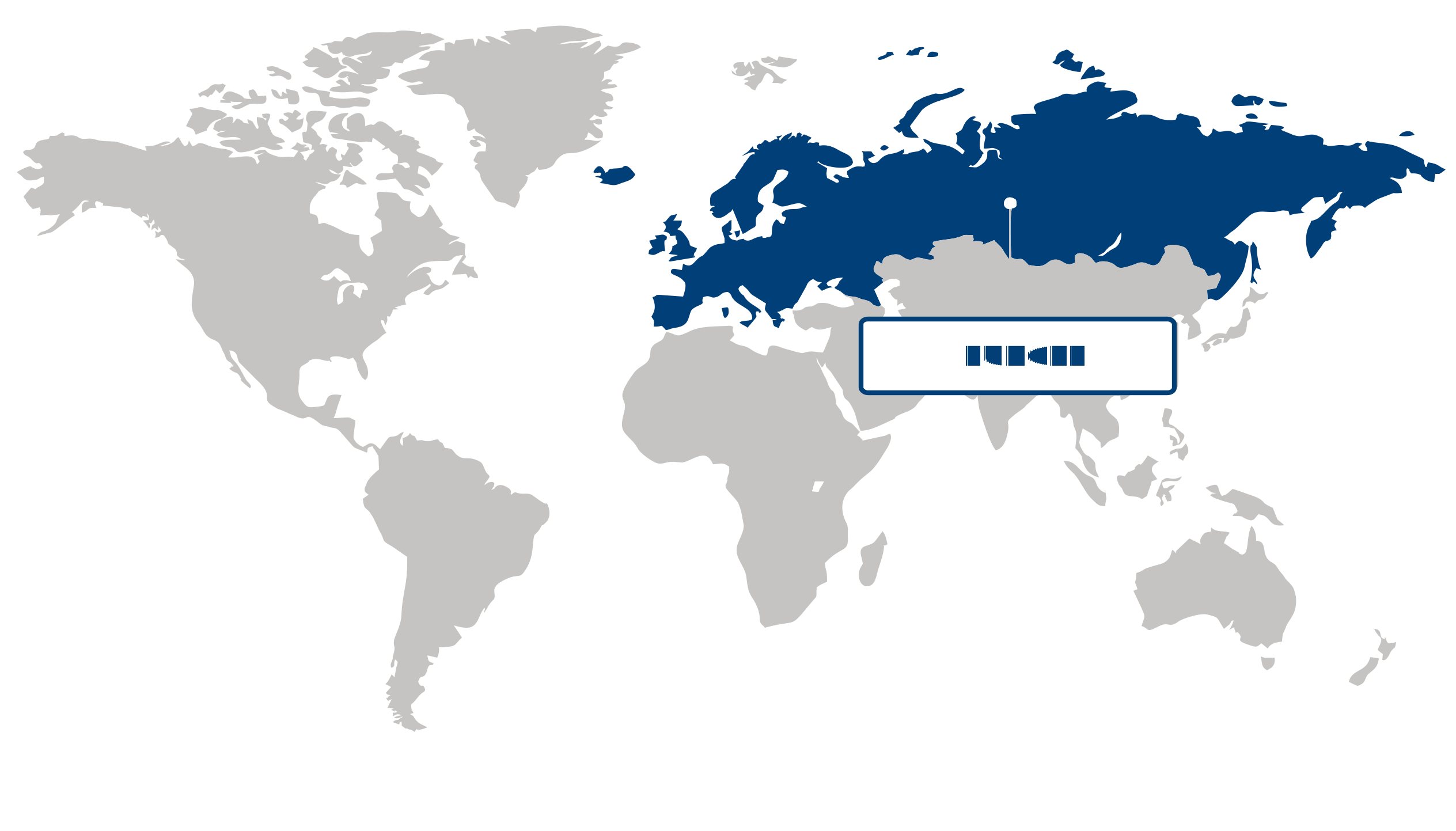
Europe captured approximately 38% of the global digital inks market in 2025, the largest regional share driven by strong textile printing, packaging and commercial print demand across the continent. Eurostat manufacturing data show resilient output in apparel and printed packaging segments while the European Commission’s Circular Economy Action Plan and packaging directives are accelerating adoption of lower-solvent and UV/LED-curable formulations; suppliers such as Sun Chemical and Siegwerk are publicly positioning portfolios for these shifts. The convergence of advanced press suppliers, converter investment, and sustainability mandates creates sustained demand and attractive entry points for investors focused on product innovation and supply-chain differentiation in Europe.
Germany anchors Europe’s industrial printing and OEM ecosystem and the digital inks market is deeply integrated with its advanced manufacturing base. Policy support for digitalization from the Bundesministerium für Wirtschaft und Klimaschutz and equipment roadmaps from Heidelberger Druckmaschinen and Koenig & Bauer reinforce rapid uptake of process-stable inks for high-throughput commercial and packaging runs; local converters prioritize reliability and long-term service contracts, strengthening Germany’s role as a scale market that amplifies regional supply-chain opportunities.
France is positioned as a pivotal hub where fashion, luxury and sustainable packaging requirements shape the digital inks market. Demand patterns led by major brands such as LVMH and Kering, together with environmental stewardship steered by ADEME and industry training from Institut Français de la Mode, favor specialty textile inks and recyclable packaging-compatible chemistries; this creates a laboratory for premium applications that complements Germany’s volume-driven leadership and fuels broader European commercialization.
Asia Pacific Market Analysis:
Asia Pacific emerged as the fastest-growing region at a CAGR of 11.2% in the digital inks market, propelled by expanding textile production and rising wide-format printing demand across apparel, soft signage, and commercial graphics. Rapid scaling of textile capacity in China and Southeast Asia, coupled with growing on-demand customization from e-commerce brands, has driven OEMs and ink suppliers to prioritize APAC: Mimaki Engineering Co., Ltd. and Seiko Epson Corporation have announced new textile and wide-format printer models and regional service investments, while the China National Bureau of Statistics documents continued textile output expansion. Environmental policy shifts and manufacturing modernization programs—cited by the Ministry of Ecology and Environment of the PRC and Japan’s Ministry of Economy, Trade and Industry—are accelerating adoption of water-saving digital inks. These dynamics position APAC to capture premium, high-volume ink sales and recurring consumables demand over the medium term.
China is the region's manufacturing powerhouse and a principal market for the digital inks market, where large-scale textile mills and fast-fashion converters drive volume and rapid SKU turnover. Domestic demand for digitally printed apparel and home textiles, supported by supply-chain integration and rapid e-commerce fulfillment, has encouraged investment in digital textile printers and eco-friendly ink systems; the China National Textile and Apparel Council (CNTAC) notes industry upgrades toward digital printing, and corporate releases from Mimaki Engineering Co., Ltd. and Seiko Epson Corporation highlight expanded China-focused product offerings. Regulatory pressure to reduce water and chemical use is nudging mills toward pigment and reactive digital inks, creating immediate opportunities for suppliers with compliant formulations and local technical support.
Japan is a technology and innovation leader shaping the digital inks market in APAC, supplying advanced ink formulations, printheads, and workflow systems that enable high-value applications. Japanese OEMs such as Mimaki Engineering Co., Ltd., Seiko Epson Corporation, and Ricoh Company, Ltd. regularly publish product and partnership announcements for textile and industrial wide-format printing, supporting quality-conscious segments like luxury apparel, automotive interiors, and technical textiles. High-skilled manufacturers and tight supplier networks allow rapid prototyping and integrated ink-substrate solutions; Japan External Trade Organization (JETRO) analyses emphasize Japanese firms’ role in exporting printing know-how. For investors and strategists, Japan’s innovation ecosystem offers premium product roadmaps and commercialization pathways that reinforce APAC’s broader growth in digital inks.
North America Market Trends:
Held a commanding share, North America’s digital inks market benefits from robust demand in packaging, labels and commercial print as buyers prioritize sustainability, shorter runs and faster time-to-market. Evidence from the U.S. Environmental Protection Agency on VOC limits has accelerated uptake of UV‑curable and water‑based formulations, while Sun Chemical and EFI product announcements illustrate active formulation innovation and process integration. Trade activity at Printing United Alliance events and statements from the United States Department of Commerce about manufacturing resilience underscore supply‑chain adjustments and onshoring. These dynamics position the region for continued premiumization in specialty and low‑emission inks and growth in customized, short‑run packaging solutions.
The U.S. acts as the primary growth engine for the digital inks market, driven by a large commercial print base, advanced OEM presence and high technology adoption among converters and brand owners. HP Inc., Xerox and EFI have rolled out inkjet platforms and ink portfolios targeted at packaging and industrial printing, while Sun Chemical’s U.S. investments and Printing United Alliance member activity signal strong commercial adoption. This concentration of demand and OEM partnerships makes the U.S. a strategic launchpad for differentiated formulations, collaborative R&D and onshore supply agreements that amplify North American opportunities.
| Parameter | North America | Asia Pacific | Europe | Latin America | MEA |
|---|---|---|---|---|---|
| Innovation Hub i Scale Nascent Developing Advanced | |||||
| Cost-Sensitive Region i Scale Low Medium High | |||||
| Regulatory Environment i Scale Restrictive Neutral Supportive | |||||
| Demand Drivers i Scale Weak Moderate Strong | |||||
| Development Stage i Scale Emerging Developing Developed | |||||
| Adoption Rate i Scale Low Medium High | |||||
| New Entrants / Startups i Scale Sparse Moderate Dense | |||||
| Macro Indicators i Scale Weak Stable Strong |
Segment Leadership and Growth Trends
Digital Inks Market Share (%), by Formulation, 2026
Go beyond the chart, access full insights & data tables
Request Free Sample ReportSolvent-Based dominated the digital inks market in 2025 as the largest share, driven by strong industrial and commercial printing demand for robust adhesion and outdoor durability. Manufacturers such as Sun Chemical and DIC highlight solvent formulations for large-format signage and packaging applications, supporting this leadership amid supply-chain scale advantages and OEM compatibility with established press fleets. Customer preference for long-lasting outdoor graphics, regulatory trade-offs around VOCs led by the U.S. EPA, and ongoing equipment optimization sustain demand while opening avenues for lower-VOC solvent blends. The segment offers strategic advantages to incumbents through distribution and R&D scale and to nimble entrants via specialty low-emission chemistries, and it should remain central near term as industrial printing requirements and retrofitting cycles continue.
Analysis by Application
Advertising & Promotion represented largest share of the digital inks market in 2025, propelled by growth in digital printing for advertising, packaging, and promotional materials and by demand for short runs and personalization. Industry organizations such as FESPA and PRINTING United Alliance document rapid adoption of wide-format and UV technologies for banners, point-of-sale, and experiential campaigns, reflecting brand-driven shifts and seasonal demand patterns. Sustainability preferences favor UV-cured and eco-solvent inks, creating product differentiation opportunities; established printers gain margin via integrated services while startups capture niche fast-turn and personalized offerings. Continued brand investment in targeted, digitally printed media and advances in inkjet and curing systems underpin sustained relevance through the near-to-medium term.
| Segment | Sub-Segment | Largest Segment | Fastest Growing |
|---|---|---|---|
| Formulation | Solvent-Based, Water-Based, UV-Cured | ||
| Application | Advertising & Promotion, Ceramic Tiles Printing, Clothing & Household Textiles, Others |
Competitive Landscape and Market Positioning
The competitive landscape is marked by strategic moves that broaden application reach, enhance supply reliability, and accelerate platform capabilities: market leaders have integrated complementary capabilities, tightened ties with press manufacturers, and advanced sustainable formulations and workflow tools. Some have consolidated manufacturing to improve consistency and service, while others focus on niche advantages—high-speed textile, UV/LED, or food-contact-safe inks—to protect margins and secure converter partnerships, driving faster product differentiation across segments.
Strategic / Actionable Recommendations for Regional Players
North America: Prioritize co-development pathways with OEMs and large converters, augment digital services (color management, remote diagnostics), and reinforce pigment and LED-curing capabilities to win label and short-run packaging business.
Asia Pacific: Invest in localized formulation and application labs, align closely with regional press makers and converters to deliver cost-effective, tailored inks, and concentrate on textile and flexible-packaging demand tied to regional supply chains.
Europe: Accelerate adoption of low-impact chemistries and regulatory-aligned formulations, deepen technology linkages with equipment vendors, and pursue premium packaging niches where recyclability and traceability add value.
| Company | Market Share | Company Revenue | Revenue CAGR (%) | Product Portfolio | Geographic Presence | Innovation / R&D Focus | Strategic Developments |
|---|---|---|---|---|---|---|---|
| No companies available. | |||||||
Industry Development/News
| Company Name | Date | Key Development |
|---|
Customize Your Report
Explore examples of how this report can be tailored to different research needs, including custom segments, additional topics or chapters, and related reports. Click a section of the wheel or its numbered marker to explore the available options.
Digital Inks Market — Custom Segments
| Segment | Sub-Segment |
|---|---|
| No segment data available. | |
Digital Inks Market — Custom TOC
| Custom Chapter | Custom Details | ||
|---|---|---|---|
| No custom TOC data available. | |||
Need a different cut of the data?
Request Custom ResearchWhat is the current revenue of the digital inks market?
What are the growth projections for the digital inks industry?
What is the leading region in terms of digital inks market share?
Which region leads in terms of year-over-year growth for the digital inks sector?
How does solvent-based segment fare in the digital inks industry?
What share does advertising & promotion segment hold in the digital inks sector as of 2025?
Which companies are driving growth in the digital inks landscape?
Our Clients
"The report helped us understand emerging consumer trends in our product category. It clarified where to focus innovation for the next product launch."
LyondellBasell
"The regional forecast section was incredibly useful. We were able to identify two new potential partners in Europe thanks to the vendor mapping you included."
SABIC
"We appreciated how actionable the recommendations were. It guided us to improve supply chain resilience."
Olin Corporation
Our Research Team & Methodology
Every Fundamental Business Insights report is built by a dedicated vertical research team, validated through a structured primary-and-secondary methodology, and reviewed for accuracy before it reaches you.
Research Team Overview
Prepared by the Chemicals & Materials Research Team
Delivery
Published
Demand
Available
Support
Trust & Compliance
Research Intelligence
Research Workflow & Quality Assurance
Data Collection
Verified information gathered through primary and secondary research.
Data Triangulation
Cross-validation using multiple independent data sources.
Forecast Modelling
Market estimates developed using historical trends and analytical models.
Analyst Validation
Findings reviewed by domain experts for accuracy and consistency.
Editorial & Quality Review
Final editorial, quality, and compliance checks before publication.
Final Publication
Released after successful completion of the internal review process.
Report Coverage
📊 Market Assessment
- Market Size & Forecast
- Market Segmentation
- Regional Analysis
- Growth Drivers & Challenges
- Market Dynamics
🏢 Competitive Intelligence
- Competitive Landscape
- Company Profiles
- Competitive Benchmarking
- Mergers & Acquisitions
- Market Share Analysis or Key Company Strategies
🔍 Strategic Analysis
- Value Chain Analysis
- Porter's Five Forces
- PESTLE Analysis
- Pricing Trends
- Supply-Demand Analysis
🚀 Future Outlook
- Technology Landscape
- Regulatory Landscape
- Investment & Funding Landscape
- Emerging Opportunities
- Future Market Outlook
Have a question about this report or need a custom scope?
Request Customization