Digital Camera Market Size & Growth Forecast 2027–2036, By Segments (Lens, Product, End Use), Regional Demand Trends (North America, Asia Pacific, Europe), Key Country Insights (U.S., Japan, South Korea, Germany, France, Italy), and Competitive Landscape
Market Size and Growth Outlook
Digital Camera Market size stood at USD 8.8 billion in 2026 and is predicted to grow at a 5.04% CAGR from 2027 to 2036, attaining USD 14.39 billion by 2036. The industry revenue for 2027 is assessed at USD 9.17 billion.
Get more details on this report
Request Free Sample ReportDigital Camera Market Intelligence Snapshot
Regional Market Dynamics
- Asia Pacific held a 38.90% market share in 2026, supported by a strong electronics manufacturing base, extensive retail networks, and broad availability of digital cameras across multiple price segments.
- North America is projected to grow at a 5.59% CAGR, fueled by rising demand for premium mirrorless, interchangeable-lens, and feature-rich cameras among professionals, content creators, and enthusiasts.
Segment Momentum
- Built-in lens cameras held a 64.21% share in 2026 because they offer convenience, portability, and an all-in-one shooting experience, making them ideal for everyday photography, travel, and casual content creation.
- Compact digital cameras are growing fastest as buyers seek portable, easy-to-use devices dedicated to photography, supporting convenient travel, daily shooting, and casual content creation with lower operational complexity.
Market Expansion Drivers
- Rising demand for high-quality imaging driven by social media and professional content creation growth.
- Continued preference for mirrorless systems and advanced optics over smartphone photography.
- Expansion of photography in commercial sectors like advertising, surveillance, and mapping applications.
Leading Market Participants
- Major players in the digital camera market include Canon Inc. (Japan), Sony Group Corporation (Japan), Nikon Corporation (Japan), FUJIFILM Holdings Corporation (Japan), Panasonic Holdings Corporation (Japan), Leica Camera AG (Germany), OM Digital Solutions Corporation (Japan), Ricoh Imaging Company, Ltd. (Japan), SIGMA Corporation (Japan), Hasselblad (Sweden).
Global Market Forecast Snapshot
Market Outlook
- 2026 Market Size: USD 8.8 billion
- 2027 Estimated Market Size: USD 9.17 billion.
- Projected Market Size: USD 14.39 billion by 2036
- Growth Forecast: 5.04% CAGR (2027-2036)
Regional and Segment Outlook
- Leading Regional Market: Asia Pacific
- High-Growth Regional Hub: North America
- Core Revenue Segment: Built-in (Lens) | Mirrorless (Product) | Prosumers (End Use)
- Emerging Opportunity Segment: Interchangeable (Lens) | Compact Digital Camera (Product) | Hobbyists (End Use)
Market Growth Drivers and Industry Trends
Rising demand for high-quality imaging driven by social media and professional content creation growth
The expansion of social media and professional content creation is driving the digital camera market as creators increasingly require high-quality images and video for visually intensive applications. Dedicated cameras provide greater control over imaging and support sophisticated content production requirements, making them relevant for creators seeking enhanced output quality. This demand is reinforcing camera purchases among users whose content activities extend beyond basic smartphone photography.
Continued preference for mirrorless systems and advanced optics over smartphone photography
The continued adoption of mirrorless systems and advanced optical technologies is supporting the digital camera market by appealing to users who prioritize greater imaging control and specialized photographic performance. Mirrorless cameras can accommodate advanced lenses and provide capabilities suited to more demanding photography requirements, encouraging enthusiasts and professional users to select dedicated systems when smartphone cameras do not meet their preferred shooting needs.
Expansion of photography in commercial sectors like advertising, surveillance, and mapping applications
Increasing use of photography across advertising, surveillance, and mapping applications is broadening the digital camera market beyond consumer-oriented demand. Commercial users require imaging equipment suited to specialized operational tasks, including visual documentation, monitoring, and geographic data collection. As photography becomes more integrated into these professional activities, demand is expanding for dedicated imaging systems capable of supporting application-specific requirements.
| Growth Driver | Impact on CAGR | Regulatory Influence | Geographic Relevance | Adoption Rate | Impact Timeline |
|---|---|---|---|---|---|
| Rising demand for high-quality imaging driven by social media and professional content creation growth | 1.80% | Low | Asia Pacific, North America | High | Near Term |
| Continued preference for mirrorless systems and advanced optics over smartphone photography | 1.60% | Low | Asia Pacific, Europe | High | Mid Term |
| Expansion of photography in commercial sectors like advertising, surveillance, and mapping applications | 1.30% | Moderate | North America, Middle East & Africa | Medium | Mid Term |
Unlock insights tailored to your business with our bespoke market research solutions.
Click to get your customized report now.
Regional Demand Dynamics
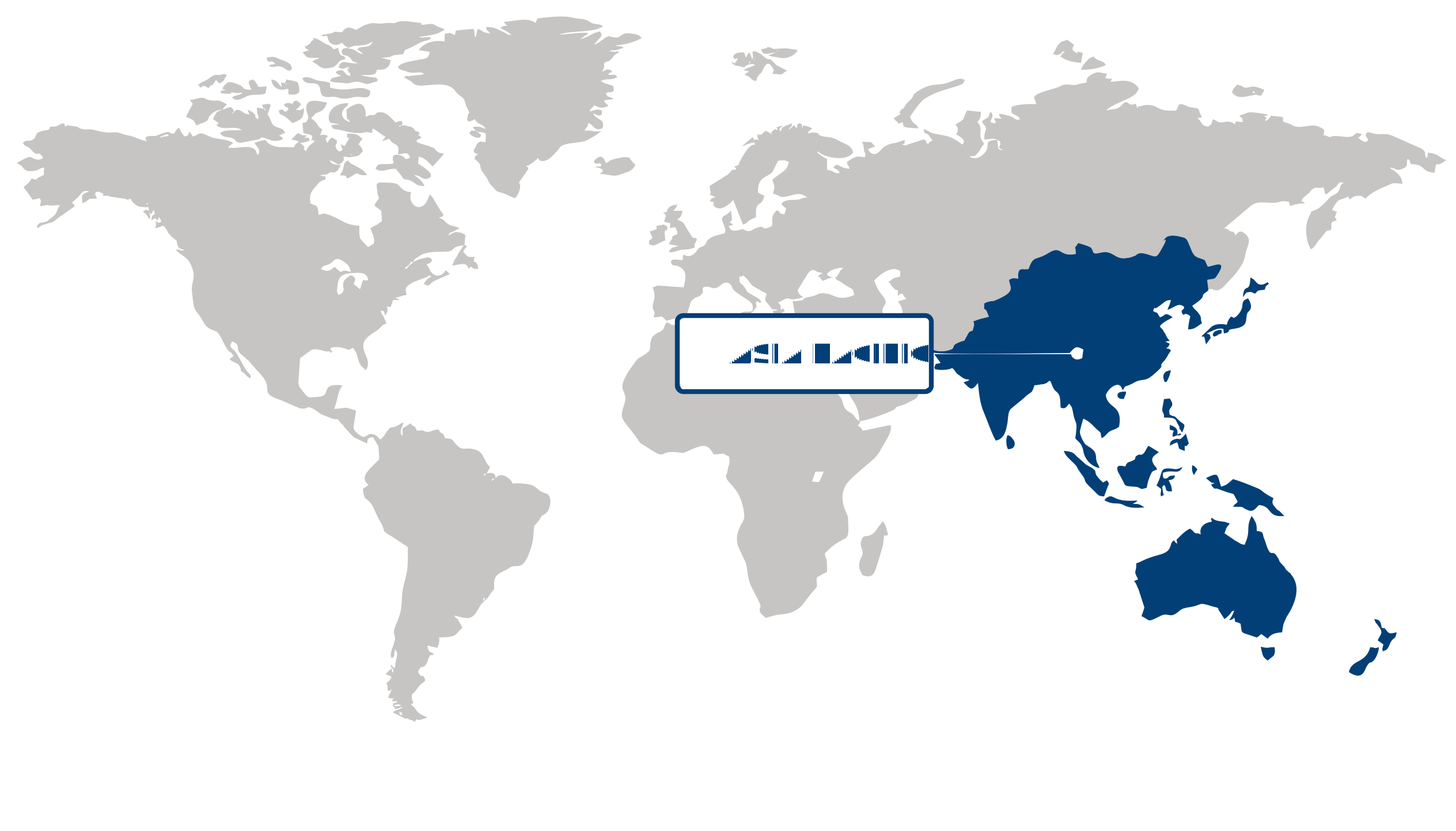
Asia Pacific (Largest Region)
Asia Pacific led the digital camera market with a 38.90% share in 2026, underpinned by its extensive consumer electronics ecosystem, strong demand for imaging devices, and growing interest in photography and video content creation. The region benefits from a broad base of technology-oriented consumers and a well-developed manufacturing and distribution environment for imaging equipment. Increasing participation in travel, outdoor activities, professional content creation, and social media-driven visual communication is sustaining demand for cameras with improved image quality, interchangeable lenses, enhanced video capabilities, and advanced connectivity. The expansion of digital commerce and specialty electronics retail is also improving access to a wide range of camera products across consumer and professional segments. In addition, technological familiarity among consumers and continued interest in high-quality visual content are encouraging users to upgrade from basic imaging devices toward more capable dedicated cameras. Professional photography, creative industries, and growing demand for advanced video production equipment further strengthen the regional market base, supporting Asia Pacific's leading position.
North America (Fastest-Growing Region)
North America is positioned as the fastest-growing region for the digital camera market, supported by strong consumer interest in professional-grade imaging, content creation, travel photography, and advanced video production. The expansion of creator-focused applications is increasing demand for cameras that combine high-resolution photography with sophisticated video functionality, connectivity, and portability. Professional users across media, entertainment, commercial photography, sports, and creative services continue to value dedicated imaging systems for applications where specialized performance remains important. Consumer demand is also being influenced by growing interest in premium photography experiences and equipment that provides greater control and image quality than conventional mobile devices. Established specialty retail and e-commerce channels enable consumers to compare and access a broad portfolio of imaging equipment, lenses, and accessories, while technological improvements are encouraging adoption of increasingly capable camera systems. The convergence of photography, video creation, and digital content production is therefore creating favorable conditions for continued market expansion in North America.
| Parameter | North America | Asia Pacific | Europe | Latin America | MEA |
|---|---|---|---|---|---|
| Innovation Hub i Scale Nascent Developing Advanced | |||||
| Cost-Sensitive Region i Scale Low Medium High | |||||
| Regulatory Environment i Scale Restrictive Neutral Supportive | |||||
| Demand Drivers i Scale Weak Moderate Strong | |||||
| Development Stage i Scale Emerging Developing Developed | |||||
| Adoption Rate i Scale Low Medium High | |||||
| New Entrants / Startups i Scale Sparse Moderate Dense | |||||
| Macro Indicators i Scale Weak Stable Strong |
Key Country Insights
Germany 🇩🇪
Professional Imaging ApplicationsGermany maintains demand for digital cameras across industrial imaging, professional photography, and creative media. Users prioritize precision optics, image quality, and durable equipment capable of supporting demanding commercial applications.
France 🇫🇷
Creative Visual ExcellenceFrance supports digital camera demand across fashion, advertising, tourism, and professional photography. Buyers favor advanced camera systems that combine image quality with portability for commercial and artistic applications.
Italy 🇮🇹
Enthusiast Photography MarketItaly sustains digital camera demand through tourism, cultural photography, and independent creative professionals. Retailers emphasize versatile camera systems and premium lenses that meet the needs of both enthusiasts and professional photographers.
Japan 🇯🇵
Imaging Technology DevelopmentJapan remains a center for digital camera innovation, with manufacturers advancing sensor technology, autofocus performance, and compact system designs. Domestic demand supports premium cameras for enthusiasts and professional users requiring high-performance imaging.
South Korea 🇰🇷
Digital Content ProductionSouth Korea expands digital camera adoption through content creation, entertainment production, and social media activities. Consumers increasingly value lightweight cameras offering high-resolution video capabilities and seamless mobile integration.
United States 🇺🇸
Creator Economy DemandThe U.S. digital camera market is driven by content creators, professional photography, and hybrid video production. Buyers increasingly seek advanced imaging performance, connectivity features, and interchangeable lens systems that support diverse creative workflows.
Segment Leadership and Growth Trends
Digital Camera Market Share (%), by Lens, 2026
Go beyond the chart, access full insights & data tables
Request Free Sample ReportLens Segment Analysis: Built-in (Largest Segment) vs Interchangeable (Fastest-Growing Segment)
The built-in lens segment dominated the digital camera market with a 64.21% share in 2026, supported by its convenience, compact design, and suitability for users seeking an integrated imaging solution without the need to purchase or carry additional lenses. Built-in systems are particularly attractive for everyday photography and travel because they simplify operation while offering versatile focal-length capabilities in a single device. Their accessibility and lower complexity continue to support broad adoption among consumers and casual photographers.
Interchangeable lenses are expanding more rapidly as photography enthusiasts and professional users increasingly prioritize creative control, optical flexibility, and specialized shooting capabilities. The ability to select lenses according to focal length, aperture, subject type, and shooting environment provides greater customization than fixed-lens systems. Growing demand for higher-quality imaging and more specialized photographic applications is therefore supporting stronger interest in interchangeable-lens cameras.
Product Segment Analysis: Mirrorless (Largest Segment) vs Compact Digital Camera (Fastest-Growing Segment)
Mirrorless cameras held the largest share of the digital camera market in 2026, reflecting their combination of advanced imaging performance, compact form factors, electronic viewfinder capabilities, and adaptable lens systems. Their appeal spans enthusiasts and professional photographers who require strong image quality while valuing portability and sophisticated camera controls. Continued innovation in autofocus, video functionality, and image processing is reinforcing the relevance of mirrorless systems across diverse photography applications.
Compact digital cameras are growing at a faster pace as consumers seek lightweight, convenient imaging devices that offer greater photographic capability than smartphones in selected use cases. Their portability and straightforward operation make them suitable for travel, casual photography, and users who prefer dedicated cameras without the complexity of interchangeable systems. Renewed interest in dedicated compact imaging devices and demand for convenient alternatives to larger camera bodies are supporting the segment's expansion.
| Segment | Sub-Segment | Largest Segment | Fastest Growing |
|---|---|---|---|
| Lens | Built-in, Interchangeable | Built-in | Interchangeable |
| Product | Compact Digital Camera, DSLR, Mirrorless | Mirrorless | Compact Digital Camera |
| End Use | Pro Photographers, Prosumers, Hobbyists | Prosumers | Hobbyists |
Competitive Landscape and Market Positioning
Prominent players in the digital camera market:
1. Canon Inc. (Japan)
2. Sony Group Corporation (Japan)
3. Nikon Corporation (Japan)
4. FUJIFILM Holdings Corporation (Japan)
5. Panasonic Holdings Corporation (Japan)
6. Leica Camera AG (Germany)
7. OM Digital Solutions Corporation (Japan)
8. Ricoh Imaging Company Ltd. (Japan)
9. SIGMA Corporation (Japan)
10. Hasselblad (Sweden)
Advancements in imaging sensors and connectivity features are reshaping the digital camera market. Hybrid usage patterns combining professional and casual content creation are influencing product development strategies. The digital camera market is steadily adapting to integrated ecosystem-based photography solutions.
| Company | Market Share | Company Revenue | Revenue CAGR (%) | Product Portfolio | Geographic Presence | Innovation / R&D Focus | Strategic Developments |
|---|---|---|---|---|---|---|---|
| Canon Inc. (Japan) | |||||||
| Sony Group Corporation (Japan) | |||||||
| Nikon Corporation (Japan) | |||||||
| FUJIFILM Holdings Corporation (Japan) | |||||||
| Panasonic Holdings Corporation (Japan) | |||||||
| Leica Camera AG (Germany) | |||||||
| OM Digital Solutions Corporation (Japan) | |||||||
| Ricoh Imaging Company Ltd. (Japan) | |||||||
| SIGMA Corporation (Japan) | |||||||
| Hasselblad (Sweden). |
Industry Development/News
| Company Name | Date | Key Development |
|---|---|---|
| Canon | May-26 | Canon announced the PowerShot V1, a compact camera specifically engineered for vloggers and content creators. By incorporating a large CMOS sensor and specialized imaging capabilities into a portable form factor, Canon is strategically targeting the high-growth creator economy to broaden its market reach beyond traditional photography segments. |
| Sony | May-26 | Sony launched a new 105-megapixel image sensor featuring advanced technology to minimize rolling shutter distortion. This innovation is commercially significant for the professional digital camera market, as it provides a critical performance upgrade that enables higher-quality image capture, likely serving as a foundational component for next-generation high-resolution camera systems. |
| Hasselblad | May-26 | Hasselblad expanded its professional digital imaging portfolio with the introduction of a new camera body and a dedicated standard zoom lens. This strategic product launch strengthens the company’s presence in the premium professional segment, providing photographers with an integrated high-end system tailored for demanding creative workflows. |
| Fujifilm | May-26 | Fujifilm introduced the X half, a premium digital half-frame camera that bridges modern digital imaging with a retro-inspired design. By targeting the niche for film-like aesthetics through digital technology, the company is diversifying its camera lineup to capture specific consumer segments interested in unique, nostalgic photography experiences. |
| Ricoh | May-26 | Ricoh launched the GR IV Monochrome, a specialized premium pocket camera dedicated exclusively to black-and-white photography. This release is a strategic move to serve the high-engagement enthusiast market by offering a differentiated, niche-focused imaging tool that caters to photographers prioritizing specific artistic capabilities over general-purpose functionality. |
| DJI | May-26 | DJI announced the development of a new 360-degree camera, signaling a strategic entry into the immersive content creation market. This expansion broadens the company's imaging portfolio, allowing it to compete in the burgeoning segment of panoramic and immersive video, which is increasingly relevant for modern content creators and social media applications. |
| The Flashback Camera | May-26 | The Flashback Camera secured AUD 500,000 in investment to accelerate the commercialization of its retro-inspired digital cameras. This funding marks a critical step in the company's growth, enabling it to scale operations and expand its market presence in the rising segment of simplified, nostalgic digital photography devices. |
| Leica Camera AG | Jul-24 | Leica Camera AG launched the D-Lux 8 compact camera, featuring a refined ergonomic design and upgraded user interface technology. The product focuses on enhancing the user experience through an optimized control layout, reflecting a strategic effort to maintain brand loyalty and competitiveness within the premium compact camera segment through superior usability and design. |
| Nikon | Jun-24 | Nikon expanded its lens portfolio with the introduction of the NIKKOR Z 35mm f/1.4 lens. Designed for full-frame/FX-format cameras using the Nikon Z mount, this addition provides a critical optical tool for professionals and enthusiasts, reinforcing the ecosystem support for the company's mirrorless digital camera system. |
| Nikon | Mar-24 | Nikon completed the acquisition of RED, a specialist in high-end digital cinema cameras. This acquisition significantly enhances Nikon's technological capabilities in video production and strengthens its competitive position within the professional imaging market by integrating specialized cinema-grade sensor and workflow expertise into its existing camera portfolio. |
Customize Your Report
Explore examples of how this report can be tailored to different research needs, including custom segments, additional topics or chapters, and related reports. Click a section of the wheel or its numbered marker to explore the available options.
Digital Camera Market — Custom Segments
| Segment | Sub-Segment |
|---|---|
| Sensor Technology | CMOS, CCD, Stacked CMOS, Other Sensor Technologies |
| Connectivity Features | Wi-Fi Enabled, Bluetooth Enabled, Wi-Fi & Bluetooth Enabled, Other/No Wireless Connectivity |
| Price Tier | Entry-Level, Mid-Range, Premium, Professional |
Digital Camera Market — Custom TOC
| Custom Chapter | Custom Details |
|---|---|
| Professional Imaging Application Evolution |
|
| Creator Economy Impact Assessment |
|
| Camera Technology Adoption Roadmap |
|
Need a different cut of the data?
Request Custom ResearchWhat is the current revenue of the digital camera market?
What is the projected value of the digital camera industry by 2036?
How is rising demand from content creation and social media shaping purchasing priorities in the digital camera market?
Why is the shift toward mirrorless systems strengthening ecosystem-based demand in the digital camera market?
Why do built-in lens cameras lead the digital camera market?
Why are compact digital cameras the fastest-growing product segment?
Why does Asia Pacific lead the digital camera market?
What is driving digital camera market growth in North America?
Which companies are driving growth in the digital camera landscape?
Our Clients
"Working with FBI has been a good experience. The market report provided a holistic view, covering everything from emerging trends to potential risks."
Semtech Corporation
"The experience was highly positive. The team showcased remarkable flexibility in adapting to our specific needs and delivered report that perfectly aligned with all our requirements."
TSMC
"What really stood out to me was how clearly and promptly the Fundamental Business Insights team communicated throughout. It made the collaboration feel effortless."
NXP Semiconductors
Our Research Team & Methodology
Every Fundamental Business Insights report is built by a dedicated vertical research team, validated through a structured primary-and-secondary methodology, and reviewed for accuracy before it reaches you.
Research Team Overview
Prepared by the Electronics & Semiconductors Research Team
Delivery
Published
Demand
Available
Support
Trust & Compliance
Research Domains
10 coverage areasResearch Intelligence
| Source | Reference |
|---|---|
| Semiconductor Industry Association (SIA) | www.semiconductors.org |
| SEMI | www.semi.org |
| JEDEC Solid State Technology Association | www.jedec.org |
| IEEE | www.ieee.org |
| IPC – Association Connecting Electronics Industries | www.ipc.org |
| International Electrotechnical Commission (IEC) | www.iec.ch |
| International Organization for Standardization (ISO) | www.iso.org |
| U.S. Bureau of Industry and Security (BIS) | www.bis.gov |
| U.S. Patent and Trademark Office (USPTO) | www.uspto.gov |
| European Patent Office (EPO) | www.epo.org |
| Taiwan Semiconductor Industry Association (TSIA) | www.tsia.org.tw |
| World Semiconductor Trade Statistics (WSTS) | www.wsts.org |
| International Energy Agency (IEA) | www.iea.org |
| GSMA | www.gsma.com |
| 3GPP | www.3gpp.org |
| ITU (International Telecommunication Union) | www.itu.int |
| Omdia (public insights) | omdia.tech.informa.com |
| Display Supply Chain Consultants (DSCC) | www.displaysupplychain.com |
| U.S. Department of Energy (DOE) | www.energy.gov |
| NIST (National Institute of Standards and Technology) | www.nist.gov |
Research Workflow & Quality Assurance
Data Collection
Verified information gathered through primary and secondary research.
Data Triangulation
Cross-validation using multiple independent data sources.
Forecast Modelling
Market estimates developed using historical trends and analytical models.
Analyst Validation
Findings reviewed by domain experts for accuracy and consistency.
Editorial & Quality Review
Final editorial, quality, and compliance checks before publication.
Final Publication
Released after successful completion of the internal review process.
Report Coverage
📊 Market Assessment
- Market Size & Forecast
- Market Segmentation
- Regional Analysis
- Growth Drivers & Challenges
- Market Dynamics
🏢 Competitive Intelligence
- Competitive Landscape
- Company Profiles
- Competitive Benchmarking
- Mergers & Acquisitions
- Market Share Analysis or Key Company Strategies
🔍 Strategic Analysis
- Value Chain Analysis
- Porter's Five Forces
- PESTLE Analysis
- Pricing Trends
- Supply-Demand Analysis
🚀 Future Outlook
- Technology Landscape
- Regulatory Landscape
- Investment & Funding Landscape
- Emerging Opportunities
- Future Market Outlook
Have a question about this report or need a custom scope?
Request Customization