Diamond Jewelry Market Size & Growth Forecast 2027–2036, By Segments (Color, Clarity, Cut, Carat), Regional Demand Trends (North America, Asia Pacific, Europe), Key Country Insights (U.S., Japan, South Korea, Germany, France, Italy), and Competitive Landscape
Market Size and Growth Outlook
Diamond Jewelry Market size was around USD 100.76 billion in 2026 and is slated to grow at a 4.28% CAGR from 2027 to 2036, attaining USD 153.21 billion by 2036. The industry revenue for 2027 is assessed at USD 104.39 billion.
Get more details on this report
Request Free Sample ReportDiamond Jewelry Market Intelligence Snapshot
Regional Market Dynamics
- Asia Pacific led the market in 2026 and is projected to grow at a 5.36% CAGR, supported by a broad consumer base, strong retail presence, rising spending, and expanding brand penetration.
- Growth is fueled by rising consumer spending, wider product accessibility, expanding digital channels, and stronger brand presence across diverse price points, increasing adoption in both mature and developing markets.
Segment Momentum
- Near Colorless diamonds captured 59.42% of the market in 2026 because they offer an attractive balance between visual appeal and affordability, making them popular across gifting and self-purchase segments.
- VS 2 is the fastest-growing clarity segment because it provides strong visual cleanliness and perceived quality while avoiding the higher pricing associated with premium clarity grades.
Market Expansion Drivers
- Rising disposable incomes and premium lifestyle spending increasing global diamond jewelry purchases.
- Growing preference for fashionable personalized jewelry designs accelerating millennial consumer engagement.
- Expanding online luxury retail platforms improving accessibility to branded diamond jewelry collections.
Leading Market Participants
- Major players in the diamond jewelry market include Tiffany & Co. (United States), Cartier International SNC (France), Bulgari S.p.A. (Italy), Signet Jewelers Limited (Bermuda), Pandora A/S (Denmark), Chow Tai Fook Jewellery Group Limited (Hong Kong), De Beers Group (United Kingdom), Swarovski AG (Austria), Petra Diamonds Limited (United Kingdom), Harry Winston, Inc. (United States).
Global Market Forecast Snapshot
Market Outlook
- 2026 Market Size: USD 100.76 billion
- 2027 Estimated Market Size: USD 104.39 billion.
- Projected Market Size: USD 153.21 billion by 2036
- Growth Forecast: 4.28% CAGR (2027-2036)
Regional and Segment Outlook
- Leading Regional Market: Asia Pacific
- High-Growth Regional Hub: Asia Pacific
- Core Revenue Segment: Near Colorless (GRADE G/H/I/J) (Color) | VS 2 (Clarity) | Round Brilliant Cut Diamond (Cut) | 1.00 CT (Carat)
- Emerging Opportunity Segment: Near Colorless (GRADE G/H/I/J) (Color) | VS 2 (Clarity) | Princess Cut Diamond (Cut) | 0.50 CT (Carat)
Market Growth Drivers and Industry Trends
Rising disposable incomes and premium lifestyle spending increasing global diamond jewelry purchases
Higher household purchasing power and greater willingness to allocate spending toward premium lifestyle products are supporting expansion of the diamond jewelry market. As consumers gain greater financial flexibility, jewelry can serve not only as a traditional purchase for special occasions but also as an expression of personal style, status, and achievement. Diamonds remain closely associated with luxury and enduring value, encouraging demand for rings, necklaces, earrings, bracelets, and other premium adornments. Growing interest in aspirational consumption is also supporting purchases outside conventional ceremonial occasions as consumers incorporate fine jewelry into broader lifestyle spending.
Growing preference for fashionable personalized jewelry designs accelerating millennial consumer engagement
Younger consumers are increasingly seeking jewelry that reflects individual identity, fashion preferences, and personal milestones, creating opportunities for the diamond jewelry market. Millennials in particular are showing greater interest in distinctive designs, customized pieces, and jewelry that carries personal meaning rather than relying solely on traditional styles. Personalization can include variations in stone arrangements, settings, metal choices, and design elements, allowing consumers to participate more actively in product selection. The combination of fashion-oriented aesthetics and individualized purchasing is making diamond jewelry more relevant to younger shoppers who value uniqueness and self-expression.
Expanding online luxury retail platforms improving accessibility to branded diamond jewelry collections
The growth of digital luxury retail is changing how consumers discover, compare, and purchase premium jewelry, supporting wider reach for the diamond jewelry market. Online platforms provide consumers with convenient access to detailed product information, high-resolution imagery, customization options, and extensive collections without requiring an immediate visit to a physical store. Digital channels also enable jewelry sellers to engage consumers across wider geographic markets and provide personalized shopping experiences through targeted recommendations and customer support. Greater online accessibility is helping reduce traditional barriers associated with premium jewelry discovery while allowing consumers to evaluate designs and collections at their own convenience.
| Growth Driver | Impact on CAGR | Regulatory Influence | Geographic Relevance | Adoption Rate | Impact Timeline |
|---|---|---|---|---|---|
| Increasing demand for diamond jewelry in luxury segment | 1.50% | Short term (≤ 2 yrs) | North America, Europe (spillover: Asia Pacific) | Medium | Fast |
| Expansion of online and retail luxury jewelry channels | 1.60% | Medium term (2–5 yrs) | Europe, Asia Pacific (spillover: North America) | Medium | Moderate |
| Adoption of sustainable and lab-grown diamonds | 1.60% | Long term (5+ yrs) | North America, Europe (spillover: Asia Pacific) | High | Slow |
| Rising disposable incomes and premium lifestyle spending increasing global diamond jewelry purchases | 1.90% | Low | Asia Pacific, North America | High | Near Term |
| Growing preference for fashionable personalized jewelry designs accelerating millennial consumer engagement | 1.70% | Low | Europe, Asia Pacific | High | Mid Term |
| Expanding online luxury retail platforms improving accessibility to branded diamond jewelry collections | 1.30% | Moderate | North America, Asia Pacific | Emerging | Mid Term |
Unlock insights tailored to your business with our bespoke market research solutions.
Click to get your customized report now.
Regional Demand Dynamics
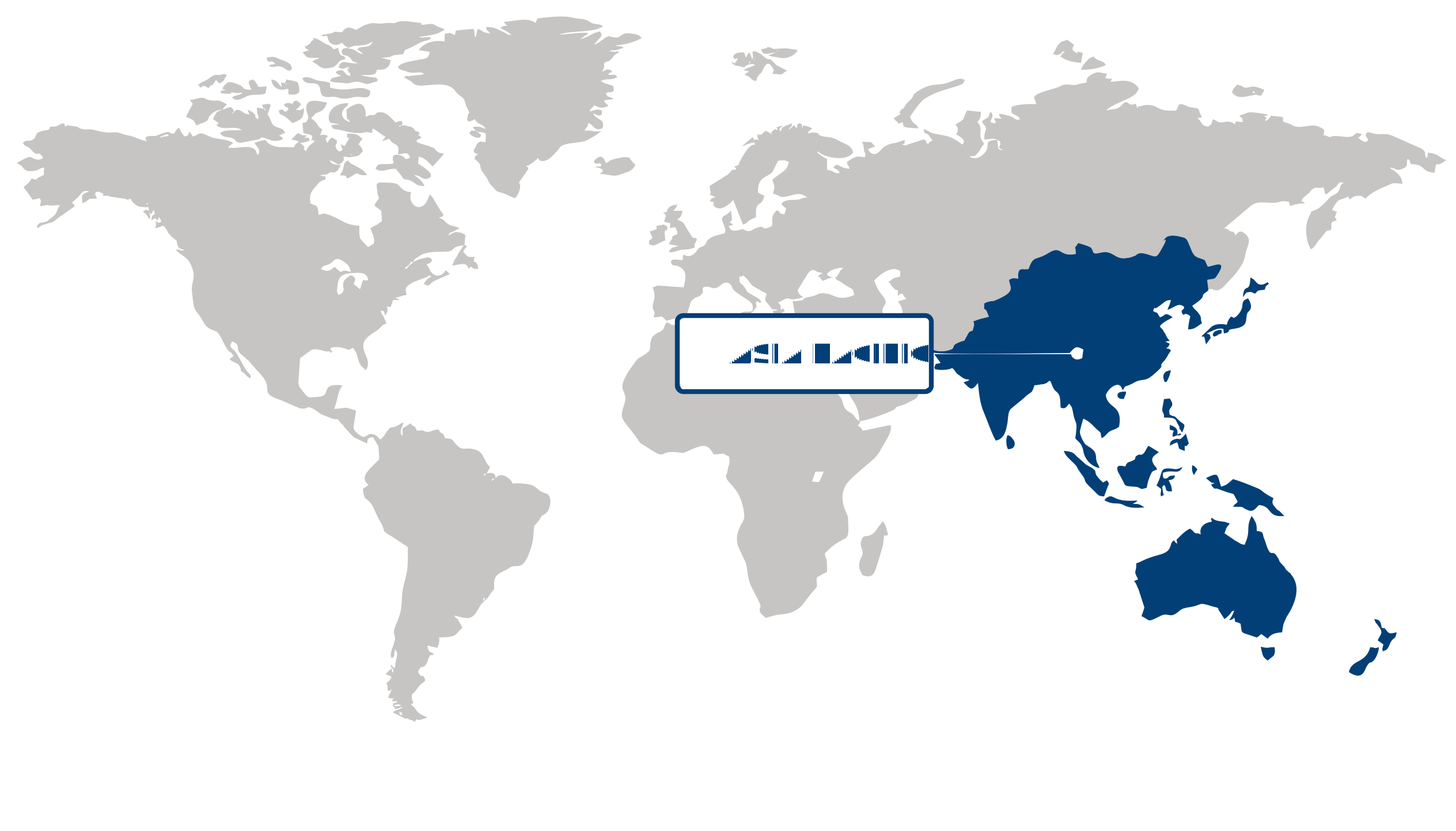
Asia Pacific (Largest & Fastest-Growing Region)
Asia Pacific dominated the diamond jewelry market in 2026 and also represents the fastest-growing regional market, supported by expanding consumer purchasing power, evolving luxury preferences, and the region's strong cultural affinity for jewelry. Rising urbanization and the development of organized retail are increasing access to branded and premium jewelry products, while younger consumers are showing growing interest in contemporary designs alongside traditional jewelry purchases. Demand is also supported by jewelry's role in celebrations, weddings, gifting, and other cultural occasions across major regional markets. The expansion of e-commerce and digital retail channels is improving product discovery and accessibility, while greater exposure to international jewelry trends is encouraging consumers to consider diamonds across a broader range of designs and price segments. Increasing interest in premium personal accessories and continued development of the regional luxury retail ecosystem are further reinforcing the market's growth trajectory.
| Parameter | North America | Asia Pacific | Europe | Latin America | MEA |
|---|---|---|---|---|---|
| Innovation Hub i Scale Nascent Developing Advanced | |||||
| Cost-Sensitive Region i Scale Low Medium High | |||||
| Regulatory Environment i Scale Restrictive Neutral Supportive | |||||
| Demand Drivers i Scale Weak Moderate Strong | |||||
| Development Stage i Scale Emerging Developing Developed | |||||
| Adoption Rate i Scale Low Medium High | |||||
| New Entrants / Startups i Scale Sparse Moderate Dense | |||||
| Macro Indicators i Scale Weak Stable Strong |
Key Country Insights
Germany 🇩🇪
Design-Oriented PurchasingGermany favors diamond jewelry that combines refined craftsmanship with certified sourcing and understated luxury. Consumer demand increasingly supports durable designs and transparent product information across premium retail channels.
France 🇫🇷
Heritage Luxury CraftsmanshipFrance maintains strong demand for finely crafted diamond jewelry supported by luxury retail traditions and premium design. Companies emphasize artisanal quality, exclusive collections, and responsible sourcing to reinforce brand value.
Italy 🇮🇹
Artisanal Jewelry ExcellenceItaly's diamond jewelry market benefits from renowned jewelry manufacturing expertise and demand for distinctive handcrafted pieces. Producers continue integrating contemporary aesthetics with traditional craftsmanship to attract domestic and international buyers.
Japan 🇯🇵
Refined Luxury PreferenceJapan values precision craftsmanship and timeless diamond jewelry designs that emphasize quality over elaborate styling. Brands are focusing on premium finishing, trusted certification, and personalized service to meet discerning consumer expectations.
South Korea 🇰🇷
Contemporary Fashion AppealSouth Korea blends luxury jewelry with fashion-driven purchasing, encouraging demand for modern diamond collections and versatile everyday designs. Brands increasingly collaborate with designers and digital channels to engage younger consumers.
United States 🇺🇸
Premium Bridal DemandThe U.S. diamond jewelry market continues to be shaped by bridal purchases alongside growing interest in branded and ethically sourced collections. Retailers are expanding personalization options and omnichannel experiences to strengthen customer engagement.
Segment Leadership and Growth Trends
Diamond Jewelry Market Share (%), by Color, 2026
Go beyond the chart, access full insights & data tables
Request Free Sample ReportColor Segment Analysis: Near Colorless (GRADE G/H/I/J) (Largest & Fastest-Growing Segment)
The near colorless (GRADE G/H/I/J) segment led the diamond jewelry market and accounted for a 59.42% share in 2026, while also representing the fastest-growing color category. Its strong position reflects the balance these diamonds offer between visual appeal and value, making them suitable for a broad range of jewelry applications. Their minimal visible color enables diamonds to maintain a bright and refined appearance while offering buyers an attractive alternative to higher-color grades. Strong consumer preference for diamonds that combine perceived quality with affordability is supporting demand, while their versatility across engagement rings, necklaces, earrings, and other jewelry formats further broadens their commercial appeal. The segment is also benefiting from continued interest in standardized diamond grading, which helps consumers compare quality characteristics when making purchasing decisions.
Clarity Segment Analysis: VS 2 (Largest & Fastest-Growing Segment)
VS 2 represented the largest and fastest-growing clarity segment in the diamond jewelry market, supported by its favorable balance between visible quality and purchasing value. Diamonds in this clarity category generally provide a clean visual appearance under ordinary viewing conditions while avoiding the higher cost associated with more flawless grades. This combination makes VS 2 particularly attractive for consumers seeking a premium-looking stone without paying for clarity characteristics that may have limited visible impact. Its suitability for a wide range of jewelry designs, combined with continued consumer focus on value-oriented diamond selection, is reinforcing demand and supporting the segment's leading position.
| Segment | Sub-Segment | Largest Segment | Fastest Growing |
|---|---|---|---|
| Color | Colorless (GRADE D/E/F), Near Colorless (GRADE G/H/I/J), Faint (K/L/M), Very Light (GRADE N/O/P/Q/R), Light (GRADE S/T/U/V/W/X/Y/Z) | Near Colorless (GRADE G/H/I/J) | Near Colorless (GRADE G/H/I/J) |
| Clarity | FL and IF, I (1/2/3), VVS 1, VVS 2, VS 1, VS 2, SI 1, SI 2 | VS 2 | VS 2 |
| Cut | Round Brilliant Cut Diamond, Princess Cut Diamond, Emerald Cut Diamond, Radiant Cut Diamond, Cushion Cut Diamond, Oval Cut Diamond, Asscher Cut Diamond, Marquise Cut Diamond, Pear Cut Diamond, Heart Cut Diamond, Others | Round Brilliant Cut Diamond | Princess Cut Diamond |
| Carat | 0.009 CT - 0.30 CT, 0.50 CT, 0.75 CT, 1.00 CT, 1.25 CT, 1.50 CT, 1.75 CT, 2.00 CT, 2.50 CT, 3.00 CT, 3.50 CT, 4.00 CT, 5.00 CT and Above | 1.00 CT | 0.50 CT |
Competitive Landscape and Market Positioning
Prominent players in the diamond jewelry market:
1. Tiffany & Co. (United States)
2. Cartier International SNC (France)
3. Bulgari S.p.A. (Italy)
4. Signet Jewelers Limited (Bermuda)
5. Pandora A/S (Denmark)
6. Chow Tai Fook Jewellery Group Limited (Hong Kong)
7. De Beers Group (United Kingdom)
8. Swarovski AG (Austria)
9. Petra Diamonds Limited (United Kingdom)
10. Harry Winston Inc. (United States)
The diamond jewelry market is being reshaped by evolving consumer preferences toward personalization and ethically sourced designs. Product innovation is increasingly focused on customization and modern styling to align with changing lifestyle choices. Rising demand for unique and symbolic jewelry pieces is influencing design strategies, while ongoing creative development is enhancing craftsmanship and material usage. These shifts are redefining competitive positioning in the diamond jewelry market.
| Company | Market Share | Company Revenue | Revenue CAGR (%) | Product Portfolio | Geographic Presence | Innovation / R&D Focus | Strategic Developments |
|---|---|---|---|---|---|---|---|
| Tiffany & Co. (United States) | |||||||
| Cartier International SNC (France) | |||||||
| Bulgari S.p.A. (Italy) | |||||||
| Signet Jewelers Limited (Bermuda) | |||||||
| Pandora A/S (Denmark) | |||||||
| Chow Tai Fook Jewellery Group Limited (Hong Kong) | |||||||
| De Beers Group (United Kingdom) | |||||||
| Swarovski AG (Austria) | |||||||
| Petra Diamonds Limited (United Kingdom) | |||||||
| Harry Winston Inc. (United States). |
Industry Development/News
| Company Name | Date | Key Development |
|---|---|---|
| GIA & De Beers | May-26 | The Gemological Institute of America acquired a 30% stake in De Beers’ Tracr platform. This strategic investment enhances digital provenance and authentication capabilities throughout the diamond jewelry value chain, addressing increasing industry requirements for transparency and ethical supply chain verification. |
| Signet Jewelers | May-26 | Signet Jewelers acquired The Clear Cut to accelerate its luxury brand repositioning strategy. This acquisition enables the company to expand its premium jewelry portfolio, capturing a larger share of the high-end consumer segment and strengthening its competitive position in the luxury diamond jewelry market. |
| Lucira Jewelry | Jan-26 | Lucira Jewelry expanded its physical retail presence by opening its third location at Sky City Mall in Mumbai. This growth reflects the company’s strategic commitment to scaling its operations within the lab-grown diamond jewelry segment to meet rising consumer demand for accessible alternatives to natural stones. |
| Tanishq | Jul-25 | Tanishq announced a strategic expansion into North America, specifically targeting the Indian diaspora. This move is designed to strengthen the company’s international retail footprint and capitalize on the growing demand for premium diamond jewelry among international market segments. |
| Tanishq | Mar-25 | Tanishq further scaled its U.S. presence by opening new retail locations in Washington and Georgia. This expansion marks a significant milestone in the company’s broader North American growth strategy, focusing on increasing brand accessibility in key regional markets. |
| Chow Sang | Mar-25 | Hong Kong-based retailer Chow Sang launched “The Future Rocks,” a dedicated e-commerce platform specializing in jewelry crafted from lab-grown diamonds and recycled metals. This platform represents a strategic response to shifting consumer preferences regarding sustainability and the adoption of modern, alternative materials in the jewelry sector. |
| Effy Jewelry | Jan-25 | Effy Jewelry launched “Promise by Effy,” a new brand dedicated to lab-grown diamond engagement rings and fashion jewelry. This strategic diversification expands the company’s product portfolio, allowing it to address the growing market demand for lab-grown diamond alternatives across multiple jewelry categories. |
| De Beers & Tanishq | Aug-24 | De Beers and Tanishq entered a long-term strategic partnership focused on promoting natural diamonds in India. The collaboration utilizes joint marketing and consumer awareness initiatives to drive demand and reaffirm the value proposition of natural diamonds in one of the world's largest jewelry-consuming markets. |
Customize Your Report
Explore examples of how this report can be tailored to different research needs, including custom segments, additional topics or chapters, and related reports. Click a section of the wheel or its numbered marker to explore the available options.
Diamond Jewelry Market — Custom Segments
| Segment | Sub-Segment |
|---|---|
| Jewelry Type | Rings, Earrings, Necklaces & Pendants, Bracelets, Other Jewelry |
| Diamond Origin | Natural Diamonds, Lab-Grown Diamonds |
| Price Tier | Mass Market, Mid-Range, Premium, Luxury |
Diamond Jewelry Market — Custom TOC
| Custom Chapter | Custom Details |
|---|---|
| Lab-Grown Diamond Market Impact |
|
| Diamond Sourcing and Traceability |
|
| Luxury Consumer and Brand Strategy |
|
Need a different cut of the data?
Request Custom ResearchWhat is the market size of diamond jewelry?
How is the diamond jewelry industry expected to grow over the next 10 years?
How are rising disposable incomes and premium lifestyle spending shaping demand patterns in the diamond jewelry market?
How is digital retail expansion and personalization reshaping consumer engagement in the diamond jewelry market?
Why is the Near Colorless (G/H/I/J) category leading the diamond jewelry market?
Which clarity segment is growing fastest in the diamond jewelry market?
Why does Asia Pacific lead the diamond jewelry market?
What is driving diamond jewelry growth in Asia Pacific?
Which organizations are considered leaders in the diamond jewelry landscape?
Our Clients
"The report provided us with a clear direction, and the level of detail was beyond what we expected. I would definitely recommend their services to others."
Haier Appliances
"The collaboration with Fundamental Business Insights has added significant value to our decision-making process, and we look forward to continuing this partnership for our future market research requirements."
Luxottica Group S.p.A.
"The team at FBI delivered an exceptional research report. The insights on industry innovations were particularly impressive and added a lot of value to the overall report."
Nike
Our Research Team & Methodology
Every Fundamental Business Insights report is built by a dedicated vertical research team, validated through a structured primary-and-secondary methodology, and reviewed for accuracy before it reaches you.
Research Team Overview
Prepared by the Consumer Goods & Services Research Team
Delivery
Published
Demand
Available
Support
Trust & Compliance
Research Domains
10 coverage areasResearch Intelligence
| Source | Reference |
|---|---|
| International Organization for Standardization (ISO) | www.iso.org |
| ASTM International | www.astm.org |
| U.S. Consumer Product Safety Commission (CPSC) | www.cpsc.gov |
| European Commission – Consumer Safety | ec.europa.eu/safety-gate |
| Consumer Technology Association (CTA) | www.cta.tech |
| National Retail Federation (NRF) | nrf.com |
| World Retail Congress | www.worldretailcongress.com |
| World Travel & Tourism Council (WTTC) | wttc.org |
| UN Tourism | www.unwto.org |
| Personal Care Products Council (PCPC) | www.personalcarecouncil.org |
| Cosmetics Europe | cosmeticseurope.eu |
| International Housewares Association (IHA) | www.housewares.org |
| American Apparel & Footwear Association (AAFA) | www.aafaglobal.org |
| World Federation of the Sporting Goods Industry (WFSGI) | wfsgi.org |
| Juvenile Products Manufacturers Association (JPMA) | www.jpma.org |
| Pet Industry Joint Advisory Council (PIJAC) | pijac.org |
| International Council of Toy Industries (ICTI) | www.toy-icti.org |
| International Association of Amusement Parks and Attractions (IAAPA) | iaapa.org |
| Organisation for Economic Co-operation and Development (OECD) | www.oecd.org |
| World Bank Data | data.worldbank.org |
Research Workflow & Quality Assurance
Data Collection
Verified information gathered through primary and secondary research.
Data Triangulation
Cross-validation using multiple independent data sources.
Forecast Modelling
Market estimates developed using historical trends and analytical models.
Analyst Validation
Findings reviewed by domain experts for accuracy and consistency.
Editorial & Quality Review
Final editorial, quality, and compliance checks before publication.
Final Publication
Released after successful completion of the internal review process.
Report Coverage
📊 Market Assessment
- Market Size & Forecast
- Market Segmentation
- Regional Analysis
- Growth Drivers & Challenges
- Market Dynamics
🏢 Competitive Intelligence
- Competitive Landscape
- Company Profiles
- Competitive Benchmarking
- Mergers & Acquisitions
- Market Share Analysis or Key Company Strategies
🔍 Strategic Analysis
- Value Chain Analysis
- Porter's Five Forces
- PESTLE Analysis
- Pricing Trends
- Supply-Demand Analysis
🚀 Future Outlook
- Technology Landscape
- Regulatory Landscape
- Investment & Funding Landscape
- Emerging Opportunities
- Future Market Outlook
Have a question about this report or need a custom scope?
Request Customization