Demolition Hammers Market Size & Growth Forecast 2027–2036, By Segments (End Use, Type, Distribution Channel, Power Range), Regional Demand Trends (North America, Asia Pacific, Europe), Key Country Insights (U.S., Japan, South Korea, Germany, France, Italy), and Competitive Landscape
Jump to Content
Market Size and Growth Outlook
Demolition Hammers Market size stood at USD 3 Billion in 2026 and is predicted to grow at 5.62% CAGR from 2027 to 2036, crossing USD 5.18 Billion by 2036. The industry revenue for 2027 is calculated at USD 3.14 Billion.
Get more details on this report
Request Free Sample ReportDemolition Hammers Market Intelligence Snapshot
Regional Market Dynamics
- Extensive construction, urbanization, renovation, and transportation infrastructure investment are sustaining strong demand for heavy-duty demolition equipment across Asia Pacific.
- Renovation and refurbishment activity, aging buildings, infrastructure modernization, and demand for productive, efficient equipment are accelerating European adoption.
Segment Momentum
- The building & construction segment held a 49.29% share in 2026, driven by strong demand for demolition hammers in concrete breaking, renovation, infrastructure development, and new construction projects.
- The online distribution channel is expected to grow the fastest as contractors increasingly use e-commerce platforms to compare products, access competitive pricing, and benefit from convenient purchasing and delivery.
Market Expansion Drivers
- Expanding construction and infrastructure renovation activities driving equipment demand growth
- Rising government infrastructure spending accelerating heavy construction equipment adoption
- Technological advancements improving tool durability and reducing operator fatigue in construction applications
Leading Market Participants
- Major companies in the demolition hammers market include Stanley Black & Decker Inc. (United States), Robert Bosch GmbH (Germany), Hilti AG (Liechtenstein), Makita Corporation (Japan), Techtronic Industries Co. Ltd. (Hong Kong), Koki Holdings Co., Ltd. (Japan), Einhell Germany AG (Germany), Ferm International B.V. (Netherlands), VEVOR (China)
Global Market Forecast Snapshot
Market Outlook
- 2026 Market Size: USD 3 Billion
- 2027 Estimated Market Size: USD 3.14 Billion
- Projected Market Size: USD 5.18 Billion by 2036
- Growth Forecast: 5.62% CAGR (2027-2036)
Regional and Segment Outlook
- Leading Regional Market: Asia Pacific
- High-Growth Regional Hub: Europe
- Core Revenue Segment: Building & Construction (End Use) | Electric (Type) | Offline (Distribution Channel) | Above 1200 Watts (Power Range)
- Emerging Opportunity Segment: Building & Construction (End Use) | Electric (Type) | Online (Distribution Channel) | Above 1200 Watts (Power Range)
Market Growth Drivers and Industry Trends
Expanding construction and infrastructure renovation activities driving equipment demand growth
Growing investments in commercial construction, residential redevelopment, and infrastructure rehabilitation are increasing the need for high-performance demolition equipment across a wide range of projects. The demolition hammers market will drive growth as contractors require powerful tools for breaking concrete, removing masonry, and carrying out structural modifications with greater speed and precision. Rising renovation activity involving aging buildings, transportation infrastructure, and public facilities is also encouraging wider adoption of demolition hammers that improve productivity while supporting demanding job site requirements.
Rising government infrastructure spending accelerating heavy construction equipment adoption
Governments are expanding investments in transportation networks, public utilities, urban redevelopment, and other large-scale infrastructure projects, creating sustained demand for construction equipment. The demolition hammers market benefits from these initiatives as infrastructure upgrades frequently involve demolition, repair, and reconstruction activities that require reliable and durable breaking tools. Contractors engaged in road expansion, bridge rehabilitation, and public infrastructure modernization increasingly prioritize equipment capable of delivering consistent performance under intensive operating conditions.
Technological advancements improving tool durability and reducing operator fatigue in construction applications
Manufacturers are continuously enhancing demolition equipment through innovations that improve performance, reliability, and user comfort during extended operation. Advancements across the demolition hammers market include improved impact mechanisms, vibration reduction technologies, ergonomic handle designs, and durable construction materials that extend equipment service life while minimizing operator strain. These product improvements enable construction professionals to complete demanding demolition tasks more efficiently while maintaining better control and reducing physical fatigue on challenging worksites.
| Growth Driver | Impact on CAGR | Regulatory Influence | Geographic Relevance | Adoption Rate | Impact Timeline |
|---|---|---|---|---|---|
| Expanding construction and infrastructure renovation activities driving equipment demand growth | 1.9% | Moderate | Asia Pacific, Middle East & Africa | High | Near Term |
| Rising government infrastructure spending accelerating heavy construction equipment adoption | 1.7% | High | North America, Europe | High | Mid Term |
| Technological advancements improving tool durability and reducing operator fatigue in construction applications | 1.4% | Low | Global | Medium | Mid Term |
Unlock insights tailored to your business with our bespoke market research solutions.
Click to get your customized report now.
Regional Demand Dynamics
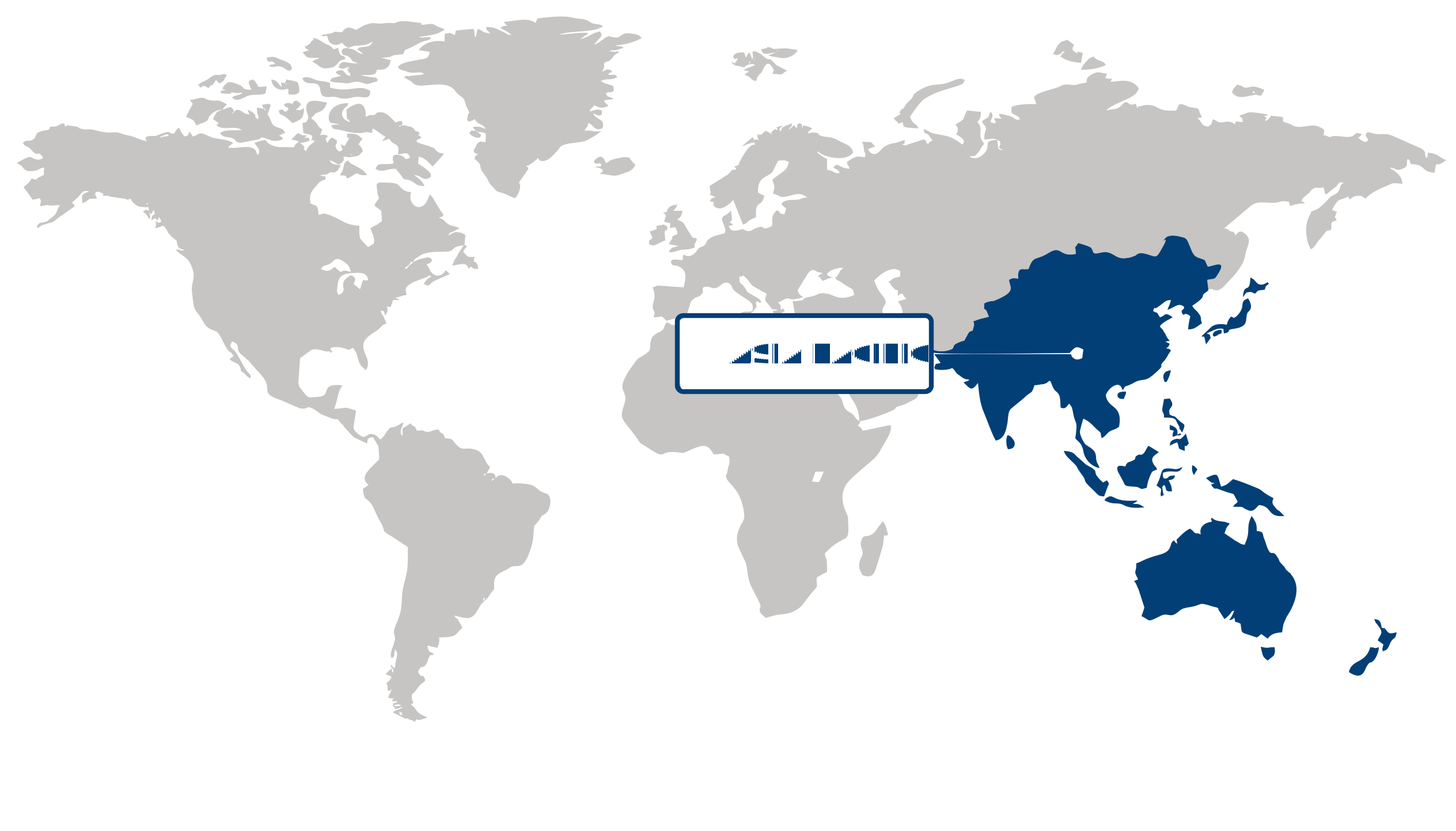
Asia Pacific (Largest Region)
Asia Pacific held the largest share of the demolition hammers market in 2026, supported by extensive construction and infrastructure development across emerging and established economies. Rising urbanization, renovation activity, and investment in transportation and commercial infrastructure are sustaining demand for heavy-duty demolition equipment. The expansion of construction and remodeling applications is further encouraging the adoption of efficient power tools capable of handling demanding demolition tasks.
Europe (Fastest-Growing Region)
Europe is emerging as the fastest-growing region, driven by increasing renovation and refurbishment activity alongside continued investment in infrastructure modernization. Aging building structures are creating a sustained need for demolition and reconstruction work, while greater emphasis on workplace productivity and equipment efficiency is encouraging contractors to adopt advanced demolition tools. Growing attention to sustainable construction practices and the modernization of existing structures is expected to further support regional demand.
| Parameter | North America | Asia Pacific | Europe | Latin America | MEA |
|---|---|---|---|---|---|
| Innovation HubiScaleNascentDeveloping Advanced | |||||
| Cost-Sensitive RegioniScaleLowMedium High | |||||
| Regulatory EnvironmentiScaleRestrictiveNeutral Supportive | |||||
| Demand DriversiScaleWeakModerate Strong | |||||
| Development StageiScaleEmergingDeveloping Developed | |||||
| Adoption RateiScaleLowMedium High | |||||
| New Entrants / StartupsiScaleSparseModerate Dense | |||||
| Macro IndicatorsiScaleWeakStable Strong |
Key Country Insights
United States 🇺🇸
Infrastructure Equipment DemandThe U.S. demolition hammers market is supported by renovation, commercial redevelopment, and infrastructure projects that require durable high-performance tools. Buyers increasingly prioritize productivity, operator safety, and compatibility with cordless and dust-control solutions.
Germany 🇩🇪
Precision Construction ToolsGermany emphasizes demolition hammers that deliver consistent performance for industrial construction and refurbishment projects. Demand favors durable equipment with low vibration, energy efficiency, and compliance with stringent workplace safety requirements.
Japan 🇯🇵
Compact Urban ApplicationsJapan focuses on compact demolition hammers suited for urban construction, seismic retrofitting, and space-constrained renovation projects. End users value lightweight designs, reduced noise, and dependable performance for continuous professional use.
South Korea 🇰🇷
Smart Jobsite IntegrationSouth Korea is adopting demolition hammers that support efficient construction workflows through cordless technology and improved ergonomics. Contractors increasingly seek equipment that minimizes downtime while meeting productivity expectations on large development projects.
France 🇫🇷
Sustainable Renovation FocusFrance prioritizes demolition hammers for building renovation and energy-efficiency upgrade projects across residential and commercial sectors. Buyers favor equipment offering dust reduction, operator comfort, and reliable performance in refurbishment environments.
Italy 🇮🇹
Restoration Project SupportItaly's demolition hammers market reflects demand from infrastructure maintenance and restoration of aging buildings. Professional users prefer versatile equipment capable of balancing controlled demolition with durability across varied construction applications.
Demolition Hammers Market Share (%), by End Use, 2026
Go beyond the chart, access full insights & data tables
Request Free Sample ReportEnd Use Segment Analysis: Building & Construction (Largest & Fastest-Growing Segment)
The building & construction segment dominated the demolition hammers market, accounting for 49.29% in 2026 while also emerging as the fastest-growing end-use segment. Demolition hammers are extensively used for breaking concrete, masonry, pavements, and other structural materials during renovation, infrastructure development, and new construction projects. Rising investments in urban development, transportation infrastructure, and commercial construction continue to support demand for powerful demolition equipment. The need for faster project execution and efficient material removal further reinforces the segment’s leadership.
Type Segment Analysis: Electric (Largest & Fastest-Growing Segment)
Holding the largest share of the demolition hammers market, the electric segment accounted for 52.36% in 2026 while also recording the fastest growth. Electric demolition hammers are widely adopted because they combine strong breaking performance with lower maintenance requirements and ease of operation compared with alternative power sources. Their suitability for indoor applications, reduced emissions, and compatibility with modern construction environments make them increasingly attractive for contractors. Continuous improvements in motor efficiency, portability, and ergonomics are further strengthening demand for electric models.
Distribution Channel Segment Analysis: Offline (Largest Segment) vs Online (Fastest-Growing Segment)
The offline distribution channel held the largest share of the demolition hammers market in 2026. Professional contractors and industrial buyers often prefer purchasing through authorized dealers and equipment retailers where they can evaluate product performance, receive technical guidance, and access maintenance services. Established dealer networks and immediate product availability continue to support the dominance of offline sales.
The online distribution channel is the fastest-growing segment, driven by increasing digital procurement across the construction industry. E-commerce platforms enable buyers to compare specifications, pricing, and product reviews while providing convenient purchasing and delivery options. Growing digital adoption among professional users, combined with broader product availability and competitive pricing, continues to accelerate online sales of demolition hammers.
| Segment | Sub-Segment | Largest Segment | Fastest Growing |
|---|---|---|---|
| End Use | Building & Construction, General Engineering & Manufacturing, Others | Building & Construction | Building & Construction |
| Type | Electric, Pneumatic, Hydraulic | Electric | Electric |
| Distribution Channel | Online, Offline | Offline | Online |
| Power Range | Up to 600 Watts, 600 Watts to 1200 Watts, Above 1200 Watts | Above 1200 Watts | Above 1200 Watts |
Competitive Landscape and Market Positioning
Prominent players in the demolition hammers market:
- Stanley Black & Decker, Inc. (United States)
- Robert Bosch GmbH (Germany)
- Hilti AG (Liechtenstein)
- Makita Corporation (Japan)
- Techtronic Industries Co., Ltd. (Hong Kong)
- Koki Holdings Co., Ltd. (Japan)
- Einhell Germany AG (Germany)
- Ferm International B.V. (Netherlands)
- VEVOR (China)
Competitive momentum in the demolition hammers market is increasingly driven by the balance between high-impact performance and operator usability rather than maximum power alone. Manufacturers are refining tool architectures to improve vibration control, weight distribution, and durability, recognizing that contractors evaluate equipment based on productivity over extended operating periods as well as maintenance requirements. Growing adoption of battery-powered professional tools has also introduced a new dimension of rivalry, prompting suppliers to optimize energy efficiency, charging ecosystems, and compatibility across broader equipment platforms. As end users seek equipment that performs reliably in varied jobsite conditions, differentiation is becoming more closely tied to lifecycle value, serviceability, and ergonomic engineering than to isolated technical specifications.
| Company | Market Share | Company Revenue | Revenue CAGR (%) | Product Portfolio | Geographic Presence | Innovation / R&D Focus | Strategic Developments |
|---|---|---|---|---|---|---|---|
| Stanley Black & Decker Inc. (United States) | |||||||
| Robert Bosch GmbH (Germany) | |||||||
| Hilti AG (Liechtenstein) | |||||||
| Makita Corporation (Japan) | |||||||
| Techtronic Industries Co. Ltd. (Hong Kong) | |||||||
| Koki Holdings Co. Ltd. (Japan) | |||||||
| Einhell Germany AG (Germany) | |||||||
| Ferm International B.V. (Netherlands) | |||||||
| VEVOR (China) |
Industry Development/News
| Company Name | Date | Key Development |
|---|---|---|
| Bobcat | Mar-25 | Bobcat expanded its equipment attachments infrastructure to feature over 120 compatible options, with multiple secondary products currently under development. This strategic expansion aims to broaden attachment compatibility across diverse machinery platforms, direct engineering resources toward multi-tool flexibility, and enhance operational footprints within structural demolition segments. |
| Makita U.S.A., Inc. | Oct-24 | Makita U.S.A., Inc. launched a new 70 lb. Breaker Hammer engineered for its XGT cordless platform. The addition expands the brand's heavy-duty tool portfolio, targeting the replacement of traditional corded concrete equipment with high-capacity cordless alternatives to improve portability and efficiency on commercial construction and demolition job sites. |
| HiKOKI | Sep-24 | HiKOKI introduced the H3641DA 36V SDS-MAX demolition hammer to its high-performance cordless product line. Designed to match the operating performance of corded counterparts, the tool integrates advanced cordless mobility to address demanding construction and masonry demolition applications, optimizing worker efficiency through improved portability. |
Customize Your Report
Explore examples of how this report can be tailored to different research needs, including custom segments, additional topics or chapters, and related reports. Click a section of the wheel or its numbered marker to explore the available options.
Demolition Hammers Market — Custom Segments
| Segment | Sub-Segment |
|---|---|
| Impact Energy Class | Low Impact Energy, Medium Impact Energy, High Impact Energy |
| Purchase Model | Direct Purchase, Rental, Equipment-as-a-Service |
| Duty Cycle | Light-Duty, Medium-Duty, Heavy-Duty, Continuous-Duty |
Demolition Hammers Market — Custom TOC
| Custom Chapter | Chapter Details |
|---|---|
| Jobsite Productivity Economics |
|
| Battery-Powered Transition |
|
| Rental Market Opportunity Assessment |
|
Need a different cut of the data?
Request Custom ResearchFrequently Asked Questions
What is the market valuation of demolition hammers?
What is the forecasted size of the demolition hammers industry?
How is infrastructure investment influencing demand for demolition hammers?
What product innovations are strengthening the competitive position of demolition hammers?
Why is the building & construction segment the largest end user of demolition hammers?
Which distribution channel is growing the fastest in the demolition hammers market?
Why does Asia Pacific hold the largest share of the demolition hammers market?
How is Europe emerging as the fastest-growing demolition hammers market?
Which companies dominate the demolition hammers landscape?
Our Clients
"Your insights on workforce structures were spot-on. The analysis on mid-to-senior level roles validated some of our hiring decisions and highlighted gaps."
Ateliers De France
"The report gave us insights on competitors in the market. It helped our team refine our bidding strategy for upcoming contracts."
Clark Construction
"The reports provided a deep dive into market trends, and competitive landscape. The strategic insights and recommendations have been very helpful."
Rudolph and Sletten
Our Research Team & Methodology
Every Fundamental Business Insights report is built by a dedicated vertical research team, validated through a structured primary-and-secondary methodology, and reviewed for accuracy before it reaches you.
Delivery
Published
Available
Support
- Market Size & Forecast
- Market Segmentation
- Regional Analysis
- Growth Drivers & Challenges
- Market Dynamics
- Competitive Landscape
- Company Profiles
- Competitive Benchmarking
- Mergers & Acquisitions
- Market Share Analysis or Key Company Strategies
- Value Chain Analysis
- Porter's Five Forces
- PESTLE Analysis
- Pricing Trends
- Supply-Demand Analysis
- Technology Landscape
- Regulatory Landscape
- Investment & Funding Landscape
- Emerging Opportunities
- Future Market Outlook