Copper Scrap Market Size & Growth Forecast 2027–2036, By Segments (Feed Material, Grade, Application, End-use), Regional Demand Trends (North America, Asia Pacific, Europe), Key Country Insights (U.S., Japan, South Korea, Germany, France, Italy), and Competitive Landscape
Market Size and Growth Outlook
Copper Scrap Market size stood at USD 42.4 billion in 2026 and is predicted to grow at a 8.84% CAGR from 2027 to 2036, attaining USD 98.91 billion by 2036. The industry revenue for 2027 is estimated at USD 45.55 billion.
Get more details on this report
Request Free Sample ReportCopper Scrap Market Intelligence Snapshot
Regional Market Dynamics
- Asia Pacific held a 62.90% market share in 2026, supported by its large metal processing base, dense manufacturing activity, and efficient scrap collection feeding smelting and fabrication operations.
- North America is projected to grow at a 9.83% CAGR as stronger recycling activity and greater use of secondary copper increase demand for organized scrap recovery, sorting, and processing capacity.
Segment Momentum
- Old Scrap leads with 54.18% share in 2026 due to abundant end-of-life wiring, plumbing, and industrial materials, ensuring consistent recoverable feedstock for recyclers and stable processing volumes.
- Bare Bright is the fastest-growing grade as demand rises for cleaner, high-purity copper that improves processing efficiency and reduces preparation effort, supporting higher-value downstream applications.
Market Expansion Drivers
- Sustainability-driven recycling demand reducing emissions and improving copper resource efficiency.
- Advancements in scrap sorting, metallurgical recovery, and e-waste processing technologies.
- Expanding EV and renewable energy infrastructure increasing demand for recycled copper supply chains.
Leading Market Participants
- Major players in the copper scrap market include Aurubis AG (Germany), Glencore plc (Switzerland), Commercial Metals Company (United States), Sims Limited (Australia), European Metal Recycling Ltd. (United Kingdom), OmniSource, LLC (United States), Schnitzer Steel Industries, Inc. (United States), Kuusakoski Group Oy (Finland), David J. Joseph Company (United States), HKS Metals B.V. (Netherlands).
Global Market Forecast Snapshot
Market Outlook
- 2026 Market Size: USD 42.4 billion
- 2027 Estimated Market Size: USD 45.55 billion.
- Projected Market Size: USD 98.91 billion by 2036
- Growth Forecast: 8.84% CAGR (2027-2036)
Regional and Segment Outlook
- Leading Regional Market: Asia Pacific
- High-Growth Regional Hub: North America
- Core Revenue Segment: Old Scrap (Feed Material) | #2 Copper Scrap (Grade) | Brass Mills (Application) | Electrical & Electronics (End-use)
- Emerging Opportunity Segment: Old Scrap (Feed Material) | Bare Bright (Grade) | Ingots Makers (Application) | Electrical & Electronics (End-use)
Market Growth Drivers and Industry Trends
Sustainability-driven recycling demand reducing emissions and improving copper resource efficiency
Greater emphasis on resource conservation and lower-emission manufacturing is strengthening demand for recovered copper, which will drive the copper scrap market growth. Recycling copper allows valuable metal to be returned to industrial supply chains while reducing dependence on newly extracted resources and improving material utilization. Manufacturers and processors are increasingly incorporating recycled inputs into production strategies as sustainability objectives become more important across metal-intensive industries. The ability to recover copper from discarded products, manufacturing residues, and obsolete equipment also supports more efficient use of existing resources, particularly where industries are seeking to improve material circularity and reduce the environmental burden associated with primary metal production.
Advancements in scrap sorting, metallurgical recovery, and e-waste processing technologies
Technological improvements throughout the recovery process are increasing the efficiency and quality of copper recycling, thereby supporting expansion in the copper scrap market. Advanced sorting systems can improve the separation of copper-bearing materials from mixed scrap streams, while improved metallurgical techniques enable greater recovery from complex feedstocks. Developments in e-waste processing are particularly important because discarded electronic equipment contains copper in increasingly diverse forms and concentrations, requiring more sophisticated recovery methods. Better processing efficiency can increase the amount of recoverable copper while improving the consistency of recycled material supplied to downstream manufacturers, making previously difficult or uneconomical scrap streams more attractive for recovery.
Expanding EV and renewable energy infrastructure increasing demand for recycled copper supply chains
Rapid development of electric vehicles and renewable energy infrastructure is creating additional requirements for copper-intensive components, strengthening the role of recycled materials in the copper scrap market. Electric vehicles rely heavily on copper in electrical systems, motors, wiring, and charging infrastructure, while renewable power installations require copper for electrical connections, cabling, generators, and grid integration. As these applications expand, manufacturers and material suppliers are seeking diversified sources of copper to complement primary production. Recycled copper can provide an important secondary feedstock for these supply chains, encouraging stronger collection networks, processing capacity, and long-term investment in scrap recovery operations.
| Growth Driver | Impact on CAGR | Regulatory Influence | Geographic Relevance | Adoption Rate | Impact Timeline |
|---|---|---|---|---|---|
| Sustainability-driven recycling demand reducing emissions and improving copper resource efficiency | 2.50% | High | North America, Europe, Asia Pacific | High | Near Term |
| Advancements in scrap sorting, metallurgical recovery, and e-waste processing technologies | 2.00% | Moderate | Europe, Asia Pacific | Medium | Mid Term |
| Expanding EV and renewable energy infrastructure increasing demand for recycled copper supply chains | 1.70% | Moderate | Asia Pacific, Europe, North America | High | Mid Term |
Unlock insights tailored to your business with our bespoke market research solutions.
Click to get your customized report now.
Regional Demand Dynamics
Asia Pacific (Largest Region)
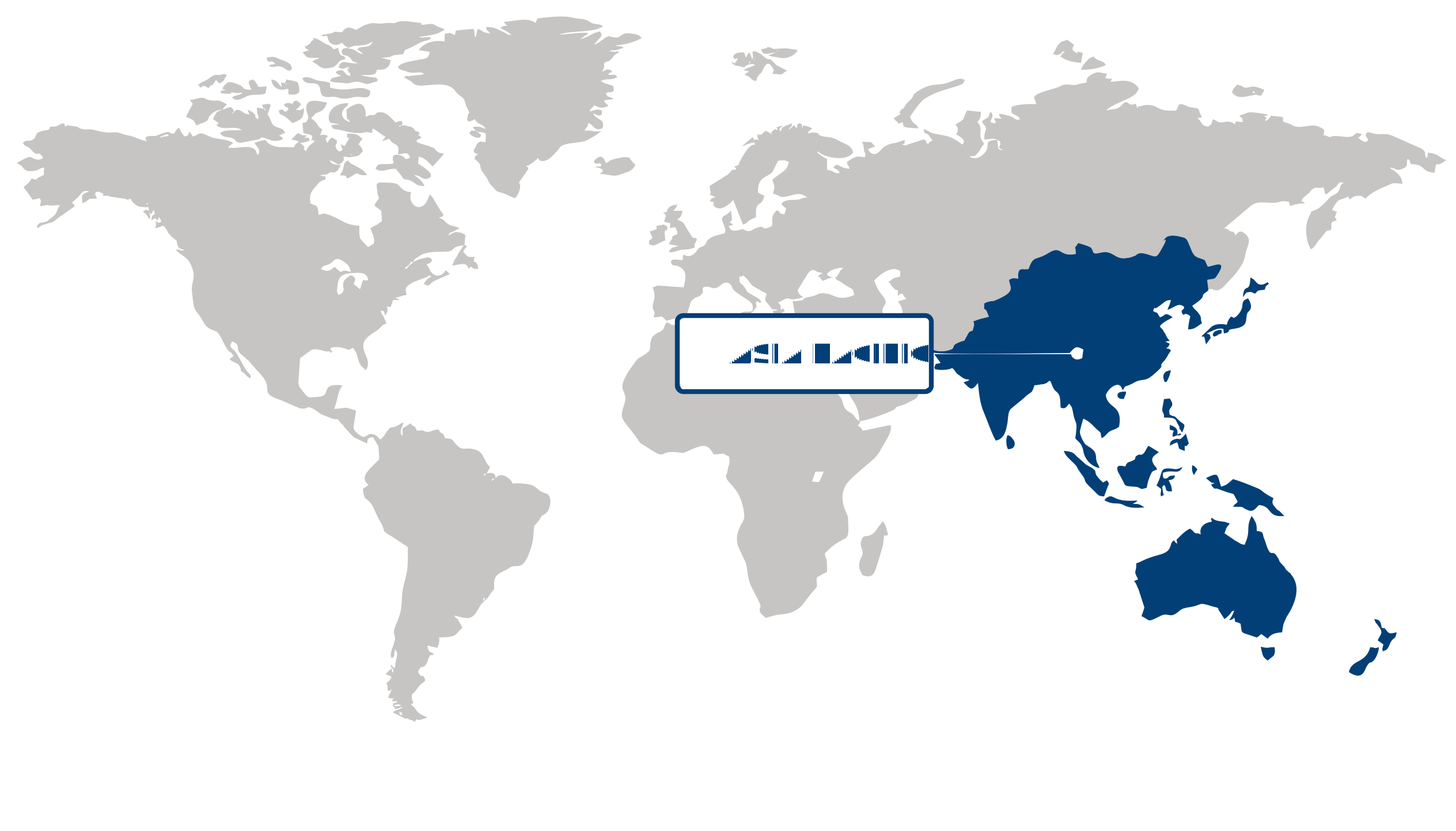
Holding the largest share of the copper scrap market, Asia Pacific accounted for 62.90% in 2026, reflecting its extensive manufacturing base, large-scale metal-processing industries, and strong demand for copper across electrical, construction, electronics, and infrastructure applications. The region's concentration of fabrication and industrial activity generates substantial volumes of recoverable copper while supporting strong demand for recycled material as manufacturers seek efficient and cost-effective sources of metal. Expanding electrification and infrastructure development further reinforce copper consumption, making efficient scrap collection, processing, and reintegration into production increasingly important. Growing attention to resource efficiency and industrial sustainability is also encouraging greater utilization of secondary copper.
North America (Fastest-Growing Region)
North America is the fastest-growing region, supported by increasing emphasis on domestic material recovery, supply-chain resilience, and efficient resource utilization. Demand for copper associated with electrification, power infrastructure, construction, and advanced manufacturing is strengthening the importance of recycled supply streams. Investments in recycling infrastructure and improved scrap collection systems are helping increase the availability and quality of recovered copper, while manufacturers are placing greater value on dependable secondary raw materials. Sustainability objectives and efforts to reduce reliance on newly extracted resources are also encouraging broader participation in organized copper recovery and recycling networks.
| Parameter | North America | Asia Pacific | Europe | Latin America | MEA |
|---|---|---|---|---|---|
| Innovation Hub i Scale Nascent Developing Advanced | |||||
| Cost-Sensitive Region i Scale Low Medium High | |||||
| Regulatory Environment i Scale Restrictive Neutral Supportive | |||||
| Demand Drivers i Scale Weak Moderate Strong | |||||
| Development Stage i Scale Emerging Developing Developed | |||||
| Adoption Rate i Scale Low Medium High | |||||
| New Entrants / Startups i Scale Sparse Moderate Dense | |||||
| Macro Indicators i Scale Weak Stable Strong |
Key Country Insights
Germany 🇩🇪
Industrial Recycling IntegrationGermany emphasizes copper scrap recovery as part of its resource efficiency and industrial decarbonization agenda. German manufacturers are strengthening partnerships with recyclers to secure high-quality secondary copper inputs for automotive, machinery, and electrical equipment production.
France 🇫🇷
Sustainable Materials TransitionFrance is integrating copper scrap utilization into broader circular economy initiatives and industrial sustainability programs. French manufacturers are increasingly seeking traceable recycled copper sources to align with environmental targets and reduce dependence on primary metal extraction.
Italy 🇮🇹
Manufacturing Feedstock DiversificationItaly's copper scrap market benefits from demand across metalworking, cable, and equipment manufacturing industries. Italian recyclers are prioritizing efficient collection networks and higher-value processing to provide manufacturers with dependable secondary copper feedstock.
Japan 🇯🇵
Resource Security Through RecyclingJapan relies on copper scrap processing to reduce exposure to imported raw material constraints and improve supply resilience. Companies in Japan are investing in advanced sorting and refining technologies that enable greater recovery of high-purity copper from end-of-life products.
South Korea 🇰🇷
Electronics Recovery EcosystemSouth Korea's copper scrap market is supported by the recycling of electronic equipment and industrial waste streams. Domestic processors are focusing on efficient material recovery systems that can supply secondary copper for semiconductor, battery, and electrical manufacturing applications.
United States 🇺🇸
Circular Metals Supply BaseThe U.S. copper scrap market is increasingly tied to domestic manufacturing and grid modernization investments that require stable secondary copper supply. Processors in the U.S. are expanding collection and refining capabilities to support demand from electric vehicles, construction, and renewable energy equipment.
Segment Leadership and Growth Trends
Copper Scrap Market Share (%), by Feed Material, 2026
Go beyond the chart, access full insights & data tables
Request Free Sample ReportFeed Material Segment Analysis: Old Scrap (Largest & Fastest-Growing Segment)
The copper scrap market was led by the old scrap segment, which captured a 54.18% share in 2026 while also representing the fastest-growing feed material category. Old scrap from demolished buildings, retired electrical equipment, transportation assets, and industrial machinery provides a substantial source of recoverable copper for secondary production. Growing emphasis on resource conservation, energy-efficient metal recovery, and circular manufacturing is increasing investment in collection and processing infrastructure. Rising demand for recycled copper in electrical, construction, and industrial applications further strengthens the segment's dominant position.
Grade Segment Analysis: #2 Copper Scrap (Largest Segment) vs Bare Bright (Fastest-Growing Segment)
#2 copper scrap accounted for the largest grade share at 33.5% in 2026, supported by its widespread availability from mixed industrial, commercial, and residential waste streams. Although it requires additional processing before reuse, its abundant supply and economic value make it an important input for secondary smelting and refining operations. Expanding recycling networks continue to sustain demand for this grade.
Bare bright is the fastest-growing grade because of its high purity and suitability for applications that require premium recycled copper with minimal processing. Manufacturers increasingly value cleaner recycled feedstock to improve production efficiency and meet stringent quality requirements, particularly in electrical and electronic products. Greater emphasis on high-value recycling is accelerating demand for this premium-grade material.
| Segment | Sub-Segment | Largest Segment | Fastest Growing |
|---|---|---|---|
| Feed Material | Old Scrap, New Scrap | Old Scrap | Old Scrap |
| Grade | Bare Bright, #1 Copper Scrap, #2 Copper Scrap, Others | #2 Copper Scrap | Bare Bright |
| Application | Wire Rod Mills, Brass Mills, Ingots Makers, Others | Brass Mills | Ingots Makers |
| End-use | Building & Construction, Electrical & Electronics, Industrial Machinery & Equipment, Transportation Equipment, Consumer and General Products | Electrical & Electronics | Electrical & Electronics |
Competitive Landscape and Market Positioning
Prominent players in the copper scrap market:
1. Aurubis AG (Germany)
2. Glencore plc (Switzerland)
3. Commercial Metals Company (United States)
4. Sims Limited (Australia)
5. European Metal Recycling Ltd. (United Kingdom)
6. OmniSource LLC (United States)
7. Schnitzer Steel Industries Inc. (United States)
8. Kuusakoski Group Oy (Finland)
9. David J. Joseph Company (United States)
10. HKS Metals B.V. (Netherlands)
Growing demand for recycled metals is encouraging efficiency improvements throughout the copper scrap market. Investment in advanced sorting, processing, and recovery technologies is enhancing recycling performance while supporting reliable raw material supply for manufacturing and infrastructure applications.
| Company | Market Share | Company Revenue | Revenue CAGR (%) | Product Portfolio | Geographic Presence | Innovation / R&D Focus | Strategic Developments |
|---|---|---|---|---|---|---|---|
| Aurubis AG (Germany) | |||||||
| Glencore plc (Switzerland) | |||||||
| Commercial Metals Company (United States) | |||||||
| Sims Limited (Australia) | |||||||
| European Metal Recycling Ltd. (United Kingdom) | |||||||
| OmniSource LLC (United States) | |||||||
| Schnitzer Steel Industries Inc. (United States) | |||||||
| Kuusakoski Group Oy (Finland) | |||||||
| David J. Joseph Company (United States) | |||||||
| HKS Metals B.V. (Netherlands). |
Industry Development/News
| Company Name | Date | Key Development |
|---|---|---|
| Aurubis AG | Sep-25 | Aurubis AG launched its $800 million copper recycling facility in Richmond, Georgia. The plant is engineered to process 180,000 metric tons of complex copper scrap annually, producing 70,000 tons of blister copper. This strategic investment significantly expands North American recycling capacity and strengthens the regional circular supply chain for copper. |
| Wieland | Aug-25 | Wieland held a groundbreaking ceremony for a new investment project at its Vöhringen site in Germany. This expansion scales the company's copper and brass production footprint, supporting downstream industrial demand and strengthening the integrated supply chain for both primary and secondary copper-based manufacturing materials. |
| Cunext Group | Jul-25 | Cunext Group announced the construction of a new secondary copper production facility in Córdoba, Spain. With an annual capacity of 100,000 tons of recycled copper, the project represents a major capital investment in European circular economy infrastructure, aimed at increasing the availability of high-quality recycled copper for industrial applications. |
| Aurubis | Jul-25 | Aurubis is currently navigating significant executive and governance adjustments following an ongoing fraud investigation. The organizational instability at one of Europe's largest copper recyclers introduces potential risks to operational oversight and long-term strategic initiatives within the regional copper recycling and production value chain. |
| Sims Limited | May-24 | Sims Limited initiated an expansion of its non-ferrous metal recycling operations in the United States. The initiative centers on upgrading sorting and processing technologies to enhance the recovery rates of high-value copper and aluminum from industrial and post-consumer scrap, directly supporting the growing market demand for recycled feedstock. |
| Radius Recycling | Mar-24 | Radius Recycling (formerly Schnitzer Steel) invested in advanced metal recovery technology upgrades across its North American facility network. These improvements are designed to increase the efficiency of non-ferrous scrap processing, specifically targeting higher output yields of recycled copper to meet the needs of domestic and global manufacturing sectors. |
Customize Your Report
Explore examples of how this report can be tailored to different research needs, including custom segments, additional topics or chapters, and related reports. Click a section of the wheel or its numbered marker to explore the available options.
Copper Scrap Market — Custom Segments
| Segment | Sub-Segment |
|---|---|
| Scrap Source Industry | Construction & Demolition, Electrical & Electronics, Automotive & Transportation, Industrial Manufacturing, Consumer & Commercial Products |
| Processing Stage | Unprocessed Scrap, Sorted & Prepared Scrap, Processed Scrap, Refined Copper Feedstock |
| Trade Channel | Domestic Direct Sales, Domestic Scrap Dealers & Traders, International Direct Trade, International Scrap Trading |
Copper Scrap Market — Custom TOC
| Custom Chapter | Custom Details |
|---|---|
| Scrap Supply Chain Optimization Analysis |
|
| Urban Mining Opportunity Assessment |
|
| Secondary Copper Demand Outlook |
|
Need a different cut of the data?
Request Custom ResearchHow much revenue does the copper scrap market generate?
What are the growth projections for the copper scrap industry?
How are decarbonization and circular sourcing requirements influencing procurement strategies in the copper scrap market?
What impact is electrification infrastructure expansion having on recycled copper supply chain development?
Why does Old Scrap dominate the copper scrap feed material segment?
What is driving growth in Bare Bright copper scrap within the market?
Why does Asia Pacific lead the copper scrap market?
Why is North America the fastest-growing region in the copper scrap market?
What are the prominent companies operating in the copper scrap landscape?
Our Clients
"The report helped us understand emerging consumer trends in our product category. It clarified where to focus innovation for the next product launch."
LyondellBasell
"The regional forecast section was incredibly useful. We were able to identify two new potential partners in Europe thanks to the vendor mapping you included."
SABIC
"We appreciated how actionable the recommendations were. It guided us to improve supply chain resilience."
Olin Corporation
Our Research Team & Methodology
Every Fundamental Business Insights report is built by a dedicated vertical research team, validated through a structured primary-and-secondary methodology, and reviewed for accuracy before it reaches you.
Research Team Overview
Prepared by the Chemicals & Materials Research Team
Delivery
Published
Demand
Available
Support
Trust & Compliance
Research Domains
10 coverage areasResearch Intelligence
| Source | Reference |
|---|---|
| American Chemistry Council (ACC) | www.americanchemistry.com |
| European Chemical Industry Council (Cefic) | cefic.org |
| International Council of Chemical Associations (ICCA) | icca-chem.org |
| European Chemicals Agency (ECHA) | echa.europa.eu |
| U.S. Environmental Protection Agency (EPA) | www.epa.gov |
| ASTM International | www.astm.org |
| International Organization for Standardization (ISO) | www.iso.org |
| National Institute of Standards and Technology (NIST) | www.nist.gov |
| Plastics Industry Association (PLASTICS) | www.plasticsindustry.org |
| European Biplastics | www.european-bioplastics.org |
| The Adhesive and Sealant Council (ASC) | www.ascouncil.org |
| National Association of Corrosion Engineers (AMPP) | www.ampp.org |
| Society of Plastics Engineers (SPE) | www.4spe.org |
| International Fertilizer Association (IFA) | www.fertilizer.org |
| CropLife International | croplife.org |
| Packaging Europe | packagingeurope.com |
| Flexible Packaging Association (FPA) | www.flexpack.org |
| Battery Council International (BCI) | batterycouncil.org |
| International Copper Association (ICA) | internationalcopper.org |
| World Steel Association | worldsteel.org |
Research Workflow & Quality Assurance
Data Collection
Verified information gathered through primary and secondary research.
Data Triangulation
Cross-validation using multiple independent data sources.
Forecast Modelling
Market estimates developed using historical trends and analytical models.
Analyst Validation
Findings reviewed by domain experts for accuracy and consistency.
Editorial & Quality Review
Final editorial, quality, and compliance checks before publication.
Final Publication
Released after successful completion of the internal review process.
Report Coverage
📊 Market Assessment
- Market Size & Forecast
- Market Segmentation
- Regional Analysis
- Growth Drivers & Challenges
- Market Dynamics
🏢 Competitive Intelligence
- Competitive Landscape
- Company Profiles
- Competitive Benchmarking
- Mergers & Acquisitions
- Market Share Analysis or Key Company Strategies
🔍 Strategic Analysis
- Value Chain Analysis
- Porter's Five Forces
- PESTLE Analysis
- Pricing Trends
- Supply-Demand Analysis
🚀 Future Outlook
- Technology Landscape
- Regulatory Landscape
- Investment & Funding Landscape
- Emerging Opportunities
- Future Market Outlook
Have a question about this report or need a custom scope?
Request Customization