Convection Reflow Soldering Oven Market Size & Forecasts 2026-2035, By Segments (Product Type, Solder Paste Composition, Application, PCB Size, Number of Zones), Growth Opportunities, Innovation Landscape, Regulatory Shifts, Strategic Regional Insights (U.S., Japan, China, South Korea, UK, Germany, France), and Competitive Dynamics (Heller Industries, ERSA, JUKI Corporation, Rehm Thermal Systems, SMT Solutions)
Market Size and Growth Outlook
Convection Reflow Soldering Oven Market size is predicted to expand from USD 1.11 billion in 2025 to USD 1.79 billion by 2035, with growth underpinned by a CAGR above 4.9% between 2026 and 2035. The industry revenue outlook for 2026 is USD 1.16 billion.
Get more details on this report
Request Free Sample ReportConvection Reflow Soldering Oven Market Intelligence Snapshot
Regional Market Dynamics
Segment Momentum
Market Expansion Drivers
Leading Market Participants
Global Market Forecast Snapshot
Market Outlook
Regional and Segment Outlook
Market Growth Drivers and Industry Trends
Expansion of small-scale electronics production: Growth in maker ecosystems and contract micro-fabrication is creating steady demand for compact, flexible reflow systems in the convection reflow soldering oven market. Platforms and communities such as Arduino and Adafruit Industries, alongside manufacturing-as-a-service providers like MacroFab and PCBWay, publicly document increases in short-run orders and rapid prototyping needs. This trend opens opportunities for modular, low-footprint ovens, subscription-based service models, and localized support for new entrants, while incumbents can capture aftermarket consumables and training revenue; the proliferation of regional micro-fabs suggests stable, diversified demand.
Advancements in convection and precision reflow technology: Improvements in thermal control, zone profiling, and inline analytics are raising process yield expectations and shifting buyer criteria across the convection reflow soldering oven market. Suppliers including Panasonic, Rehm Thermal Systems, and Nordson Corporation have promoted enhanced convection control and software-enabled profile management in product literature and press releases, while SEMI’s emphasis on equipment traceability reinforces digital integration. These innovations favor vendors that bundle sensors, SPC and connectivity, and give contract manufacturers and OEMs clearer value propositions; continued supplier roadmaps and standards activity indicate accelerated adoption of precision-focused systems.
Industry Restraints:
RoHS-driven Lead-Free Transition and Thermal Complexity
The EU’s Directive 2011/65/EU (RoHS) and parallel global restrictions have forced widespread adoption of lead-free solders with higher melting points, increasing thermal stress and tight process windows for convection reflow ovens. IPC’s J-STD-001 guidance and IPC training emphasize tighter profiling and new process controls, while vendors such as Heller Industries and Rehm Thermal Systems cite customer demand for advanced zone control and nitrogen capability to manage lead-free challenges. Strategically, incumbent OEMs with R&D and aftermarket profiling services gain pricing power, whereas smaller equipment makers and contract manufacturers face retrofit costs and reliability risk. Near to medium term, regulatory enforcement and continued component miniaturization will sustain demand for higher-specification ovens and profiling services, favoring suppliers who can deliver validated, lead-free-ready process solutions.
Capital Intensity, Energy Consumption and Sustainability Pressures
High upfront equipment costs and significant energy consumption of convection reflow ovens constrain adoption, particularly for capital-constrained assemblers and new entrants. The U.S. Department of Energy and the International Energy Agency highlight industrial energy intensity as a priority, and manufacturers such as BTU International and Rehm Thermal Systems promote energy-efficient designs and zone optimization in press releases to reduce total cost of ownership. Strategically, large OEMs and service-focused vendors can amortize R&D and offer financing or retrofit packages, while startups face barriers to entry and slower upgrade cycles. Looking ahead, rising energy costs and corporate sustainability mandates will keep energy-efficient models and retrofit services central to purchasing decisions, prompting product differentiation and increased aftermarket revenue models.
| Growth Driver | Impact on CAGR | Regulatory Influence | Geographic Relevance | Adoption Rate | Impact Timeline |
|---|---|---|---|---|---|
| Adoption in PCB and electronics manufacturing | 2.00% | Short term (≤ 2 yrs) | Asia Pacific, North America | Medium | Fast |
| Expansion of small-scale electronics production | 1.50% | Medium term (2–5 yrs) | Europe, North America | Medium | Moderate |
| Advancements in convection and precision reflow technology | 1.00% | Long term (5+ yrs) | North America, Europe | Low | Slow |
Unlock insights tailored to your business with our bespoke market research solutions.
Click to get your customized report now.
Regional Demand Dynamics
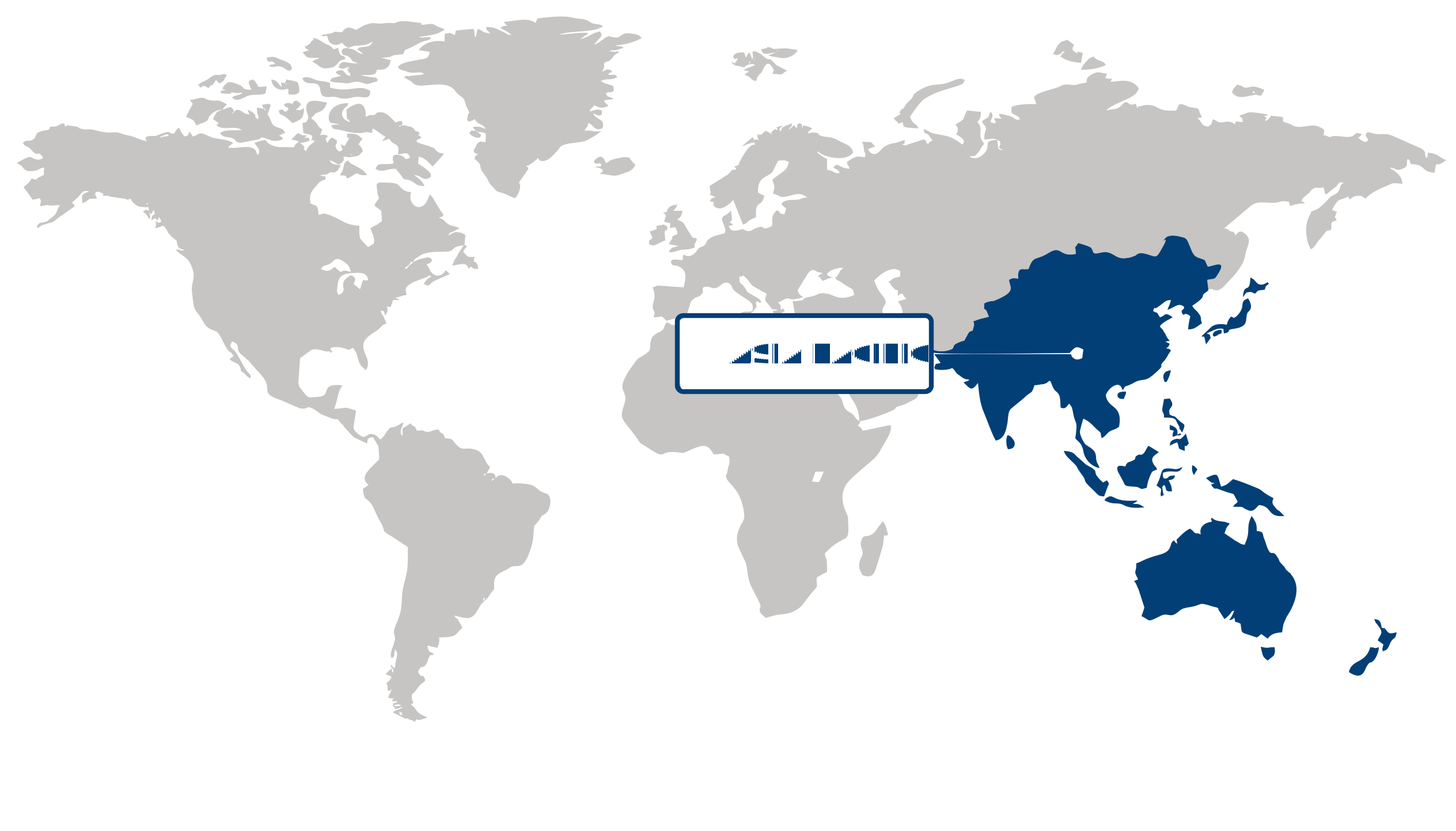
Asia Pacific captured over 47% of the convection reflow soldering oven market in 2025 and, at a 6.5% CAGR, stands as both the largest and fastest-growing region. Growth is anchored in the concentration of electronics manufacturing hubs across China and India—supported by policy and investment signals from the Ministry of Industry and Information Technology (MIIT) and India’s Ministry of Electronics and Information Technology (MeitY)—and reinforced by major contract manufacturers such as Foxconn scaling capacity (Foxconn press releases) and brand investments noted by Samsung Electronics. Evidence from the Asian Development Bank on regional supply-chain resilience and World Bank data on manufacturing investment underpins demand for higher-throughput, energy-efficient ovens. Continued modernization, stricter local content rules, and sustainability targets make Asia Pacific a high-opportunity market for suppliers offering automation and green process solutions.
Japan is positioned as a pivotal hub in Asia Pacific, and the convection reflow soldering oven market benefits from Japan’s emphasis on high-mix, high-reliability assembly. Ministry of Economy, Trade and Industry (METI) initiatives and corporate commitments from Toyota and Panasonic toward electrified vehicles and miniaturized consumer electronics are raising requirements for precision reflow profiles and inline process control (Toyota and Panasonic press releases). Strong OEM quality expectations and government support for advanced manufacturing mean suppliers with precision control, traceability, and service networks can capture premium segments and feed regional demand for specialized equipment.
China anchors the Asia Pacific market, and the convection reflow soldering oven market is driven by scale, localization, and rapid capacity additions. MIIT guidance, the practical effects of domestic supply-chain integration, and large-scale expansions by EMS players such as Hon Hai/Foxconn (Foxconn press releases) and assembly growth at Huawei and BYD create volume demand for throughput-optimized, cost-effective ovens. Regulatory nudges favoring domestic suppliers and investments documented by the China Council for the Promotion of International Trade further shorten adoption cycles. For oven manufacturers, tailored cost-performance offerings and local service footprints in China are strategically essential to capitalize on regional volume growth.
Europe Market Analysis:
Europe held a commanding share in the convection reflow soldering oven market, supported by dense electronics manufacturing clusters, tight environmental and product‑safety regulation, and a strong services ecosystem that favors high‑mix, high‑reliability assembly. The European Commission’s Green Deal and circular-economy directives have accelerated demand for energy‑efficient, low-emission process equipment, while Eurostat manufacturing data and ZVEI commentary show resilient electronics and automotive production across the bloc. Recent corporate moves—Siemens Digital Industries’ factory automation deployments and Infineon Technologies’ capacity investments—illustrate buyer preference for integrated, controllable reflow solutions. Given continued policy support, skilled manufacturing labor, and reshoring incentives, Europe remains a strategically attractive market for suppliers of advanced convection reflow ovens seeking durable, low‑volume/high‑value business.
Germany is the region’s industrial backbone and its convection reflow soldering oven market is characterized by strong adoption in automotive and industrial electronics assembly. Demand patterns are driven by Tier‑1 suppliers and OEMs such as Bosch and Infineon Technologies that require process repeatability and traceability; ZVEI reports highlight German firms’ emphasis on automation and quality assurance. Siemens Digital Industries’ smart‑factory initiatives and robust vocational training pipelines support rapid integration of advanced reflow systems into production lines. For equipment vendors, Germany offers concentrated, specification‑driven opportunities where after‑sales services and systems integration are decisive competitive advantages, reinforcing Europe’s broader market strength.
France functions as an innovation and policy‑driven hub where the convection reflow soldering oven market is catalyzed by government industrial programs and semiconductor/back‑end activity. The French Government’s France 2030 strategy and support for STMicroelectronics and CEA research facilities have elevated local electronics assembly and test capabilities, while Schneider Electric’s regional manufacturing priorities signal demand for energy‑efficient process equipment. Public incentives and cluster initiatives make France receptive to suppliers offering low‑waste, energy‑saving reflow technologies and close technical collaboration. Strategically, France’s policy backing and manufacturing upgrades complement Germany’s volume and automation strengths, strengthening Europe’s overall opportunity set for advanced reflow oven suppliers.
North America Market Trends:
convection reflow soldering oven market held a significant share in Europe, supported by concentrated electronics assembly clusters, strong OEM demand, and policy-driven efficiency upgrades; the European Commission’s Green Deal and energy-efficiency directives have nudged manufacturers toward low-emission process equipment, while Siemens press releases on factory digitalization illustrate adoption of Industry 4.0 controls that improve oven yield and traceability; Rehm Thermal Systems product announcements underscore supplier innovation in energy-efficient convection ovens, and Infineon Technologies press releases describing capacity expansions point to sustained demand—together these signals make Europe attractive for investors focused on energy-efficient, digitally enabled assembly equipment and service ecosystems.
convection reflow soldering oven market in Germany serves as the regional technology and production backbone, where high-mix automotive and industrial electronics volumes raise demand for precision, repeatable reflow solutions; Infineon Technologies press releases on ramping European production and Rehm Thermal Systems announcements on German-built ovens show co-located demand and supplier strength, while Siemens statements on digital factory platforms highlight integration opportunities; Germany’s skilled workforce and Fraunhofer research collaborations create a test-bed for process optimization, implying strong market entry and aftermarket services potential.
convection reflow soldering oven market in France plays a strategic role for automotive electronics and power-management assembly, driven by local fab activity and state-backed modernization programs; STMicroelectronics press releases on European site investments and France Relance program communications demonstrate policy and OEM-driven upgrades toward more efficient assembly lines, and Bpifrance support for industrial modernization signals financing pathways for adopters; the combination of OEM demand and public funding makes France a tactical market for targeted sales, retrofit, and digital-service offerings that scale regionally.
| Parameter | North America | Asia Pacific | Europe | Latin America | MEA |
|---|---|---|---|---|---|
| Innovation Hub i Scale Nascent Developing Advanced | |||||
| Cost-Sensitive Region i Scale Low Medium High | |||||
| Regulatory Environment i Scale Restrictive Neutral Supportive | |||||
| Demand Drivers i Scale Weak Moderate Strong | |||||
| Development Stage i Scale Emerging Developing Developed | |||||
| Adoption Rate i Scale Low Medium High | |||||
| New Entrants / Startups i Scale Sparse Moderate Dense | |||||
| Macro Indicators i Scale Weak Stable Strong |
Segment Leadership and Growth Trends
Convection Reflow Soldering Oven Market Share (%), by Product Type, 2026
Go beyond the chart, access full insights & data tables
Request Free Sample ReportConvection Reflow Oven dominated the convection reflow soldering oven market in 2025 among Product Type segments, holding the largest share because thermal uniformity and throughput meet high‑volume manufacturing needs. Leadership reflects adoption by contract manufacturers such as Foxconn and Samsung Electronics and alignment with IPC thermal profiling practices, while digital process controls and supply‑chain investments reduce changeover time. This creates opportunities for established OEMs to scale modular, service‑oriented lines and for emerging suppliers to win retrofit and analytics niches. Given sustained consumer and automotive volume growth and ongoing factory automation at firms like Intel, relevance will persist in the near to medium term.
Analysis by Solder Paste Composition
No-Clean Flux represented largest share of the convection reflow soldering oven market in 2025 among Solder Paste Composition segments, driven by widespread adoption of no‑clean pastes that simplify post‑solder cleanliness and support automated lines. The driver is reinforced by contract manufacturers such as Jabil and Flex favoring no‑clean to lower solvent use and line downtime, and by regulatory momentum from the U.S. EPA and European Commission toward reduced emissions. This trend opens strategic angles for paste formulators and oven makers to co‑optimize profiles; as automation and sustainability priorities intensify, no‑clean dominance is likely to continue.
Analysis by Application
Printed Circuit Boards held largest share of the convection reflow soldering oven market in 2025 among Application segments, propelled by rising demand for PCB‑based electronics across consumer, automotive, and industrial sectors. Demand from automotive suppliers such as Bosch and Continental and consumer players like Samsung Electronics drives high‑volume PCB assembly that favors convection solutions, while OEM reliability standards and supply‑chain localization shape purchasing. Opportunities include capacity expansion for contract manufacturers (e.g., Foxconn, Jabil) and specialized offerings for automotive reliability; ongoing electrification, IoT proliferation, and ADAS investments support continued relevance in the near to medium term.
| Segment | Sub-Segment | Largest Segment | Fastest Growing |
|---|---|---|---|
| Product Type | Convection Reflow Oven, Forced Convection Reflow Oven, Vacuum Convection Reflow Oven | ||
| Solder Paste Composition | No-Clean Flux, Water-Soluble Flux, Rosin Flux | ||
| Application | Printed Circuit Boards, Electronic Components, Semiconductor Assembly | ||
| PCB Size | Small (less than 100 mm x 100 mm), Medium (100 mm x 100 mm to 300 mm x 300 mm), Large (greater than 300 mm x 300 mm) | ||
| Number of Zones | Single-Zone, Multi-Zone (2-5 Zones), High-Zone (more than 5 Zones) |
Competitive Landscape and Market Positioning
The competitive environment is defined by moves that broaden technical capability and market reach: collaborations with systems integrators and EMS providers, targeted corporate expansions to fill capability gaps, refreshed product families emphasizing tighter thermal control and energy efficiency, and steady investment in process control software and connectivity. These initiatives sharpen differentiation around service depth, integration with upstream and downstream equipment, and the ability to serve high-mix, high-throughput production, raising barriers for smaller entrants while accelerating solution-led competition among established suppliers.
Strategic / Actionable Recommendations for Regional Players
Cultivate deeper ties with major contract manufacturers and tier-1 OEMs, emphasizing retrofit programs, field service excellence, and analytics-enabled uptime improvements to win fleet-level purchasing decisions.
Leverage proximity to high-volume electronics clusters by enhancing cost-competitive manufacturing, partnering with local integrators and R&D centers to deliver compact, high-throughput systems tuned for mobile and consumer segments.
Differentiate through precision, sustainability, and compliance: collaborate with automation partners to offer energy-efficient, high-mix solutions, and bundle software upgrades and retrofit pathways that preserve installed-base value.
| Company | Market Share | Company Revenue | Revenue CAGR (%) | Product Portfolio | Geographic Presence | Innovation / R&D Focus | Strategic Developments |
|---|---|---|---|---|---|---|---|
| No companies available. | |||||||
Industry Development/News
| Company Name | Date | Key Development |
|---|
Customize Your Report
Explore examples of how this report can be tailored to different research needs, including custom segments, additional topics or chapters, and related reports. Click a section of the wheel or its numbered marker to explore the available options.
Convection Reflow Soldering Oven Market — Custom Segments
| Segment | Sub-Segment |
|---|---|
| No segment data available. | |
Convection Reflow Soldering Oven Market — Custom TOC
| Custom Chapter | Custom Details | ||
|---|---|---|---|
| No custom TOC data available. | |||
Need a different cut of the data?
Request Custom ResearchWhat is the market valuation of convection reflow soldering oven?
What are the growth projections for the convection reflow soldering oven industry?
What is the leading region in terms of convection reflow soldering oven market share?
Who is driving the fastest regional growth in the convection reflow soldering oven sector?
Why does convection reflow oven sub-segment dominate the product type segment of convection reflow soldering oven sector?
How much is the no-clean flux segment expected to grow in the convection reflow soldering oven industry beyond 2025?
What factors give printed circuit boards segment a competitive edge in the convection reflow soldering oven sector?
Which is the largest sub-segment within the PCB size segment for convection reflow soldering oven industry?
Why does multi-zone (2-5 zones) sub-segment dominate the number of zones segment of convection reflow soldering oven sector?
Which companies dominate the convection reflow soldering oven landscape?
Our Clients
"The team at Fundamental Business Insights & Consulting demonstrated a commitment to excellence, not only in the quality of the report but also in their client-centric approach."
FANUC
"The level of detail in the market segmentation provided were particularly noteworthy. The detailed country-level insights were also very helpful."
B&R Industrial Automation GmbH
"The consultant took the time to understand our specific business objectives, ensuring that the reports were tailored to address our unique challenges and opportunities."
KUKA SE & Co. KGaA
Our Research Team & Methodology
Every Fundamental Business Insights report is built by a dedicated vertical research team, validated through a structured primary-and-secondary methodology, and reviewed for accuracy before it reaches you.
Research Team Overview
Prepared by the Industrial Automation & Equipment Research Team
Delivery
Published
Demand
Available
Support
Trust & Compliance
Research Domains
10 coverage areasResearch Intelligence
| Source | Reference |
|---|---|
| International Society of Automation (ISA) | www.isa.org |
| International Organization for Standardization (ISO) | www.iso.org |
| National Institute of Standards and Technology (NIST) | www.nist.gov |
| IEEE | www.ieee.org |
| VDMA (German Mechanical Engineering Industry Association) | www.vdma.org |
| Association for Advancing Automation (A3) | www.automate.org |
| International Federation of Robotics (IFR) | ifr.org |
| ASME (American Society of Mechanical Engineers) | www.asme.org |
| ASHRAE | www.ashrae.org |
| American Society of Heating, Refrigerating and Air-Conditioning Engineers (ASHRAE) | www.ashrae.org |
| Material Handling Industry (MHI) | www.mhi.org |
| OSHA (Occupational Safety and Health Administration) | www.osha.gov |
| National Fire Protection Association (NFPA) | www.nfpa.org |
| ASTM International | www.astm.org |
| International Electrotechnical Commission (IEC) | www.iec.ch |
| Open Process Automation Forum (The Open Group) | www.opengroup.org/open-process-automation-forum |
| AGMA (American Gear Manufacturers Association) | www.agma.org |
| Association of Equipment Manufacturers (AEM) | www.aem.org |
| Food and Agriculture Organization (FAO) | www.fao.org |
| International Labour Organization (ILO) | www.ilo.org |
Research Workflow & Quality Assurance
Data Collection
Verified information gathered through primary and secondary research.
Data Triangulation
Cross-validation using multiple independent data sources.
Forecast Modelling
Market estimates developed using historical trends and analytical models.
Analyst Validation
Findings reviewed by domain experts for accuracy and consistency.
Editorial & Quality Review
Final editorial, quality, and compliance checks before publication.
Final Publication
Released after successful completion of the internal review process.
Report Coverage
📊 Market Assessment
- Market Size & Forecast
- Market Segmentation
- Regional Analysis
- Growth Drivers & Challenges
- Market Dynamics
🏢 Competitive Intelligence
- Competitive Landscape
- Company Profiles
- Competitive Benchmarking
- Mergers & Acquisitions
- Market Share Analysis or Key Company Strategies
🔍 Strategic Analysis
- Value Chain Analysis
- Porter's Five Forces
- PESTLE Analysis
- Pricing Trends
- Supply-Demand Analysis
🚀 Future Outlook
- Technology Landscape
- Regulatory Landscape
- Investment & Funding Landscape
- Emerging Opportunities
- Future Market Outlook
Have a question about this report or need a custom scope?
Request Customization