Consumer Data Storage Devices Market Size & Forecasts 2026-2035, By Segments (Application, Type), Growth Opportunities, Innovation Landscape, Regulatory Shifts, Strategic Regional Insights (U.S., Japan, China, South Korea, UK, Germany, France), and Competitive Dynamics (Samsung, Western Digital, Seagate Technology, SanDisk, Micron Technology)
Market Size and Growth Outlook
Consumer Data Storage Devices Market size is forecasted to reach USD 33.45 billion by 2035, rising from USD 20.93 billion in 2025, at a CAGR of more than 4.8% between 2026 and 2035. In 2026, revenue is projected at USD 21.8 billion.
Get more details on this report
Request Free Sample ReportConsumer Data Storage Devices Market Intelligence Snapshot
Regional Market Dynamics
Segment Momentum
Market Expansion Drivers
Leading Market Participants
Global Market Forecast Snapshot
Market Outlook
Regional and Segment Outlook
Market Growth Drivers and Industry Trends
Rising volumes of photos, video, app data and enterprise backups are reshaping the consumer data storage devices market, as consumers and businesses demand seamless sync, tiered backup and device-to-cloud continuity. Apple’s iCloud announcements and Microsoft OneDrive and Google Workspace enhancements illustrate vendor responses to persistent capacity needs, while Samsung Electronics' sensor and device upgrades increase per-device storage pressure. Established HDD/SSD makers can extend value by bundling software, subscription services and tight OEM integration; new entrants can differentiate with privacy-focused edge storage or lightweight migration tools. Given continued device-level capture and remote work trends reported by Gartner, product roadmaps will prioritize integrated backup, encryption and cross-platform compatibility.
Expansion of cloud and hybrid storage solutions
The shift toward hybrid architectures and cloud-managed storage transforms the consumer data storage devices market by redefining where data resides and how devices interoperate with services. Amazon Web Services’ Outposts, Microsoft Azure Stack and Google Cloud Anthos demonstrate major providers enabling on-premise/cloud hybrid models, while the European Commission’s GDPR continues to influence localization and governance choices. Incumbents can form certified partnerships with cloud providers and offer managed hybrid appliances; startups can capture niche demand with migration, compliance and edge orchestration tools. Observable investments by AWS, Microsoft and Google in edge footprints indicate devices that natively integrate cloud orchestration and secure synchronization will be favored.
Innovations in storage density and speed
Advances in areal density, heat- or energy-assisted recording and high-performance NVMe interfaces are altering cost‑performance dynamics in the consumer data storage devices market, narrowing trade-offs between capacity and responsiveness. Seagate and Western Digital press releases on HDD density roadmaps, Samsung Electronics' SSD announcements, and standards work by PCI‑SIG and NVM Express show industry alignment toward faster, denser media. Larger OEMs can leverage next‑gen media into premium consumer SKUs with system-level thermal and power management; new entrants can specialize in controllers, firmware optimization or cooling subsystems. With vendors and standards bodies actively delivering interoperable platforms, product designs will increasingly emphasize system throughput and energy efficiency.
Industry Restraints:
NAND Flash Supply and Geopolitical Semiconductor Risks
Persistent constraints in NAND flash capacity and export-control regimes materially limit device availability and product diversification for consumer storage. Supply tightness raises lead times and input costs, constraining lower-margin external SSDs and USB flash drives while favoring prioritized shipments to high-value OEMs. Evidence includes public statements from Samsung Electronics and Micron Technology about capacity investments and production prioritization, and regulatory actions by the U.S. Department of Commerce that have complicated supplier relationships and equipment flows. Strategically, incumbent suppliers and vertically integrated brands can leverage scale and secured supply agreements, while smaller vendors and new entrants face higher capital and sourcing barriers. Near to medium term, industry investment and supplier diversification will ease pressure selectively, but geopolitical controls and the capital intensity of memory fabs will keep supply dynamics a persistent market restraint.
E-waste and Circular-Economy Regulations
Tighter requirements on recyclability, repairability, and hazardous substances increase product costs and redesign burdens across the consumer storage value chain. Compliance with the European Commission’s WEEE Directive and emerging Ecodesign rules, together with transboundary controls under the Basel Convention, forces manufacturers to redesign enclosures, materials, and service models—raising development and compliance overheads. Apple’s Environmental Progress Report and Apple’s public recycling and self-service repair initiatives illustrate how large brands absorb regulatory and consumer-pressure costs while smaller vendors struggle to fund circular programs. Strategically, incumbents with established take-back and refurbishment systems gain competitive advantage; new entrants must factor lifecycle compliance into go-to-market plans. This restraint will continue to push consolidation, modular design, and extended-life product strategies across the market in the near to medium term.
| Growth Driver | Impact on CAGR | Regulatory Influence | Geographic Relevance | Adoption Rate | Impact Timeline |
|---|---|---|---|---|---|
| Growth in personal and enterprise data storage needs | 2.00% | Short term (≤ 2 yrs) | North America, Europe | Medium | Fast |
| Expansion of cloud and hybrid storage solutions | 1.50% | Medium term (2–5 yrs) | Asia Pacific, North America | Low | Moderate |
| Innovations in storage density and speed | 0.80% | Long term (5+ yrs) | Europe, Asia Pacific | Low | Moderate |
Unlock insights tailored to your business with our bespoke market research solutions.
Click to get your customized report now.
Regional Demand Dynamics
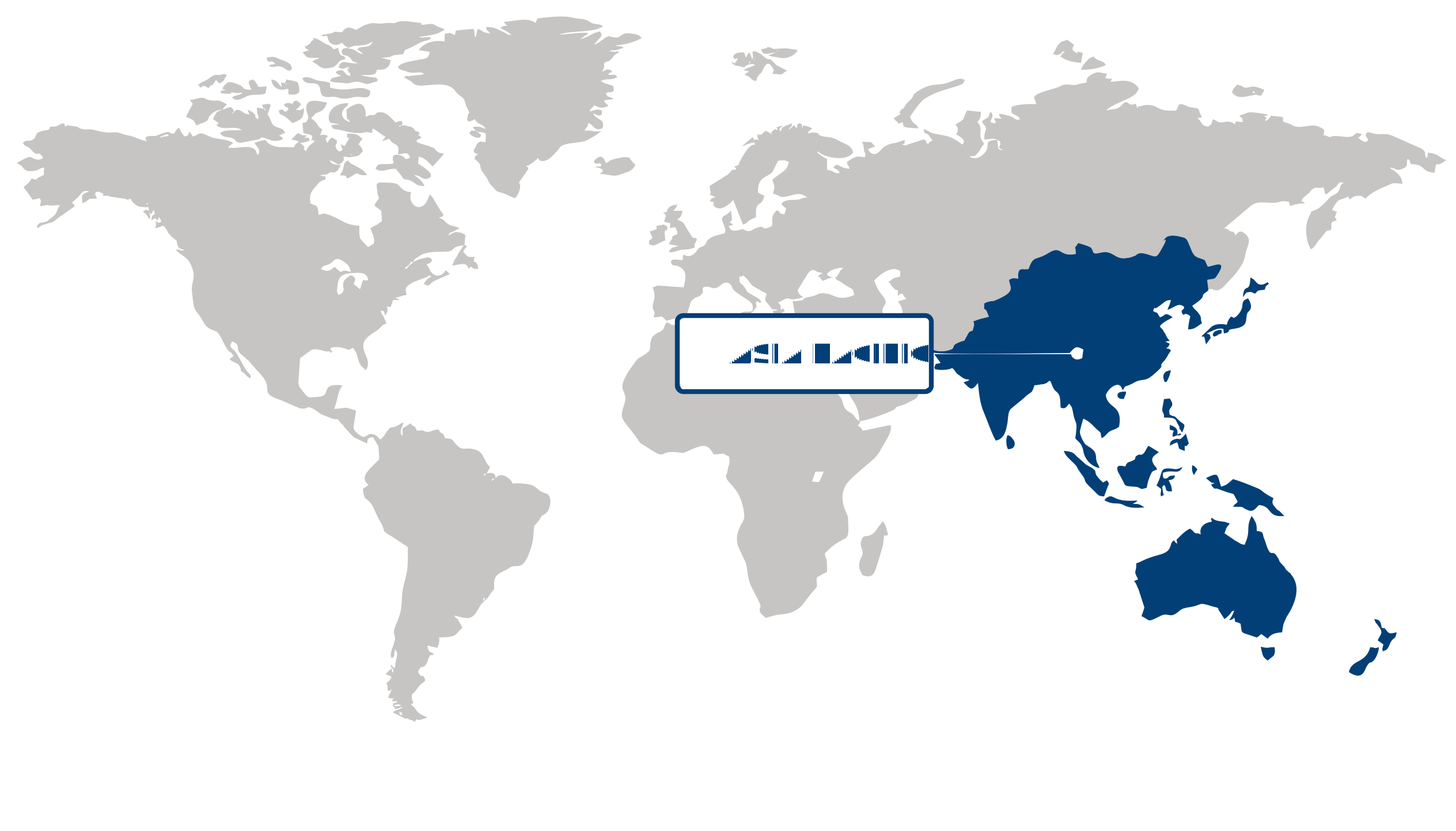
consumer data storage devices market captured approximately 36% of the global market in Asia Pacific in 2025, making the region the largest by share. This leadership is underpinned by rapid growth in digital content creation and proliferation of cloud-connected devices, which is expanding demand for high-capacity flash, removable media, and hybrid local-cloud solutions; the China Internet Network Information Center (CNNIC) and GSMA note rising content creation and IoT connections across the region, while the International Telecommunication Union (ITU) documents improving broadband capacity that enables seamless cloud backup. Device makers and memory suppliers such as Kioxia and Samsung Electronics have cited Asia Pacific product launches and capacity investments in their press releases, illustrating supply-side commitment. Taken together, these dynamics position the region for opportunities in premium flash, edge-sync features, and integrated cloud-storage services.
consumer data storage devices market Japan is positioned as a pivotal hub in Asia Pacific owing to strong consumer willingness to pay for premium, high-reliability storage and a dense ecosystem of local suppliers. Firms like Kioxia and Sony continue to announce product innovation in NAND and memory cards, and Japan’s Ministry of Economy, Trade and Industry (METI) initiatives to support advanced manufacturing reinforce onshore production. High device replacement rates and cultural preferences for photography and portable media create steady demand, while corporate announcements from Toshiba/Kioxia on fabs support supply resilience. Strategically, Japan offers investors premium-margin product pathways and R&D partnerships that complement regional scale plays.
consumer data storage devices market China anchors the Asia Pacific market by scale, integration with major cloud platforms, and rapid consumer adoption of content-creation apps. The China Internet Network Information Center (CNNIC) documents massive user bases and content activity, while Alibaba Cloud and Huawei consumer cloud announcements highlight tight device-to-cloud integration that reduces friction for consumers. Regulatory activity from the Cyberspace Administration of China shapes data portability and local storage requirements, influencing product designs and go-to-market strategies. Given manufacturing scale, platform integration, and supportive ecosystem players such as Xiaomi and Huawei, China remains the principal opportunity for volume-driven device growth and bundled cloud-service business models.
North America Market Analysis:
consumer data storage devices market in North America emerged as the fastest-growing region at a CAGR of 6.72%, driven by robust consumer migration to external SSDs and premium storage solutions. High-performance NVMe SSD launches and promotional activity from Samsung Electronics, Western Digital, and Seagate press releases demonstrate vendor investment in speed and capacity tiers to serve creators, gamers, and remote workers, while Consumer Technology Association commentary and U.S. Census Bureau retail trends show sustained consumer spending on premium electronics. Supply-chain shifts toward localized distribution, retailer assortment expansion, and rising demand for energy-efficient storage form a durable backdrop, making the region attractive for premium hardware, embedded services, and channel-partner strategies."
consumer data storage devices market in the U.S. acts as the primary growth engine, where adoption of external SSDs and premium solutions is most pronounced. U.S. consumer preferences favor portable high-speed storage for gaming and content creation—Best Buy assortment changes and Samsung Electronics product launches illustrate retail and vendor alignment—while Western Digital earnings commentary points to premiumization in aftermarket upgrades. Policy and procurement norms, reflected in Federal Communications Commission spectrum and digital infrastructure discussions, support faster household connectivity that amplifies storage needs. Strategic implication: targeting U.S. retail channels, creator communities, and value-added software bundling will accelerate regional scale and monetization.
Europe Market Trends:
Held a significant share, Europe’s consumer data storage devices market benefits from deep digital penetration and resilient household tech spending. Eurostat and the European Commission’s Digital Economy and Society Index document high broadband and device adoption that sustains demand for external drives, SSDs and NAS; Seagate Technology and Western Digital maintain broad European distribution while Samsung Electronics highlights portable SSD uptake in regional channels. The European Commission’s European Green Deal and rising consumer preference for energy-efficient products are nudging manufacturers toward greener materials and packaging. These dynamics, combined with GDPR-driven emphasis on device-level security, create clear opportunities for differentiated, secure and low-carbon storage offerings across the region.
Germany plays a leading role in the consumer data storage devices market driven by sophisticated retail channels and strong home-IT adoption. Bitkom has highlighted rising consumer interest in NAS and home backup solutions, and Deutsche Telekom’s consumer services infrastructure supports bundled offers that increase storage device trial and replacement cycles; multinational suppliers such as Samsung Electronics and Western Digital have reinforced German retail and e‑commerce supply lines. Given Germany’s manufacturing-adjacent logistics and high consumer spending on tech, vendors should prioritize distribution partnerships, after-sales service and localized product features to capture sustained unit and value growth.
France acts as a compliance-driven adopter in the consumer data storage devices market where data protection and security shape purchasing choices. CNIL guidance and ANSSI recommendations have elevated demand for encrypted and privacy-conscious devices, while Orange and retail chains like Fnac Darty influence bundled cloud-plus-hardware propositions and omnichannel distribution. These institutional and commercial forces favor secure, certified devices and operator partnerships, making France a strategic market for products that pair robust security credentials with telco-led go-to-market models, reinforcing broader European uptake.
| Parameter | North America | Asia Pacific | Europe | Latin America | MEA |
|---|---|---|---|---|---|
| Innovation Hub i Scale Nascent Developing Advanced | |||||
| Cost-Sensitive Region i Scale Low Medium High | |||||
| Regulatory Environment i Scale Restrictive Neutral Supportive | |||||
| Demand Drivers i Scale Weak Moderate Strong | |||||
| Development Stage i Scale Emerging Developing Developed | |||||
| Adoption Rate i Scale Low Medium High | |||||
| New Entrants / Startups i Scale Sparse Moderate Dense | |||||
| Macro Indicators i Scale Weak Stable Strong |
Segment Leadership and Growth Trends
Consumer Data Storage Devices Market Share (%), by Application, 2026
Go beyond the chart, access full insights & data tables
Request Free Sample ReportAdults represented largest share in 2025 in the consumer data storage devices market among application segments, propelled by a surge in digital content creation, multimedia storage needs, and personal data accumulation by adults. Leadership stems from adults’ greater demand for high-capacity, reliable storage to support remote work, social media publishing, and long-term archives, a pattern noted by Pew Research Center on adult digital behavior and reinforced by Apple device messaging about expanded storage tiers. Supply-chain maturation and consumer preference for convenience favor established OEMs, while the trend opens opportunities for niche software and secure-storage entrants. Given persistent content generation and device proliferation, the adults segment is poised to remain strategically central in the near to medium term.
Analysis by Type
Solid State Drive dominated the consumer data storage devices market in 2025 among type segments, driven by dramatic performance improvements, declining costs, and increasing consumer awareness of SSD benefits. This leadership reflects advances in NAND and controller technologies highlighted by Samsung Electronics and Western Digital product announcements and standards work by NVM Express, which together improve endurance and energy efficiency. Shifts in buyer preferences toward speed, stealthier form factors, and lower power consumption favor SSD suppliers and create openings for challengers specializing in sustainable flash recycling and firmware differentiation. Continued innovation in flash technology and wider OEM adoption support SSDs’ sustained relevance over the near to medium term.
| Segment | Sub-Segment | Largest Segment | Fastest Growing |
|---|---|---|---|
| Application | Adults, Teenagers | ||
| Type | Hard Disk Drive, Solid State Drive, Memory Card, USB Flash Drive, Optical Disks |
Competitive Landscape and Market Positioning
The competitive environment is characterized by intensified product differentiation and channel orchestration among the Top 10. Market leaders are deepening technical capabilities in high-density NAND, low-latency NVMe, and firmware optimization while broadening retail, OEM, and cloud-aligned partnerships. Concurrently, channel-centric brands emphasize cost efficiency and form-factor innovation to protect volume segments. These moves compress product lifecycles, raise barriers for late entrants, and elevate the importance of integrated hardware-software propositions for consumer adoption.
Strategic / Actionable Recommendations for Regional Players
Prioritize closer engagement with system integrators and premium device ecosystems, pairing advanced NVMe and firmware capabilities with branded aftercare to defend higher-margin segments and offset pricing pressure.
Scale local manufacturing and supply relationships while co-developing compact, cost-optimized flash solutions for mobile and value-oriented consumer cohorts to capture regional volume growth.
Differentiate through energy-efficient product lines, tighter retail and channel partnerships, and targeted offerings for creative and prosumer niches where reliability and compliance command premiums.
| Company | Market Share | Company Revenue | Revenue CAGR (%) | Product Portfolio | Geographic Presence | Innovation / R&D Focus | Strategic Developments |
|---|---|---|---|---|---|---|---|
| No companies available. | |||||||
Industry Development/News
| Company Name | Date | Key Development |
|---|
Customize Your Report
Explore examples of how this report can be tailored to different research needs, including custom segments, additional topics or chapters, and related reports. Click a section of the wheel or its numbered marker to explore the available options.
Consumer Data Storage Devices Market — Custom Segments
| Segment | Sub-Segment |
|---|---|
| No segment data available. | |
Consumer Data Storage Devices Market — Custom TOC
| Custom Chapter | Custom Details | ||
|---|---|---|---|
| No custom TOC data available. | |||
Need a different cut of the data?
Request Custom ResearchHow much revenue does the consumer data storage devices market generate?
How is the consumer data storage devices industry size expected to evolve during the forecast period?
Which part of the world shows the greatest dominance in the consumer data storage devices market?
Where has the consumer data storage devices sector recorded the sharpest year-over-year increase?
What share does adults segment hold in the consumer data storage devices sector as of 2025?
Where is the solid state drive segment seeing the strongest adoption within the consumer data storage devices industry?
What are the prominent companies operating in the consumer data storage devices landscape?
Our Clients
"Working with FBI has been a good experience. The market report provided a holistic view, covering everything from emerging trends to potential risks."
Semtech Corporation
"The experience was highly positive. The team showcased remarkable flexibility in adapting to our specific needs and delivered report that perfectly aligned with all our requirements."
TSMC
"What really stood out to me was how clearly and promptly the Fundamental Business Insights team communicated throughout. It made the collaboration feel effortless."
NXP Semiconductors
Our Research Team & Methodology
Every Fundamental Business Insights report is built by a dedicated vertical research team, validated through a structured primary-and-secondary methodology, and reviewed for accuracy before it reaches you.
Research Team Overview
Prepared by the Electronics & Semiconductors Research Team
Delivery
Published
Demand
Available
Support
Trust & Compliance
Research Domains
10 coverage areasResearch Intelligence
| Source | Reference |
|---|---|
| Semiconductor Industry Association (SIA) | www.semiconductors.org |
| SEMI | www.semi.org |
| JEDEC Solid State Technology Association | www.jedec.org |
| IEEE | www.ieee.org |
| IPC – Association Connecting Electronics Industries | www.ipc.org |
| International Electrotechnical Commission (IEC) | www.iec.ch |
| International Organization for Standardization (ISO) | www.iso.org |
| U.S. Bureau of Industry and Security (BIS) | www.bis.gov |
| U.S. Patent and Trademark Office (USPTO) | www.uspto.gov |
| European Patent Office (EPO) | www.epo.org |
| Taiwan Semiconductor Industry Association (TSIA) | www.tsia.org.tw |
| World Semiconductor Trade Statistics (WSTS) | www.wsts.org |
| International Energy Agency (IEA) | www.iea.org |
| GSMA | www.gsma.com |
| 3GPP | www.3gpp.org |
| ITU (International Telecommunication Union) | www.itu.int |
| Omdia (public insights) | omdia.tech.informa.com |
| Display Supply Chain Consultants (DSCC) | www.displaysupplychain.com |
| U.S. Department of Energy (DOE) | www.energy.gov |
| NIST (National Institute of Standards and Technology) | www.nist.gov |
Research Workflow & Quality Assurance
Data Collection
Verified information gathered through primary and secondary research.
Data Triangulation
Cross-validation using multiple independent data sources.
Forecast Modelling
Market estimates developed using historical trends and analytical models.
Analyst Validation
Findings reviewed by domain experts for accuracy and consistency.
Editorial & Quality Review
Final editorial, quality, and compliance checks before publication.
Final Publication
Released after successful completion of the internal review process.
Report Coverage
📊 Market Assessment
- Market Size & Forecast
- Market Segmentation
- Regional Analysis
- Growth Drivers & Challenges
- Market Dynamics
🏢 Competitive Intelligence
- Competitive Landscape
- Company Profiles
- Competitive Benchmarking
- Mergers & Acquisitions
- Market Share Analysis or Key Company Strategies
🔍 Strategic Analysis
- Value Chain Analysis
- Porter's Five Forces
- PESTLE Analysis
- Pricing Trends
- Supply-Demand Analysis
🚀 Future Outlook
- Technology Landscape
- Regulatory Landscape
- Investment & Funding Landscape
- Emerging Opportunities
- Future Market Outlook
Have a question about this report or need a custom scope?
Request Customization