Construction Risk Assessment Software Market Size & Growth Forecast 2027–2036, By Segments (Deployment Mode, Organization Size, End-user), Regional Demand Trends (North America, Asia Pacific, Europe), Key Country Insights (U.S., Japan, South Korea, Germany, France, Italy), and Competitive Landscape
Market Size and Growth Outlook
Construction Risk Assessment Software Market size was valued at USD 2.1 Billion in 2026 and is anticipated to grow at 12.06% CAGR from 2027 to 2036, exceeding USD 6.56 Billion by 2036. The industry revenue for 2027 is assessed at USD 2.32 Billion.
Get more details on this report
Request Free Sample ReportConstruction Risk Assessment Software Market Intelligence Snapshot
Regional Market Dynamics
- Asia Pacific held 33.48% share in 2026, supported by rapid urbanization, expanding construction activity, infrastructure development, and growing digital project-management adoption.
- Cloud-based project management, connected construction technologies, and rising attention to workplace safety, compliance, and construction quality are accelerating adoption.
Segment Momentum
- Cloud-based deployment held 74.88% of the market in 2026 and remains the fastest-growing segment due to scalable access, real-time monitoring, centralized risk management, lower infrastructure costs, and seamless collaboration.
- Residential construction is the fastest-growing end-user segment as increasing housing projects encourage builders to adopt digital risk assessment tools for better cost control, worker safety, project planning, and schedule management.
Market Expansion Drivers
- Increasing regulatory compliance requirements driving adoption of construction risk management software
- Rising complexity of infrastructure projects accelerating digital risk modeling and predictive analytics adoption
- Digital transformation in construction improving real-time safety monitoring and project risk visibility
Leading Market Participants
- Top companies in the construction risk assessment software market include Autodesk Inc. (United States), Procore Technologies, Inc. (United States), Oracle Corporation (United States), Trimble Inc. (United States), Bentley Systems, Incorporated (United States), SAP SE (Germany), Sage Group plc (United Kingdom), Fieldwire (United States), Raken Inc. (United States), HammerTech Global, Inc. (Australia)
Global Market Forecast Snapshot
Market Outlook
- 2026 Market Size: USD 2.1 Billion
- 2027 Estimated Market Size: USD 2.32 Billion
- Projected Market Size: USD 6.56 Billion by 2036
- Growth Forecast: 12.06% CAGR (2027-2036)
Regional and Segment Outlook
- Leading Regional Market: Asia Pacific
- High-Growth Regional Hub: Asia Pacific
- Core Revenue Segment: Cloud-based (Deployment Mode) | Large Enterprises (Organization Size) | Infrastructure Construction (End-user)
- Emerging Opportunity Segment: Cloud-based (Deployment Mode) | Small & Medium-sized Enterprises (SME) (Organization Size) | Residential Construction (End-user)
Market Growth Drivers and Industry Trends
Increasing regulatory compliance requirements driving adoption of construction risk management software
Construction projects are subject to increasingly stringent regulations governing worker safety, environmental compliance, documentation, and operational accountability. The construction risk assessment software market growth is driven by organizations seeking digital platforms that simplify compliance management while improving consistency in risk identification and reporting. Risk assessment software enables contractors, project owners, and engineering firms to document hazards, maintain audit trails, automate compliance workflows, and support timely corrective actions across multiple project sites. Centralized digital records also help organizations demonstrate regulatory adherence while reducing administrative complexity associated with manual compliance processes.
Rising complexity of infrastructure projects accelerating digital risk modeling and predictive analytics adoption
Large-scale infrastructure developments involve multiple stakeholders, interconnected construction activities, and evolving project risks that require more sophisticated planning and decision-making capabilities. Increasing project complexity will propel the construction risk assessment software market growth through the adoption of digital risk modeling tools and predictive analytics that identify potential issues before they disrupt project execution. These solutions analyze historical project information, operational data, and site-specific variables to improve risk forecasting, resource allocation, and contingency planning. Enhanced analytical capabilities enable project teams to make informed decisions while managing technical, financial, and operational uncertainties throughout the construction lifecycle.
Digital transformation in construction improving real-time safety monitoring and project risk visibility
The construction industry is increasingly embracing digital technologies to improve project oversight, operational efficiency, and workforce safety. As organizations modernize their project management practices, the construction risk assessment software market benefits from growing demand for platforms that provide real-time visibility into safety conditions, site activities, and evolving project risks. Integration with connected devices, mobile applications, inspection tools, and cloud-based project management systems enables continuous monitoring and faster communication among project stakeholders. Improved access to real-time information supports proactive risk management by helping teams identify emerging hazards, monitor corrective actions, and maintain greater transparency across construction operations.
| Growth Driver | Impact on CAGR | Regulatory Influence | Geographic Relevance | Adoption Rate | Impact Timeline |
|---|---|---|---|---|---|
| Increasing regulatory compliance requirements driving adoption of construction risk management software | 2.3% | High | North America, Europe | High | Near Term |
| Rising complexity of infrastructure projects accelerating digital risk modeling and predictive analytics adoption | 2% | Moderate | Asia Pacific, North America | High | Mid Term |
| Digital transformation in construction improving real-time safety monitoring and project risk visibility | 1.8% | Moderate | Europe, Asia Pacific | High | Mid Term |
Unlock insights tailored to your business with our bespoke market research solutions.
Click to get your customized report now.
Regional Demand Dynamics
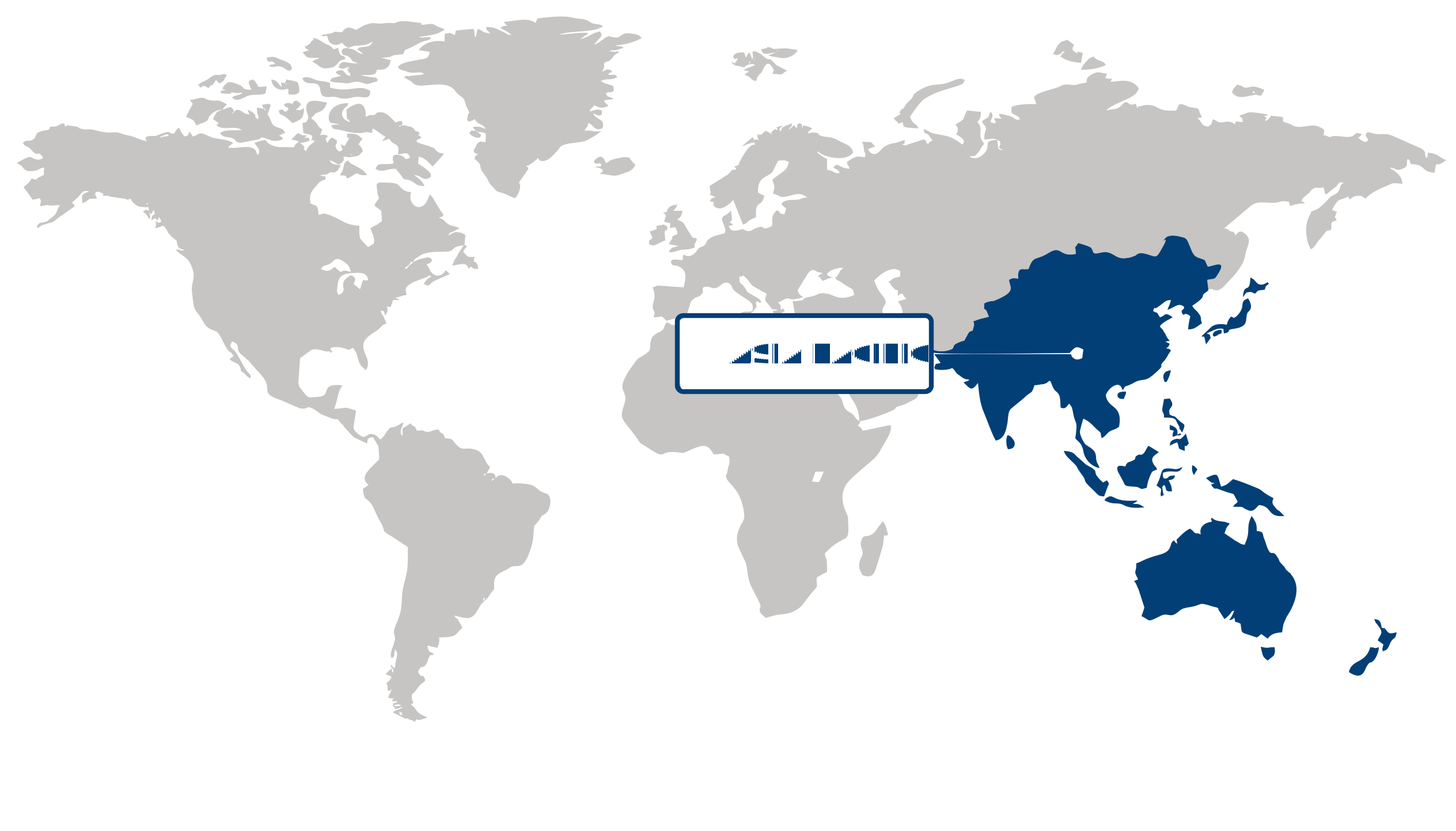
Asia Pacific (Largest & Fastest-Growing Region)
Asia Pacific accounted for the largest share of the construction risk assessment software market at 33.48% in 2026 and is also positioned as the fastest-growing regional market. Rapid urbanization, expanding construction activity, and large-scale infrastructure development are increasing the need for digital tools that help project stakeholders identify, monitor, and mitigate construction risks. Growing adoption of cloud-based project management, building information modeling, and connected construction technologies is improving the integration of risk assessment into broader project workflows. In addition, rising regulatory attention to workplace safety, project compliance, and construction quality is encouraging contractors and developers to adopt software-based approaches that provide greater visibility into potential hazards and operational risks.
| Parameter | North America | Asia Pacific | Europe | Latin America | MEA |
|---|---|---|---|---|---|
| Innovation Hub i Scale Nascent Developing Advanced | |||||
| Cost-Sensitive Region i Scale Low Medium High | |||||
| Regulatory Environment i Scale Restrictive Neutral Supportive | |||||
| Demand Drivers i Scale Weak Moderate Strong | |||||
| Development Stage i Scale Emerging Developing Developed | |||||
| Adoption Rate i Scale Low Medium High | |||||
| New Entrants / Startups i Scale Sparse Moderate Dense | |||||
| Macro Indicators i Scale Weak Stable Strong |
Key Country Insights
United States 🇺🇸
Integrated Project OversightThe U.S. construction risk assessment software market emphasizes digital platforms that consolidate safety, compliance, scheduling, and financial risk management. Contractors increasingly integrate software with project management ecosystems to improve decision-making across complex construction portfolios.
Germany 🇩🇪
Compliance-Centric Risk ControlGermany prioritizes construction risk assessment software that strengthens regulatory compliance and structured project governance. German construction firms value solutions offering detailed documentation, predictive risk analysis, and integration with engineering workflows.
Japan 🇯🇵
Infrastructure Risk PlanningJapan applies construction risk assessment software to support infrastructure projects requiring detailed planning and operational continuity. Japanese organizations emphasize early risk identification, lifecycle monitoring, and efficient coordination among multiple project stakeholders.
South Korea 🇰🇷
Smart Construction IntegrationSouth Korea incorporates construction risk assessment software into digitally connected construction environments. Local companies focus on integrating risk analytics with BIM, site monitoring, and data-driven project management to improve execution efficiency.
France 🇫🇷
Sustainable Project GovernanceFrance uses construction risk assessment software to strengthen project governance while supporting sustainability and regulatory objectives. French contractors increasingly rely on digital risk monitoring to improve documentation, compliance management, and project transparency.
Italy 🇮🇹
Contractor Workflow OptimizationItaly is expanding the use of construction risk assessment software to improve planning, contractor coordination, and operational oversight. Italian construction firms prioritize practical digital tools that simplify risk documentation and support efficient project execution.
Segment Leadership and Growth Trends
Construction Risk Assessment Software Market Share (%), by Deployment Mode, 2026
Go beyond the chart, access full insights & data tables
Request Free Sample ReportDeployment Mode Segment Analysis: Cloud-based (Largest & Fastest-Growing Segment)
The cloud-based deployment mode dominated the construction risk assessment software market, accounting for the largest share of 74.88% in 2026, while also emerging as the fastest-growing segment. Its strong position is driven by the growing preference for scalable, remotely accessible software platforms that enable real-time project monitoring, centralized risk management, and seamless collaboration among distributed project teams. Cloud-based solutions also simplify software updates, reduce infrastructure costs, and support integration with other digital construction management tools, making them an increasingly preferred deployment model for organizations seeking operational efficiency and improved project visibility.
Organization Size Segment Analysis: Large Enterprises (Largest Segment) vs Small & Medium-sized Enterprises (SME) (Fastest-Growing Segment)
The large enterprise segment held the dominant position with a 57.24% market share in 2026. Large construction organizations typically manage multiple high-value projects simultaneously and require comprehensive risk assessment platforms to monitor compliance, contractor performance, financial exposure, and project safety. Their greater investment capacity and focus on digital transformation continue to support widespread adoption of advanced software solutions across complex construction operations.
The small and medium-sized enterprise segment is expected to witness the fastest growth as affordable and scalable software solutions become more accessible. Smaller contractors are increasingly recognizing the value of digital risk management tools to improve project planning, strengthen regulatory compliance, reduce operational uncertainties, and compete more effectively in increasingly technology-driven construction markets.
End-user Segment Analysis: Infrastructure Construction (Largest Segment) vs Residential Construction (Fastest-Growing Segment)
Infrastructure construction held the largest share in 2026 due to the complexity and long execution timelines associated with transportation networks, utilities, bridges, and public development projects. These projects require continuous identification and mitigation of operational, financial, and regulatory risks, driving sustained adoption of specialized risk assessment software to improve decision-making and project governance.
The construction risk assessment software market is witnessing rapid expansion in the residential construction segment, which is expected to be the fastest-growing end-user category. Rising residential development activity and increasing emphasis on cost control, worker safety, and schedule management are encouraging builders to implement digital risk assessment platforms that enhance project planning while minimizing construction-related uncertainties.
| Segment | Sub-Segment | Largest Segment | Fastest Growing |
|---|---|---|---|
| Deployment Mode | Cloud-based, On-premises | Cloud-based | Cloud-based |
| Organization Size | Small & Medium-sized Enterprises (SME), Large Enterprises | Large Enterprises | Small & Medium-sized Enterprises (SME) |
| End-user | Residential Construction, Commercial Construction, Industrial Construction, Infrastructure Construction | Infrastructure Construction | Residential Construction |
Competitive Landscape and Market Positioning
Major players in the construction risk assessment software market:
- Autodesk, Inc. (United States)
- Procore Technologies, Inc. (United States)
- Oracle Corporation (United States)
- Trimble, Inc. (United States)
- Bentley Systems Incorporated (United States)
- SAP SE (Germany)
- Sage Group plc (United Kingdom)
- Fieldwire (United States)
- Raken, Inc. (United States)
- HammerTech Global, Inc. (Australia)
Digital transformation within the construction industry is reshaping rivalry in the construction risk assessment software market, where providers are competing to deliver platforms that combine predictive insights with practical workflow integration. The emphasis is increasingly on simplifying risk identification, compliance management, and project monitoring through intelligent automation rather than offering isolated assessment tools. Vendors are enhancing interoperability with broader construction management ecosystems while incorporating configurable analytics that reflect the operational realities of different project types. This evolution is encouraging competition based on implementation flexibility, user experience, and the ability to support informed decision-making throughout the project lifecycle.
| Company | Market Share | Company Revenue | Revenue CAGR (%) | Product Portfolio | Geographic Presence | Innovation / R&D Focus | Strategic Developments |
|---|---|---|---|---|---|---|---|
| Autodesk Inc. (United States) | |||||||
| Procore Technologies Inc. (United States) | |||||||
| Oracle Corporation (United States) | |||||||
| Trimble Inc. (United States) | |||||||
| Bentley Systems Incorporated (United States) | |||||||
| SAP SE (Germany) | |||||||
| Sage Group plc (United Kingdom) | |||||||
| Fieldwire (United States) | |||||||
| Raken Inc. (United States) | |||||||
| HammerTech Global Inc. (Australia) |
Industry Development/News
| Company Name | Date | Key Development |
|---|---|---|
| Procore Technologies | Jun-24 | Procore Technologies expanded its construction management capabilities by launching Procore Copilot AI with Microsoft Teams integration. The artificial intelligence solution leverages natural language processing to extract project data, automate location index generation from construction drawings, and integrate visual mapping tracking, optimizing risk visibility, field productivity, and cost control workflows. |
| Autodesk | Mar-24 | Autodesk Construction Cloud released more than 45 platform enhancements across Autodesk Build, including deep CAD software integrations, audit-trail Activity Logs, and streamlined submittal management. The comprehensive system updates expand administrative oversight, risk governance, and reporting efficiency across complex building and infrastructure project workflows. |
Customize Your Report
Explore examples of how this report can be tailored to different research needs, including custom segments, additional topics or chapters, and related reports. Click a section of the wheel or its numbered marker to explore the available options.
Construction Risk Assessment Software Market — Custom Segments
| Segment | Sub-Segment |
|---|---|
| Risk Category | Financial Risks, Safety and Health Risks, Schedule and Delay Risks, Quality Risks, Compliance and Regulatory Risks, Environmental Risks |
| Project Lifecycle Stage | Pre-Construction, Design and Planning, Construction, Project Closeout |
| Pricing Model | Subscription-Based, Per-Project, Usage-Based, Perpetual License |
Construction Risk Assessment Software Market — Custom TOC
| Custom Chapter | Custom Details |
|---|---|
| Digital Risk Management Maturity |
|
| Contractor and Insurer Adoption Strategy |
|
| Claims Prevention and Loss Reduction Strategies |
|
Need a different cut of the data?
Request Custom ResearchWhat is the market size of construction risk assessment software?
How will the construction risk assessment software industry grow in terms of size and CAGR by 2036?
How are regulatory compliance requirements accelerating construction risk software adoption?
How is digital risk intelligence improving construction project oversight?
Why is cloud-based deployment the leading choice in the construction risk assessment software market?
What is driving the rapid adoption of construction risk assessment software in residential construction?
Why does Asia Pacific lead the construction risk assessment software market?
What is driving faster growth in Asia Pacific’s construction risk assessment software market?
Which organizations are considered leaders in the construction risk assessment software landscape?
Our Clients
"The team demonstrated a great understanding of our business needs, and the reports were tailored to address our specific concerns and objectives."
Infosys
"The report was up-to-date with the latest industry trends and technological advancements. The detailed competitive landscape analysis was quite helpful."
Zebra Technologies
"The data presented in the report was accurate and well-researched. I also found the market dynamics section particularly useful."
Arlo Technologies
Our Research Team & Methodology
Every Fundamental Business Insights report is built by a dedicated vertical research team, validated through a structured primary-and-secondary methodology, and reviewed for accuracy before it reaches you.
Research Team Overview
Prepared by the Smart Technologies Research Team
Delivery
Published
Demand
Available
Support
Trust & Compliance
Research Domains
10 coverage areasResearch Intelligence
| Source | Reference |
|---|---|
| National Institute of Standards and Technology (NIST) | www.nist.gov |
| International Organization for Standardization (ISO) | www.iso.org |
| Institute of Electrical and Electronics Engineers (IEEE) | www.ieee.org |
| Internet Engineering Task Force (IETF) | www.ietf.org |
| World Wide Web Consortium (W3C) | www.w3.org |
| Cloud Security Alliance (CSA) | cloudsecurityalliance.org |
| Open Source Initiative (OSI) | opensource.org |
| Linux Foundation | www.linuxfoundation.org |
| FinOps Foundation | www.finops.org |
| PCI Security Standards Council | www.pcisecuritystandards.org |
| SWIFT | www.swift.com |
| Financial Stability Board (FSB) | www.fsb.org |
| GSMA | www.gsma.com |
| International Telecommunication Union (ITU) | www.itu.int |
| OWASP Foundation | owasp.org |
| MITRE | www.mitre.org |
| World Economic Forum (WEF) | www.weforum.org |
| OECD Digital Economy | www.oecd.org/digital |
| World Bank Data | data.worldbank.org |
| U.S. Census Bureau | www.census.gov |
Research Workflow & Quality Assurance
Data Collection
Verified information gathered through primary and secondary research.
Data Triangulation
Cross-validation using multiple independent data sources.
Forecast Modelling
Market estimates developed using historical trends and analytical models.
Analyst Validation
Findings reviewed by domain experts for accuracy and consistency.
Editorial & Quality Review
Final editorial, quality, and compliance checks before publication.
Final Publication
Released after successful completion of the internal review process.
Report Coverage
📊 Market Assessment
- Market Size & Forecast
- Market Segmentation
- Regional Analysis
- Growth Drivers & Challenges
- Market Dynamics
🏢 Competitive Intelligence
- Competitive Landscape
- Company Profiles
- Competitive Benchmarking
- Mergers & Acquisitions
- Market Share Analysis or Key Company Strategies
🔍 Strategic Analysis
- Value Chain Analysis
- Porter's Five Forces
- PESTLE Analysis
- Pricing Trends
- Supply-Demand Analysis
🚀 Future Outlook
- Technology Landscape
- Regulatory Landscape
- Investment & Funding Landscape
- Emerging Opportunities
- Future Market Outlook
Have a question about this report or need a custom scope?
Request Customization