Connected Vehicle Technology Market Size & Growth Forecast 2027–2036, By Segments (End Use, Technology, Vehicle, Application), Regional Demand Trends (North America, Asia Pacific, Europe), Key Country Insights (U.S., Japan, South Korea, Germany, France, Italy), and Competitive Landscape
Market Size and Growth Outlook
Connected Vehicle Technology Market size was assessed at USD 47.43 Billion in 2026 and is poised to grow at 11.86% CAGR between 2027 and 2036, surpassing USD 145.48 Billion by 2036. The industry revenue for 2027 is estimated at USD 52.3 Billion.
Get more details on this report
Request Free Sample ReportConnected Vehicle Technology Market Intelligence Snapshot
Regional Market Dynamics
- Europe held 39.96% in 2026, supported by advanced automotive infrastructure, connected mobility adoption, and strong emphasis on vehicle safety and digitalization.
- Asia Pacific is expected to grow fastest through rapid urbanization, expanding vehicle adoption, connected infrastructure deployment, and smart-city development.
Segment Momentum
- OEMs accounted for 70.85% of the market in 2026 by integrating connected technologies during vehicle production, ensuring better system compatibility, cybersecurity, software functionality, and seamless digital vehicle experiences.
- V2X communication is the fastest-growing technology as it enables real-time communication between vehicles, infrastructure, pedestrians, and networks to improve road safety, traffic efficiency, and autonomous driving capabilities.
Market Expansion Drivers
- Expansion of 5G and cellular infrastructure enabling real-time connected vehicle ecosystems
- Rising adoption of ADAS and safety systems accelerating vehicle connectivity integration
- Growth of software-defined and electric vehicles driving integrated mobility platforms
Leading Market Participants
- Leading players in the connected vehicle technology market include Robert Bosch GmbH (Germany), Continental AG (Germany), Aptiv PLC (Ireland), Denso Corporation (Japan), Qualcomm Incorporated (United States), NXP Semiconductors N.V. (Netherlands), Harman International (United States), Mobileye Global Inc. (Israel), Valeo SE (France), Ericsson AB (Sweden)
Global Market Forecast Snapshot
Market Outlook
- 2026 Market Size: USD 47.43 Billion
- 2027 Estimated Market Size: USD 52.3 Billion
- Projected Market Size: USD 145.48 Billion by 2036
- Growth Forecast: 11.86% CAGR (2027-2036)
Regional and Segment Outlook
- Leading Regional Market: Europe
- High-Growth Regional Hub: Asia Pacific
- Core Revenue Segment: OEMs (End Use) | Embedded System (Technology) | Passenger Cars (Vehicle) | Safety and Security (Application)
- Emerging Opportunity Segment: Aftermarket (End Use) | V2X Communication (Technology) | Electric Vehicles (Vehicle) | Autonomous Driving (Application)
Market Growth Drivers and Industry Trends
Expansion of 5G and cellular infrastructure enabling real-time connected vehicle ecosystems
The continuous expansion of high-speed cellular networks is creating the communication backbone required for seamless data exchange between vehicles, infrastructure, and cloud-based platforms. This development will drive the connected vehicle technology market growth by enabling real-time connectivity for navigation, traffic management, remote diagnostics, and intelligent mobility services. Low-latency communication improves the responsiveness of connected applications while supporting continuous software updates, enhanced telematics capabilities, and more reliable information sharing across increasingly interconnected transportation ecosystems.
Rising adoption of ADAS and safety systems accelerating vehicle connectivity integration
Vehicle manufacturers are incorporating advanced driver assistance technologies into a growing number of vehicle platforms to improve road safety and driving convenience. The connected vehicle technology market is expanding as these safety systems increasingly rely on continuous connectivity to exchange data, monitor vehicle surroundings, and support informed driving decisions. Integration between onboard sensors, communication modules, and intelligent software platforms enables more accurate environmental awareness while strengthening coordination between safety functions and connected mobility services across modern vehicle architectures.
Growth of software-defined and electric vehicles driving integrated mobility platforms
Automotive manufacturers are transitioning toward software-centric vehicle architectures that support continuous feature enhancements, remote upgrades, and integrated digital services throughout the vehicle lifecycle. This evolution will propel the connected vehicle technology market growth as software-defined and electric vehicles require advanced connectivity platforms capable of managing vehicle functions, battery systems, infotainment services, and cloud-based applications through centralized digital ecosystems. These integrated platforms also enable greater flexibility for future feature deployment while improving operational efficiency across connected mobility environments.
| Growth Driver | Impact on CAGR | Regulatory Influence | Geographic Relevance | Adoption Rate | Impact Timeline |
|---|---|---|---|---|---|
| Expansion of 5G and cellular infrastructure enabling real-time connected vehicle ecosystems | 2% | High | North America, Asia Pacific, Europe | High | Near Term |
| Rising adoption of ADAS and safety systems accelerating vehicle connectivity integration | 1.9% | High | Europe, North America, Asia Pacific | High | Near Term |
| Growth of software-defined and electric vehicles driving integrated mobility platforms | 1.7% | High | Asia Pacific, North America | High | Mid Term |
Unlock insights tailored to your business with our bespoke market research solutions.
Click to get your customized report now.
Regional Demand Dynamics
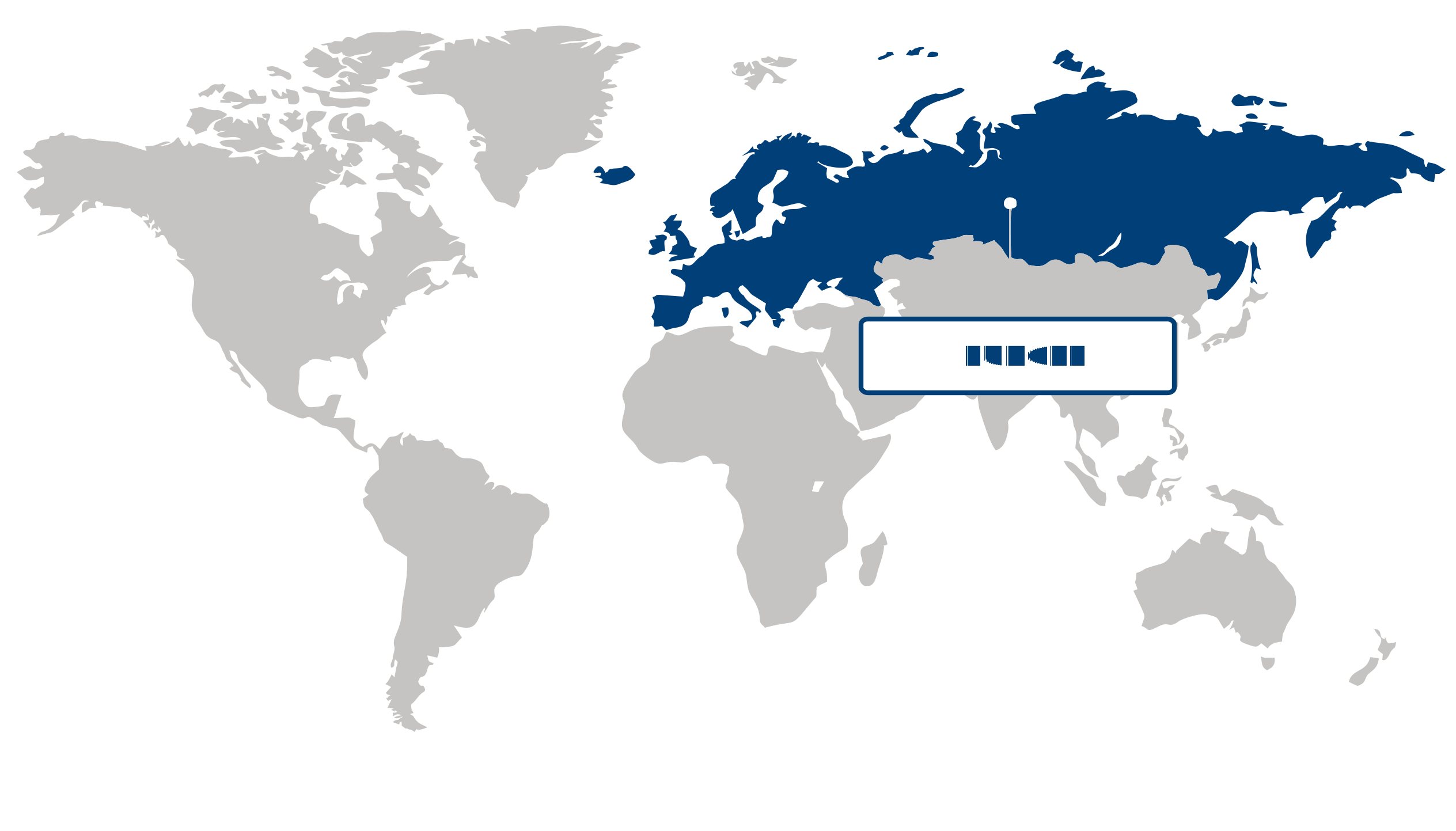
Europe (Largest Region)
Europe represented 39.96% of the connected vehicle technology market in 2026, supported by advanced automotive infrastructure, strong adoption of connected mobility solutions, and increasing emphasis on vehicle safety and digitalization. The region’s focus on intelligent transportation, in-vehicle connectivity, and improved traffic management is creating sustained demand for technologies that enable vehicles to communicate with drivers, infrastructure, and other vehicles. Continued development of smart mobility ecosystems is further strengthening the regional market.
Asia Pacific (Fastest-Growing Region)
Asia Pacific is anticipated to experience the fastest growth, driven by rapid urbanization, expanding vehicle adoption, and accelerating digital transformation across transportation systems. Growing deployment of connected infrastructure and increasing consumer expectations for digitally enabled vehicles are encouraging broader integration of connectivity technologies. The development of smart cities and intelligent transportation networks is also creating new opportunities for connected vehicle applications, supporting strong regional expansion.
| Parameter | North America | Asia Pacific | Europe | Latin America | MEA |
|---|---|---|---|---|---|
| Innovation Hub i Scale Nascent Developing Advanced | |||||
| Cost-Sensitive Region i Scale Low Medium High | |||||
| Regulatory Environment i Scale Restrictive Neutral Supportive | |||||
| Demand Drivers i Scale Weak Moderate Strong | |||||
| Development Stage i Scale Emerging Developing Developed | |||||
| Adoption Rate i Scale Low Medium High | |||||
| New Entrants / Startups i Scale Sparse Moderate Dense | |||||
| Macro Indicators i Scale Weak Stable Strong |
Key Country Insights
United States 🇺🇸
Digital Mobility IntegrationThe U.S. connected vehicle technology market is driven by growing adoption of software-defined vehicles, telematics, and cloud-based mobility services. Automakers increasingly integrate real-time connectivity, over-the-air updates, and cybersecurity capabilities into new vehicle platforms.
Germany 🇩🇪
Intelligent Vehicle PlatformsGermany advances connected vehicle technology through integration of digital services with premium automotive engineering. German manufacturers prioritize secure communication architectures, vehicle-to-everything connectivity, and seamless software integration across evolving mobility ecosystems.
Japan 🇯🇵
Smart Mobility NetworksJapan focuses on connected vehicle technologies that complement intelligent transportation systems and automated driving initiatives. Japanese automakers continue integrating advanced telematics, predictive maintenance capabilities, and connected safety services across passenger vehicle portfolios.
South Korea 🇰🇷
Software-Centric ConnectivitySouth Korea strengthens connected vehicle technology through its expertise in automotive electronics, semiconductors, and telecommunications. Domestic manufacturers increasingly develop integrated connectivity platforms that support autonomous driving features and cloud-enabled vehicle services.
France 🇫🇷
Connected Mobility ServicesFrance promotes connected vehicle technology by expanding digital mobility services and intelligent transportation infrastructure. French automotive companies emphasize secure data exchange, fleet connectivity, and integrated vehicle services that enhance user experience and operational efficiency.
Italy 🇮🇹
Integrated Automotive ElectronicsItaly applies connected vehicle technology across passenger and commercial vehicle segments through greater adoption of advanced electronic systems. Italian suppliers focus on communication modules, intelligent diagnostics, and connected vehicle platforms that improve operational reliability and digital functionality.
Segment Leadership and Growth Trends
Connected Vehicle Technology Market Share (%), by End Use, 2026
Go beyond the chart, access full insights & data tables
Request Free Sample ReportEnd Use Segment Analysis: OEMs (Largest Segment) vs Aftermarket (Fastest-Growing Segment)
OEMs dominated the connected vehicle technology market and accounted for a 70.85% share in 2026. Their leadership is driven by the increasing integration of connected technologies directly during vehicle production, allowing manufacturers to optimize system compatibility, cybersecurity, and software functionality from the design stage. Growing consumer demand for factory-installed connectivity features, advanced safety systems, real-time diagnostics, and cloud-enabled services has further reinforced OEM adoption. Strong collaboration between automakers and technology providers to deliver seamless digital vehicle ecosystems continues to strengthen the segment's market position.
The aftermarket segment is expected to experience the fastest growth as vehicle owners increasingly seek to upgrade existing vehicles with connected capabilities without purchasing new models. Rising demand for retrofit telematics devices, navigation solutions, remote monitoring systems, and vehicle tracking technologies is expanding opportunities within this segment. Continued advances in plug-and-play connectivity solutions and the growing focus on fleet optimization and predictive maintenance are further supporting aftermarket expansion.
Technology Segment Analysis: Embedded System (Largest Segment) vs V2X Communication (Fastest-Growing Segment)
The embedded system segment held the largest share in 2026, supported by its fundamental role in enabling onboard connectivity, vehicle diagnostics, infotainment, and intelligent electronic control functions. Embedded systems provide the computing backbone required to integrate multiple vehicle subsystems while ensuring reliable communication and efficient data processing. Their widespread deployment across modern passenger and commercial vehicles continues to sustain strong demand as vehicles become increasingly software-defined.
In the connected vehicle technology market, the V2X communication segment is projected to register the fastest growth. Increasing emphasis on cooperative mobility, intelligent transportation infrastructure, and enhanced road safety is accelerating the adoption of vehicle-to-everything communication technologies. The ability to facilitate real-time communication between vehicles, infrastructure, pedestrians, and network systems supports improved traffic efficiency, collision avoidance, and autonomous driving capabilities, creating significant momentum for this segment.
Vehicle Segment Analysis: Passenger Cars (Largest Segment) vs Electric Vehicles (Fastest-Growing Segment)
Passenger cars represented the largest vehicle segment in 2026 due to their high production volumes and the rapid incorporation of connected technologies across mainstream vehicle models. Consumers increasingly expect integrated navigation, remote vehicle management, infotainment, and advanced driver assistance capabilities as standard features, encouraging manufacturers to expand connected technology deployment throughout the passenger car segment. Continuous innovation in digital vehicle experiences further supports its dominant position.
Electric vehicles are anticipated to witness the fastest growth as connectivity becomes an essential component of electric mobility ecosystems. Connected technologies enable battery monitoring, charging optimization, over-the-air software updates, predictive maintenance, and remote vehicle management, making them particularly valuable for electric vehicle owners. The expanding adoption of electrified transportation and growing investments in intelligent mobility infrastructure continue to accelerate demand within this segment.
| Segment | Sub-Segment | Largest Segment | Fastest Growing |
|---|---|---|---|
| End Use | OEMs, Aftermarket | OEMs | Aftermarket |
| Technology | V2X Communication, Embedded System | Embedded System | V2X Communication |
| Vehicle | Passenger Cars, Commercial Vehicle, Electric Vehicles | Passenger Cars | Electric Vehicles |
| Application | Autonomous Driving, Mobility as a Service, Infotainment, Fleet Management, Safety and Security, Vehicle Diagnostics and Maintenance | Safety and Security | Autonomous Driving |
Competitive Landscape and Market Positioning
Top players in the connected vehicle technology market:
- Robert Bosch GmbH (Germany)
- Continental AG (Germany)
- Aptiv PLC (Ireland)
- Denso Corporation (Japan)
- Qualcomm Incorporated (United States)
- NXP Semiconductors N.V. (Netherlands)
- Harman International (United States)
- Mobileye Global, Inc. (Israel)
- Valeo SE (France)
- Ericsson AB (Sweden)
Competitive positioning in the connected vehicle technology market is evolving around the ability to deliver integrated software ecosystems rather than isolated connectivity functions. Market participants are expanding development efforts toward platforms capable of supporting seamless communication between vehicles, infrastructure, cloud environments, and digital mobility services while maintaining strong cybersecurity and data management capabilities. As software-defined vehicle architectures become more widespread, competition increasingly favors suppliers that can deliver scalable, update-ready solutions compatible with diverse vehicle platforms, encouraging continuous investment in interoperability, system integration, and long-term lifecycle support.
| Company | Market Share | Company Revenue | Revenue CAGR (%) | Product Portfolio | Geographic Presence | Innovation / R&D Focus | Strategic Developments |
|---|---|---|---|---|---|---|---|
| Robert Bosch GmbH (Germany) | |||||||
| Continental AG (Germany) | |||||||
| Aptiv PLC (Ireland) | |||||||
| Denso Corporation (Japan) | |||||||
| Qualcomm Incorporated (United States) | |||||||
| NXP Semiconductors N.V. (Netherlands) | |||||||
| Harman International (United States) | |||||||
| Mobileye Global Inc. (Israel) | |||||||
| Valeo SE (France) | |||||||
| Ericsson AB (Sweden) |
Industry Development/News
| Company Name | Date | Key Development |
|---|---|---|
| WeRide | Jun-26 | WeRide partnered with Uber to launch Spain's first robotaxi service in Madrid. This deployment marks the company’s first commercial entry into the European market, utilizing its connected and autonomous vehicle technology stack to establish an operational footprint in urban mobility services. |
| BYD | Jun-26 | BYD integrated connected emergency call capabilities into its Australian vehicle lineup, starting with the Sealion 8 SUV. Through a partnership with Intelematics, the initiative enhances safety-critical connectivity and ensures compliance with modern regulatory requirements for automated crash response and vehicle-to-network communications. |
| Stellantis | Apr-26 | Stellantis secured a five-year partnership with Microsoft to accelerate its software-defined vehicle strategy. The collaboration focuses on enhancing vehicle connectivity and software integration, supporting the company's objective to modernize its digital architecture and provide scalable connected mobility features across its global brand portfolio. |
| Continental | Mar-26 | Continental launched its 5G-enabled TCU 3.0 featuring multi-access edge computing. The unit delivers a 10-fold performance increase and 30% reduction in power consumption. Initial production targets 2027 vehicle models for European and Asian OEMs, with scaling projected to reach an annual capacity of 5 million units by 2028. |
| Qualcomm | Feb-26 | Qualcomm expanded its partnership with General Motors to deploy Snapdragon Automotive 5G platforms. The agreement integrates hardware, cloud services, and OTA infrastructure for 2027 models. The collaboration aims to scale connectivity solutions across GM's portfolio, with an estimated impact on over 10 million vehicles annually by 2030. |
| Targa Telematics | Jan-26 | Targa Telematics entered a partnership with Motability Operations to provide advanced connected fleet solutions. The initiative leverages deep telematics integration to enhance digital vehicle management, improving operational efficiency and data visibility for large-scale mobility and fleet service providers. |
| Denso | Dec-25 | Denso established a dedicated Software & Connected Services business unit backed by a ¥300 billion (~USD 2 billion) investment through 2030. The strategy includes the creation of global development centers in Japan, the US, and China, employing 3,000 engineers to focus on cloud platforms and OTA infrastructure for connected vehicles. |
| Verra Mobility | Nov-25 | Verra Mobility introduced AutoKinex, a solution enabling secure in-vehicle payments. Concurrently, the company partnered with Stellantis to integrate nationwide tolling capabilities directly into vehicle platforms, expanding the ecosystem of connected services available to automotive OEMs and end-users. |
| Volvo | Sep-25 | Volvo reached a milestone of one million connected trucks operating globally, including 218,000 units in North America. This scale highlights the successful commercialization of the company’s connected fleet ecosystem, which provides real-time telematics and operational data to support optimized logistics and maintenance services for commercial transport. |
| European Union | — | The European Union announced an accelerated C-V2X infrastructure program, committing to the deployment of 10,000 new roadside units by the end of 2027. The €2.5 billion investment focuses on high-accident urban zones to optimize traffic management, directly incentivizing increased OEM investment in V2X-compatible vehicle technologies. |
Customize Your Report
Explore examples of how this report can be tailored to different research needs, including custom segments, additional topics or chapters, and related reports. Click a section of the wheel or its numbered marker to explore the available options.
Connected Vehicle Technology Market — Custom Segments
| Segment | Sub-Segment |
|---|---|
| Service Delivery Model | Embedded Connectivity, Tethered Connectivity, Smartphone-Based Connectivity, Cloud-Managed Connectivity |
| Connectivity Subscription Model | One-Time Connectivity, Bundled Connectivity, Monthly Subscription, Usage-Based Subscription |
| Vehicle Lifecycle Stage | Factory-Installed Systems, New-Vehicle Retrofit, Replacement & Upgrade, Used-Vehicle Retrofit |
Connected Vehicle Technology Market — Custom TOC
| Custom Chapter | Custom Details |
|---|---|
| Connected Services Monetization |
|
| Vehicle Data Commercialization |
|
| Connected Vehicle Ecosystem Readiness |
|
Need a different cut of the data?
Request Custom ResearchWhat is the current size of the connected vehicle technology market?
How is the connected vehicle technology industry size expected to evolve during the forecast period?
How is expanding 5G infrastructure accelerating connected vehicle technology adoption?
Why are software-defined vehicles driving demand for connected vehicle platforms?
Why do OEMs lead the connected vehicle technology market?
How is V2X communication driving growth in the connected vehicle technology market?
Why does Europe lead the connected vehicle technology market?
How is Asia Pacific driving future market growth?
Who are the leading players in the connected vehicle technology landscape?
Our Clients
"The team surpassed our expectations with the report depth. The actionable insights provided proved crucial in navigating market challenges."
Tata Motors
"We found the report to be very informative. The expertise and attention to market nuances significantly influenced our business direction."
DENSO Corporation
"The consumer survey findings were quite good. We now have a clearer picture of the customer churning and retention strategy."
HL Mando
Our Research Team & Methodology
Every Fundamental Business Insights report is built by a dedicated vertical research team, validated through a structured primary-and-secondary methodology, and reviewed for accuracy before it reaches you.
Research Team Overview
Prepared by the Automotive & Transportation Research Team
Delivery
Published
Demand
Available
Support
Trust & Compliance
Research Domains
10 coverage areasResearch Intelligence
| Source | Reference |
|---|---|
| International Organization of Motor Vehicle Manufacturers (OICA) | www.oica.net |
| SAE International | www.sae.org |
| International Energy Agency (IEA) | www.iea.org |
| International Transport Forum (ITF) | www.itf-oecd.org |
| International Road Federation (IRF) | www.irf.global |
| International Organization for Standardization (ISO) | www.iso.org |
| United Nations Economic Commission for Europe (UNECE) | unece.org |
| National Highway Traffic Safety Administration (NHTSA) | www.nhtsa.gov |
| U.S. Department of Transportation (USDOT) | www.transportation.gov |
| European Automobile Manufacturers' Association (ACEA) | www.acea.auto |
| Society of Indian Automobile Manufacturers (SIAM) | www.siam.in |
| International Air Transport Association (IATA) | www.iata.org |
| International Civil Aviation Organization (ICAO) | www.icao.int |
| International Maritime Organization (IMO) | www.imo.org |
| International Union of Railways (UIC) | uic.org |
| American Public Transportation Association (APTA) | www.apta.com |
| International Federation of Robotics (IFR) | ifr.org |
| CharIN | www.charin.global |
| World Shipping Council | www.worldshipping.org |
| International Federation of Freight Forwarders Associations (FIATA) | fiata.org |
Research Workflow & Quality Assurance
Data Collection
Verified information gathered through primary and secondary research.
Data Triangulation
Cross-validation using multiple independent data sources.
Forecast Modelling
Market estimates developed using historical trends and analytical models.
Analyst Validation
Findings reviewed by domain experts for accuracy and consistency.
Editorial & Quality Review
Final editorial, quality, and compliance checks before publication.
Final Publication
Released after successful completion of the internal review process.
Report Coverage
📊 Market Assessment
- Market Size & Forecast
- Market Segmentation
- Regional Analysis
- Growth Drivers & Challenges
- Market Dynamics
🏢 Competitive Intelligence
- Competitive Landscape
- Company Profiles
- Competitive Benchmarking
- Mergers & Acquisitions
- Market Share Analysis or Key Company Strategies
🔍 Strategic Analysis
- Value Chain Analysis
- Porter's Five Forces
- PESTLE Analysis
- Pricing Trends
- Supply-Demand Analysis
🚀 Future Outlook
- Technology Landscape
- Regulatory Landscape
- Investment & Funding Landscape
- Emerging Opportunities
- Future Market Outlook
Have a question about this report or need a custom scope?
Request Customization