Connected Rail System Market Size & Growth Forecast 2027–2036, By Segments (Component, Application, Rail), Regional Demand Trends (North America, Asia Pacific, Europe), Key Country Insights (U.S., Japan, South Korea, Germany, France, Italy), and Competitive Landscape
Market Size and Growth Outlook
Connected Rail System Market size was around USD 18.7 Billion in 2026 and is slated to grow at 9.22% CAGR from 2027 to 2036, reaching USD 45.17 Billion by 2036. The industry revenue for 2027 is assessed at USD 20.16 Billion.
Get more details on this report
Request Free Sample ReportConnected Rail System Market Intelligence Snapshot
Regional Market Dynamics
- Asia Pacific leads and is the fastest-growing region, driven by railway modernization, intelligent mobility investment, urbanization, and deployment of IoT-enabled monitoring and predictive maintenance.
- Expanding high-speed and mass transit networks are increasing demand for integrated digital platforms that connect trains, infrastructure, passengers, and control centers.
Segment Momentum
- Operations management led the market with a 35.64% share in 2026 as rail operators prioritized train scheduling, fleet utilization, asset coordination, and maintenance planning to improve service reliability and reduce disruptions.
- Passenger management is expanding rapidly as rail operators deploy smart ticketing, real-time passenger information, crowd management, and journey planning solutions to deliver more connected and efficient travel experiences.
Market Expansion Drivers
- Urbanization and congestion pressures driving adoption of intelligent connected rail infrastructure
- Government investments and smart mobility initiatives accelerating digital rail system deployment
- Advancements in predictive maintenance and signaling systems improving rail operational efficiency
Leading Market Participants
- Leading companies in the connected rail system market include Siemens AG (Germany), Alstom S.A. (France), Hitachi Ltd. (Japan), Thales Group (France), Wabtec Corporation (United States), ABB Ltd. (Switzerland), Stadler Rail AG (Switzerland), Huawei Technologies Co., Ltd. (China), Nokia Corporation (Finland), Mitsubishi Electric Corporation (Japan)
Global Market Forecast Snapshot
Market Outlook
- 2026 Market Size: USD 18.7 Billion
- 2027 Estimated Market Size: USD 20.16 Billion
- Projected Market Size: USD 45.17 Billion by 2036
- Growth Forecast: 9.22% CAGR (2027-2036)
Regional and Segment Outlook
- Leading Regional Market: Asia Pacific
- High-Growth Regional Hub: Asia Pacific
- Core Revenue Segment: Hardware (Component) | Operations Management (Application) | High-speed Rail (Rail)
- Emerging Opportunity Segment: Software (Component) | Passenger Management (Application) | Metro/monorail (Rail)
Market Growth Drivers and Industry Trends
Urbanization and congestion pressures driving adoption of intelligent connected rail infrastructure
Rapid urban expansion and increasing transportation congestion are prompting cities to modernize rail networks with digitally connected infrastructure capable of supporting higher passenger volumes and improved service reliability. The connected rail system market will drive growth as transit authorities deploy intelligent communication, monitoring, and control technologies to optimize rail operations while enhancing passenger mobility. Connected infrastructure enables real-time coordination between trains, stations, and operational control centers, improving scheduling accuracy and reducing service disruptions across densely populated urban corridors. These capabilities also support more efficient utilization of existing rail assets without relying solely on large-scale physical network expansion.
Government investments and smart mobility initiatives accelerating digital rail system deployment
Public sector investment in transportation modernization and smart mobility strategies is creating favorable conditions for the adoption of advanced digital rail technologies. Increasing infrastructure funding will propel the connected rail system market growth by supporting the deployment of connected signaling, communication platforms, automated traffic management systems, and integrated passenger information solutions. Governments are prioritizing digital transformation initiatives to improve transportation efficiency, strengthen network resilience, and encourage sustainable public transit usage. These programs frequently include modernization of legacy rail infrastructure alongside the introduction of interoperable digital technologies that enhance coordination across regional and metropolitan rail networks.
Advancements in predictive maintenance and signaling systems improving rail operational efficiency
Technological progress in predictive analytics and intelligent signaling is reshaping maintenance practices and operational management across modern railway systems. The connected rail system market benefits from growing implementation of sensor-enabled monitoring platforms that continuously assess the condition of rolling stock, tracks, signaling assets, and critical infrastructure to identify maintenance requirements before operational failures occur. Advanced signaling technologies further improve train movement coordination, network capacity utilization, and operational safety through real-time communication and automated decision support. The integration of maintenance intelligence with connected operational systems allows rail operators to optimize asset utilization while reducing unexpected service interruptions.
| Growth Driver | Impact on CAGR | Regulatory Influence | Geographic Relevance | Adoption Rate | Impact Timeline |
|---|---|---|---|---|---|
| Urbanization and congestion pressures driving adoption of intelligent connected rail infrastructure | 2% | High | Asia Pacific, Europe | High | Near Term |
| Government investments and smart mobility initiatives accelerating digital rail system deployment | 1.9% | High | Europe, North America | High | Near Term |
| Advancements in predictive maintenance and signaling systems improving rail operational efficiency | 1.6% | High | Asia Pacific, Europe | Medium | Mid Term |
Unlock insights tailored to your business with our bespoke market research solutions.
Click to get your customized report now.
Regional Demand Dynamics
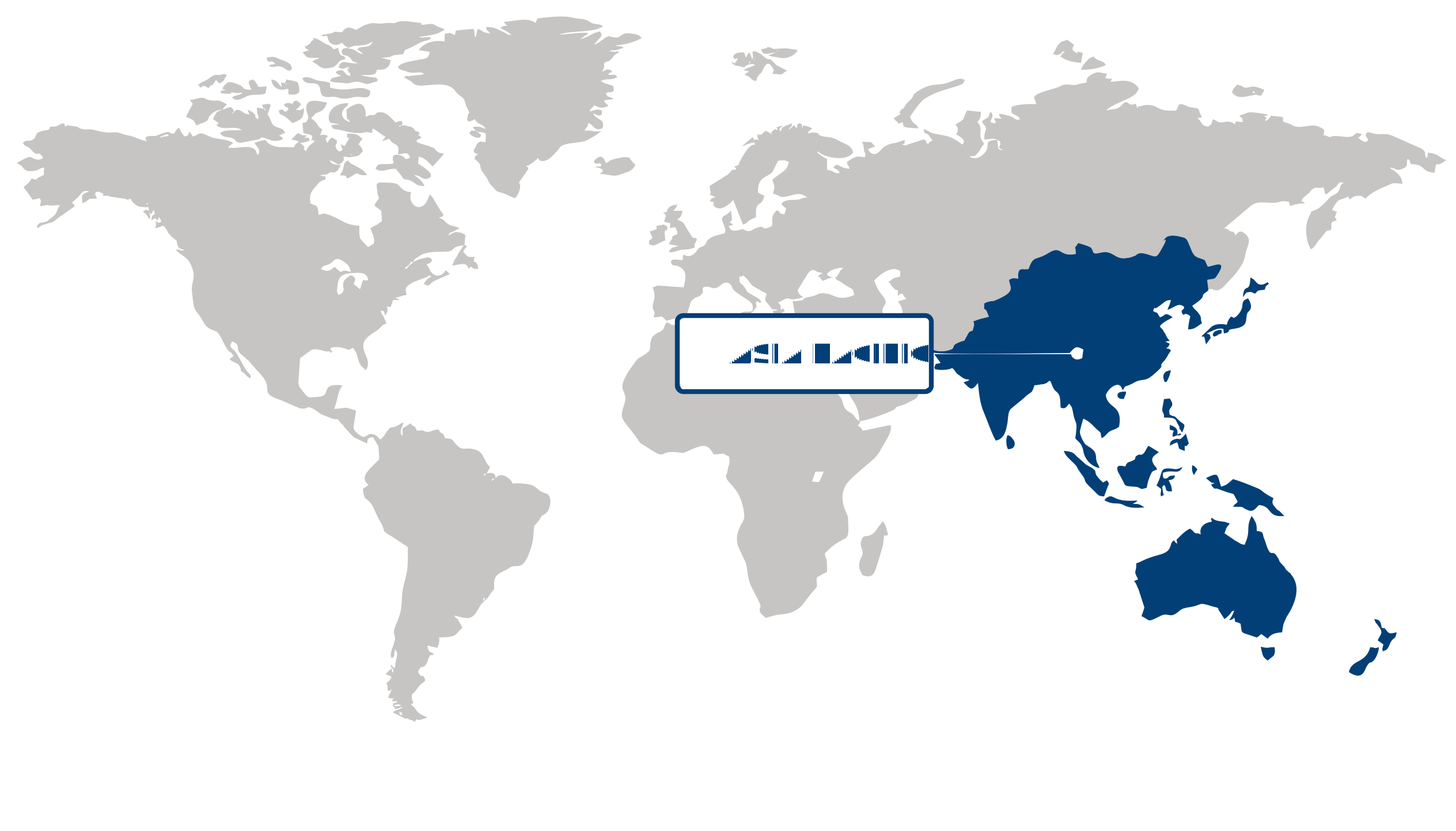
Asia Pacific (Largest & Fastest-Growing Region)
The connected rail system market was led by Asia Pacific in 2026 and is also expected to remain the fastest-growing regional market, supported by rapid railway modernization, expanding urban transportation networks, and increasing investments in intelligent mobility infrastructure. Governments and railway operators across the region are prioritizing digital technologies to improve operational efficiency, passenger safety, asset utilization, and network reliability. The growing deployment of IoT-enabled monitoring, real-time communication, predictive maintenance, and automated railway management solutions is strengthening demand for connected rail systems. Rapid urbanization and the expansion of high-speed and mass transit networks are further creating opportunities for integrated digital platforms that can connect trains, infrastructure, passengers, and control centers. Continued investment in smart transportation infrastructure is expected to sustain the region's strong market position.
| Parameter | North America | Asia Pacific | Europe | Latin America | MEA |
|---|---|---|---|---|---|
| Innovation Hub i Scale Nascent Developing Advanced | |||||
| Cost-Sensitive Region i Scale Low Medium High | |||||
| Regulatory Environment i Scale Restrictive Neutral Supportive | |||||
| Demand Drivers i Scale Weak Moderate Strong | |||||
| Development Stage i Scale Emerging Developing Developed | |||||
| Adoption Rate i Scale Low Medium High | |||||
| New Entrants / Startups i Scale Sparse Moderate Dense | |||||
| Macro Indicators i Scale Weak Stable Strong |
Key Country Insights
United States 🇺🇸
Digital Network ModernizationThe U.S. advances connected rail systems through investments in digital signaling, predictive maintenance, and network monitoring. Rail operators prioritize connected technologies that improve operational visibility, safety, and asset utilization across freight and passenger networks.
Germany 🇩🇪
Intelligent Rail OperationsGermany integrates connected rail systems with automated signaling, traffic management, and smart infrastructure initiatives. Technology providers focus on interoperable digital platforms that enhance network efficiency and maintenance planning.
Japan 🇯🇵
Smart Mobility IntegrationJapan develops connected rail systems that combine real-time monitoring, automation, and passenger information services. Railway operators emphasize dependable digital infrastructure that supports punctual operations and optimized asset management.
South Korea 🇰🇷
Digital Transit InfrastructureSouth Korea expands connected rail systems through smart transportation investments and advanced communication technologies. Operators prioritize integrated digital platforms that strengthen operational coordination, maintenance efficiency, and passenger service reliability.
France 🇫🇷
Network Connectivity EnhancementFrance strengthens connected rail systems by deploying intelligent signaling, remote monitoring, and infrastructure analytics. Rail authorities focus on improving operational resilience while supporting more efficient maintenance and network management practices.
Italy 🇮🇹
Railway Technology UpgradesItaly adopts connected rail systems to modernize railway infrastructure and improve operational performance. Technology investments emphasize real-time data integration, predictive maintenance capabilities, and enhanced coordination across rail operations.
Segment Leadership and Growth Trends
Connected Rail System Market Share (%), by Component, 2026
Go beyond the chart, access full insights & data tables
Request Free Sample ReportComponent Segment Analysis: Hardware (Largest Segment) vs Software (Fastest-Growing Segment)
The hardware component led the market with a 47.7% share in 2026 due to substantial investments in physical rail infrastructure and connected equipment. Sensors, communication devices, surveillance systems, onboard electronics, and networking equipment form the technological foundation of connected rail operations, enabling real-time data collection and system monitoring. Ongoing modernization of railway infrastructure and increasing deployment of intelligent transport technologies have continued to sustain demand for hardware solutions.
In the connected rail system market, the software component is expected to record the fastest growth as railway operators increasingly adopt digital platforms for analytics, predictive maintenance, traffic optimization, and operational control. The growing emphasis on data-driven decision-making, cloud-based management systems, and artificial intelligence-enabled applications is enhancing software adoption. As rail networks become more interconnected, advanced software solutions are playing a critical role in improving efficiency, service reliability, and passenger experience.
Application Segment Analysis: Operations Management (Largest Segment) vs Passenger Management (Fastest-Growing Segment)
Operations management accounted for the largest share of 35.64% in 2026, reflecting its central role in ensuring efficient railway performance. Rail operators continue to prioritize solutions that optimize train scheduling, fleet utilization, asset coordination, and maintenance planning to improve service reliability and reduce operational disruptions. The increasing complexity of modern rail networks has further strengthened investment in integrated operations management platforms.
The passenger management application is anticipated to expand at the fastest pace as demand grows for digitally connected travel experiences across the connected rail system market. Railway authorities are increasingly implementing smart ticketing, real-time passenger information, crowd management, and journey planning solutions to improve convenience and operational efficiency. Rising urbanization and growing passenger expectations for seamless mobility are further supporting adoption of advanced passenger management technologies.
Rail Segment Analysis: High-speed Rail (Largest Segment) vs Metro/monorail (Fastest-Growing Segment)
High-speed rail represented the largest rail segment in 2026, supported by significant investments in advanced transportation corridors and the need for fast, efficient intercity mobility. These networks rely heavily on sophisticated communication, signaling, and monitoring technologies to maintain operational safety and performance. Continuous expansion of high-speed rail infrastructure has reinforced demand for connected rail solutions across this segment.
The metro/monorail segment is expected to witness the fastest growth in the connected rail system market as cities increasingly invest in smart urban transit systems to address congestion and improve public transportation. Connected technologies enable better traffic coordination, enhanced passenger services, and more efficient fleet management, making them essential for modern metro and monorail operations. Continued urban development and digital transformation initiatives are expected to accelerate deployment within this segment.
| Segment | Sub-Segment | Largest Segment | Fastest Growing |
|---|---|---|---|
| Component | Hardware, Software, Services | Hardware | Software |
| Application | Passenger Management, Asset Management, Operations Management, Safety and Security | Operations Management | Passenger Management |
| Rail | Metro/monorail, Light Rail, High-speed Rail, Freight Rail, Commuter Rail | High-speed Rail | Metro/monorail |
Competitive Landscape and Market Positioning
Key companies in the connected rail system market:
- Siemens AG (Germany)
- Alstom S.A. (France)
- Hitachi Ltd. (Japan)
- Thales Group (France)
- Wabtec Corporation (United States)
- ABB Ltd. (Switzerland)
- Stadler Rail AG (Switzerland)
- Huawei Technologies Co., Ltd. (China)
- Nokia Corporation (Finland)
- Mitsubishi Electric Corporation (Japan)
Digital transformation across railway infrastructure is redefining how suppliers compete in the connected rail system market, with increasing attention directed toward platforms capable of linking signaling, communications, asset monitoring, and operational management into unified environments. Customers are placing greater importance on interoperability with existing rail infrastructure, encouraging vendors to design flexible architectures that accommodate phased modernization rather than complete system replacement. As predictive maintenance and real-time operational intelligence become integral to network performance, competitive advantage is increasingly shaped by software capabilities, cybersecurity resilience, and the ability to translate large volumes of operational data into actionable insights for rail operators.
| Company | Market Share | Company Revenue | Revenue CAGR (%) | Product Portfolio | Geographic Presence | Innovation / R&D Focus | Strategic Developments |
|---|---|---|---|---|---|---|---|
| Siemens AG (Germany) | |||||||
| Alstom S.A. (France) | |||||||
| Hitachi Ltd. (Japan) | |||||||
| Thales Group (France) | |||||||
| Wabtec Corporation (United States) | |||||||
| ABB Ltd. (Switzerland) | |||||||
| Stadler Rail AG (Switzerland) | |||||||
| Huawei Technologies Co. Ltd. (China) | |||||||
| Nokia Corporation (Finland) | |||||||
| Mitsubishi Electric Corporation (Japan) |
Industry Development/News
| Company Name | Date | Key Development |
|---|---|---|
| Etihad Rail | Jun-26 | Etihad Rail officially launched the UAE's inaugural passenger rail service, connecting Fujairah and Abu Dhabi. Utilizing the advanced European Train Control System (ETCS2) for high-level automation and safety, this introductory phase represents a major milestone in establishing an integrated national rail network, with further station expansions planned through 2027 to improve intercity connectivity. |
| Siemens Mobility | Mar-24 | Siemens Mobility committed USD 350 million toward the development of smart rail technologies. The strategic investment focuses on advancing signaling systems and digital infrastructure, specifically leveraging AI and IoT integrations to enhance overall network safety, operational efficiency, and system reliability for global rail operators. |
| Thales Group | Sep-23 | Thales Group and Huawei announced a collaborative partnership to advance the cybersecurity and communication frameworks of railway signaling systems. The initiative integrates Huawei’s advanced network solutions with Thales’s established signaling technology, aiming to provide more robust, secure, and digitally resilient infrastructure for modern railway networks. |
Customize Your Report
Explore examples of how this report can be tailored to different research needs, including custom segments, additional topics or chapters, and related reports. Click a section of the wheel or its numbered marker to explore the available options.
Connected Rail System Market — Custom Segments
| Segment | Sub-Segment |
|---|---|
| Deployment Model | On-Premise, Cloud-Based, Hybrid |
| Buyer Type | Passenger Rail Operators, Freight Rail Operators, Rail Infrastructure Managers, Government and Transit Authorities |
| Deployment Stage | New Rail Projects, Network Modernization, Retrofit and Upgrade |
Connected Rail System Market — Custom TOC
| Custom Chapter | Custom Details |
|---|---|
| Connected Rail Deployment Readiness |
|
| Interoperability Strategy for Connected Rail |
|
| Connected Rail Cybersecurity Strategy |
|
Need a different cut of the data?
Request Custom ResearchWhat is the current revenue of the connected rail system market?
What is the projected value of the connected rail system industry by 2036?
How are smart mobility initiatives accelerating connected rail system deployment?
Why is predictive maintenance becoming a strategic priority in connected rail systems?
Which application segment held the largest share of the connected rail system market in 2026?
Why is the passenger management segment expected to grow the fastest?
Why does Asia Pacific lead and maintain strong growth in the connected rail system market?
What is driving connected rail system adoption across Asia Pacific?
Which companies are driving growth in the connected rail system landscape?
Our Clients
"The team surpassed our expectations with the report depth. The actionable insights provided proved crucial in navigating market challenges."
Tata Motors
"We found the report to be very informative. The expertise and attention to market nuances significantly influenced our business direction."
DENSO Corporation
"The consumer survey findings were quite good. We now have a clearer picture of the customer churning and retention strategy."
HL Mando
Our Research Team & Methodology
Every Fundamental Business Insights report is built by a dedicated vertical research team, validated through a structured primary-and-secondary methodology, and reviewed for accuracy before it reaches you.
Research Team Overview
Prepared by the Automotive & Transportation Research Team
Delivery
Published
Demand
Available
Support
Trust & Compliance
Research Domains
10 coverage areasResearch Intelligence
| Source | Reference |
|---|---|
| International Organization of Motor Vehicle Manufacturers (OICA) | www.oica.net |
| SAE International | www.sae.org |
| International Energy Agency (IEA) | www.iea.org |
| International Transport Forum (ITF) | www.itf-oecd.org |
| International Road Federation (IRF) | www.irf.global |
| International Organization for Standardization (ISO) | www.iso.org |
| United Nations Economic Commission for Europe (UNECE) | unece.org |
| National Highway Traffic Safety Administration (NHTSA) | www.nhtsa.gov |
| U.S. Department of Transportation (USDOT) | www.transportation.gov |
| European Automobile Manufacturers' Association (ACEA) | www.acea.auto |
| Society of Indian Automobile Manufacturers (SIAM) | www.siam.in |
| International Air Transport Association (IATA) | www.iata.org |
| International Civil Aviation Organization (ICAO) | www.icao.int |
| International Maritime Organization (IMO) | www.imo.org |
| International Union of Railways (UIC) | uic.org |
| American Public Transportation Association (APTA) | www.apta.com |
| International Federation of Robotics (IFR) | ifr.org |
| CharIN | www.charin.global |
| World Shipping Council | www.worldshipping.org |
| International Federation of Freight Forwarders Associations (FIATA) | fiata.org |
Research Workflow & Quality Assurance
Data Collection
Verified information gathered through primary and secondary research.
Data Triangulation
Cross-validation using multiple independent data sources.
Forecast Modelling
Market estimates developed using historical trends and analytical models.
Analyst Validation
Findings reviewed by domain experts for accuracy and consistency.
Editorial & Quality Review
Final editorial, quality, and compliance checks before publication.
Final Publication
Released after successful completion of the internal review process.
Report Coverage
📊 Market Assessment
- Market Size & Forecast
- Market Segmentation
- Regional Analysis
- Growth Drivers & Challenges
- Market Dynamics
🏢 Competitive Intelligence
- Competitive Landscape
- Company Profiles
- Competitive Benchmarking
- Mergers & Acquisitions
- Market Share Analysis or Key Company Strategies
🔍 Strategic Analysis
- Value Chain Analysis
- Porter's Five Forces
- PESTLE Analysis
- Pricing Trends
- Supply-Demand Analysis
🚀 Future Outlook
- Technology Landscape
- Regulatory Landscape
- Investment & Funding Landscape
- Emerging Opportunities
- Future Market Outlook
Have a question about this report or need a custom scope?
Request Customization