Conductive Ink Market Size & Growth Forecast 2027–2036, By Segments (Product, Application), Regional Demand Trends (North America, Asia Pacific, Europe), Key Country Insights (U.S., Japan, South Korea, Germany, France, Italy), and Competitive Landscape
Market Size and Growth Outlook
Conductive Ink Market size was valued at USD 3.76 trillion in 2026 and is anticipated to grow at a 5.7% CAGR from 2027 to 2036, attaining USD 6.55 trillion by 2036. The industry revenue for 2027 is estimated at USD 3.94 trillion.
Get more details on this report
Request Free Sample ReportConductive Ink Market Intelligence Snapshot
Regional Market Dynamics
- Asia Pacific captured a 60.90% market share in 2026, supported by its extensive electronics manufacturing ecosystem and high-volume production of printed circuits, sensors, and display components.
- Asia Pacific is expected to grow at a 6.89% CAGR as manufacturers expand flexible and printed electronics production while integrating conductive materials into a wider range of devices.
Segment Momentum
- Conductive Silver Ink held 22.68% share due to high electrical conductivity, reliable print performance, and strong compatibility with established manufacturing processes, making it the preferred choice for large-volume industrial production and consistent procurement needs.
- Carbon/Graphene Ink is expanding fastest due to growing demand for flexible electronics, wearable devices, and lightweight printed circuits, enabling cost-sensitive production and greater material adaptability across emerging printed electronics applications.
Market Expansion Drivers
- Expanding flexible electronics demand in consumer devices and wearable applications.
- Rising photovoltaic cell production increasing conductive ink utilization in solar applications.
- Growth of printed electronics in automotive sensors and smart packaging systems.
Leading Market Participants
- Major players in the conductive ink market include DuPont de Nemours, Inc. (United States), Heraeus Holding GmbH (Germany), Sun Chemical Corporation (United States), Henkel AG & Co. KGaA (Germany), NovaCentrix Corporation (United States), Creative Materials Inc. (United States), Vorbeck Materials Corp. (United States), Fujikura Ltd. (Japan), Johnson Matthey Plc (United Kingdom), Engineered Conductive Materials, LLC (United States).
Global Market Forecast Snapshot
Market Outlook
- 2026 Market Size: USD 3.76 trillion
- 2027 Estimated Market Size: USD 3.94 trillion.
- Projected Market Size: USD 6.55 trillion by 2036
- Growth Forecast: 5.7% CAGR (2027-2036)
Regional and Segment Outlook
- Leading Regional Market: Asia Pacific
- High-Growth Regional Hub: Asia Pacific
- Core Revenue Segment: Conductive Silver Ink (Product) | Photovoltaic (Application)
- Emerging Opportunity Segment: Carbon/Graphene Ink (Product) | Smart Packaging (Application)
Market Growth Drivers and Industry Trends
Expanding flexible electronics demand in consumer devices and wearable applications
The growing integration of flexible electronic components into compact consumer products and wearable devices is opening new application opportunities for printed conductive materials. The conductive ink market will expand as manufacturers seek lightweight and flexible alternatives for creating electrically functional patterns on substrates that may bend, stretch, or conform to different product geometries. Conductive inks enable the production of printed circuits, electrodes, antennas, and other electronic features without relying exclusively on conventional rigid manufacturing approaches. Their compatibility with flexible substrates is particularly relevant to wearable electronics, smart accessories, flexible displays, and compact consumer devices where design flexibility, miniaturization, and efficient manufacturing are important considerations.
Rising photovoltaic cell production increasing conductive ink utilization in solar applications
Increasing photovoltaic manufacturing activity is supporting the use of conductive materials required to establish electrical pathways within solar cells. In the conductive ink market, demand is closely associated with the role of conductive formulations in forming contacts and electrically functional patterns during photovoltaic production. Manufacturers require materials that can provide reliable conductivity while supporting efficient processing and compatibility with increasingly advanced cell architectures. The ongoing emphasis on improving solar energy generation and manufacturing efficiency is encouraging development of conductive ink formulations suited to different photovoltaic technologies, while the need for dependable electrical connections remains an important consideration in cell production.
Growth of printed electronics in automotive sensors and smart packaging systems
The expansion of printed electronics is creating additional applications for conductive materials across automotive and packaging environments. Within the conductive ink market, automotive manufacturers can use printed conductive patterns to support sensors, heating elements, touch interfaces, and other electronic functions integrated into vehicle components. Smart packaging applications similarly rely on printed conductive elements to enable features such as sensing, identification, connectivity, and interactive product information. Conductive inks are well suited to these applications because they can be deposited onto diverse substrates and incorporated into compact or customized designs, allowing manufacturers to integrate electronic functionality into products without requiring conventional circuit assemblies for every application.
| Growth Driver | Impact on CAGR | Regulatory Influence | Geographic Relevance | Adoption Rate | Impact Timeline |
|---|---|---|---|---|---|
| Expanding flexible electronics demand in consumer devices and wearable applications | 2.10% | Moderate | Asia Pacific, North America, Europe | High | Mid Term |
| Rising photovoltaic cell production increasing conductive ink utilization in solar applications | 2.00% | High | Asia Pacific, Europe | High | Near Term |
| Growth of printed electronics in automotive sensors and smart packaging systems | 1.70% | Moderate | North America, Asia Pacific | Emerging | Mid Term |
Unlock insights tailored to your business with our bespoke market research solutions.
Click to get your customized report now.
Regional Demand Dynamics
Asia Pacific (Largest & Fastest-Growing Region)
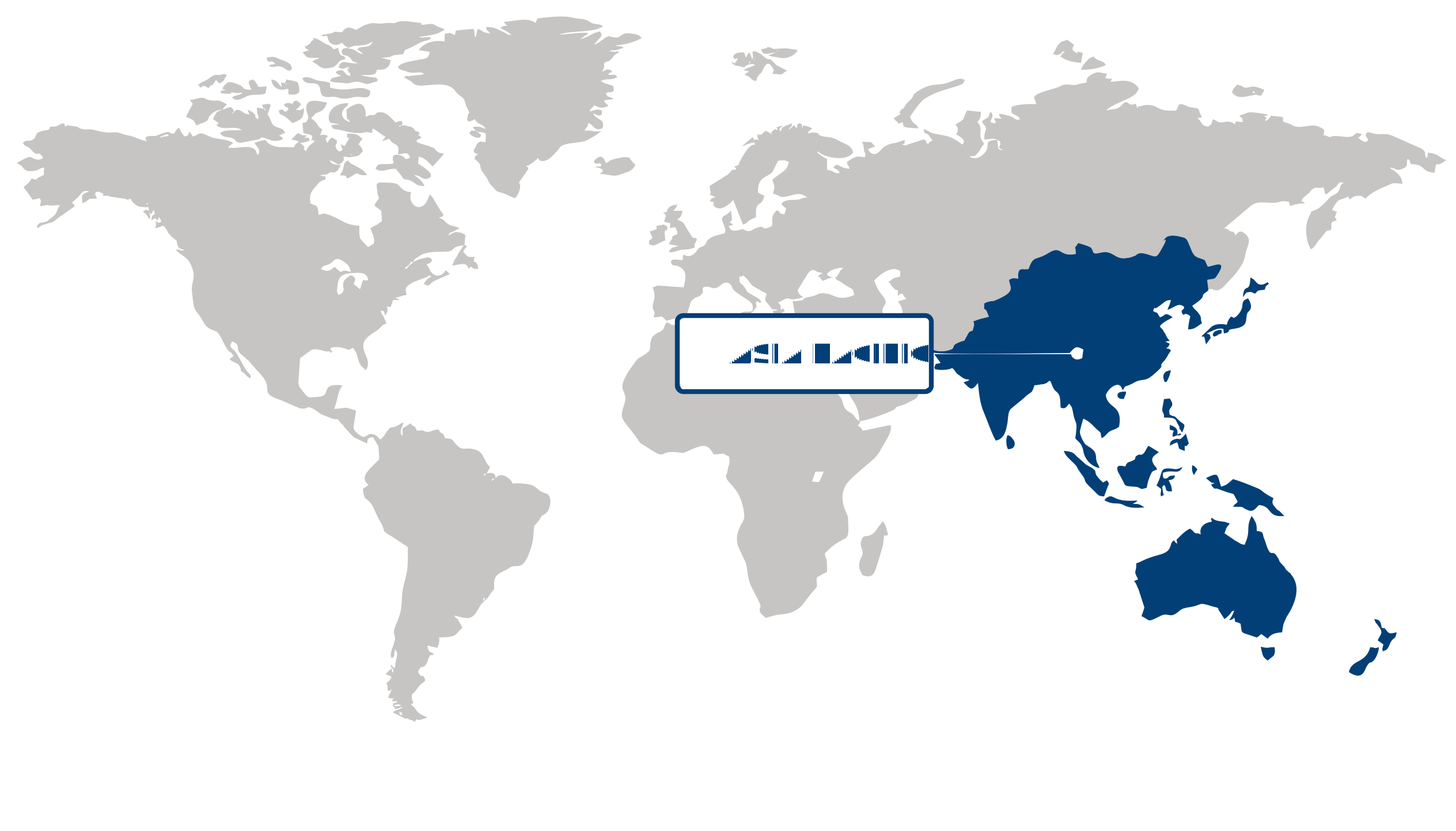
Asia Pacific dominated the conductive ink market and accounted for a 60.90% share in 2026, while also representing the fastest-growing regional market, owing to the region's extensive electronics manufacturing ecosystem and expanding adoption of printed and flexible electronic technologies. Strong production activity in consumer electronics, displays, sensors, printed circuits, and smart devices is generating substantial demand for conductive materials used in electronic components and functional surfaces. The region also benefits from established manufacturing infrastructure, specialized materials supply chains, and continued investment in miniaturized and flexible electronics. Growing adoption of wearable devices, connected products, and advanced packaging technologies is further broadening application opportunities for conductive inks, while ongoing improvements in printing processes and material performance are supporting their integration into next-generation electronic applications.
| Parameter | North America | Asia Pacific | Europe | Latin America | MEA |
|---|---|---|---|---|---|
| Innovation Hub i Scale Nascent Developing Advanced | |||||
| Cost-Sensitive Region i Scale Low Medium High | |||||
| Regulatory Environment i Scale Restrictive Neutral Supportive | |||||
| Demand Drivers i Scale Weak Moderate Strong | |||||
| Development Stage i Scale Emerging Developing Developed | |||||
| Adoption Rate i Scale Low Medium High | |||||
| New Entrants / Startups i Scale Sparse Moderate Dense | |||||
| Macro Indicators i Scale Weak Stable Strong |
Key Country Insights
Germany 🇩🇪
Industrial Manufacturing IntegrationGermany emphasizes conductive inks for automotive electronics, industrial automation, and precision manufacturing. Companies in Germany are focusing on durable materials that support reliable conductivity and integration into advanced production processes.
France 🇫🇷
Functional Materials DevelopmentFrance is expanding conductive ink applications across smart packaging, aerospace, and industrial electronics. French companies are developing specialized materials that balance electrical performance with sustainable manufacturing requirements and evolving product designs.
Italy 🇮🇹
Specialty Electronics ProductionItaly supports conductive ink demand through specialty electronics, industrial equipment, and printed component manufacturing. Italian manufacturers increasingly adopt customized conductive materials that improve production flexibility and application-specific performance.
Japan 🇯🇵
Precision Electronics MaterialsJapan continues to advance conductive ink adoption through its established electronics manufacturing ecosystem. Japanese producers prioritize fine-line printing performance, material consistency, and compatibility with compact electronic components and display technologies.
South Korea 🇰🇷
Display Technology ApplicationsSouth Korea leverages conductive inks in display panels, wearable electronics, and next-generation consumer devices. Manufacturers in South Korea are investing in formulations that improve conductivity while supporting flexible and lightweight electronic designs.
United States 🇺🇸
Printed Electronics InnovationThe U.S. conductive ink market benefits from strong demand across flexible electronics, medical devices, and advanced sensor applications. Manufacturers in the U.S. are prioritizing high-performance formulations compatible with printed electronics and scalable production technologies.
Segment Leadership and Growth Trends
Conductive Ink Market Share (%), by Product, 2026
Go beyond the chart, access full insights & data tables
Request Free Sample ReportProduct Segment Analysis: Conductive Silver Ink (Largest Segment) vs Carbon/Graphene Ink (Fastest-Growing Segment)
Conductive silver ink held the largest share of the conductive ink market, accounting for 22.68% in 2026. Its established position is supported by the excellent electrical conductivity of silver and its suitability for applications requiring highly reliable conductive pathways. The material is widely used in electronic components and printed circuitry where consistent electrical performance is critical, while advances in printed electronics continue to sustain demand for high-performance conductive materials.
Carbon/Graphene ink is experiencing the fastest growth as manufacturers seek conductive materials that combine electrical functionality with flexibility, lightweight characteristics, and material efficiency. Carbon-based formulations offer opportunities for applications in flexible electronics, sensors, wearable devices, and other emerging printed technologies where conventional conductive materials may face design or cost constraints. Continued innovation in printed and flexible electronics is expanding the range of applications for carbon and graphene-based conductive inks.
Application Segment Analysis: Photovoltaic (Largest Segment) vs Smart Packaging (Fastest-Growing Segment)
The photovoltaic application represented the largest share of the conductive ink market at 22.68% in 2026, driven by the extensive requirement for conductive materials in solar-cell manufacturing. Conductive inks support the formation of electrical contacts and current-collection structures while enabling manufacturers to develop efficient printed patterns on photovoltaic surfaces. Continued expansion of solar energy deployment and ongoing efforts to improve cell efficiency and manufacturing processes reinforce the importance of conductive inks in this application.
Smart packaging is emerging as the fastest-growing application as packaging manufacturers increasingly incorporate printed electronics to enable functions such as product identification, sensing, authentication, and consumer interaction. Conductive inks provide a practical means of creating printed circuits and electronic features directly on packaging substrates, supporting the development of connected and interactive packaging formats. Rising interest in intelligent supply-chain solutions and digitally enabled consumer experiences is creating new opportunities for conductive ink adoption beyond conventional electronics applications.
| Segment | Sub-Segment | Largest Segment | Fastest Growing |
|---|---|---|---|
| Product | Conductive Silver Ink, Conductive Copper Ink, Conductive Polymers, Carbon Nanotube Ink, Dielectric Inks, Carbon/Graphene Ink, Others | Conductive Silver Ink | Carbon/Graphene Ink |
| Application | Photovoltaic, Membrane Switches, Displays, Automotive, Smart Packaging, Biosensors, Printed Circuit Boards, Others | Photovoltaic | Smart Packaging |
Competitive Landscape and Market Positioning
Prominent players in the conductive ink market:
1. DuPont de Nemours Inc. (United States)
2. Heraeus Holding GmbH (Germany)
3. Sun Chemical Corporation (United States)
4. Henkel AG & Co. KGaA (Germany)
5. NovaCentrix Corporation (United States)
6. Creative Materials Inc. (United States)
7. Vorbeck Materials Corp. (United States)
8. Fujikura Ltd. (Japan)
9. Johnson Matthey Plc (United Kingdom)
10. Engineered Conductive Materials LLC (United States)
The conductive ink market is evolving through innovations in printable electronics and flexible circuitry applications. Material advancements are improving conductivity and stability across substrates. The conductive ink market continues to expand as demand rises for smart and wearable electronic solutions.
| Company | Market Share | Company Revenue | Revenue CAGR (%) | Product Portfolio | Geographic Presence | Innovation / R&D Focus | Strategic Developments |
|---|---|---|---|---|---|---|---|
| DuPont de Nemours Inc. (United States) | |||||||
| Heraeus Holding GmbH (Germany) | |||||||
| Sun Chemical Corporation (United States) | |||||||
| Henkel AG & Co. KGaA (Germany) | |||||||
| NovaCentrix Corporation (United States) | |||||||
| Creative Materials Inc. (United States) | |||||||
| Vorbeck Materials Corp. (United States) | |||||||
| Fujikura Ltd. (Japan) | |||||||
| Johnson Matthey Plc (United Kingdom) | |||||||
| Engineered Conductive Materials LLC (United States). |
Industry Development/News
| Company Name | Date | Key Development |
|---|---|---|
| Henkel | Feb-25 | Henkel introduced recycled-silver conductive inks aimed at producing high-performance printed circuits for smart surfaces. The innovation enhances sustainability in conductive ink manufacturing while supporting applications in printed electronics, reinforcing Henkel’s position in advanced conductive materials for next-generation electronic and surface-integrated applications. |
| DuPont | Sep-24 | DuPont launched silver nanowire-based conductive ink technologies at SID Vehicle Displays and Interfaces 2024, expanding its portfolio into transparent conductive materials. Key developments include Activegrid ink for transparent heaters and OLED displays and a low-temperature curing variant designed for sensitive substrates, strengthening its footprint in automotive and consumer electronics applications. |
| Haydale Graphene Industries | Jul-24 | Haydale Graphene Industries reported successful trials of its graphene-based conductive ink for underfloor heating applications, demonstrating strong performance in energy efficiency, usability, and consistency in low-voltage systems embedded in flooring panels. The results support potential commercial scale-up of conductive ink solutions within smart building and construction heating applications. |
| Staircraft | Jul-24 | Staircraft conducted validation trials using Haydale’s graphene-based conductive ink within its pre-cut flooring systems to develop integrated underfloor heating solutions. The trials demonstrated improved installation efficiency and heating performance, and the company continues technical validation efforts aimed at progressing toward commercial deployment of conductive ink-enabled smart flooring systems. |
| OKdo | Mar-23 | OKdo, a subsidiary of RS Group, entered a strategic partnership with Bare Conductive to scale manufacturing capabilities and accelerate product innovation in conductive ink solutions. The collaboration aims to enhance production capacity and improve commercialization of printed electronics technologies across emerging application areas. |
| Encres DUBUIT | Jul-22 | Encres DUBUIT entered an acquisition agreement with POLY-INK to expand its market share and strengthen its position in conductive ink manufacturing. The acquisition supports portfolio expansion and reinforces competitive positioning within the printed electronics and functional ink segment. |
| PV Nano Cell | Apr-21 | PV Nano Cell developed a carbon-based conductive ink enabling printing of integrated resistors and capacitors with high geometric flexibility. The innovation expands functional printing capabilities for electronic components, supporting broader application development in printed electronics and enhancing design flexibility in conductive ink-based circuit manufacturing. |
| Henkel | Feb-21 | Henkel expanded its strategic partnership with Quad Industries to accelerate development of printed electronics solutions. The collaboration integrates R&D capabilities and manufacturing expertise to improve commercialization speed and enhance customer access to conductive ink-based electronic solutions. |
| Creative Materials, Inc. | May-20 | Creative Materials, Inc. launched a cost-effective gold conductive ink designed to improve conductivity efficiency while minimizing gold usage. The product enables high-coverage printing for non-oxidizing electrodes, supporting applications requiring fine detail and smooth surfaces in printed electronics and conductive coating systems. |
Customize Your Report
Explore examples of how this report can be tailored to different research needs, including custom segments, additional topics or chapters, and related reports. Click a section of the wheel or its numbered marker to explore the available options.
Conductive Ink Market — Custom Segments
| Segment | Sub-Segment |
|---|---|
| Printing Technology | Screen Printing, Inkjet Printing, Flexographic Printing, Gravure Printing, Offset Printing |
| Substrate Type | Flexible Films, Glass, Paper & Paperboard, Textiles, Rigid Plastics & Ceramics |
| End-User Industry | Consumer Electronics, Automotive & Transportation, Energy & Power, Healthcare & Medical Devices, Packaging & Printed Electronics |
Conductive Ink Market — Custom TOC
| Custom Chapter | Custom Details |
|---|---|
| Printed Electronics Application Expansion |
|
| Material Innovation and Substitution Assessment |
|
| Conductive Ink Commercialization Strategies |
|
Need a different cut of the data?
Request Custom ResearchHow much is the conductive ink market worth?
What is the anticipated CAGR of the conductive ink industry?
How is flexible electronics adoption influencing demand in the conductive ink market?
Why is smart packaging emerging as a strategic growth opportunity in the conductive ink market?
Why does conductive silver ink dominate the conductive ink market?
What is driving carbon/graphene ink growth in the conductive ink market?
Why is Asia Pacific the largest conductive ink market?
What is accelerating conductive ink market growth in Asia Pacific?
What are the key competitors in the conductive ink landscape?
Our Clients
"The report helped us understand emerging consumer trends in our product category. It clarified where to focus innovation for the next product launch."
LyondellBasell
"The regional forecast section was incredibly useful. We were able to identify two new potential partners in Europe thanks to the vendor mapping you included."
SABIC
"We appreciated how actionable the recommendations were. It guided us to improve supply chain resilience."
Olin Corporation
Our Research Team & Methodology
Every Fundamental Business Insights report is built by a dedicated vertical research team, validated through a structured primary-and-secondary methodology, and reviewed for accuracy before it reaches you.
Research Team Overview
Prepared by the Chemicals & Materials Research Team
Delivery
Published
Demand
Available
Support
Trust & Compliance
Research Domains
10 coverage areasResearch Intelligence
| Source | Reference |
|---|---|
| American Chemistry Council (ACC) | www.americanchemistry.com |
| European Chemical Industry Council (Cefic) | cefic.org |
| International Council of Chemical Associations (ICCA) | icca-chem.org |
| European Chemicals Agency (ECHA) | echa.europa.eu |
| U.S. Environmental Protection Agency (EPA) | www.epa.gov |
| ASTM International | www.astm.org |
| International Organization for Standardization (ISO) | www.iso.org |
| National Institute of Standards and Technology (NIST) | www.nist.gov |
| Plastics Industry Association (PLASTICS) | www.plasticsindustry.org |
| European Biplastics | www.european-bioplastics.org |
| The Adhesive and Sealant Council (ASC) | www.ascouncil.org |
| National Association of Corrosion Engineers (AMPP) | www.ampp.org |
| Society of Plastics Engineers (SPE) | www.4spe.org |
| International Fertilizer Association (IFA) | www.fertilizer.org |
| CropLife International | croplife.org |
| Packaging Europe | packagingeurope.com |
| Flexible Packaging Association (FPA) | www.flexpack.org |
| Battery Council International (BCI) | batterycouncil.org |
| International Copper Association (ICA) | internationalcopper.org |
| World Steel Association | worldsteel.org |
Research Workflow & Quality Assurance
Data Collection
Verified information gathered through primary and secondary research.
Data Triangulation
Cross-validation using multiple independent data sources.
Forecast Modelling
Market estimates developed using historical trends and analytical models.
Analyst Validation
Findings reviewed by domain experts for accuracy and consistency.
Editorial & Quality Review
Final editorial, quality, and compliance checks before publication.
Final Publication
Released after successful completion of the internal review process.
Report Coverage
📊 Market Assessment
- Market Size & Forecast
- Market Segmentation
- Regional Analysis
- Growth Drivers & Challenges
- Market Dynamics
🏢 Competitive Intelligence
- Competitive Landscape
- Company Profiles
- Competitive Benchmarking
- Mergers & Acquisitions
- Market Share Analysis or Key Company Strategies
🔍 Strategic Analysis
- Value Chain Analysis
- Porter's Five Forces
- PESTLE Analysis
- Pricing Trends
- Supply-Demand Analysis
🚀 Future Outlook
- Technology Landscape
- Regulatory Landscape
- Investment & Funding Landscape
- Emerging Opportunities
- Future Market Outlook
Have a question about this report or need a custom scope?
Request Customization