Conductive Fibers Market Size & Forecasts 2026-2035, By Segments (Application, Type, Base Material Type, End-Use), Growth Opportunities, Innovation Landscape, Regulatory Shifts, Strategic Regional Insights (U.S., Japan, China, South Korea, UK, Germany, France), and Competitive Dynamics (3M, DuPont, Teijin, Kaneka Corporation, Asahi Kasei)
Market Size and Growth Outlook
Conductive Fibers Market size is expected to advance from USD 2.44 billion in 2025 to USD 7.51 billion by 2035, registering a CAGR of more than 11.9% across 2026-2035. By 2026, the industry is anticipated to generate USD 2.7 billion in revenue.
Get more details on this report
Request Free Sample ReportConductive Fibers Market Intelligence Snapshot
Regional Market Dynamics
Segment Momentum
Market Expansion Drivers
Leading Market Participants
Global Market Forecast Snapshot
Market Outlook
Regional and Segment Outlook
Market Growth Drivers and Industry Trends
Consumer demand for connected, health‑monitoring and fashion‑forward garments is directly driving product development and adoption in the conductive fibers market. Visible examples include Levi Strauss & Co.’s collaboration with Google ATAP on Jacquard-enabled garments and specialist suppliers such as Hexoskin and Sensoria commercializing biometric shirts, demonstrating route‑to‑market and retail acceptance. Established textile manufacturers can partner with electronics firms to embed value‑added services, while startups can capture niche use cases (sports, eldercare) through OEM agreements. Given ongoing retailer and technology tie‑ups, expect continued iterative launches and broader retail distribution rather than a single disruptive shift.
Advancements in conductive fiber materials
Material improvements—better washability, stretchable conductivity and integration with conventional yarns—are maturing the conductive fibers market’s addressable applications. Firms such as DuPont, Toray Industries and Teijin have disclosed R&D and product initiatives aimed at durability and manufacturability, lowering barriers for apparel and industrial integration. Incumbent fiber producers can monetize scale and co‑development with apparel brands, while specialty entrants can focus on patented chemistries or coatings that solve washability or biocompatibility constraints. Observable patent filings and product releases from these suppliers indicate steady technical progression supporting broader commercialization.
Integration in automotive and healthcare applications
Automotive seat sensors, EMI shielding and clinical wearable monitors are creating durable, high‑value demand pockets within the conductive fibers market. Suppliers are responding to automotive OEM pilots led by Bosch and Continental AG for sensorized interiors and healthcare partnerships involving Philips and Medtronic for remote monitoring textiles. This creates opportunities for tier‑one suppliers and textile firms to lock in multi‑year supply contracts and for agile startups to win pilot programs with hospitals or automakers. With ongoing pilot deployments and procurement announcements from these OEMs and medical device firms, procurement pipelines and certification activity will shape near‑term industrial adoption.
Industry Restraints:
Raw Material Supply and Price Volatility
The conductive fibers market is constrained by volatile availability and pricing of key metals and feedstocks; swings in copper and silver markets recorded by the London Metal Exchange (LME) and the London Bullion Market Association (LBMA), coupled with global logistics bottlenecks documented by the United Nations Conference on Trade and Development (UNCTAD), raise input-cost uncertainty and stretch inventory management. Manufacturers face higher working capital and delayed time-to-market, squeezing margins for both incumbents and startups that lack hedging scale. Strategically, firms must balance vertical integration, long-term supplier contracts, and product design substitutions to remain competitive. Given ongoing energy and geopolitical pressures flagged by the International Energy Agency (IEA), this constraint will continue to drive procurement sophistication and material-substitution strategies in the near to medium term.
Regulatory and Environmental Compliance Burdens
Heightened regulatory scrutiny of conductive materials—especially metal nanoparticles and treatment chemistries—raises testing, certification, and liability costs: the European Chemicals Agency (ECHA) actions under REACH, increased oversight from the U.S. Environmental Protection Agency (EPA) under TSCA, and the Organisation for Economic Co-operation and Development (OECD) guidance on nanomaterials collectively raise barriers to commercialization. Compliance timelines and expensive toxicology testing slow product launches and favor established firms with regulatory teams and capital, while creating steep entry costs for innovators. Strategically, market participants must invest in safer formulations, transparent supply chains, and third‑party certifications. Expect continued tightening of substance restrictions and labeling expectations in the near to medium term, pushing the sector toward greener chemistries and higher compliance spend.
| Growth Driver | Impact on CAGR | Regulatory Influence | Geographic Relevance | Adoption Rate | Impact Timeline |
|---|---|---|---|---|---|
| Rising use in wearable electronics and smart textiles | 4.00% | Short term (≤ 2 yrs) | Asia Pacific, North America | Medium | Fast |
|
Explore Growth Opportunities Request Free Sample Report |
|||||
| Advancements in conductive fiber materials | 4.50% | Medium term (2–5 yrs) | Europe, North America | Medium | Moderate |
|
Explore Growth Opportunities Request Free Sample Report |
|||||
| Integration in automotive and healthcare applications | 3.40% | Long term (5+ yrs) | North America, Europe; Spillover: Asia Pacific | Low | Slow |
|
Explore Growth Opportunities Request Free Sample Report |
Regional Demand Dynamics
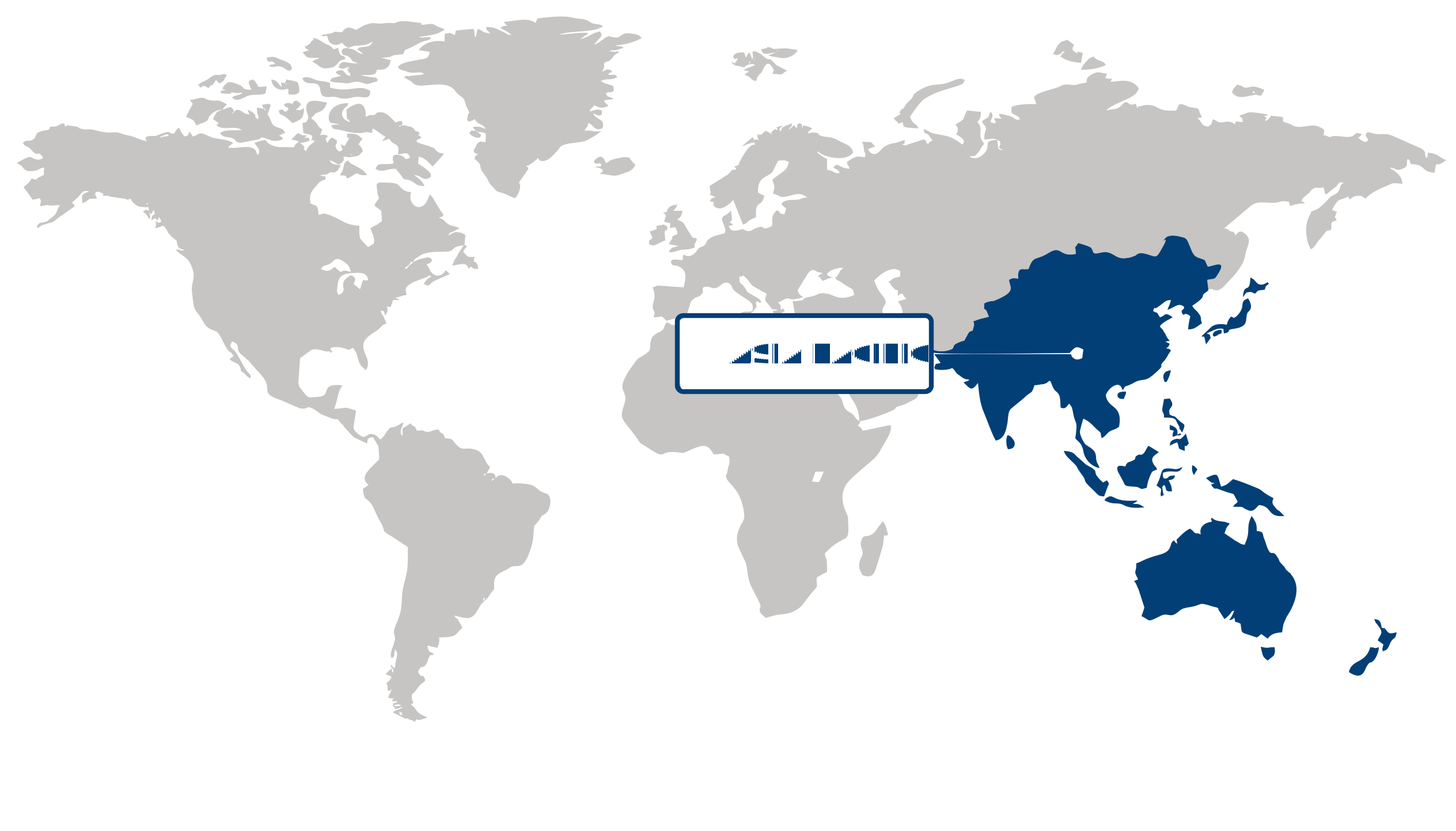
Asia Pacific captured approximately 48% of the conductive fibers market in 2025 and, at a 14% CAGR, is the largest and fastest-growing region; leadership is rooted in simultaneous expansion of smart-textiles manufacturing and large-scale electronics production across the region. Regional momentum is visible in private-sector R&D by Toray Industries and Teijin Limited on functional and conductive yarns and in contract-manufacturing scale at Hon Hai Precision Industry Co., Ltd. (Foxconn), while policy support from the Ministry of Industry and Information Technology (MIIT) and targeted materials initiatives from the Ministry of Economy, Trade and Industry (METI) sustain supply-chain investment. Given strong end-market pull for wearables, EMI shielding, and industrial sensing, APAC offers significant commercial runway for integrated conductive-fiber solutions and localized manufacturing partnerships.
Japan is positioned as a pivotal hub in Asia Pacific; the conductive fibers market in Japan leverages deep advanced-materials know-how and targeted industrial policy. Companies such as Toray Industries and Teijin Limited are translating polymer and fiber expertise into wearable and medical textile prototypes, supported by METI programs that promote materials innovation and commercialization. High domestic demand for automotive electronics and precision medical devices creates early-adopter pathways, making Japan an R&D-to-commercialization bridge that strengthens broader APAC supply chains.
China anchors much of APAC’s manufacturing scale; the conductive fibers market in China is propelled by high-volume electronics assembly and integrated supplier networks. Large contract manufacturers like Hon Hai Precision Industry Co., Ltd. (Foxconn) and strong platform demand from firms such as Huawei have broadened use cases for conductive fibers in consumer electronics and IoT devices, while MIIT-driven industrial policies accelerate localization of inputs. For investors and strategists, China offers scale-focused opportunities—component integration, cost optimization, and rapid validation of new conductive-fiber applications that can be scaled across the region.
North America Market Analysis:
North America recorded lucrative growth in the conductive fibers market, propelled by concentrated R&D clusters and public–private initiatives that accelerate prototype-to-production cycles. Regional significance stems from coordinated investments and pilot manufacturing: Advanced Functional Fabrics of America (AFFOA) has mobilized university and industry partners to industrialize smart textiles, while DARPA programs and National Institute of Standards and Technology (NIST) collaborations have pushed materials science and measurement frameworks that reduce technical risk. Rising consumer demand for health-tracking wearables and continued defense procurement have shifted supply chains toward integration-ready yarns and scalable processes. Given deep research funding, established textile manufacturing nodes, and growing procurement pipelines, North America offers sustained entry points for firms focusing on commercialization, certification, and sustainable sourcing in conductive-fibers-enabled products.
The U.S. is the commercialization engine for the conductive fibers market, converting research into products through targeted grants, procurement, and consumer platforms. National Science Foundation (NSF) grants and Department of Defense contracts have underwritten applied projects that de-risk manufacturing steps, while Apple Inc.’s expanding wearables ecosystem demonstrates consumer willingness to adopt sensor-integrated apparel. The U.S. supply base combines advanced material suppliers, venture funding, and Manufacturing USA participation that support scale-up and quality control, and regulatory attention to safety and data standards tightens buyer confidence. Strategically, U.S. commercialization capacity and procurement demand reinforce North America’s attractiveness for investors and manufacturers seeking to scale conductive-fiber innovations into mainstream consumer and defense applications.
Europe Market Trends:
Maintained a notable presence in the conductive fibers market, North America combines strong applied R&D and early commercial adoption to hold a significant share of high-value segments; evidence includes funding initiatives from the U.S. Department of Energy Advanced Manufacturing Office and National Science Foundation (NSF) grants for wearable electronics, corporate pilots such as Google ATAP’s Project Jacquard with Levi Strauss & Co., and industry engagement via the American Association of Textile Chemists and Colorists (AATCC). Regional logistics shifts reported by the Port of Los Angeles and policy focus from the U.S. Department of Commerce further support nearshoring and resiliency, positioning the region for expanded medical, defense, and industrial applications.
The United States acts as the primary innovation and commercialization hub in the conductive fibers market, driven by scale-up capacity, venture activity, and procurement from institutional buyers; examples include Defense Advanced Research Projects Agency (DARPA) investments in wearable technologies and corporate materials work by DuPont and 3M. This environment accelerates pilot-to-production pathways and attracts strategic investment, implying the U.S. will remain the principal engine for North American market growth and supplier consolidation.
Canada serves as a specialized research and niche-product provider in the conductive fibers market, leveraging academic-industry collaborations and health-tech commercialization; examples include Hexoskin’s biometric garments and support from the National Research Council Canada (NRC) and Natural Sciences and Engineering Research Council of Canada (NSERC). Canada’s strengths in medical wearables and materials testing create strategic opportunities to supply differentiated components and IP to U.S. manufacturers, reinforcing North America’s competitive ecosystem.
| Parameter | North America | Asia Pacific | Europe | Latin America | MEA |
|---|---|---|---|---|---|
| Innovation Hub i Scale Nascent Developing Advanced | |||||
| Cost-Sensitive Region i Scale Low Medium High | |||||
| Regulatory Environment i Scale Restrictive Neutral Supportive | |||||
| Demand Drivers i Scale Weak Moderate Strong | |||||
| Development Stage i Scale Emerging Developing Developed | |||||
| Adoption Rate i Scale Low Medium High | |||||
| New Entrants / Startups i Scale Sparse Moderate Dense | |||||
| Macro Indicators i Scale Weak Stable Strong |
Segment Leadership and Growth Trends
Conductive Fibers Market Share (%), by Application, 2026
Go beyond the chart, access full insights & data tables
Request Free Sample ReportWoven Fabric dominated the conductive fibers market in 2025, representing the largest application segment driven by demand for structurally stable conductive textiles used in industrial, aerospace and EMI-shielding applications. Its leadership reflects adoption by aerospace OEMs such as Boeing and system integrators citing proven EMI performance and dimensional stability, and is reinforced by FAA avionics certification pressures and IEEE guidance on electromagnetic compatibility. Supply-chain moves toward certified textile suppliers, customer preference for long-life assemblies, and corporate sustainability programs favoring durable materials further entrench woven offerings. Established suppliers can expand certified supply chains while entrants can specialize in lightweight shielding; the segment will stay relevant as avionics density and regulatory EMI scrutiny grow.
Analysis by Type
Copper represented largest share in the conductive fibers market in 2025, owing to copper’s high electrical conductivity and cost-performance balance that suits high-performance conductive fabrics. The Copper Development Association documents copper’s superior conductivity and recyclability, underpinning adoption by electronics and industrial textile makers such as 3M for conductive interconnects and shielding. Market leadership is supported by manufacturers optimizing copper coating processes, buyers prioritizing performance-per-cost, and circular-economy initiatives that improve feedstock resilience. Strategic opportunities include scalable copper-coated yarn production for incumbents and niche high-value coatings for startups; continued electronics miniaturization and reliability standards (IEEE/IPC) ensure copper’s ongoing relevance.
Analysis by Base Material Type
Nylon held largest share in the conductive fibers market in 2025, propelled by nylon’s strength, elasticity, and compatibility with conductive coatings that suit durable wearable and defense textiles. DuPont materials data and defense procurement specifications highlight nylon’s mechanical performance and processability for coated or plated conductive finishes, while Aquafil’s ECONYL example illustrates recycling pathways addressing sustainability priorities. Market leadership is reinforced by demand for flexible, long-wear smart garments, supply-chain investments in durable polymer processing, and workforce skills in textile finishing. Incumbents can leverage integrated coating-capabilities; challengers can differentiate via recycled-nylon conductive solutions — factors that support sustained relevance as wearables and defense requirements evolve.
| Segment | Sub-Segment | Largest Segment | Fastest Growing |
|---|---|---|---|
| Application | Non-Woven Fabric, Woven Fabric, Knitted Fabric | ||
| Type | Copper, Carbon, Nickel, Lead, Silver, Others | ||
| Base Material Type | Cotton, Nylon, Polyester, Wool, Polyamide, Others | ||
| End-Use | Military & Defense, Aerospace & Aviation, Sports & Fitness, Consumer Electronics, Protection & Safety, Fashion & Entertainment, Transportation, Architecture, Industrial Belts |
Unlock insights tailored to your business with our bespoke market research solutions.
Click to get your customized report now.
Competitive Landscape and Market Positioning
Competitive intensity is shaped by moves to integrate conductive chemistries with textile processes, secure downstream OEM access, and broaden application suites. Several incumbents have augmented portfolios and expanded channel reach while others are rolling out upgraded filament and plated-yarn offerings, reinforcing technical services and pilot manufacturing. Sustained investment in multifunctional fibers, surface treatments and co-development with electronics and garment players is elevating differentiation and raising practical entry thresholds for newcomers.
Strategic / Actionable Recommendations for Regional Players
North America: Focus on tighter integration with electronics OEMs and research centers to accelerate polymer-to-fabric conversion, pilot advanced coating platforms, and prioritize industrial and defense shielding segments where reliability and specification conformity command premium.
Asia Pacific: Leverage proximity to garment and electronics supply chains by scaling plated-yarn and e-textile modules, linking converters and component suppliers to shorten development cycles, and capture wearable and consumer accessory demand through cost-efficient production and rapid iteration.
Europe: Differentiate through high-value technical textiles and circular-material credentials, deepen ties with specialist converters and automotive/medical OEMs for sensor and safety applications, and protect margins by concentrating on certified, niche fiber systems.
| Company | Market Share | Company Revenue | Revenue CAGR (%) | Product Portfolio | Geographic Presence | Innovation / R&D Focus | Strategic Developments |
|---|---|---|---|---|---|---|---|
| No companies available. | |||||||
Industry Development/News
| Company Name | Date | Key Development |
|---|
Customize Your Report
Explore examples of how this report can be tailored to different research needs, including custom segments, additional topics or chapters, and related reports. Click a section of the wheel or its numbered marker to explore the available options.
Conductive Fibers Market — Custom Segments
| Segment | Sub-Segment |
|---|---|
| No segment data available. | |
Conductive Fibers Market — Custom TOC
| Custom Chapter | Chapter Details | ||
|---|---|---|---|
| No custom TOC data available. | |||
Need a different cut of the data?
Request Custom ResearchHow much revenue does the conductive fibers market generate?
What is the projected value of the conductive fibers industry by 2035?
In which region is the conductive fibers market most concentrated?
Who is driving the fastest regional growth in the conductive fibers sector?
When did woven fabric sub-segment emerge as the largest sub-segment in the application segment of conductive fibers sector?
Why is the copper segment leading in the conductive fibers industry?
Why does nylon sub-segment dominate the base material type segment of conductive fibers sector?
How much is the military & defense segment expected to grow in the conductive fibers industry beyond 2025?
What are the prominent companies operating in the conductive fibers landscape?
Our Clients
"The report helped us understand emerging consumer trends in our product category. It clarified where to focus innovation for the next product launch."
LyondellBasell
"The regional forecast section was incredibly useful. We were able to identify two new potential partners in Europe thanks to the vendor mapping you included."
SABIC
"We appreciated how actionable the recommendations were. It guided us to improve supply chain resilience."
Olin Corporation
Our Research Team & Methodology
Every Fundamental Business Insights report is built by a dedicated vertical research team, validated through a structured primary-and-secondary methodology, and reviewed for accuracy before it reaches you.
Research Team Overview
Prepared by the Chemicals & Materials Research Team
Delivery
Published
Demand
Available
Support
Trust & Compliance
Research Intelligence
Research Workflow & Quality Assurance
Data Collection
Verified information gathered through primary and secondary research.
Data Triangulation
Cross-validation using multiple independent data sources.
Forecast Modelling
Market estimates developed using historical trends and analytical models.
Analyst Validation
Findings reviewed by domain experts for accuracy and consistency.
Editorial & Quality Review
Final editorial, quality, and compliance checks before publication.
Final Publication
Released after successful completion of the internal review process.
Report Coverage
📊 Market Assessment
- Market Size & Forecast
- Market Segmentation
- Regional Analysis
- Growth Drivers & Challenges
- Market Dynamics
🏢 Competitive Intelligence
- Competitive Landscape
- Company Profiles
- Competitive Benchmarking
- Mergers & Acquisitions
- Market Share Analysis or Key Company Strategies
🔍 Strategic Analysis
- Value Chain Analysis
- Porter's Five Forces
- PESTLE Analysis
- Pricing Trends
- Supply-Demand Analysis
🚀 Future Outlook
- Technology Landscape
- Regulatory Landscape
- Investment & Funding Landscape
- Emerging Opportunities
- Future Market Outlook
Have a question about this report or need a custom scope?
Request Customization