Condensing Chemical Boiler Market Size & Growth Forecast 2027–2036, By Segments (Product, Fuel, Capacity), Regional Demand Trends (North America, Asia Pacific, Europe), Key Country Insights (U.S., Japan, South Korea, Germany, France, Italy), and Competitive Landscape
Market Size and Growth Outlook
Condensing Chemical Boiler Market size was around USD 618.77 Million in 2026 and is slated to grow at 4.21% CAGR from 2027 to 2036, surpassing USD 934.59 Million by 2036. The industry revenue for 2027 is estimated at USD 640.49 Million.
Get more details on this report
Request Free Sample ReportCondensing Chemical Boiler Market Intelligence Snapshot
Regional Market Dynamics
- Europe leads through strong chemical industry activity, stringent energy-efficiency requirements, and investment in modern heating systems that improve thermal efficiency and reduce emissions.
- Rapid industrialization, expanding chemical production, and investment in manufacturing modernization are increasing demand for energy-efficient boilers and improved industrial heat utilization.
Segment Momentum
- Water-tube boilers lead the market because they deliver rapid steam generation, high thermal efficiency, and reliable performance under high-pressure industrial conditions, making them well suited for continuous chemical processing operations.
- The 10–25 MMBTU/hr capacity segment is expanding the fastest as medium-sized chemical facilities invest in energy-efficient steam generation systems to increase processing capacity while maintaining fuel efficiency.
Market Expansion Drivers
- Flourishing chemical production increasing demand for efficient process heating systems
- Stringent emissions regulations accelerating replacement with high-efficiency condensing boilers
- Industrial decarbonization initiatives driving adoption of advanced boiler technologies
Leading Market Participants
- Prominent companies in the condensing chemical boiler market include Viessmann Group (Germany), Bosch Industriekessel GmbH (Germany), Cleaver-Brooks, Inc. (United States), Babcock & Wilcox Enterprises, Inc. (United States), Thermax Limited (India), Miura Co., Ltd. (Japan), Alfa Laval AB (Sweden), Ariston Holding N.V. (Italy), Forbes Marshall Pvt. Ltd. (India), Babcock Wanson (France)
Global Market Forecast Snapshot
Market Outlook
- 2026 Market Size: USD 618.77 Million
- 2027 Estimated Market Size: USD 640.49 Million
- Projected Market Size: USD 934.59 Million by 2036
- Growth Forecast: 4.21% CAGR (2027-2036)
Regional and Segment Outlook
- Leading Regional Market: Europe
- High-Growth Regional Hub: Asia Pacific
- Core Revenue Segment: Water-Tube (Product) | Natural Gas (Fuel) | < 10 MMBTU/hr (Capacity)
- Emerging Opportunity Segment: Fire-Tube (Product) | Natural Gas (Fuel) | 10 - 25 MMBTU/hr (Capacity)
Market Growth Drivers and Industry Trends
Flourishing chemical production increasing demand for efficient process heating systems
The continued expansion of chemical manufacturing capacity is increasing the need for reliable and energy-efficient thermal systems capable of supporting a wide range of industrial processes. This trend will drive the condensing chemical boiler market growth as chemical producers seek advanced heating solutions that provide consistent steam generation while improving fuel utilization. Boilers with high thermal efficiency are becoming increasingly important for maintaining stable process conditions, supporting continuous production, and reducing operating costs across chemical processing facilities.
Stringent emissions regulations accelerating replacement with high-efficiency condensing boilers
Environmental regulations aimed at reducing industrial emissions are encouraging manufacturers to modernize aging boiler infrastructure with cleaner and more efficient technologies. The condensing chemical boiler market is benefiting from this regulatory shift as industrial operators replace conventional systems with condensing boilers that recover waste heat and lower fuel consumption while helping facilities meet stricter environmental compliance requirements. Improved combustion efficiency and reduced atmospheric emissions are making these systems an attractive solution for chemical plants seeking both operational and regulatory advantages.
Industrial decarbonization initiatives driving adoption of advanced boiler technologies
Manufacturers across the chemical industry are implementing decarbonization strategies that prioritize energy efficiency, lower emissions, and sustainable production practices. These initiatives will boost the condensing chemical boiler market demand by encouraging investment in advanced boiler technologies that optimize heat recovery, improve overall process efficiency, and reduce carbon intensity across industrial operations. Integration with modern energy management systems and compatibility with evolving low-emission industrial infrastructure are further strengthening the role of condensing boilers in long-term sustainability programs.
| Growth Driver | Impact on CAGR | Regulatory Influence | Geographic Relevance | Adoption Rate | Impact Timeline |
|---|---|---|---|---|---|
| Flourishing chemical production increasing demand for efficient process heating systems | 2% | Moderate | Asia Pacific, North America | High | Near Term |
| Stringent emissions regulations accelerating replacement with high-efficiency condensing boilers | 1.8% | High | Europe, North America | High | Near Term |
| Industrial decarbonization initiatives driving adoption of advanced boiler technologies | 1.4% | High | Europe, Asia Pacific | Emerging | Mid Term |
Unlock insights tailored to your business with our bespoke market research solutions.
Click to get your customized report now.
Regional Demand Dynamics
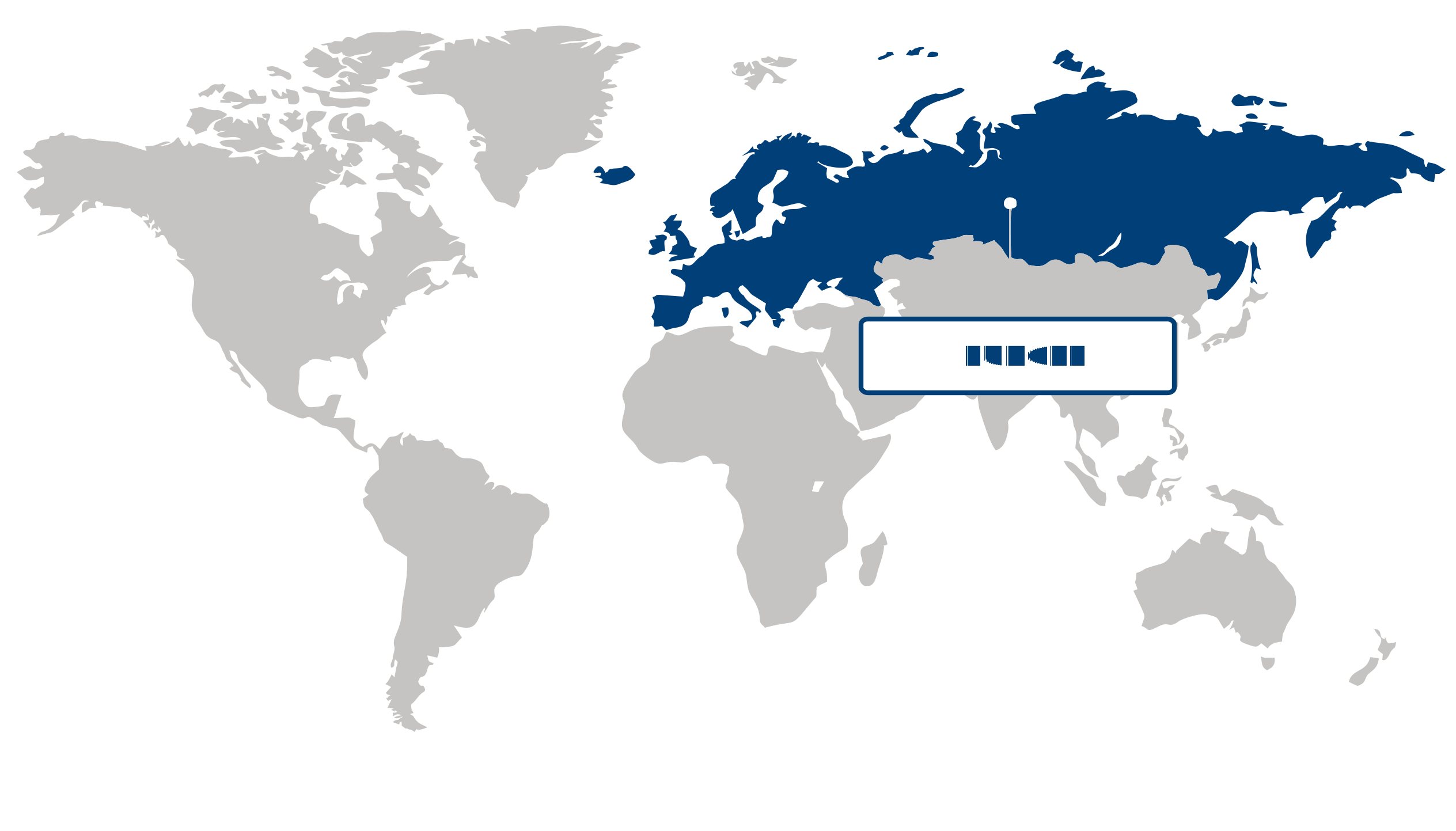
Europe (Largest Region)
Europe maintained the largest position in the condensing chemical boiler market in 2026, supported by strong industrial activity, stringent energy-efficiency requirements, and growing emphasis on reducing fuel consumption and emissions from chemical processing operations. Chemical manufacturers are increasingly focused on improving thermal efficiency and recovering usable heat from industrial processes, creating favorable conditions for condensing boiler technologies. The region’s established chemical industry, environmental regulations, and investment in modernizing industrial heating systems are reinforcing demand for high-efficiency boiler solutions that can support both operational performance and sustainability objectives.
Asia Pacific (Fastest-Growing Region)
Asia Pacific is witnessing the fastest regional expansion as rapid industrialization and growth in chemical manufacturing increase the need for efficient industrial heating systems. Expanding production capacity across chemical and related process industries is creating new applications for boilers capable of improving energy utilization and reducing operating losses. Growing attention to industrial emissions, energy conservation, and modernization of manufacturing facilities is further encouraging the adoption of condensing technologies, while infrastructure development and increasing investment in process industries are broadening the addressable market across the region.
| Parameter | North America | Asia Pacific | Europe | Latin America | MEA |
|---|---|---|---|---|---|
| Innovation Hub i Scale Nascent Developing Advanced | |||||
| Cost-Sensitive Region i Scale Low Medium High | |||||
| Regulatory Environment i Scale Restrictive Neutral Supportive | |||||
| Demand Drivers i Scale Weak Moderate Strong | |||||
| Development Stage i Scale Emerging Developing Developed | |||||
| Adoption Rate i Scale Low Medium High | |||||
| New Entrants / Startups i Scale Sparse Moderate Dense | |||||
| Macro Indicators i Scale Weak Stable Strong |
Key Country Insights
United States 🇺🇸
Process Efficiency UpgradesThe U.S. market adopts condensing chemical boilers to improve thermal efficiency in chemical processing facilities while lowering operating costs. Industrial operators increasingly replace aging systems with advanced boiler technologies that support energy optimization and emissions compliance.
Germany 🇩🇪
Industrial Energy OptimizationGermany prioritizes condensing chemical boilers that maximize heat recovery within chemical manufacturing and industrial production facilities. German companies increasingly integrate high-efficiency boiler systems into broader energy management initiatives to improve operational performance.
Japan 🇯🇵
High-Efficiency Process HeatingJapan focuses on condensing chemical boilers that deliver stable process heating with reduced fuel consumption in specialized manufacturing environments. Manufacturers in Japan increasingly favor compact, automated boiler solutions that enhance operational reliability and energy utilization.
South Korea 🇰🇷
Modern Plant ModernizationSouth Korea invests in condensing chemical boilers as industrial facilities modernize production infrastructure and improve energy efficiency. Chemical manufacturers increasingly select systems offering advanced controls, reliable performance, and integration with plant automation platforms.
France 🇫🇷
Sustainable Thermal SystemsFrance promotes condensing chemical boilers across industrial facilities seeking improved thermal efficiency and lower environmental impact. Industrial users in France increasingly prioritize boiler technologies that reduce fuel consumption while supporting evolving environmental compliance objectives.
Italy 🇮🇹
Efficient Industrial HeatingItaly applies condensing chemical boilers across chemical processing and manufacturing facilities where efficient steam and hot water generation remain essential. Italian companies increasingly modernize heating infrastructure with systems designed for operational flexibility and lower lifecycle costs.
Segment Leadership and Growth Trends
Condensing Chemical Boiler Market Share (%), by Product, 2026
Go beyond the chart, access full insights & data tables
Request Free Sample ReportProduct Segment Analysis: Water-Tube (Largest Segment) vs Fire-Tube (Fastest-Growing Segment)
The water-tube segment held the largest share in the condensing chemical boiler market in 2026, driven by its ability to operate efficiently under high-pressure and high-capacity industrial conditions. Chemical processing facilities favor water-tube boilers because they provide rapid steam generation, superior thermal efficiency, and dependable performance for continuous production processes. Their suitability for demanding industrial environments, combined with enhanced operational reliability and energy efficiency, has reinforced the segment's dominant position.
The fire-tube segment is anticipated to witness the fastest growth owing to increasing demand from small- and medium-scale chemical processing facilities seeking compact, cost-effective, and easy-to-maintain boiler systems. Advances in condensing technology have improved the efficiency of fire-tube boilers while reducing fuel consumption and emissions. Growing emphasis on energy-efficient heating solutions and simplified installation is expected to accelerate adoption across a wider range of industrial applications.
Fuel Segment Analysis: Natural Gas (Largest & Fastest-Growing Segment)
The natural gas segment dominated the condensing chemical boiler market in 2026 while also emerging as the fastest-growing fuel category. Its leadership is supported by the fuel's cleaner combustion characteristics, high thermal efficiency, and compatibility with advanced condensing boiler technologies. Chemical manufacturers are increasingly adopting natural gas-fired systems to reduce operating costs and comply with stricter environmental regulations. Continued investment in cleaner industrial energy infrastructure and the transition toward lower-emission manufacturing processes are expected to further strengthen demand for natural gas-powered condensing boilers.
Capacity Segment Analysis: < 10 MMBTU/hr (Largest Segment) vs 10 - 25 MMBTU/hr (Fastest-Growing Segment)
The less than 10 MMBTU/hr capacity segment represented the largest share in 2026, reflecting strong demand from chemical facilities requiring compact and efficient boiler systems for routine process heating and steam generation. These units are widely preferred because they offer operational flexibility, lower installation costs, and high energy efficiency for smaller production operations. Their suitability for decentralized heating applications has sustained their leading market position.
In the condensing chemical boiler market, the 10–25 MMBTU/hr capacity segment is expected to register the fastest growth as medium-sized chemical plants expand production capabilities and modernize their steam generation infrastructure. Rising investments in energy-efficient industrial equipment and the need for greater processing capacity without compromising fuel efficiency are supporting increased adoption of boilers within this capacity range.
| Segment | Sub-Segment | Largest Segment | Fastest Growing |
|---|---|---|---|
| Product | Fire-Tube, Water-Tube | Water-Tube | Fire-Tube |
| Fuel | Natural Gas, Oil, Coal, Others | Natural Gas | Natural Gas |
| Capacity | < 10 MMBTU/hr, 10 - 25 MMBTU/hr, 25 - 50 MMBTU/hr, 50 - 75 MMBTU/hr, 75 - 100 MMBTU/hr, 100 - 175 MMBTU/hr, 175 - 250 MMBTU/hr, > 250 MMBTU/hr | < 10 MMBTU/hr | 10 - 25 MMBTU/hr |
Competitive Landscape and Market Positioning
Leading companies in the condensing chemical boiler market:
- Viessmann Group (Germany)
- Bosch Industriekessel GmbH (Germany)
- Cleaver-Brooks, Inc. (United States)
- Babcock & Wilcox Enterprises, Inc. (United States)
- Thermax Limited (India)
- Miura Co., Ltd. (Japan)
- Alfa Laval AB (Sweden)
- Ariston Holding N.V. (Italy)
- Forbes Marshall Pvt. Ltd. (India)
- Babcock Wanson (France)
Rising expectations for industrial energy efficiency are encouraging suppliers to compete through advanced heat recovery capabilities and designs tailored to demanding chemical processing environments. Engineering expertise has become a defining differentiator, as customers increasingly prioritize systems that integrate seamlessly with existing plant infrastructure while maintaining reliable operation under variable process conditions. Suppliers are also expanding their focus toward lifecycle efficiency, digital monitoring, and emissions compliance support, reinforcing competition around long-term operational performance rather than equipment specifications alone.
| Company | Market Share | Company Revenue | Revenue CAGR (%) | Product Portfolio | Geographic Presence | Innovation / R&D Focus | Strategic Developments |
|---|---|---|---|---|---|---|---|
| Viessmann Group (Germany) | |||||||
| Bosch Industriekessel GmbH (Germany) | |||||||
| Cleaver-Brooks Inc. (United States) | |||||||
| Babcock & Wilcox Enterprises Inc. (United States) | |||||||
| Thermax Limited (India) | |||||||
| Miura Co. Ltd. (Japan) | |||||||
| Alfa Laval AB (Sweden) | |||||||
| Ariston Holding N.V. (Italy) | |||||||
| Forbes Marshall Pvt. Ltd. (India) | |||||||
| Babcock Wanson (France) |
Industry Development/News
| Company Name | Date | Key Development |
|---|---|---|
| Miura | Feb-24 | Miura, in collaboration with Hartford Steam Boiler, introduced the Miura Care Program, a predictive and preventive IoT-enabled boiler maintenance solution. The initiative expands lifecycle service capabilities by integrating proactive maintenance, reliability, safety, operational efficiency, and environmental performance into comprehensive steam system management for industrial boiler users. |
| Babcock Wanson | Jan-23 | Babcock Wanson launched its Pack FM steam water tube boiler range with capacities from 4.5 to 80 t/h, designed for high-output, high-pressure, and superheated steam applications. The new product broadens the company's industrial boiler portfolio by supporting demanding process industries with enhanced steam quality and high-pressure operating capabilities. |
Customize Your Report
Explore examples of how this report can be tailored to different research needs, including custom segments, additional topics or chapters, and related reports. Click a section of the wheel or its numbered marker to explore the available options.
Condensing Chemical Boiler Market — Custom Segments
| Segment | Sub-Segment |
|---|---|
| Application | Process Heating, Steam Generation, Hot Water Generation, Combined Heat & Process Applications |
| Installation Type | New Installations, Replacement & Retrofit |
| Automation Level | Manual/Basic Control, Semi-Automated, Fully Automated |
Condensing Chemical Boiler Market — Custom TOC
| Custom Chapter | Custom Details |
|---|---|
| Industrial Heat Decarbonization Roadmap |
|
| Retrofit Economics & Replacement Cycles |
|
| Fuel-Switching Investment Priorities |
|
Need a different cut of the data?
Request Custom ResearchHow much is the condensing chemical boiler market worth?
What is the anticipated CAGR of the condensing chemical boiler industry?
Why are chemical manufacturers investing in condensing boiler technologies?
How are emissions regulations shaping the condensing chemical boiler market?
Why do water-tube boilers hold the largest share in the condensing chemical boiler market?
Which boiler capacity segment is growing the fastest in the condensing chemical boiler market?
How is Europe maintaining its lead in the condensing chemical boiler market?
What is driving growth of condensing chemical boilers in Asia Pacific?
What are the key competitors in the condensing chemical boiler landscape?
Our Clients
"The team at Fundamental Business Insights & Consulting demonstrated a commitment to excellence, not only in the quality of the report but also in their client-centric approach."
FANUC
"The level of detail in the market segmentation provided were particularly noteworthy. The detailed country-level insights were also very helpful."
B&R Industrial Automation GmbH
"The consultant took the time to understand our specific business objectives, ensuring that the reports were tailored to address our unique challenges and opportunities."
KUKA SE & Co. KGaA
Our Research Team & Methodology
Every Fundamental Business Insights report is built by a dedicated vertical research team, validated through a structured primary-and-secondary methodology, and reviewed for accuracy before it reaches you.
Research Team Overview
Prepared by the Industrial Automation & Equipment Research Team
Delivery
Published
Demand
Available
Support
Trust & Compliance
Research Domains
10 coverage areasResearch Intelligence
| Source | Reference |
|---|---|
| International Society of Automation (ISA) | www.isa.org |
| International Organization for Standardization (ISO) | www.iso.org |
| National Institute of Standards and Technology (NIST) | www.nist.gov |
| IEEE | www.ieee.org |
| VDMA (German Mechanical Engineering Industry Association) | www.vdma.org |
| Association for Advancing Automation (A3) | www.automate.org |
| International Federation of Robotics (IFR) | ifr.org |
| ASME (American Society of Mechanical Engineers) | www.asme.org |
| ASHRAE | www.ashrae.org |
| American Society of Heating, Refrigerating and Air-Conditioning Engineers (ASHRAE) | www.ashrae.org |
| Material Handling Industry (MHI) | www.mhi.org |
| OSHA (Occupational Safety and Health Administration) | www.osha.gov |
| National Fire Protection Association (NFPA) | www.nfpa.org |
| ASTM International | www.astm.org |
| International Electrotechnical Commission (IEC) | www.iec.ch |
| Open Process Automation Forum (The Open Group) | www.opengroup.org/open-process-automation-forum |
| AGMA (American Gear Manufacturers Association) | www.agma.org |
| Association of Equipment Manufacturers (AEM) | www.aem.org |
| Food and Agriculture Organization (FAO) | www.fao.org |
| International Labour Organization (ILO) | www.ilo.org |
Research Workflow & Quality Assurance
Data Collection
Verified information gathered through primary and secondary research.
Data Triangulation
Cross-validation using multiple independent data sources.
Forecast Modelling
Market estimates developed using historical trends and analytical models.
Analyst Validation
Findings reviewed by domain experts for accuracy and consistency.
Editorial & Quality Review
Final editorial, quality, and compliance checks before publication.
Final Publication
Released after successful completion of the internal review process.
Report Coverage
📊 Market Assessment
- Market Size & Forecast
- Market Segmentation
- Regional Analysis
- Growth Drivers & Challenges
- Market Dynamics
🏢 Competitive Intelligence
- Competitive Landscape
- Company Profiles
- Competitive Benchmarking
- Mergers & Acquisitions
- Market Share Analysis or Key Company Strategies
🔍 Strategic Analysis
- Value Chain Analysis
- Porter's Five Forces
- PESTLE Analysis
- Pricing Trends
- Supply-Demand Analysis
🚀 Future Outlook
- Technology Landscape
- Regulatory Landscape
- Investment & Funding Landscape
- Emerging Opportunities
- Future Market Outlook
Have a question about this report or need a custom scope?
Request Customization